








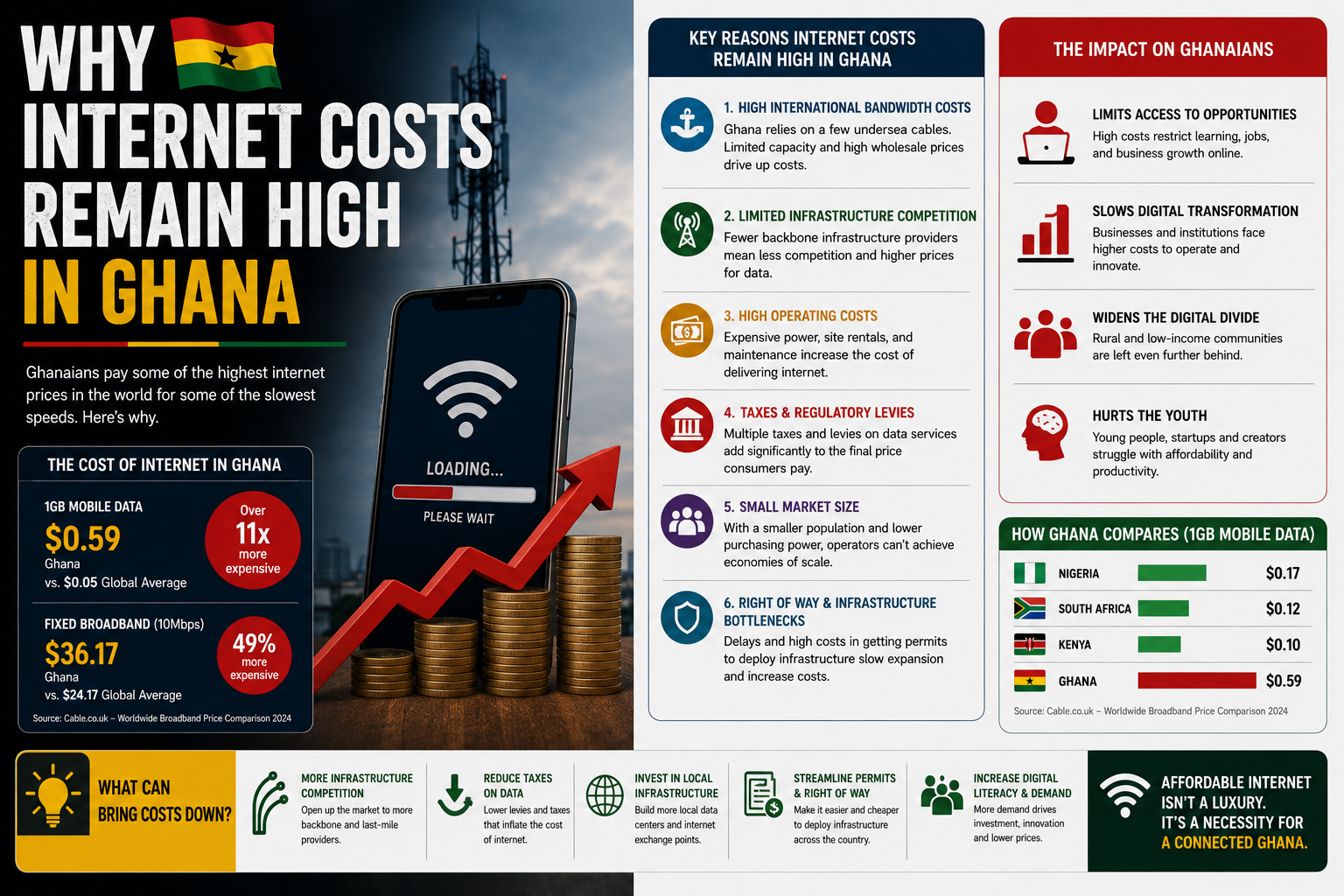

Why Internet Costs Remain High in Ghana — MTN controls 81% of Ghana’s data market, telecom taxes add nearly 40% to consumer bills, and a 5GB data package still exceeds the UN affordability threshold by 50%. Our deep‑dive analysis reveals the five structural drivers of high internet costs and three scenarios for the future of digital access.
Executive Introduction
On paper, Ghana should be a model for affordable internet in Africa. The country has climbed steadily in global data affordability rankings. By mid‑2025, the average cost of 1GB of mobile data had fallen to about $0.40 — making Ghana the third‑cheapest market on the continent, behind only Malawi and Nigeria. The Communications Minister, Sam Nartey George, has hailed these gains as evidence of a “digital reset” that is finally bridging the affordability gap that has held back inclusive digital access for years.
Yet the headline figure masks a far more complex and contradictory reality. The same data that shows Ghana as one of Africa’s cheapest markets also shows a 5GB mobile data package represents 3.06% of monthly gross national income per capita — well above the United Nations’ affordability threshold of 2%. Dr Mahamudu Bawumia, the former Vice‑President, has noted that while the price of 1GB ranges from $0.05 to $1.50 depending on provider and bundle, the real challenge is not the nominal cost but the affordability for low‑income households, who make up the majority of Ghana’s population.
📢 GET DETAILED ARTICLES + JOBS
Join THSB's WhatsApp Channel and never miss a post or opportunity.
This paradox — cheap in global rankings, still expensive for most Ghanaians — is rooted in five structural constraints. Market concentration has allowed MTN Ghana to capture 81.29% of mobile data subscriptions, effectively operating as a regulated monopoly with little competitive pressure. The tower and fibre cost base is unusually high: unreliable grid power forces operators to run thousands of sites on diesel, and frequent fibre cuts — as many as 99 per day — impose repair costs of up to $3,200 per incident. Spectrum pricing has a legacy of unaffordable auctions that have deterred new entrants and limited capacity expansion. Taxation still loads consumer data prices with nearly 40% in levies and charges, even after the abolition of the E‑Levy. And regulatory ambition has run ahead of enforcement: the government can mandate higher bundle values, but without competition, those increases have not translated into the sustained downward price pressure seen in truly competitive markets.

This profile examines why internet costs in Ghana remain high despite falling absolute prices. It analyses the market structure that entrenches MTN’s dominance; the infrastructure costs that make network maintenance expensive; the tax burden that adds nearly 40% to consumer bills; the recent policy interventions that have delivered some relief but not a structural fix; and the three possible futures for Ghana’s digital affordability — gradual improvement, stalled progress, or a genuine breakthrough. For the majority of Ghanaians, affordable internet remains an aspiration, not a reality. Understanding the structural reasons why is the first step to changing that.
The Market Structure — How One Operator Captured 81% of Ghana’s Mobile Data
The most important driver of high internet costs in Ghana is not technology, spectrum or taxes — it is competition. Or, more precisely, the absence of it.
According to the latest figures from the National Communications Authority (NCA), MTN Ghana controlled 81.29% of the country’s mobile data subscriptions as of February 2026, a marginal increase from 81.27% recorded in December 2025. Its two rivals, Telecel and AT Ghana, are holding at 14.50% and 4.21% respectively.
This is not a market that has recently tipped into concentration. It is a decade‑long trend that has consistently defied regulatory intervention. In June 2020, MTN was declared a Significant Market Power (SMP) by the NCA under Section 20(10) of the Electronic Communications Act (Act 775). At the time, MTN controlled about 57% of the voice market and nearly 68% of the data market. The SMP designation was supposed to level the playing field — imposing obligations on MTN to lower termination rates, interconnect on fair terms, and refrain from anti‑competitive conduct. Instead, MTN’s data market share has grown by 13 percentage points in five years.
The engine of MTN’s growth has not been aggressive pricing or clever marketing alone. It has been relentless capital deployment. By December 2025 the company had achieved 4G population coverage of 99.2% , effectively universal connectivity for all mobile devices in Ghana. Telecel, by contrast, has struggled to match that coverage, and AT Ghana was so financially distressed — with debts exceeding $289 million — that it was effectively nationalised and merged into Telecel in late 2025.
The result is a market that is becoming structurally uncompetitive. Economists and policy analysts have warned that the SMP policy has inadvertently allowed MTN to entrench rather than correct its dominance. Critics argue that the NCA has lacked the enforcement bandwidth to translate SMP obligations into meaningful competition. As one analysis put it, “the intervention that was meant to curb MTN’s dominance has instead enabled it to strengthen its grip”.
For the average consumer, the consequence is straightforward. In a genuinely competitive market, Telecel and AT would undercut MTN on price to win market share. Instead, Telecel’s pricing is broadly aligned with MTN’s, and AT’s network is in such poor condition that it is effectively a legacy operator in its final months. The absence of a price‑cutting rival means MTN can maintain prices at levels that protect its extraordinary profit margins. In 2025, MTN Ghana recorded a 55.9% leap in profit after tax to GH¢7.8 billion, driven by sustained growth in data and Mobile Money services. Those profits are not the reward of efficient competition. They are the rent of market dominance.
The Cost of Staying Connected — Towers, Diesel and Cable Vandalism
Even if Ghana had a perfectly competitive telecom market, the underlying cost of providing connectivity would still be higher than in many other African countries. Two factors drive this: energy costs and fibre vandalism.
Energy is the silent cost centre that most consumers never see. Roughly 70% of Africa’s 500,000 telecommunications towers rely on diesel as their power source, and in remote areas, diesel accounts for 30–60% of a tower’s operational costs — a share that has increased by 40–60% over the past two years across many African markets due to rising fuel prices. Ghana’s national grid suffers from frequent power cuts and voltage fluctuations, forcing tower operators to lean even more heavily on diesel generators.
The cost of diesel is not just a line item on an operator’s balance sheet. It is a cost that ultimately flows into the price of every megabyte. A tower that requires 200 litres of diesel per week at GH¢15 per litre adds GH¢3,000 per week in operating costs. When that cost is multiplied across thousands of sites, the aggregate burden is substantial. MTN Ghana’s investment in new network sites — 500 new sites planned for 2026 alone, a tenfold increase from 2025 — will add to this energy burden unless the company accelerates its shift to solar hybrid solutions. But solar requires significant upfront capex, and in a market where MTN is already earning record profits, the incentive to invest in green energy is tempered by the absence of competitive pressure.

The second cost driver is fibre cable vandalism and accidental damage. Industry estimates suggest that fibre cuts occur between 11 and 99 times daily across Ghana. Each repair costs between US3,214, and the problem is worsening: in 2024, operators experienced about 5,600 fibre cuts with repair expenses estimated at US$18 million, while 2025 recorded 8,000 cuts. Telecel Ghana is reportedly the most affected company due to its extensive underground network inherited from former Ghana Telecom infrastructure.
The cumulative loss to operators is staggering: approximately US$69.3 million lost to fibre cable destruction, according to industry estimates. Every cut disrupts service, requires costly repairs, and raises the cost of maintaining a reliable network. In turn, those higher costs are reflected in consumer pricing.
The government has recognised this problem. In May 2026, Communications Minister Sam Nartey George announced a proposed “Dig Once” policy that could cut the cost of rolling out fibre infrastructure by nearly 60% by ensuring that fibre is laid whenever roads are excavated for any purpose. The policy is intended to reduce duplication of excavation work and lower the overall cost of fibre deployment. However, the policy is still in the proposal stage, and its implementation — and its impact on consumer prices — remains uncertain.
The underlying reality is that Ghana’s infrastructure costs are structurally higher than in many peer countries. The combination of diesel dependence and fibre vandalism creates a floor beneath which retail data prices cannot easily fall without pushing operators into losses. MTN’s market dominance allows it to absorb these costs while still earning record profits. For smaller operators, the same costs are existential.
The Tax Burden — Nearly 40% of Data Costs Are Levies and Charges
If energy and vandalism are the supply‑side drivers of high costs, taxation is the demand‑side multiplier. The Minister of Communications has himself acknowledged that a major reason for high data prices is the heavy tax burden on the telecom sector.
In June 2025, Sam George announced that the government was reviewing what he described as a “nearly 39% tax burden on telecommunications services”. This burden includes the Communications Service Tax (CST), the National Health Insurance Levy (NHIL), the Ghana Education Trust Fund (GETFund) levy, Value‑Added Tax (VAT), and a range of regulatory fees imposed by the NCA.
The effect of these taxes is cumulative. Every cedi a consumer spends on data is taxed multiple times — first at the point of sale, then through the operator’s own tax liabilities, and finally through the various levies that are passed directly to the end‑user. The Minister stated that if the government could “properly rationalise” these taxes, consumers “should see a drop in the almost 39% tax buildup in the price of data”.
The abolition of the Electronic Transfer Levy (E‑Levy) in April 2025 was a step in the right direction. The 1% levy on electronic transactions had disproportionately affected mobile money users and created a disincentive for digital payments. Its removal was widely welcomed. However, the E‑Levy was only one component of the tax burden. The broader rationalisation that Sam George promised has not yet materialised.
The politics of telecom taxation are delicate. The government relies on telecom taxes for a significant share of domestic revenue. Cutting taxes would reduce fiscal space at a time when Ghana is still emerging from its debt restructuring. Yet the Minister has acknowledged that without tax rationalisation, the goal of genuinely affordable internet for all Ghanaians will remain elusive.
For consumers, the tax burden is largely invisible. They see the price of a data bundle; they do not see the percentage of that price that goes to the government. But the invisibility of the tax burden does not make it less regressive. A market woman earning GH¢500 per month who spends GH¢30 on a data bundle is paying a higher proportion of her income in telecom taxes than a corporate executive earning GH¢20,000. The tax burden on data is a tax on digital inclusion.
The Policy Intervention — Bigger Bundles, Not Lower Prices
Faced with persistent public discontent over data costs, the government’s primary policy response has not been to mandate price reductions, but to require operators to increase the volume of data offered at existing price points.
In June 2025, Sam George directed all three mobile network operators to increase their data bundle values by up to 15% effective July 1, 2025, without increasing prices. The directive followed months of public agitation over high data costs and was presented as a major concession to consumers. Under the new rates, MTN increased data volumes by 15% across all bundles. AT Ghana’s GH¢400 bundle increased from 190GB to 236GB, while Telecel’s GH¢400 bundle increased from 90GB to 250GB.
The effect of this intervention has been mixed. On the one hand, consumers are receiving more value for the same money. On the other hand, the absolute price of data has not fallen. A consumer who could only afford a GH¢30 bundle before the intervention can still only afford a GH¢30 bundle afterwards. The intervention increased the volume of data per cedi, but it did not reduce the cost of entry into the digital economy.
More fundamentally, the bundle‑value directive does not address the structural drivers of high costs. It does not increase competition. It does not reduce the tax burden. It does not lower energy costs or prevent fibre vandalism. It is a one‑time adjustment that operators can absorb without fundamentally altering their pricing strategies, especially MTN, whose record profits give it ample room to offer higher bundle values without affecting its bottom line.
The Minister has also announced other measures. The NCA has been directed to conduct quarterly billing integrity tests to ensure that operators are not short‑charging consumers on data usage. An Interagency Data Pricing Committee has been inaugurated to monitor and review data pricing on an ongoing basis. The NCA has proposed a regulatory framework for wholesale roaming rates, including a reference wholesale ceiling rate of GH¢0.0032 per megabyte of data usage, which could lower costs for smaller operators and reduce barriers to entry.
These are all sensible interventions. But they are incremental. They adjust the margins of a system whose fundamental structure — a near‑monopoly with high infrastructure costs and a heavy tax burden — remains unchanged.
The Affordability Threshold — Why $0.40 per GB Is Still Too Expensive for Most Ghanaians
The debate over internet costs in Ghana often conflates two different measures: absolute price and affordability relative to income. The difference is critical.
Ghana ranks among Africa’s cheapest markets for mobile data when measured in absolute terms. According to global price rankings, 1GB of mobile data costs an average of 0.38) and Nigeria ($0.39). These rankings are often cited as evidence that internet is becoming affordable in Ghana.
But absolute price tells only half the story. The United Nations Broadband Commission has set an affordability target that 1GB of mobile broadband should cost no more than 2% of monthly gross national income per capita in developing countries. In Ghana (2025), a 5GB mobile data package represents approximately 3.06% of monthly GNI per capita — exceeding the affordability threshold by more than 50%.
What this means in practice is that a household earning the minimum wage — approximately GH¢19.97 per day — would need to spend a significant portion of their daily income to purchase even a small data bundle. Dr Bawumia has noted that while the cost of 1GB ranges between approximately $0.05 and $1.50 depending on provider and bundle, the real challenge lies in affordability for low‑income households, who make up the majority of Ghana’s population.
The affordability gap is compounded by device costs. A 5G‑enabled smartphone can cost GH¢1,000–GH¢2,000 or more. Even a basic 4G smartphone can cost GH¢300–GH¢500. For a household living on GH¢600 per month, a GH¢400 smartphone represents two‑thirds of a month’s income. The device itself, not just the data plan, is a barrier to entry.
The cheapest markets in Africa — Malawi, Nigeria, Ghana — are not necessarily the most inclusive. Low absolute prices combined with low incomes still produce exclusion. The countries that have achieved both low prices and high adoption, such as Kenya and Rwanda, have done so through a combination of strong competition, infrastructure sharing, and device financing schemes that lower the cost of entry.
Ghana has made progress on absolute prices. It has not yet solved the affordability problem.
The Regional Context — Ghana vs Nigeria, Kenya and Rwanda
Comparing Ghana’s internet costs with its regional peers reveals both achievements and shortcomings.
Nigeria, the continent’s most populous nation, has successfully used intense competition to drive data prices down. With MTN Nigeria, Glo, Airtel and 9mobile all aggressively competing for market share, the average cost of 1GB fell to approximately $0.39 by mid‑2025. Nigeria’s population density and market scale give it advantages that Ghana cannot replicate, but its competitive intensity is a model that Ghana’s concentrated market has not achieved.
Kenya and Rwanda have pursued different models. Kenya’s Safaricom, which holds a dominant position similar to MTN Ghana’s, has not resulted in the same degree of price suppression. Average 1GB costs in Kenya are approximately $0.59 — higher than Ghana’s — reflecting the trade‑off between market concentration and price. Rwanda has used state‑led infrastructure deployment and aggressive infrastructure sharing to keep costs low, with 1GB averaging approximately $0.24.
The Rwandan model is worth studying for Ghana. By separating wholesale infrastructure from retail service provision through a state‑backed wholesale network, Rwanda has lowered the cost of entry for new operators and reduced duplication of infrastructure investment. Ghana’s Next‑Gen InfraCo (NGIC) was intended to play a similar role, but its rollout has been slow, and the government has now revoked its exclusivity, opting for a competitive spectrum auction instead.
The table below places Ghana in the continental context, showing both absolute data costs and competitive structure.
Country Avg. || Cost of 1GB (2025) || Market Structure || Key Affordability Drivers
- Malawi $0.38 Competitive Low incomes; regulatory price pressure
- Nigeria $0.39 Highly competitive Four major operators; aggressive price competition
- Ghana $0.40 Highly concentrated (MTN 81%) Policy‑mandated bundle increases
- Kenya $0.59 Concentrated (Safaricom) M‑Pesa ecosystem; partial competition
- Rwanda $0.24 State‑backed wholesale Infrastructure sharing; state‑led rollout
The comparison shows that Ghana has achieved relatively low absolute prices despite a highly concentrated market structure. This is a testament to the effectiveness of policy‑mandated bundle increases. But it also reveals a vulnerability: without genuine competition, price reductions are dependent on regulatory intervention rather than market dynamics. If the government’s attention shifts, or if operators resist future mandates, the downward pressure on prices could stall.
The Future of Internet Pricing in Ghana — Three Scenarios
The trajectory of internet costs in Ghana will be determined by three interacting variables: the success of regulatory efforts to increase competition, the pace of infrastructure cost reduction, and the government’s willingness to rationalise the telecom tax burden.
Scenario One: Gradual Improvement — Sticky Costs, Modest Gains (65% probability)
In this base case, MTN’s market share remains above 80% but does not increase further. Telecel, after absorbing AT Ghana, stabilises its network and gradually improves coverage, but remains a distant second with no meaningful price competition. The “Dig Once” policy is implemented, reducing fibre rollout costs over time, but vandalism continues to impose high repair expenses. Tax rationalisation proceeds slowly, with the nearly 40% burden reduced to about 30% over three to five years. Data prices in absolute terms continue to fall modestly, but affordability for low‑income households remains a challenge. The 5GB‑to‑income ratio declines from 3.06% to about 2.5% by 2028. This scenario assumes no major external shocks and continued, but not accelerated, regulatory effort.
Scenario Two: Stalled Progress — Dominance Entrenched, Affordability Stagnant (25% probability)
The absorption of AT Ghana by Telecel proves operationally difficult, and Telecel fails to achieve the coverage and service quality needed to challenge MTN. The NCA’s SMP oversight remains weak, and MTN’s market share edges toward 85%. Tax rationalisation stalls due to fiscal pressures, and the 39% burden remains intact. The “Dig Once” policy faces implementation delays. Fibre vandalism continues unabated. Data prices stop falling in real terms, and the 5GB‑to‑income ratio remains above 3%. Digital inclusion stalls, and Ghana falls behind peers such as Rwanda and Nigeria in affordability rankings. This scenario is the low‑probability, high‑impact risk that keeps policymakers focused on competition enforcement.
Scenario Three: Accelerated Breakthrough — Infrastructure and Competition Drive a Step Change (10% probability)
The “Dig Once” policy is implemented effectively, cutting fibre rollout costs by 50–60% and significantly reducing vandalism‑related disruptions. The NCA’s wholesale roaming price ceilings lower the cost of entry for new operators, and at least one new entrant — possibly a mobile virtual network operator (MVNO) — enters the market, increasing competitive pressure. Telecel successfully integrates AT Ghana and, aided by regulatory support, begins to challenge MTN on price and coverage in key regions. Tax rationalisation reduces the telecom tax burden to about 25% of consumer costs. The combination of lower infrastructure costs, tax relief, and modest competition drives data prices down sharply. The 5GB‑to‑income ratio falls below 2% by 2028, and Ghana becomes a regional leader in affordable, inclusive internet access. This optimistic scenario depends on sustained political will, effective regulation, and successful implementation of complex infrastructure policies.
THSB Conclusion
Ghana’s high internet costs are not a single problem but a matrix of them. Market concentration has allowed MTN to capture 81% of mobile data subscriptions, earning record profits while facing no credible competitive challenger. Infrastructure costs — diesel dependence, fibre vandalism, unreliable grid power — are structurally higher than in many peer countries, creating a floor beneath which prices cannot easily fall. The tax burden loads nearly 40% onto consumer bills, a regressive levy that falls most heavily on the low‑income households who can least afford it. And regulatory intervention, while well‑intentioned, has focused on mandating higher bundle values rather than addressing the structural drivers of high costs.
The paradox of Ghana’s internet market is that it is simultaneously a success and a failure. In absolute price terms, Ghana is among Africa’s cheapest markets. In affordability terms, a 5GB data package still exceeds the UN’s threshold by more than 50%. A consumer can buy data for $0.40 per GB, but a consumer earning the minimum wage cannot afford to buy enough of it.
The way forward requires a shift in focus — from absolute price to affordability, from mandate to competition, from taxation to rationalisation. The “Dig Once” policy, if implemented effectively, could lower infrastructure costs. Tax rationalisation, if pursued seriously, could reduce consumer bills without harming government revenue. And effective enforcement of competition policy — not just SMP designation but meaningful sanctions for anti‑competitive conduct — could create the conditions for a genuine challenger to emerge.
None of these fixes is easy. Each requires political will, regulatory capacity and sustained investment. But the alternative — a future in which MTN’s dominance continues to grow, Telecel remains a distant second, and internet costs remain stubbornly high for the majority of Ghanaians — is not acceptable. Digital inclusion is not a luxury. It is the foundation of modern economic participation. And until internet access is genuinely affordable for the Ghanaian who earns the minimum wage, the promise of the digital economy will remain unfulfilled.
The government has made the right noises. It has acknowledged the tax burden, called for competition, and announced infrastructure policies. The question is whether it can translate those announcements into sustained, structural change — or whether Ghana’s internet will remain, for most of its citizens, something they can access but cannot truly afford.
Quick Facts Box
Category || Details
- MTN Ghana Data Market Share (Feb 2026) 81.29% (Telecel 14.50%, AT Ghana 4.21%)
- MTN Ghana Profit After Tax (2025) GH¢7.8 billion (+55.9% year‑on‑year)
- MTN Ghana 4G Population Coverage 99.2%
- MTN Ghana Capex (2026) US$300 million (500 new sites planned)
- Telecel Network Investment Increase (2026) 150%
- AT Ghana Debt US$289 million
- AT‑Telecel Merger Required Investment US$600 million over four years
- Fibre Cuts (2025) 8,000 incidents (estimated 11–99 daily)
- Fibre Cut Repair Cost US3,214 per incident
- Annual Fibre Damage Loss US$69.3 million
- Telecom Tax Burden (Minister’s estimate) Nearly 39% of consumer data costs
- Average Cost of 1GB Data (mid‑2025) GH¢17 approx. (US$1.37)
- Daily Minimum Wage (2025) GH¢19.97
- 5GB Data as % of Monthly GNI per capita 3.06% (exceeds UN 2% threshold)
- Ghana’s Global Data Affordability Rank (2025) 33rd (Africa’s 3rd cheapest)
- 1GB Cost Comparison Malawi $0.38, Nigeria $0.39, Ghana $0.40, Kenya $0.59
- Wholesale Data Roaming Cap (NCA Proposal) GH¢0.0032 per MB
- Regulatory Bodies National Communications Authority (NCA), Ministry of Communication, Digital Technology and Innovations
- Key Policy Interventions (2025–26) 15% bundle value increase (July 2025); “Dig Once” fibre policy (proposed); Wholesale roaming price ceilings; Quarterly billing integrity tests
Frequently Asked Questions (FAQ)
Q1: How much does internet cost in Ghana compared to other African countries?
Ghana is the third‑cheapest market in Africa for mobile data in absolute terms, with an average cost of 1GB of about 0.38) and Nigeria ($0.39) are cheaper. However, affordability relative to income is a different measure — a 5GB data package represents 3.06% of monthly GNI per capita, well above the UN’s 2% affordability threshold.
Q2: Why is MTN Ghana’s market dominance a problem for internet pricing?
MTN controls 81.29% of mobile data subscriptions in Ghana as of February 2026, up from 68% when it was declared a Significant Market Power (SMP) in 2020. With no credible competitive challenger — Telecel holds 14.50%, AT Ghana 4.21% — there is no sustained downward price pressure. MTN can maintain high prices and still earn record profits (GH¢7.8 billion in 2025).
Q3: How much tax is added to internet costs in Ghana?
The Communications Minister has stated that telecom services carry a “nearly 39% tax burden” including the Communications Service Tax, NHIL, GETFund levy, VAT, and various NCA regulatory fees. The government is reviewing these taxes, but significant reductions have not yet been implemented.
Q4: What is the “Dig Once” policy and how would it reduce data costs?
The proposed “Dig Once” policy would require that fibre optic cables be laid whenever roads are excavated for any purpose — water pipes, sewage, electricity — rather than requiring separate digging for fibre deployment. The Minister estimates this could cut fibre rollout costs by up to 60%, reducing the infrastructure cost base that ultimately feeds into consumer prices.
Q5: How does fibre vandalism affect internet pricing?
Fibre cuts occur between 11 and 99 times daily in Ghana. Each repair costs between US3,214. In 2025, operators recorded 8,000 fibre cuts, with cumulative losses estimated at US$69.3 million. These costs are passed on to consumers in the form of higher prices.
Q6: Why do telecom towers rely on diesel generators in Ghana?
Ghana’s national grid suffers frequent power cuts and voltage fluctuations. For off‑grid sites — and even for many on‑grid sites that cannot rely on stable power — diesel generators are the primary power source. Diesel accounts for 30–60% of a tower’s operational costs in remote areas. The cost of diesel has increased sharply in recent years, further driving up operating expenses.
Q7: What happened to AT Ghana, and why was it merged with Telecel?
AT Ghana, the state‑owned operator, accumulated over $289 million in debt and faced a 600 million in investment over four years.
Q8: Did the government actually reduce data prices in 2025?
Not in absolute terms. In June 2025, the government directed operators to increase data bundle values by up to 15% without increasing prices. Consumers now receive more data for the same price, but the cost of entry — the minimum amount needed to purchase a bundle — did not fall. The intervention improved value per cedi but did not make internet more affordable for the poorest consumers.
Q9: Is a 5GB data package affordable for the average Ghanaian?
No. The UN Broadband Commission’s affordability target is that 1GB of mobile data should cost no more than 2% of monthly GNI per capita. In Ghana, a 5GB package represents 3.06% of monthly GNI per capita — exceeding the threshold by more than 50%. For a household earning the minimum wage, data remains a significant expense.
Q10: What is the NCA’s wholesale roaming price ceiling?
In March 2026, the NCA proposed a regulatory framework for wholesale roaming rates, including a reference ceiling of GH¢0.0032 per megabyte of data usage. This is intended to lower the cost for smaller operators to access network infrastructure, potentially reducing barriers to entry and increasing competition over time.
Q11: How does Ghana’s internet pricing compare to Nigeria’s?
Nigeria has achieved slightly lower absolute data prices ($0.39 per GB) through more intense competition — four major operators (MTN, Glo, Airtel, 9mobile) actively compete for market share. Ghana’s highly concentrated market (one dominant operator) has not produced the same competitive pressure on prices.
Q12: What is the outlook for internet costs in Ghana?
The most likely scenario is gradual improvement: data prices will continue to fall slowly, driven by policy‑mandated bundle increases and modest infrastructure cost reductions, but affordability for low‑income households will remain a challenge. A genuine breakthrough would require effective competition, successful implementation of the “Dig Once” policy, and significant tax rationalisation — all of which remain uncertain.
Source: The High Street Business
Disclaimer: Some content on The High Street Business may be aggregated, summarized, or edited from third-party sources for informational purposes. Images and media are used under fair use or royalty-free licenses. The High Street Business is a subsidiary of SamBoad Publishing under SamBoad Business Group Ltd, registered in Ghana since 2014.
For concerns or inquiries, please visit our Privacy Policy or Contact Page.

Esther Aku-Sika is a content writer and social media strategist who helps brands and startups grow through intentional storytelling and practical marketing strategies. With a keen eye for trends and audience behavior, she shares business insights, content strategies, and real-life lessons to help entrepreneurs build visibility and turn ideas into income. Through her writing, she simplifies complex concepts and equips readers with actionable steps to grow in today’s digital space.