










The Future of 5G in Ghana — Ghana’s 5G backbone is live, but under 40,000 devices exist. MTN invests $1.1bn, Telecel boosts investment 150%, and the government targets 70% coverage by March 2027. Our deep‑dive reveals the spectrum auction, device bottleneck, and three scenarios for Ghana’s next‑gen digital future.
Executive Introduction
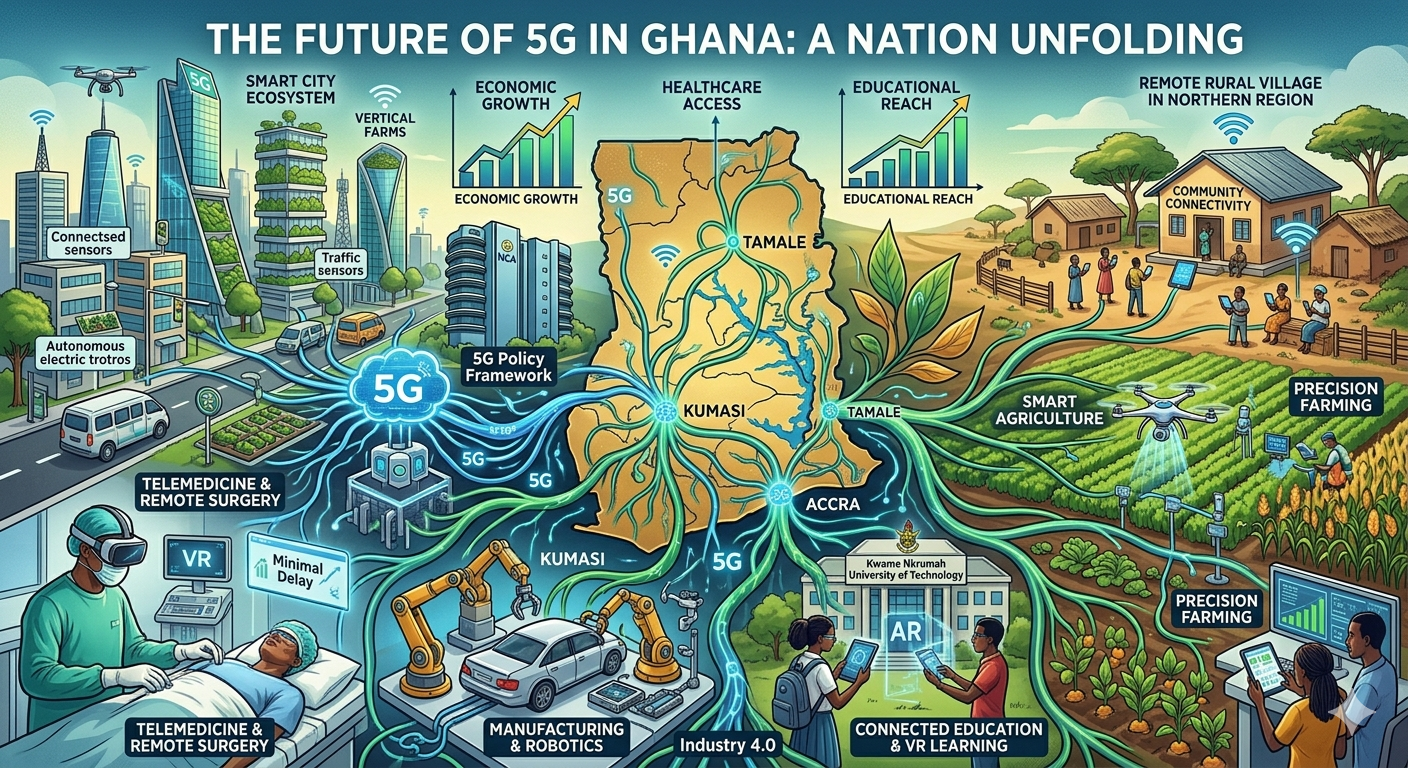
The backbone is live. After months of regulatory back‑and‑forth, Next‑Gen InfraCo (NGIC) — Ghana’s licensed national wholesale 4G/5G infrastructure provider — received formal clearance from the National Communications Authority (NCA) in March 2026 to launch full commercial operations. The shared 4G/5G platform is now active in selected parts of Accra, Kumasi and Tamale, with phased nationwide expansion underway. Yet as of late May 2026, no Ghanaian mobile network operator has announced a retail 5G service to consumers.
That silence tells a story far more complex than a simple technological delay. It is a story shaped by a radical shift in spectrum policy — from an exclusive 10‑year monopoly granted to NGIC in May 2024 to a hybrid model that opens 5G spectrum to competitive national bidding. It is a story of a telecom market increasingly structured as a duopoly, with MTN controlling 81.29% of data subscriptions and Telecel absorbing the struggling state‑owned AT Ghana. And it is a story of a fundamental device bottleneck: Ghana has fewer than 40,000 5G‑enabled devices in circulation, raising serious questions about the viability of aggressive rollout targets without corresponding device penetration.
📢 GET DETAILED ARTICLES + JOBS
Join THSB's WhatsApp Channel and never miss a post or opportunity.
This profile examines the future of 5G in Ghana, where the opportunities are transformational but the near‑term path is fraught with regulatory uncertainty, infrastructure challenges and a market structure that risks entrenching, rather than challenging, MTN’s dominance. The government’s target of 70% 5G population coverage by Ghana’s 70th independence anniversary in March 2027 is ambitious. Whether that target is met — and who benefits when it is — depends on decisions being made in Accra right now about spectrum pricing, open access and competition enforcement.

The NGIC Backbone — The Shared Infrastructure That No Operator Is Using
The technical foundation of Ghana’s 5G future is NGIC’s wholesale 4G/5G network. Backed by technology partner Nokia, NGIC is the licensed national Wholesale Electronic Communications Infrastructure provider mandated to design, deploy and operate Ghana’s shared 4G/5G network platform.
The wholesale‑first model was intended to address a fundamental flaw in traditional telecommunications rollout: under the legacy model, operators acquire spectrum through auctions to deploy their own networks, but coverage tends to concentrate in densely populated urban areas deemed profitable, leaving rural Ghana underserved. NGIC was designed to change that. As COO Nenyi George Andah explained, “separating wholesale infrastructure from retail service delivery is a strategic decision. It enables faster national reach and more efficient capital deployment”.
NGIC has begun rolling out sites: 49 sites nationwide, with 43 in Greater Accra, two in Ashanti, and one each in Western, Northern, Bono and Central regions. CEO Tenu Awoonor said the immediate priority is scaling coverage “in a coordinated and sustainable manner”.
Yet the shared network faces a critical adoption gap. As of mid‑March 2026, no Ghanaian telecom operator had announced a timeline for launching retail 5G services over NGIC’s shared infrastructure. Telecel Ghana CEO Patricia Obo‑Nai has publicly stated that her company is ready to launch 5G but is waiting for regulators to allocate spectrum. She emphasised that Telecel “hopes the spectrum allocation process will be transparent and competitive so that all telecom operators can participate on equal terms”.
NGIC’s exclusivity is already being unwound. At the end of February 2026, authorities announced they were revoking NGIC’s exclusivity mandate and would soon make frequency resources available through a competitive national tender, opting for a hybrid approach. This policy shift fundamentally changes the commercial calculus for operators, who now face the prospect of building their own 5G networks, not just connecting to a shared backbone.
The Policy Pivot — From Monopoly to Competitive Spectrum Auction
The decision to revoke NGIC’s exclusivity and open 5G spectrum to competitive bidding is the most consequential regulatory shift in Ghana’s telecommunications sector in years.
In May 2026, Communications Minister Samuel Nartey George announced that Cabinet had approved a competitive national bidding process for spectrum allocation. “We support the recommendations from the regulatory assessment of the 5G exclusivity provisions; spectrum allocations will now follow a competitive national bidding process,” he stated.
The move is a direct response to the perceived failures of the previous approach. In 2015, the NCA conducted a spectrum auction in the 800MHz band but set the minimum price at $67.5 million per lot — so high that only MTN purchased a single lot, leaving the rest of Ghana’s digital dividend spectrum unsold. Minister George explicitly warned against repeating this mistake: “Auctions designed only for revenue can suppress investment, delay coverage and fail to serve consumers effectively”. He has called for a “balanced and investment‑friendly approach to spectrum pricing” to support Ghana’s 5G rollout agenda, warning that “excessive spectrum pricing could undermine the investments required to achieve” the 70% population coverage target.
The government plans to auction 5G spectrum in the 3.5 GHz and 26 GHz bands during 2026, allowing additional operators or private networks to enter the market. However, the hard part lies ahead: designing an auction that works. Minister George tasked industry stakeholders with providing technical input on auction structure, reserve pricing and rollout obligations — the three levers that determine whether a spectrum auction actually benefits consumers or simply maximises short‑term revenue.
The minister also confirmed that the government is targeting 70% 5G population coverage by Ghana’s 70th independence anniversary in March 2027, as part of President John Dramani Mahama’s “digital reset” agenda. This five‑pillar agenda spans legal reforms, AI development, affordable connectivity and digital infrastructure, skills and inclusion, and structural reforms in spectrum management.

The Device Bottleneck — 40,000 Devices and the Viability Question
The most immediate constraint on Ghana’s 5G future is neither spectrum nor infrastructure — it is devices.
Ghana has fewer than 40,000 5G‑enabled devices in circulation, a figure that should give pause to any discussion of mass 5G adoption. Sylvia Owusu‑Ankomah, CEO of the Ghana Chamber of Telecommunications, called the figure “raising serious questions about the viability of aggressive rollout targets without corresponding device penetration”.
The device constraint has a direct economic logic. 5G‑enabled smartphones are significantly more expensive than 4G alternatives. Until prices fall — or unless operators subsidise devices — the addressable market for 5G services will be limited to early adopters and high‑income urban consumers. The GSMA estimates that 5G penetration across Africa remains in early stages, at about 3.8% of total mobile connections, with 2G‑4G still accounting for the vast majority of connectivity.
Owusu‑Ankomah also warned of a “growing disconnect between coverage and actual usage.” Despite widespread 4G coverage, many network sites remain underutilised, a problem she attributed “largely to limited access to affordable smart devices”. This is a warning for 5G. Building the infrastructure is only half the challenge. The other half is putting affordable devices in the hands of users.
She called for targeted incentives to improve internet‑enabled phone penetration, noting that “infrastructure without accessible devices produces a usage gap that undermines the value of investment already made”. The government’s 70% coverage target risks being a numerical achievement without substantive change in how Ghanaians access digital services.
The Billion‑Dollar Investment War — MTN, Telecel and the Market Re‑alignment
Behind the policy debates, a billion‑dollar investment war is reshaping Ghana’s telecom infrastructure. The stakes are enormous, the timelines are aggressive and the outcome will determine which operators dominate the 5G era.
MTN Ghana: The market leader has committed to a $1.1 billion investment plan over the next three years to drive 5G rollout, network expansion and fintech growth. Approximately $380 million of that investment will be deployed in 2026 alone, including the construction of about 800 new network sites. MTN plans to add at least 500 new network sites by the end of 2026 — a tenfold increase from 50 sites in 2025. CEO Stephen Blewett said the company will “aggressively pursue Ghana’s 5G transition”, calling the investment an “accelerated push” to build resilient infrastructure across the country.
Telecel Ghana: The distant second player is fighting back. The company recorded nearly 30% revenue growth and returned to profitability in 2025 for the first time in years. Telecel plans to increase network infrastructure investment by about 150% in 2026, focusing on expanding capacity, improving reliability and preparing for 5G. The company has already deployed more than 500 4G sites within a year and aims to reach 2,500 sites within three years.
Telecel is also absorbing AT Ghana’s 3.2 million customers, a merger that will boost its market share from 15% to approximately 27%, creating the first genuine duopoly Ghana has seen in over a decade. However, AT Ghana was in financial collapse, accumulating over $289 million in debt and facing $150 million in unpaid bills to American Tower Corporation. The government stepped in to prevent a blackout, ordering Telecel to provide national roaming for AT customers and mandating the migration.
Market Share Reality: Despite these efforts, the competitive imbalance is stark. MTN controls 81.29% of Ghana’s mobile data subscriptions as of February 2026 — up from 81.27% in December 2025 — while Telecel and AT Ghana hold 14.50% and 4.21% respectively. MTN’s 4G population coverage stands at 99.2%. The gulf is not closing; it is widening.
The investment war is directly visible in the contrast between the two major players. MTN’s 380 million in 2026) dwarfs Telecel’s $50 million commitment for immediate AT integration. However, the Ministry anticipates the merger could unlock up to $600 million in sector‑wide investment over four years, supporting 5G trials, rural network expansion and mobile money modernisation.
The Market Structure — From Three Operators to a Duopoly
The absorption of AT Ghana into Telecel changes Ghana’s telecom market structure more fundamentally than any 5G network deployment will. The sector, which once had six competitive firms, is now down to three and soon effectively two: MTN and Telecel.
The new structure has immediate 5G implications. With only two major retail operators, the scope for competitive differentiation will be limited. Telecel will argue it needs regulatory support — including spectrum pricing concessions — to remain a credible competitor. MTN will argue that any such concessions are anti‑competitive subsidies that distort the market.
The NCA has already designated MTN as a Significant Market Power (SMP) operator, imposing obligations designed to level competition. But the data suggests these constraints are having the opposite effect. MTN’s market share has quietly expanded from 61% in early 2022 to nearly 79% today — a level of dominance that both the NCA and the Communications Ministry have publicly flagged as a concern. The numbers tell a story of a race that is, for all practical purposes, already over.
The government’s stated intention to use 5G spectrum allocation to promote competition — including through reserved spectrum for smaller operators or private networks — will be the first real test of whether the new duopoly structure can be managed in a way that serves consumers.
The Use Cases — What 5G Actually Enables Beyond Consumer Broadband
The consumer benefit of 5G — faster downloads, smoother video streaming — is the headline, but the real economic transformation lies in enterprise and industrial applications.
Healthcare: Telemedicine and remote consultations become accessible in even the remotest regions. Real‑time video consultations with specialists, remote patient monitoring and transmission of diagnostic images are all technically feasible at 5G speeds.
Agriculture: 5G‑enabled precision farming — using IoT devices to monitor crop health, soil moisture and weather patterns in real time — can boost crop yields, improve food security and transform livelihoods in rural Ghana.
Manufacturing and Industry: Smart factories, real‑time data collection and machine‑to‑machine communication become viable at scale, driving productivity and sustainability. The ability to connect thousands of sensors across a production line without latency opens new frontiers for automation.
AI and Digital Transformation: Blewett has argued that “the future is not just about 4G or 5G as technologies, but what they enable. We are moving into an AI‑driven world where digital services will become more integrated and intuitive”.
Enterprise and Fixed Wireless Access (FWA): Across Africa, about 25 operators have deployed 5G FWA services, offering broadband‑like connectivity without extensive fibre infrastructure. This is likely to be the primary near‑term revenue generator for 5G in Ghana.
Minister George has positioned 5G as foundational to moving “from digital consumption to digital production and leadership”. That shift — from using digital tools to building digital industries — is the real prize.
The Regional Context — Ghana Versus Nigeria, Kenya and South Africa
Ghana’s 5G ambitions must be understood in regional context. South Africa leads the continent, with Nigeria, Egypt, Morocco and Kenya trailing behind.
As of early 2026, Nigeria recorded 7.2 million 5G subscribers, representing 3.94% of its 182 million connected subscribers. MTN Nigeria has deployed over 2,100 5G sites, offering unlimited, high‑capacity data plans. Safaricom in Kenya has scaled up to 1,700+ sites, covering roughly 30% of the population.
Across Africa, 5G coverage touches only about 11% of the population. GSMA estimates that capex on 5G in Sub‑Saharan Africa will reach $62 billion between 2023 and 2030, as part of a $1.5 trillion global investment.
Ghana’s wholesale‑first, shared‑infrastructure model is a deliberate attempt to leapfrog the coverage concentration problems that have plagued other African markets. The question is whether the hybrid model — combining shared infrastructure with competitive spectrum allocation — can deliver the speed of deployment that Nigeria and Kenya have achieved.
Three Scenarios for Ghana’s 5G Future
Scenario One: Hybrid Market – Gradual Urban Rollout (65 per cent probability)
The competitive spectrum auction concludes in late 2026. MTN secures the largest spectrum block, with Telecel acquiring a smaller allocation. NGIC continues to build out the shared infrastructure, but operators move slowly, prioritising urban centres where device penetration is highest. The 70% coverage target is missed by a significant margin. 5G adoption grows but remains limited to high‑income urban consumers and enterprises. 4G remains the dominant connectivity standard for most Ghanaians. This scenario requires no major external shocks and assumes regulatory decisions are made without sustained controversy.
Scenario Two: Accelerated Breakthrough – Duopoly Competition Drives Coverage (25 per cent probability)
Spectrum pricing is set at a level that encourages rapid deployment. MTN and Telecel aggressively expand coverage to meet rollout obligations attached to their spectrum licences. The government accelerates device subsidies, bringing 5G‑enabled phones within reach of mass consumers. NGIC’s shared infrastructure is fully integrated, reducing duplication and lowering costs. The 70% coverage target is met or exceeded by March 2027. Ghana becomes a regional leader in inclusive 5G deployment, and enterprise adoption — particularly in agriculture, health and manufacturing — drives economic transformation.
Scenario Three: Policy Stalemate – Entrenched Dominance and Fragmented Coverage (10 per cent probability)
Spectrum pricing negotiations stall. MTN challenges the auction rules, delaying the entire process. Telecel fails to secure sufficient spectrum to compete effectively. The absorption of AT Ghana proves operationally difficult, diverting attention from 5G deployment. Device penetration remains low. NGIC’s shared network struggles to attract operator customers. 5G coverage remains concentrated in Accra and Kumasi, with minimal rural reach. MTN’s dominance becomes permanent, and Telecel operates as a perpetual second‑tier provider. This scenario would be a significant setback for Ghana’s digital competitiveness.
The most likely path is Scenario One: a hybrid market with gradual urban rollout, fragmented coverage and 4G remaining the dominant standard for most Ghanaians through 2028. The device bottleneck, the complexity of the hybrid model and the entrenched market dominance of MTN make accelerated breakthrough unlikely without sustained, coordinated intervention.
THSB Conclusion
Ghana’s 5G future is not a story of technology or infrastructure. It is a story of policy, investment and market structure. The backbone is live. The spectrum is being prepared for auction. MTN has committed $1.1 billion. Telecel is investing heavily. The government is targeting 70% coverage by March 2027. The building blocks for a successful 5G transition are all present.
But the building blocks are not the building. NGIC’s shared network is commercially active, but no operator has launched retail 5G services. The policy pivot to competitive spectrum auction is the right direction, but the auction design is not finalised. MTN has the capital and coverage to dominate the 5G era, but Telecel’s absorption of AT Ghana is an operational and financial challenge. And beneath all of it is the device constraint: fewer than 40,000 5G‑enabled devices in circulation. Without affordable devices, the fastest network in the world is a theoretical exercise.
The promise of 5G in Ghana is real. Telemedicine for rural clinics. Precision agriculture for smallholder farmers. Real‑time data for manufacturing. AI‑powered digital services for every sector of the economy. But the distance between the promise and the reality is measured in spectrum allocations, tower deployments and device subsidies.
Ghana is not behind its peers. Nigeria’s 5G penetration stands at just 3.94% of connected subscribers, despite over 2,100 sites. South Africa leads, but even there, coverage is concentrated in metropolitan areas. The opportunity for Ghana is to avoid the mistakes of those markets — the coverage gaps, the urban concentration, the device shortages — by designing a 5G transition that reaches the 80% of the population outside Accra, not just the 20% within it.
That will require regulators to set spectrum prices that encourage deployment, not maximise revenue. It will require operators to compete on coverage and quality, not just on price. It will require the government to subsidise devices, not just infrastructure. And it will require a fundamental shift in perspective: from seeing 5G as a faster consumer network to seeing it as a foundational infrastructure for economic transformation.
The 70% coverage target by March 2027 is ambitious. But ambition without implementation is just a number on a slide. Ghana’s 5G future will be determined not by the speed of its networks but by the wisdom of its decisions — about spectrum, about competition, about devices and about who gets left behind. The technology is ready. The question is whether the policy, the capital and the political will are ready too.
Quick Facts Box
Category || Details
- NGIC Full Commercial Launch March 2026
- NGIC 4G/5G Sites Deployed 49 (43 in Accra, 2 in Ashanti, 1 each in Western, Northern, Bono, Central)
- Government Coverage Target 70% population coverage by March 2027 (Ghana @70)
- MTN Ghana 3‑Year Investment $1.1 billion (2026–2028)
- MTN 2026 Investment $380 million
- MTN 2026 New Sites ~800 (500 new sites target)
- Telecel 2026 Investment Increase 150%
- Telecel Current Sites ~9,000 (up from ~5,000)
- Telecel‑AT Ghana Merger Absorbs 3.2m customers; Telecel market share rises from 15% to ~27%
- AT Ghana Debt $289 million
- 5G‑Enabled Devices in Ghana Fewer than 40,000
- MTN Data Market Share (Feb 2026) 81.29%
- Telecel Data Market Share 14.50%
- AT Ghana Data Market Share 4.21%
- MTN 4G Population Coverage 99.2%
- Planned Spectrum Auction Bands 3.5 GHz and 26 GHz (2026)
- Spectrum Auction Precedent (2015) $67.5m per lot — only MTN purchased
- Ghana Telecom Market Size Forecast (2031) $2.32 billion (up from $1.93bn in 2025)
- Nigerian 5G Subscribers (early 2026) 7.2 million (3.94% of 182m subscribers)
- African 5G Population Coverage ~11%
- 5G Capex Sub‑Saharan Africa (2023‑2030) $62 billion
- Regulatory Authorities NCA, Ministry of Communications, NGIC
Frequently Asked Questions (FAQ)
Q1: Is 5G available in Ghana yet?
The shared 4G/5G wholesale backbone operated by NGIC is commercially live in selected parts of Accra, Kumasi and Tamale. However, as of late May 2026, no Ghanaian mobile network operator has launched retail 5G services to consumers. The infrastructure exists, but the retail offering does not.
Q2: When will 5G be available to consumers in Ghana?
The government is targeting 70% population coverage by March 2027, Ghana’s 70th independence anniversary. Realistically, limited retail 5G services are expected to launch in late 2026, following the conclusion of the competitive spectrum auction. Full nationwide coverage will take several years.
Q3: How many 5G‑enabled devices are there in Ghana?
Ghana has fewer than 40,000 5G‑enabled devices in circulation. This is a significant constraint on the viability of aggressive rollout targets. The device gap — the difference between infrastructure availability and affordable handsets — is arguably the single biggest barrier to 5G adoption.
Q4: Which telecom companies are investing in 5G in Ghana?
MTN Ghana has committed $1.1 billion over three years, with $380 million in 2026 alone, including about 800 new network sites. Telecel Ghana plans to increase network investment by 150% in 2026, has already deployed more than 500 4G sites and aims to reach 2,500 sites within three years. Both are preparing infrastructure for 5G.
Q5: What is NGIC and what does it do?
NGIC (Next‑Gen InfraCo) is Ghana’s licensed national wholesale 4G/5G infrastructure provider. It is mandated to design, deploy and operate a shared 4G/5G network platform. Mobile network operators (MNOs) can connect to this platform to deliver retail 5G services to consumers without each building their own separate network from scratch.
Q6: Why was NGIC’s exclusivity revoked?
Authorities cited delays in network deployment as the reason. After NGIC was granted an exclusive 10‑year licence in May 2024, only 49 sites had been deployed by early 2026 — far short of expectations. In late February 2026, the government announced it was revoking exclusivity and would soon make 5G frequency resources available through a competitive national bidding process.
Q7: When will the 5G spectrum auction happen?
The government plans to auction 5G spectrum in the 3.5 GHz and 26 GHz bands during 2026. The Communications Minister has tasked industry stakeholders with providing technical input on auction structure, reserve pricing and rollout obligations. No exact date has been announced.
Q8: How much will 5G spectrum cost in Ghana?
Spectrum pricing is not yet finalised. The Communications Minister has strongly cautioned against repeating the 2015 auction, where $67.5 million per lot pricing left most spectrum unsold. The new framework aims to balance government revenue with investment incentives, but specific prices have not been disclosed.
Q9: What is happening with AT Ghana?
AT Ghana, the struggling state‑owned operator with over $289 million in debt, is being absorbed by Telecel. The government mandated a national‑roaming agreement to keep AT’s 3.2 million customers connected, with full migration expected by the end of Q1 2026. Telecel’s subscriber base will increase from approximately 4 million to 7.2 million, boosting its market share from 15% to about 27%.
Q10: How dominant is MTN Ghana in the data market?
MTN controls 81.29% of Ghana’s mobile data subscriptions as of February 2026, up from 81.27% in December 2025. Its closest competitor, Telecel, holds 14.50%, and AT Ghana holds 4.21%. MTN’s 4G population coverage stands at 99.2%. The competitive imbalance is stark and widening.
Q11: What are the main use cases for 5G in Ghana beyond faster internet?
Key use cases include telemedicine and remote health consultations; precision agriculture with real‑time IoT monitoring; smart manufacturing and machine‑to‑machine communication; AI‑powered digital services across finance, education and government; and Fixed Wireless Access (FWA) providing broadband‑like connectivity without fibre, which is expected to be the primary near‑term revenue generator.
Q12: How does Ghana’s 5G rollout compare to other African countries?
South Africa leads the continent. Nigeria has 7.2 million 5G subscribers (3.94% of connected subscribers) and over 2,100 MTN 5G sites. Kenya’s Safaricom has over 1,700 sites, covering about 30% of the population. Ghana is launching later, but the wholesale‑first, shared‑infrastructure model could potentially avoid the urban coverage concentration that has limited 5G’s reach in other African markets. Africa’s 5G coverage remains at only about 11% of the population.
Source: The High Street Business
Disclaimer: Some content on The High Street Business may be aggregated, summarized, or edited from third-party sources for informational purposes. Images and media are used under fair use or royalty-free licenses. The High Street Business is a subsidiary of SamBoad Publishing under SamBoad Business Group Ltd, registered in Ghana since 2014.
For concerns or inquiries, please visit our Privacy Policy or Contact Page.

Esther Aku-Sika is a content writer and social media strategist who helps brands and startups grow through intentional storytelling and practical marketing strategies. With a keen eye for trends and audience behavior, she shares business insights, content strategies, and real-life lessons to help entrepreneurs build visibility and turn ideas into income. Through her writing, she simplifies complex concepts and equips readers with actionable steps to grow in today’s digital space.