









How Telecom Companies Make Billions From Data Consumption- MTN Ghana’s data revenue surged 48.8% to drive GH¢7.8bn profit. Our deep‑dive analysis reveals data bundle economics, network investment, the MoMo flywheel, and the 5G future reshaping Ghana’s digital economy.
Executive Introduction
The era when voice calls accounted for the bulk of telecom revenue in Ghana is over. In 2022, voice still contributed 47 percent of MTN Ghana’s service revenue. By the first quarter of 2026, that figure had collapsed to just 31.6 percent. In its place, data has surged to 59 percent of service revenue – up from 52.6 percent a year earlier – driven by a mass migration to Over‑The‑Top (OTT) services like WhatsApp, Messenger, YouTube and Netflix.
This shift has forced telecom operators to completely rebuild their business models around being connectivity providers rather than communication channels. The numbers are staggering. MTN Ghana – the market leader – reported a 55.9 percent jump in profit after tax to GH¢7.8 billion for the 2025 fiscal year, with service revenue rising 36.2 percent to GH¢24.4 billion. Data revenue alone grew 48.8 percent. Active data subscribers reached 20.6 million, and average monthly usage per user expanded 40.9 percent to 18.8 gigabytes.
📢 GET DETAILED ARTICLES + JOBS
Join THSB's WhatsApp Channel and never miss a post or opportunity.
Telecel Ghana, the distant second player, recorded nearly 30 percent revenue growth in 2025 and declared profits for the first time in years after restructuring from its Vodafone heritage. AT Ghana, the state‑owned laggard, is fighting for survival, with the government negotiating a sale of a 60 percent stake to inject fresh capital.

This profile explains the economics of that transformation: how mobile operators design and price data bundles to capture value from different customer segments, the heavy network investment required to maintain speed and reliability, how the data flywheel ties together mobile money and digital services, the financial stakes for each operator, and the regulatory forces – including the imminent 5G rollout – that are reshaping the competitive landscape. Understanding how telcos make billions from data is not merely an academic exercise. It is the key to understanding the infrastructure upon which Ghana’s entire digital economy is being built.
The Data Revenue Explosion — The Numbers That Define the Transformation
The headline numbers speak for themselves.
MTN Ghana, the market leader, reported a 55.9 percent jump in profit after tax to GH¢7.8 billion for the 2025 fiscal year. Service revenue rose 36.2 percent year-on-year to GH¢24.4 billion, with the growth driven by three engines: a 48.8 percent increase in data revenue, a 35.7 percent rise in Mobile Money (MoMo) revenue, and a 109.9 percent spike in digital revenue.
The data performance is particularly striking. In the first quarter of 2026 alone, MTN Ghana earned GH¢2.5 billion in revenue, with active data subscribers growing 16 percent year-on-year to 20.6 million. Average monthly data usage per active user expanded 40.9 percent to 18.8 gigabytes, driven by video streaming, social media, and digital applications. Across the full year 2025, data traffic across MTN’s network surged 27 percent, while average monthly consumption per user rose to 12.5GB from 10.8GB previously.
Telecel Ghana, the distant second player, recorded nearly 30 percent revenue growth in 2025 and declared profits for the first time in years after restructuring from its Vodafone heritage. The company has announced plans to increase investment in network infrastructure by 150 percent to meet rising mobile data demand, including a US$70 million modernisation project with Huawei.
AT Ghana, the wholly state‑owned operator, is the laggard. Its market share has declined sharply, prompting the government to negotiate a sale of a 60 percent stake to Canadian firm Rektron Group and local partner Afritel to inject fresh capital. Its ability to compete in the data market will depend on the success of that recapitalisation.
Data services now hold 53.72 percent of total telecom revenue in Ghana, validating the shift from voice to broadband consumption. Industry analysts project that mobile data service revenue will grow at a compound annual rate of 6 percent across the forecast period 2024‑2029, driven by rising data subscriptions, growing adoption of 4G services, and eventual rollout of higher‑ARPU‑yielding 5G.
The Bundle Architecture — How Data Packages Are Structured to Capture Value
The fundamental mechanism by which telcos turn data consumption into revenue is the data bundle. Bundles are not merely a pricing convenience — they are a strategic tool for segmenting the market, managing network load, and maximising revenue from each customer.
The typical data bundle in Ghana has three dimensions. Volume determines how many megabytes or gigabytes the customer can consume before the bundle expires. Validity period determines how long the bundle remains active — typically 1 day, 7 days, 30 days, or in some cases 90 days. Rollover rules determine whether unused data carries over to the next period or expires. Most standard bundles expire at the end of the validity period, with the unused data forfeited — a structure that encourages over‑purchase and generates significant “breakage” revenue.

Telcos design their bundle menus to capture value from different customer segments. Daily bundles, priced at GH¢1–GH¢5 for 500MB–2GB, target low‑income, casual users and gig economy workers who need connectivity on specific days. Weekly bundles, priced at GH¢10–GH¢30 for 3GB–10GB, target commuters, students, and informal workers with moderate usage. Monthly bundles, priced at GH¢50–GH¢200 for 15GB–60GB, target salaried workers, SMEs, and heavy users who rely on connectivity for work and entertainment. Social and night bundles, offering discounted rates for specific apps (WhatsApp, YouTube, Netflix) or for off‑peak hours, are used to shift traffic away from peak times and to lock users into specific platforms.
The structure of the bundle market directly determines the operator’s Average Revenue Per User (ARPU). In 2025, MTN Ghana’s ARPU reached $6.76 per month, the highest in the MTN Group and nearly double Nigeria’s $3.60. This high ARPU reflects both Ghana’s relatively high data prices and the willingness of Ghanaian consumers to pay for multiple bundles across different devices and use cases.
The market is not static. In July 2025, following regulatory discussions, the operators revised their data bundles: MTN increased data volumes by 15 percent, while Telecel and AT raised theirs by 10 percent. This adjustment effectively reduced the effective price per gigabyte, a response to both competitive pressure and the recognition that lower prices stimulate demand.
Network Economics — Where the Revenue Goes
The billions of cedis in data revenue do not drop to the bottom line untouched. Telecom operators face a heavy cost structure dominated by capital investment, spectrum licensing, and ongoing operational expenses.
Spectrum is the most fundamental input. Mobile operators purchase radio frequency spectrum licences from the National Communications Authority (NCA) to transmit data over the airwaves. Spectrum auctions can cost tens of millions of dollars. The upcoming 5G spectrum auction is expected to attract bids from MTN Ghana, Telecel Ghana, and potentially new entrants.
Network infrastructure is the most visible cost. Telecel Ghana signed a US$70 million agreement with Huawei in November 2025 to modernise its network, a multi‑phase initiative to enhance performance and deliver next‑generation digital services. President Mahama announced that the government will install 500 new 4G and 5G communication sites to improve national connectivity. Industry sources indicate that the telcos collectively pledged to invest $150 million in 2025 to improve service quality. In the first quarter of 2026 alone, MTN Ghana deployed over 500 4G sites and upgraded its core network to handle surging traffic.
Energy is a silent but substantial cost. Ghana’s telecom towers are predominantly powered by diesel generators due to unreliable grid electricity. Diesel fuel must be transported to thousands of sites nationwide. As data consumption grows, power consumption at each site grows, and energy costs rise in lockstep.
Maintenance and operations — site leases, tower maintenance, backhaul transmission (fibre and microwave), and customer support — constitute a substantial annual outlay.
Operators balance these costs against revenue through a constant process of optimisation. Capex-to-revenue ratios in Ghana typically range from 15 to 20 percent. The financial logic is straightforward: if an operator can increase data consumption without a proportionate increase in network investment — by encouraging off‑peak usage, offloading traffic to less congested cells, or upgrading to more efficient technology — the incremental revenue flows largely to the bottom line.
The Data Flywheel — How Data Consumption Feeds Adjacent Revenue Streams
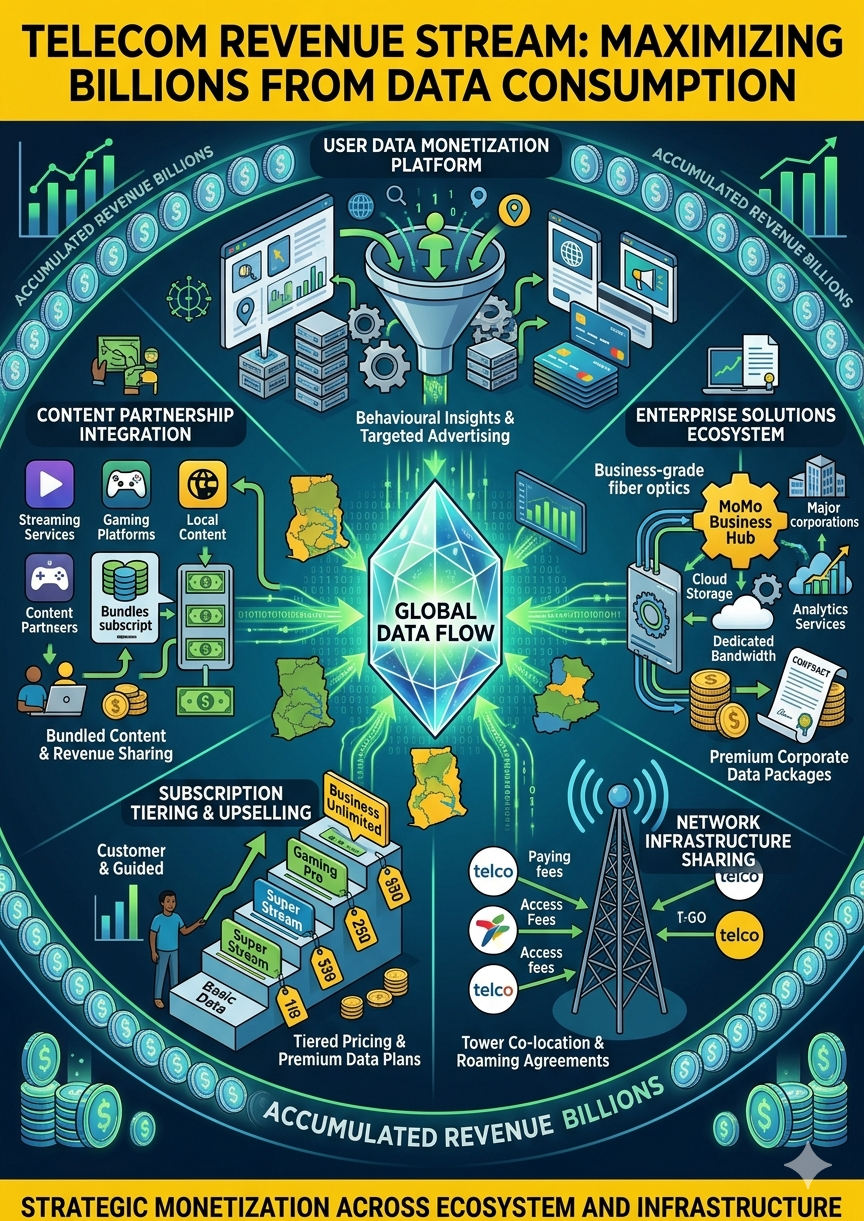
The most sophisticated element of the telecom business model is the data flywheel. Data consumption is not merely a revenue stream in itself — it is the engine that powers MoMo, digital services, and enterprise solutions.
Mobile Money is the most important adjacent revenue stream. MTN Ghana’s MoMo revenue jumped 35.7 percent to GH¢6 billion in 2025, driven by a 12.3 percent rise in active users to 19.3 million. MoMo requires reliable data connectivity to process transactions. Every MoMo transaction generates data traffic. Every new MoMo user is a potential data customer.
Digital services — music streaming, video content, gaming — are heavy data consumers that generate their own revenue while also driving further data usage. MTN Ghana’s digital revenue more than doubled in 2025, underscoring the company’s pivot toward digital ecosystems.
Enterprise solutions — dedicated data connections, cloud services, IoT platforms — represent a higher‑margin segment that serves corporate and government customers. Enterprise clients pay premium rates for service‑level agreements (SLAs) that guarantee uptime.
The flywheel effect compounds. Better data connectivity drives more MoMo usage, which drives more digital service adoption, which drives more data consumption, which justifies further network investment — and the cycle continues.
The Market Players — Financial Performance and Strategic Positioning
The Ghanaian telecom market has three major operators, each with a distinct financial position and strategic orientation.
MTN Ghana is the undisputed market leader. The company posted a 55.9 percent jump in profit after tax to GH¢7.8 billion in 2025, with service revenue reaching GH¢24.4 billion. Its revenue accounts for roughly 31.6 percent of the MTN Group’s total. Data revenue surged 48.8 percent, while MoMo and digital revenues soared. MTN Ghana paid GH¢10.5 billion in direct and indirect taxes in 2025 — making it one of the country’s largest corporate taxpayers — and invested GH¢6.4 billion in capital expenditure, largely directed at 4G expansion. The company’s leadership expects service revenue growth in the “mid‑to‑upper thirties” percent range in the medium term.
Telecel Ghana has successfully emerged from restructuring. The company recorded nearly 30 percent revenue growth in 2025 and declared profits for the first time in years, supported by pricing adjustments, revised product value, and customer growth. It has announced plans to increase network infrastructure investment by 150 percent and signed a $70 million modernisation deal with Huawei. Telecel’s return to profitability is a significant turnaround, but it remains far behind MTN in scale.
AT Ghana is the struggling state‑owned operator. Its market share has sharply declined, and its data revenue is negligible compared to its competitors. The government has agreed to sell a 60 percent stake to Canadian firm Rektron Group and local partner Afritel to inject fresh capital. The success of the sale will determine whether AT can become a viable competitor or continue to lose ground.
The competitive imbalance is stark. MTN Ghana effectively operates as a quasi‑monopoly in the data market, with an estimated 60–70 percent share of data subscribers and an even larger share of data revenue. Telecel and AT compete for the remainder, with Telecel gaining momentum and AT fighting for survival.
The Regulatory Environment — The Rules That Shape the Market
The data market does not operate in a regulatory vacuum. The NCA and the Ministry of Communications set the rules that shape competition, pricing, and infrastructure rollout.
The most consequential regulatory development is the 5G rollout. In March 2026, Ghana activated its wholesale 5G network through the Next‑Gen Infrastructure Company (NGIC), a government‑backed shared infrastructure provider. The network went live in selected locations in Accra, Kumasi and Tamale. The government has set a target of reaching 70 percent 5G population coverage by Ghana’s 70th independence anniversary in March 2027.
The 5G rollout has been carefully managed to prevent market distortion. The Ministry of Communications confirmed that “no operator will roll out 5G before any other — all networks will roll out 5G on the same day”. A new 5G spectrum auction is expected to be concluded soon, with the objective of ensuring universal deployment across operators. The government’s strategy is to use shared wholesale infrastructure to lower barriers to entry and prevent a single operator from dominating the next generation of connectivity.
Regulatory pressure has also influenced data pricing. In 2025, the operators revised their data bundles following engagement with the government: MTN increased data volumes by 15 percent, while Telecel and AT raised theirs by 10 percent. This adjustment effectively reduced prices, benefiting consumers while squeezing operator margins.
Future Outlook — The Three Engines of Growth
The long‑term growth of data revenue in Ghana will be driven by three interlocking engines.
Smartphone penetration is the most important demand driver. As more Ghanaians acquire smartphones — particularly 4G and 5G‑capable devices — their data consumption rises exponentially. A feature phone user consumes hundreds of megabytes per month. A smartphone user consumes gigabytes. The price of entry‑level smartphones has fallen below GH¢500, putting 4G connectivity within reach of millions of new users.
5G adoption will drive the next phase of revenue growth. 5G offers speeds 10‑100 times faster than 4G and enables entirely new use cases: ultra‑HD video streaming, cloud gaming, virtual reality, and industrial IoT. More importantly, 5G supports significantly higher ARPU. Operators will price 5G as a premium service, capturing higher revenue from early adopters and business customers.
Enterprise and IoT — connected sensors, fleet tracking, smart meters — will generate new sources of data revenue. Businesses are increasingly willing to pay premium rates for guaranteed connectivity, and IoT deployments consume data in predictable, high‑volume patterns.
The three‑year outlook is one of continued strong growth, albeit at a decelerating rate. Industry analysts project that mobile data service revenue will grow at a CAGR of 6 percent through 2029. MTN Ghana’s leadership expects service revenue growth in the “mid‑to‑upper thirties” percent range in the medium term, though this appears optimistic given market maturation.
The greatest risk to the data revenue model is regulatory intervention. If the government mandates further price reductions, or if competition intensifies as Telecel gains strength, per‑gigabyte revenue could compress faster than usage expands. The other risk is infrastructure bottleneck. Network congestion is already a reality in peak hours in Accra and Kumasi. If investment lags behind demand, customer experience will deteriorate, and churn will rise.
THSB Conclusion
The question of how telecom companies make billions from data consumption is answered by understanding the flywheel. Data subscriptions generate revenue directly. Data consumption drives MoMo and digital service adoption, which generate more revenue. Data also drives network investment, which improves service quality, which attracts more subscribers, which generates more data traffic — and the cycle repeats.
MTN Ghana’s financial performance is the clearest evidence of the model’s success: GH¢24.4 billion in service revenue, GH¢7.8 billion in profit after tax, data now accounting for 59 percent of revenue, and MoMo and digital services growing at rates that would be the envy of almost any industry. Telecel’s turnaround — nearly 30 percent revenue growth and a return to profitability — demonstrates that the market can support a second competitor, even if the market share gap remains wide.
Yet the model has limits. Data prices, in real terms, are falling. The average Ghanaian is paying less per gigabyte today than they were two years ago. For data revenue to continue growing, operators must either increase the volume of data consumed (which they can, by upgrading networks and attracting new smartphone users) or increase the value captured from each user (which they do through ARPU‑enhancing services like premium bundles and enterprise solutions). Both strategies require continued investment. Telecel’s $70 million network upgrade and the government’s 500 new sites are part of that investment.
The Ghanaian telecom industry has successfully navigated the transition from voice to data. The next transition — from 4G to 5G, from consumer connectivity to enterprise IoT, from basic data to value‑added digital services — will determine whether data revenue can continue its ascent or whether the industry hits the ceiling of what consumers are willing and able to pay. The numbers suggest the ceiling is still high. The 20.6 million active data subscribers on MTN alone represent only a fraction of the addressable market. The 18.8GB per user per month is likely to double within a few years as video streaming and social media consumption intensify.
The billions are being made. The question is whether the companies making them will reinvest sufficiently to keep the flywheel spinning — or whether the very success of the data economy will eventually attract the kind of regulatory scrutiny that caps its growth. For now, the engine is running. The data is flowing. And the money is following.
Frequently Asked Questions (FAQ)
Q1: How much of MTN Ghana’s revenue comes from data?
As of the first quarter of 2026, data accounted for 59 percent of MTN Ghana’s service revenue, up from 52.6 percent a year earlier. Voice has declined to just 31.6 percent.
Q2: How much profit did MTN Ghana make in 2025?
MTN Ghana reported a 55.9 percent jump in profit after tax to GH¢7.8 billion for the 2025 fiscal year. Service revenue rose 36.2 percent to GH¢24.4 billion, driven by a 48.8 percent increase in data revenue and a 35.7 percent rise in Mobile Money revenue.
Q3: How do telecom companies price data bundles in Ghana?
Operators use a tiered bundle structure: daily bundles (GH¢1–GH¢5 for 500MB–2GB) target casual users; weekly bundles (GH¢10–GH¢30 for 3GB–10GB) target commuters and students; monthly bundles (GH¢50–GH¢200 for 15GB–60GB) target salaried workers and heavy users. Social and night bundles offer discounted rates for specific apps or off‑peak hours.
Q4: What is the average data usage per subscriber in Ghana?
MTN Ghana reported average monthly data usage per active user of 18.8 gigabytes in Q1 2026, up 40.9 percent year‑on‑year. This is driven by video streaming, social media, and digital applications.
Q5: How does mobile money contribute to data revenue?
Mobile money (MoMo) and data consumption reinforce each other. MoMo requires reliable data connectivity. Every MoMo transaction generates data traffic, and every new MoMo user is a potential data customer. MTN’s MoMo revenue jumped 35.7 percent to GH¢6 billion in 2025, with 19.3 million active users.
Q6: What is Telecel Ghana’s financial performance?
Ghana recorded nearly 30 percent revenue growth in 2025 and declared profits for the first time in years after restructuring. The company plans to increase network infrastructure investment by 150 percent and signed a US$70 million modernisation agreement with Huawei.
Q7: Why is AT Ghana struggling?
AT Ghana, the state‑owned operator, has seen its market share decline sharply. The government has agreed to sell a 60 percent stake to Canadian firm Rektron Group and local partner Afritel to inject fresh capital. Its ability to compete in the data market depends on the success of that sale.
Q8: What is the status of 5G rollout in Ghana?
In March 2026, Ghana activated its wholesale 5G network through the Next‑Gen Infrastructure Company (NGIC) , a government‑backed shared infrastructure provider. The network went live in selected locations in Accra, Kumasi and Tamale. The government targets 70 percent 5G population coverage by March 2027.
Q9: How much do telecom companies invest in network infrastructure?
In Q1 2026 alone, MTN Ghana deployed over 500 4G sites and upgraded its core network. Telecel signed a US150 million in 2025** to improve service quality. The government will install 500 new 4G and 5G sites.
Q10: What is the Average Revenue Per User (ARPU) in Ghana?
MTN Ghana’s ARPU reached $6.76 per month in 2025, the highest in the MTN Group and nearly double Nigeria’s $3.60. This reflects both relatively high data prices and the willingness of Ghanaian consumers to pay for multiple bundles across different devices.
Q11: How does data consumption affect telecom profitability?
Data revenue has high incremental margins. Once the network is built, the cost of delivering an additional gigabyte is very low. However, operators face heavy fixed costs: spectrum licensing (often tens of millions of dollars), network infrastructure (capex‑to‑revenue ratios of 15‑20%), energy (diesel for thousands of towers), and ongoing maintenance.
Q12: What is the outlook for data revenue in Ghana?
Industry analysts project mobile data service revenue will grow at a compound annual rate of 6 percent through 2029. Growth will be driven by rising smartphone penetration (entry‑level 4G phones below GH¢500), 5G adoption (which supports higher ARPU), and enterprise/IoT services. The greatest risks are regulatory price intervention and infrastructure bottlenecks.
Source: The High Street Business
Disclaimer: Some content on The High Street Business may be aggregated, summarized, or edited from third-party sources for informational purposes. Images and media are used under fair use or royalty-free licenses. The High Street Business is a subsidiary of SamBoad Publishing under SamBoad Business Group Ltd, registered in Ghana since 2014.
For concerns or inquiries, please visit our Privacy Policy or Contact Page.

Esther Aku-Sika is a content writer and social media strategist who helps brands and startups grow through intentional storytelling and practical marketing strategies. With a keen eye for trends and audience behavior, she shares business insights, content strategies, and real-life lessons to help entrepreneurs build visibility and turn ideas into income. Through her writing, she simplifies complex concepts and equips readers with actionable steps to grow in today’s digital space.