








Float, friction, and the invisible backbone of Ghana’s digital economy
QUICK FACTS BOX
| Category | Details |
|---|---|
| Industry | Mobile money agency / Digital financial services retail |
| Typical Business Model | Commission-based agency (telecom operators) + retail margin (ancillary services) |
| Primary Revenue Driver | Cash-out commissions (0.4% – flat fee per transaction) |
| Average Daily Earnings (Active Agent) | GHS 50–200 (high-volume); GHS 20–50 (low-volume) |
| Average Monthly Earnings | GHS 1,500–6,000+ (depending on location, volume, services) |
| Industry Size (Annual Transaction Value) | GH¢1.77 trillion (2024); GH¢323.2 billion (H1 2025) |
| Registered Agents (June 2025) | 923,000 |
| Active Agents (June 2025) | 423,000 (46% active rate, down from 65% in June 2024) |
| MMAAG Membership | 12,000+ agents |
| Key Telcos | MTN, Telecel, AT |
| Barriers to Entry | Low (GHS 1,000–5,000 working capital + agent SIM + ID) |
EXECUTIVE INTRODUCTION
There are 923,000 registered mobile money agents in Ghana. That is more than the number of teachers. More than the number of nurses. More than the number of people employed by the entire formal manufacturing sector. And yet, only 423,000 of them are active — meaning they processed at least one transaction in the last 30 days . The other half a million registered but do not transact. They exist on paper. Not in practice.
This gap — between registration and activity — is the story of the mobile money agent business in Ghana. It is a story of thin margins, intense competition, regulatory shifts, and a business model that looks simple but is brutally unforgiving to the undercapitalised.
📢 GET DETAILED ARTICLES + JOBS
Join THSB's WhatsApp Channel and never miss a post or opportunity.
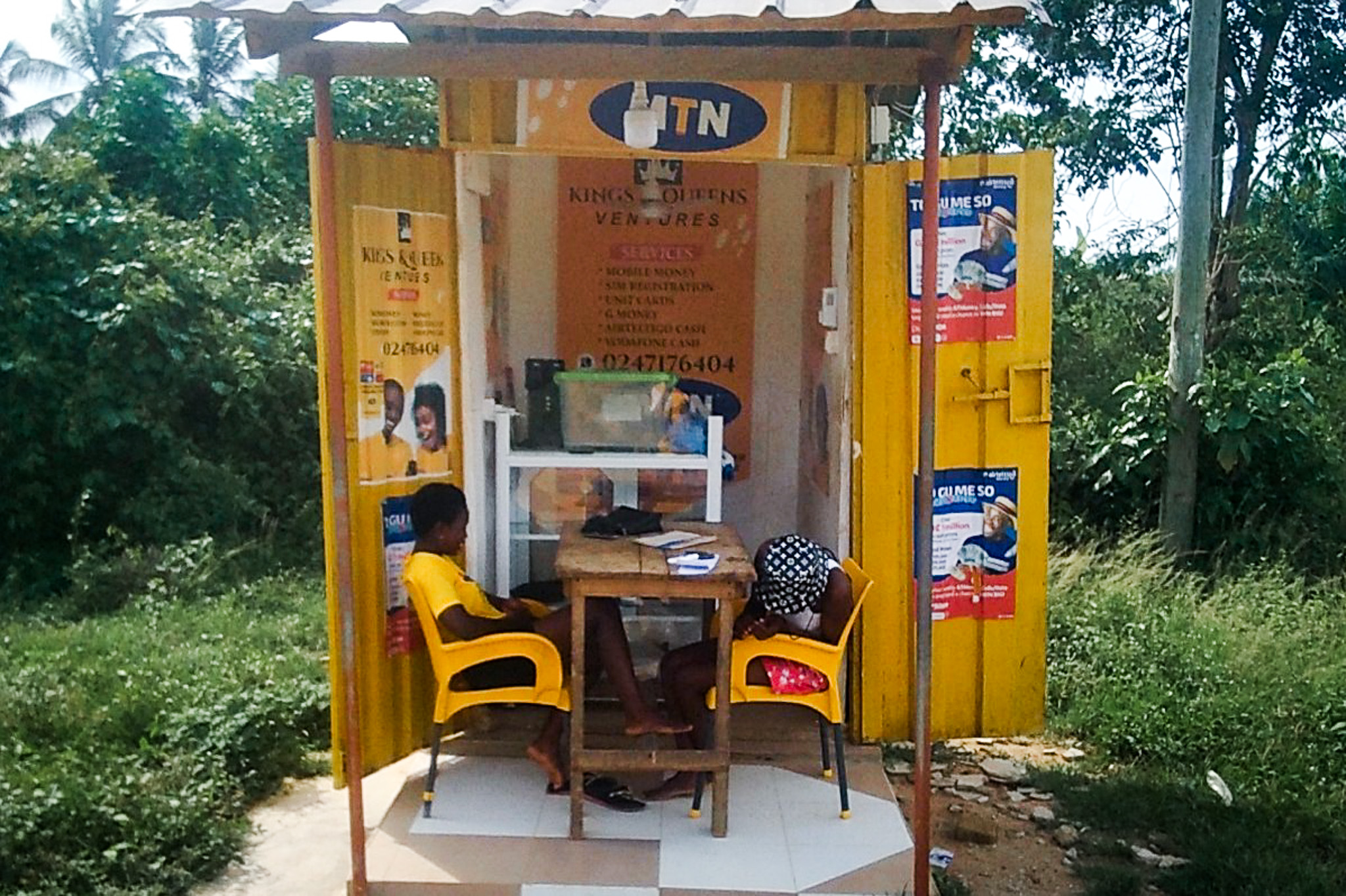
The mobile money agent is the human interface of Ghana’s digital financial revolution. When a market woman needs to deposit her day’s sales into her mobile wallet, she goes to an agent. When a university student needs cash to pay for a textbook, she goes to an agent. When a family in a village receives a remittance from a relative in Accra, they collect it from an agent. The agent converts cash to e-money (cash-in) and e-money to cash (cash-out). They are the bridges between the informal cash economy and the formal digital ledger.
This profile examines how mobile money agents actually make money: the commission structures (which have changed significantly in 2024), the cost of maintaining float, the importance of ancillary services, the risks (fraud, float theft, network downtime), and the structural reasons why nearly half of registered agents are inactive.
The agent model is not dying. It is evolving. The agents who survive and thrive are those who treat their kiosk not as a MoMo stand but as a financial services hub — selling airtime, paying bills, processing government fees, registering SIM cards, and, increasingly, offering small loans and micro-insurance. The standalone MoMo agent who does nothing but cash-in and cash-out is an endangered species. The diversified micro-bank is the future.
THE AGENT VALUE CHAIN (STRUCTURE)
Mobile money in Ghana operates under the regulatory oversight of the Bank of Ghana. The telecoms — MTN (market leader), Telecel, and AT — are the licensed scheme operators. Agents are the retail distribution points.
The Agent-Telco Relationship
| Entity | Role | Revenue Model |
|---|---|---|
| Telco (MTN, Telecel, AT) | Operates mobile money platform; sets commission rates; settles agent payments | Transaction fees from customers (GHS 0.50–2.00 per transaction) |
| Agent | Provides cash-in/cash-out services; maintains float; serves customers | Commission from telco (share of transaction fee) |
| Customer | Uses mobile money for payments, transfers, savings | Pays transaction fee (sometimes waived for small amounts) |
The agent does not set prices. The agent does not keep the float (it is the telco’s money, held by the agent on consignment). The agent is a franchisee in all but name — using the telco’s brand, platform, and pricing, earning a commission on each transaction.
The Agent Commission Structure (2024–2025)
Commission rates have been a source of tension between agents and telcos for years. Agents have threatened strikes over low payouts and delayed settlements . In March 2024, the Bank of Ghana’s upward revision of wallet limits prompted a revision of commission rates .
Current cash-out commission structure (MTN, 2024–2025):
| Transaction Amount (GHS) | Commission |
|---|---|
| Below 50 | GHS 0.20 (flat) |
| 50 – 2,000 | 0.4% of transaction value |
| Above 2,000 | GHS 8 (maximum, capped) |
Example commissions:
| Cash-out amount (GHS) | Commission (GHS) | Effective rate |
|---|---|---|
| 20 | 0.20 | 1.00% |
| 100 | 0.40 | 0.40% |
| 500 | 2.00 | 0.40% |
| 1,000 | 4.00 | 0.40% |
| 2,000 | 8.00 | 0.40% |
| 5,000 | 8.00 | 0.16% |
| 10,000 | 8.00 | 0.08% |
The cap problem: For large withdrawals (above GHS 2,000), the agent’s commission is capped at GHS 8 regardless of amount. An agent who facilitates a GHS 10,000 cash-out earns the same GHS 8 as for a GHS 2,000 withdrawal. This is a significant complaint among agents who serve commercial customers .
Cash-in commission: Cash-in transactions earn lower commissions (typically 0.1–0.2% or a flat fee of GHS 0.10–0.50). Cash-in is less profitable than cash-out, but it builds float (see below).
Commission payment cycle: Agents are paid their commissions monthly, typically by the 15th or 27th of the following month. Delays are common, and agents have protested the unpredictability of payments .
BUSINESS MODEL
The mobile money agent business model has three layers. The first is MoMo commissions. The second is ancillary services. The third is float management.
Layer 1: MoMo Commissions (The Base)
This is the core. The agent earns a commission on every cash-in and cash-out transaction.
Daily earnings from MoMo commissions (active agent, medium-volume location):
| Metric | Value |
|---|---|
| Daily cash-out transactions | 30–50 |
| Average transaction value | GHS 200 |
| Average commission per transaction (0.4% of GHS 200) | GHS 0.80 |
| Daily commission from cash-outs | GHS 24–40 |
| Daily cash-in transactions | 20–30 |
| Average commission per cash-in (GHS 0.20) | GHS 0.20 |
| Daily commission from cash-ins | GHS 4–6 |
| Total daily commission | GHS 28–46 |
| Monthly commission (26 days) | GHS 728–1,196 |
This is the base. GHS 1,000 monthly from MoMo commissions alone is modest — below the national average for formal employment. This is why successful agents do not rely only on commissions.
Layer 2: Ancillary Services (The Profit Engine)
Agents add services that generate additional income with minimal incremental cost:
| Service | Typical Fee / Commission | Daily volume (est.) | Daily revenue (GHS) |
|---|---|---|---|
| Airtime sales (e-voucher) | 5–10% commission | GHS 200–500 sales | 10–50 |
| Bill payments (electricity, water, DStv, school fees) | GHS 1–5 per bill | 10–20 bills | 10–100 |
| SIM registration and replacement | GHS 10–20 per SIM | 2–5 SIMs | 20–100 |
| Mobile phone accessories | 30–50% margin | GHS 50–200 sales | 15–100 |
| Phone charging | GHS 1–2 per phone | 10–20 phones | 10–40 |
| Printing / photocopying | GHS 0.50–1.00 per page | 20–50 pages | 10–50 |
| Lottery / betting services | Commission (5–10%) | Variable | 5–20 |
Total ancillary daily revenue potential: GHS 80–460.
A well-located agent with diversified services can earn more from ancillaries than from MoMo commissions.
The most profitable ancillaries (per effort):
-
Bill payments — High volume, steady demand, pure commission (no stock)
-
SIM registration — Seasonal (new SIMs, lost SIMs) but high fee per transaction
-
Airtime — Low margin but extremely high volume (every customer needs airtime)
Layer 3: Float Management (The Hidden Income)
Float is the cash that the agent holds on behalf of the telco. When a customer does cash-in, the agent receives physical cash and the customer’s mobile wallet is credited. The agent’s e-float (the electronic balance they hold with the telco) decreases. When a customer does cash-out, the agent gives physical cash and their e-float increases.
The float balancing act: The agent must maintain enough physical cash to meet cash-out demand AND enough e-float to meet cash-in demand. Running out of either loses customers.
How agents make money from float (indirectly):
-
Float interest (informal): Some agents keep excess physical cash in interest-bearing accounts (or use it for personal expenses) before rebalancing with the telco. This is technically the telco’s money, but enforcement is weak.
-
Float trading: Agents exchange e-float for physical cash with other agents (or with small businesses that need e-float for supplier payments) at a small premium (0.5–1.0%). This is unregulated but common.
-
Reduced borrowing costs: A well-capitalised agent with sufficient float does not need to borrow money for personal or business needs. The float serves as an interest-free line of credit.
These are not official revenue streams, but they contribute to the agent’s effective income.
COST STRUCTURE (AGENT LEVEL)
Startup Costs
| Item | Estimated Cost (GHS) |
|---|---|
| Agent SIM registration (MTN, Telecel, or AT) | 50–100 (each) |
| Working capital (initial float — cash + e-float) | 1,000–5,000 |
| Kiosk / table / shed (simple structure) | 500–2,000 (or rent) |
| Signage and branding | 100–500 |
| Mobile phone (basic smartphone) | 500–1,500 |
| Printer (for receipts — optional) | 300–800 |
| Stationery (receipt books, pens) | 50–100 |
| Total startup | 2,500–10,000 |
This is a low-barrier entry business. However, undercapitalised agents (starting with GHS 1,000–2,000 float) often fail because they cannot meet customer demand for large cash-outs.
Monthly Operating Costs (Active Agent)
| Cost Item | Monthly (GHS) | Notes |
|---|---|---|
| Rent (kiosk / space) | 200–1,000 | Varies by location |
| Electricity (lighting, phone charging) | 100–300 | |
| Data / internet (for transactions) | 50–150 | |
| Stationery and supplies | 50–100 | |
| Security (optional) | 100–300 | For high-cash locations |
| Float top-up (replenishing cash — not a cost, but a working capital need) | N/A (revolving) | |
| Total monthly costs | 500–1,850 |
A well-located agent with daily commission of GHS 40 (GHS 1,040 monthly) and ancillary revenue of GHS 100 daily (GHS 2,600 monthly) has total monthly revenue of GHS 3,640. After costs of GHS 1,000, net profit is GHS 2,640 monthly — a solid income.
The Float Requirement
The most common reason agents fail is insufficient float. An agent with GHS 2,000 float cannot serve a customer who wants to withdraw GHS 5,000. That customer will go elsewhere — and may never return.
Recommended float by location type:
| Location Type | Average daily transaction volume | Recommended float (GHS) |
|---|---|---|
| Rural / low-density | 5–10 transactions | 1,000–3,000 |
| Suburban residential | 20–40 transactions | 5,000–10,000 |
| Urban market / high-traffic | 50–100+ transactions | 15,000–30,000 |
| Transport terminal | 100–200+ transactions | 20,000–50,000 |
Agents with insufficient float turn away customers. Turning away customers reduces trust. Reduced trust drives customers to competitors. The agent enters a death spiral.
THE AGENT LANDSCAPE (MARKET STRUCTURE)
Registered vs. Active Agents (The 46% Problem)
According to the Bank of Ghana’s July 2025 Summary of Economic and Financial Data:
-
Registered mobile money agents: 923,000
-
Active agents (processed at least one transaction in 30 days): 423,000
-
Active rate: 46% (down from 65% in June 2024)
The active rate has fallen steadily over the past year. At the same time, mobile money transaction values are growing — GH¢323.2 billion in the first half of 2025, a 44% year-on-year increase .
What is happening? The market is consolidating. A smaller number of high-volume agents are processing an increasing share of transactions. The marginal agents — undercapitalised, poorly located, inactive — are being squeezed out.
Agent Density and Competition
With 923,000 registered agents and an adult population of approximately 20 million, there is roughly one registered agent for every 22 adults. This is extremely high density. In many neighbourhoods, agents compete fiercely for customers.
Consequences of overcrowding:
-
Lower transaction volumes per agent
-
Pressure to offer discounts (waiving fees for customers — illegal but common)
-
Some agents resort to charging “convenience fees” (extra charges beyond official commissions — also illegal)
-
High churn (agents registering, then becoming inactive within months)
The Mobile Money Agents Association of Ghana (MMAAG), with over 12,000 members, has engaged the National Communications Authority (NCA) to address industry challenges including fraud, network disruptions, and SIM card pricing .
The Roving Agent Model (Innovation)
Research presented at the Fintech for Inclusion African Summit (2025) examined a “roving agent” model — agents who travel to underserved rural communities with transport subsidies. The study found significant gains in daily transactions and customer base for roving agents compared to stationary agents .
This suggests that the future of agent networks may not be more kiosks, but more mobile agents who bring services to customers rather than waiting for customers to come to them.
CHALLENGES & RISKS
1. Fraud and Cyberattacks (The Greatest Threat)
Mobile money fraud is rampant. The MMAAG has identified fraud as a primary concern, urging the NCA to collaborate with the Cyber Security Authority to mitigate risks .
Common fraud schemes targeting agents:
| Scheme | Description | Typical loss (GHS) |
|---|---|---|
| Fake reversal | Fraudster claims transaction failed, demands cash, later transaction goes through (agent loses cash + e-float) | 500–5,000 |
| SIM swap | Fraudster impersonates agent to telco, requests SIM replacement, gains control of agent’s number and float | 1,000–50,000+ |
| Phishing | Fraudster sends fake SMS claiming to be from telco, asks agent to “verify” details | 500–2,000 |
| Collusion with customer | Customer and fraudster work together to claim transaction was never completed | 200–1,000 |
Prevention: Agents must verify every transaction via USSD or app confirmation before releasing cash. They must never act on SMS alone.
2. Network Downtime
Mobile money transactions require reliable network connectivity. When networks fail (frequently, in some areas), agents cannot process transactions. Customers leave. Revenue is lost.
The MMAAG has raised network disruptions as a key issue with the NCA .
3. Float Theft and Robbery
Agents hold significant cash. This makes them targets for armed robbery. Kiosks are often in vulnerable locations (street corners, markets). Security measures (CCTV, guards, reinforced kiosks) are expensive.
Mitigation: Many agents now limit cash held overnight, make frequent bank deposits, and operate in pairs.
4. Commission Delays and Disputes
Agents are paid commissions monthly, but delays are common. The Mobile Money Agents Advocacy Group has protested the “unilateral” payment cycles and called for payment by the 15th of each month .
Impact of delays: An agent who relies on commission income for living expenses may be unable to pay rent or restock ancillaries.
5. Regulatory Uncertainty
The Bank of Ghana periodically revises wallet limits, KYC requirements, and transaction fees. Each revision affects agent commissions. Agents have limited influence over these decisions.
The 2024 limit revision increased daily transaction limits for minimum accounts from GHS 2,000 to GHS 3,000. This increased the potential value of transactions but did not increase the commission cap (maximum GHS 8) .
6. Competition from Direct Digital Payments
As more customers use mobile money for peer-to-peer transfers and merchant payments, the need for cash-in/cash-out may decline. If customers can pay merchants directly from their wallets, they bypass the agent.
The countervailing trend: Cash is still dominant in Ghana’s informal economy. The transition to a cashless society is decades away. Agents who diversify into bill payments, government fee collection, and other digital services will survive.
ECONOMIC & INDUSTRY IMPACT
Employment
| Category | Estimated |
|---|---|
| Active agents (self-employed) | 423,000 |
| Assistants / employees of agents | 100,000–200,000 |
| Regional aggregators / super-agents | 5,000–10,000 |
| Total direct employment | 528,000–633,000 |
The mobile money agent network is one of the largest sources of self-employment in Ghana.
Financial Inclusion
Agents are the face of financial inclusion. In rural areas without bank branches, the agent is the only formal financial service provider. Customers can open wallets, save, send money, and pay bills — all through the agent.
The roving agent model holds promise for reaching underserved communities . If scaled, it could extend financial services to the 20–30% of Ghanaians who remain unbanked.
Government Revenue (Minimal)
Agents contribute to government revenue through:
-
Income tax (few active agents file or pay)
-
Business operating permits (local assemblies — irregularly enforced)
-
VAT (agents are below registration threshold)
The mobile money industry generates significant tax revenue for the government through transaction levies (e.g., the Electronic Transfer Levy — “E-Levy” — of 1.5%). However, the agents themselves are largely untaxed.
FUTURE OUTLOOK
Short-to-Medium Term (1–5 years)
-
Further consolidation. Active agent numbers may stabilise around 400,000–500,000. Marginal agents will exit. High-volume agents will capture more transactions.
-
Diversification accelerates. Agents who survive will be those who offer bill payments, government services, insurance, and credit. The “MoMo-only” agent will disappear.
-
Roving agent networks expand. Telcos and fintechs may deploy mobile agents to underserved areas, reducing the need for fixed kiosks in saturated urban markets.
-
Fraud prevention improves. Collaboration between NCA, Cyber Security Authority, and MMAAG will introduce better security protocols for agents .
-
Commission rates may be reviewed. The MMAAG continues to advocate for higher caps and fairer payment cycles .
Long-Term (5–10 years)
Scenario 1: Agent as Micro-Bank (Probability: 60%)
Agents evolve into full-service financial hubs — offering loans (from partner fintechs), savings products, insurance, government services (passport, driver’s license, birth certificate applications), and utility connections. The agent’s income shifts from transaction commissions to origination fees and interest spreads.
Scenario 2: Decline of Cash (Probability: 20%)
As Ghana becomes less cash-dependent, the need for cash-in/cash-out declines. Agent numbers fall. Surviving agents focus on merchant services (POS for shops, salary disbursement for small businesses) rather than consumer cash access.
Scenario 3: Platform Disintermediation (Probability: 20%)
Telcos and banks develop agentless solutions (e.g., cash-in via ATM, cash-out via merchant POS). The agent network shrinks significantly. The social role of the agent — the trusted neighbourhood financial advisor — remains, but the economic model weakens.
Strategic Risks to Monitor
| Risk | Probability | Impact | Mitigation |
|---|---|---|---|
| E-Levy expansion or increase | Medium (30%) | Medium (reduces digital transaction growth) | Diversify ancillaries |
| SIM re-registration disruptions | Medium (periodic) | High (loss of customers) | Assist customers with registration (fee-based) |
| Telco consolidation (reducing commission competition) | Low (10%) | Medium (agents have fewer options) | Multi-home (work with multiple telcos) |
| Mobile money fraud reputation damage | High (ongoing) | High (customer trust erosion) | Educate customers; follow security protocols |
THSB CONCLUSION
The mobile money agent is the most accessible entrepreneur in Ghana. With GHS 2,500–10,000, anyone can register, buy a SIM, and start. But accessibility is not profitability. The 923,000 registered agents and 423,000 active agents tell a clear story: nearly half of those who register fail to build a sustainable business.
The survivors are those who understand that MoMo commissions are not enough. They add airtime. They add bill payments. They add SIM registration. They add phone accessories. They diversify until MoMo commissions become a minority of their income.
The survivors also understand float. They capitalise adequately (GHS 10,000–30,000 in high-traffic areas). They do not turn away customers. They build trust.
The mobile money agent network is the circulatory system of Ghana’s digital economy. It is not perfect. Commissions are low. Fraud is high. Competition is fierce. But it works. It enables millions of Ghanaians to send, save, and spend without a bank account. And for the active, diversified, well-capitalised agent, it provides a solid middle-class income in an economy where such incomes are scarce.
The future is not fewer agents. It is better agents — more capitalised, more diversified, more professional. The momo agent who survives will not be the one with the cheapest kiosk. It will be the one who acts like a bank.
FAQ SECTION
1. How much do mobile money agents earn in Ghana?
Active agents earn between GHS 500 and GHS 3,000 monthly from MoMo commissions alone, according to industry estimates . Successful agents with ancillary services (airtime, bill payments, SIM registration) can earn GHS 3,000–6,000+ monthly. Daily earnings for high-volume agents range from GHS 50–200 .
2. What is the commission for mobile money agents on cash-out?
For MTN, agents earn GHS 0.20 for amounts below GHS 50, 0.4% for transactions between GHS 50 and GHS 2,000, and a flat GHS 8 for amounts above GHS 2,000 . The GHS 8 cap means large withdrawals are less profitable for agents per cedi transacted.
3. How many mobile money agents are there in Ghana?
As of June 2025, there were 923,000 registered agents, but only 423,000 were active (processed at least one transaction in 30 days). The active rate was 46%, down from 65% in June 2024 .
4. Why are so many mobile money agents inactive?
Factors include: undercapitalisation (insufficient float to serve customers), overcrowding (too many agents competing for the same customers), low commissions (making the business unprofitable for low-volume operators), and fraud risks that discourage participation.
5. What is the Mobile Money Agents Association of Ghana (MMAAG)?
MMAAG represents over 12,000 agents nationwide. It engages with regulators like the National Communications Authority (NCA) and the Bank of Ghana on issues including fraud, network disruptions, SIM registration, and commission structures .
6. How much capital is needed to start a mobile money agency?
Entrepreneurs need GHS 1,000–5,000 working capital (float), plus an agent SIM from MTN, Telecel, or AT, basic ID papers, and a kiosk or table. Total startup costs range from GHS 2,500–10,000 depending on location and structure .
7. What ancillary services can mobile money agents offer?
Agents supplement MoMo commissions with airtime sales (5–10% commission), bill payments (GHS 1–5 per bill), SIM registration (GHS 10–20 per SIM), phone accessories, phone charging, printing, and lottery/betting services. Diversification is key to profitability .
8. What are the biggest risks for mobile money agents?
Fraud and cyberattacks (SIM swaps, fake reversals, phishing) are the greatest threats. Other risks include armed robbery (agents hold cash float), network downtime, commission payment delays, and regulatory changes .
9. When do mobile money agents receive their commission payments?
Agents are typically paid monthly, by the 15th or 27th of the following month. Agents have protested delays and the “batching” of payments, demanding that all agents be paid by the 15th of each month .
10. What is the “roving agent” model?
A research study presented at the Fintech for Inclusion African Summit (2025) tested a model where agents travel to underserved rural communities with transport subsidies. The results showed significant gains in daily transactions and customer base compared to stationary agents .
11. How can a mobile money agent grow their business?
Experts recommend consistently earning GHS 80 or more daily before considering expansion. Adding complementary services like airtime sales, SIM registration, bill payments, or mobile accessories generates additional income without expansion costs .
12. What is the future of mobile money agents in Ghana?
Consolidation is likely — a smaller number of high-volume, well-capitalised agents will serve the majority of customers. Survivors will diversify into financial services (loans, insurance, savings) and act as “micro-banks” rather than pure cash points. The roving agent model may expand to underserved rural areas.
Source: The High Street Business
Disclaimer: Some content on The High Street Business may be aggregated, summarized, or edited from third-party sources for informational purposes. Images and media are used under fair use or royalty-free licenses. The High Street Business is a subsidiary of SamBoad Publishing under SamBoad Business Group Ltd, registered in Ghana since 2014.
For concerns or inquiries, please visit our Privacy Policy or Contact Page.

Samuel Kwame Boadu is a Ghanaian entrepreneur, writer, and digital consultant passionate about creating impactful stories and business solutions. He is the Founder & CEO of SamBoad Business Group Ltd, a dynamic company with subsidiaries in digital marketing, logistics, publishing, and risk management.