





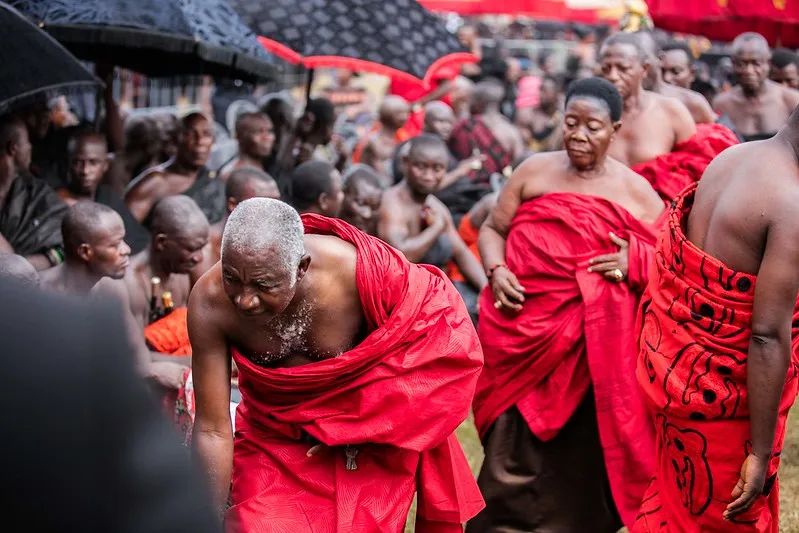
Death is certain. So is spending. The business of goodbye in Ghana’s most culturally mandatory market.
QUICK FACTS BOX
| Category | Details |
|---|---|
| Industry | Funeral services / Event planning / Catering / Memorialisation |
| Typical Business Model | Service-fee based (catering, décor, tent rental, printing, transport) + retail (coffins, cloth, drinks) |
| Primary Revenue Driver | One-off event services for bereaved families |
| Average Funeral Cost (Low-income family) | GHS 5,000–15,000 |
| Average Funeral Cost (Middle-income family) | GHS 20,000–60,000 |
| Average Funeral Cost (Upper-income/Elaborate) | GHS 80,000–300,000+ |
| Industry Size (Annual) | GHS 2.5–4.0 billion |
| Number of Funerals Annually (Est.) | 150,000–200,000 |
| Key Service Providers | Caterers, tent hire, coffin makers, printers, transport operators, MCs, video coverage |
| Barriers to Entry | Low to moderate (skills-based, capital GHS 10,000–50,000 per service line) |
EXECUTIVE INTRODUCTION
In Ghana, death is not an ending. It is a beginning — of obligations.
The moment a family member dies, a clock starts ticking. Not a clock of grief, though grief is real. A clock of expenditure. Within days, sometimes hours, the bereaved family must arrange: a coffin, a hearse, a church service or burial grounds, tents, chairs, caterers, drinks, a printed brochure (with the deceased’s biography and photos), a public address system, a master of ceremonies, a video crew, and — most significantly — enough food to feed hundreds, sometimes thousands, of mourners who will arrive to pay their respects.
📢 GET DETAILED ARTICLES + JOBS
Join THSB's WhatsApp Channel and never miss a post or opportunity.
This is the Ghanaian funeral. And it is one of the largest, most consistent, and most culturally entrenched consumer markets in the country.
No one tracks the funeral economy officially. But the numbers are staggering. An estimated 150,000–200,000 funerals take place in Ghana every year. The average cost, depending on the family’s socioeconomic status, ranges from GHS 5,000 to over GHS 100,000. Multiply these figures, and the funeral economy is worth somewhere between GHS 2.5 billion and 4 billion cedis annually. That is larger than Ghana’s tourism receipts. Larger than the country’s timber exports. Comparable to the entire cocoa marketing sector’s local expenditure.
And almost all of it is cash. Spent within days. With little negotiation. Because when death visits, you do not haggle.
This profile goes inside the funeral economy: the service providers who have built businesses around grief, the cost structures that drive prices, the cultural pressures that make overspending almost mandatory, and the quiet ways that some Ghanaians are trying to rationalise death spending without appearing disrespectful.
The story is not morbid. It is economic. Death is the most predictable event in human life. And where there is predictability, there is business opportunity.
THE FUNERAL VALUE CHAIN
A Ghanaian funeral is not a single product. It is a bundle of services provided by a range of specialists. Understanding the funeral economy requires breaking down each component.
The Core Service Providers
| Provider Type | Role | Typical Fee (GHS) | Margin (%) |
|---|---|---|---|
| Funeral planner/consultant | Coordinates all services, manages budget, liaises with family | 1,000–5,000 (or 10–15% of total cost) | 30–50% |
| Undertaker/mortuary | Embalming, storage, dressing of body | 800–2,500 | 40–60% |
| Coffin maker | Constructs and customises coffin | 800–15,000+ | 30–60% |
| Hearse/ambulance | Transport body to church/burial ground | 500–2,000 | 50–70% |
| Church/burial ground | Service venue | 300–1,500 (donation/fee) | 80–90% (mostly pure profit) |
| Tent and chair hire | Shading and seating for mourners | 1,000–10,000 | 30–40% |
| Caterer | Food preparation and serving | 5,000–50,000+ | 20–35% |
| Drinks supplier | Alcoholic and soft drinks | 2,000–20,000 | 25–40% |
| Public address (PA) system | Microphone, speakers, music | 500–3,000 | 40–60% |
| Master of ceremonies (MC) | Programme coordination, announcements | 500–3,000 | 80–95% (mostly labour) |
| Printer | Funeral brochure, banners, posters | 500–3,000 | 30–50% |
| Photography/videography | Documentation of event | 1,000–8,000 | 40–60% |
| Cloth printer/seller | Funeral cloth (family uniform) | 20–60 per yard (200–500 yards typical) | 20–40% |
| Transport (guest shuttles) | Moving guests from parking to venue | 500–3,000 | 30–50% |
No single business provides all these services (though some large funeral homes attempt to bundle). The funeral economy is a network of small, specialised businesses, each serving multiple funerals per week.
The Funeral Timeline (Typical)
| Day | Activity | Spending (Cumulative GHS) |
|---|---|---|
| Day 0 (death) | Mortuary, announcement | 500–2,000 |
| Day 1–3 | Family meeting, planning, budget | Minimal |
| Day 7 (often) | “One week” celebration (memorial service) | 5,000–20,000 |
| Day 14–90 | Final funeral (date varies by family, often weekends) | 20,000–100,000+ |
| Post-funeral | Thanksgiving service, thank-you gifts | 1,000–5,000 |
The “one week” has become almost as expensive as the final funeral. Originally a simple prayer gathering, it has evolved into a full-scale event with catering, décor, and printed programmes. Some families now spend more on the one week than on the burial.
BUSINESS MODEL BY SERVICE SEGMENT
Coffin Making (The Artisan Economy)
The coffin is the most visible funeral expense. In Ghana, coffins range from simple pine boxes to elaborate “fantasy coffins” shaped like fish, cars, aeroplanes, or mobile phones — reflecting the deceased’s profession or passion.
Cost drivers:
| Coffin Type | Materials Cost (GHS) | Labour (GHS) | Retail Price (GHS) | Gross Margin |
|---|---|---|---|---|
| Basic plywood | 200–400 | 100–200 | 500–1,000 | 40–50% |
| Standard finished (veneered) | 400–800 | 200–400 | 1,000–2,500 | 40–50% |
| Premium (hardwood, brass handles, velvet interior) | 1,000–3,000 | 500–1,500 | 3,000–8,000 | 40–60% |
| Fantasy coffin (custom shape) | 2,000–8,000 | 2,000–7,000 | 6,000–15,000+ | 40–50% |
The coffin maker’s economics: A skilled carpenter in a coffin-making hub (e.g., Abossey Okai’s coffin cluster, or specific workshops in Kumasi) can produce 2–5 coffins per week. At an average selling price of GHS 1,500 and gross margin of 45%, the coffin maker’s gross profit per coffin is GHS 675. At 3 coffins per week (12 per month), gross monthly profit is GHS 8,100. After workshop rent, tools, and transport, net profit is GHS 4,000–6,000 monthly — solidly middle-income.
The fantasy coffin niche is more lucrative but less frequent. A fantasy coffin maker may sell only 2–3 per month but at GHS 8,000–15,000 each. Gross profit per fantasy coffin is GHS 3,000–7,000. Annual income can exceed GHS 100,000.
Catering (The Largest Single Expense)
Feeding mourners is the biggest line item in most funeral budgets. The expectation: everyone who attends must eat. Not a snack. A full meal.
Typical catering cost breakdown (500 guests, middle-range funeral):
| Item | Quantity | Unit Cost (GHS) | Total (GHS) |
|---|---|---|---|
| Rice (jollof or plain) | 100 kg | 15–20/kg | 1,500–2,000 |
| Meat (chicken, goat, beef) | 150 kg | 30–50/kg | 4,500–7,500 |
| Fish (optional) | 50 kg | 25–40/kg | 1,250–2,000 |
| Oil, spices, vegetables | Bulk | 500–1,000 | |
| Disposables (plates, cups, cutlery) | 500 sets | 3–5/set | 1,500–2,500 |
| Labour (catering team) | 10–15 people | 100–200 each | 1,000–3,000 |
| Transport and fuel | 200–500 | ||
| Total catering cost | 10,450–18,500 |
Cost per guest: GHS 20–37.
Caterer’s profit: The family pays the caterer a fixed fee (GHS 15,000–25,000 for this scale). The caterer’s cost is GHS 10,450–18,500. Gross profit is GHS 4,500–6,500 per funeral (25–30% gross margin). A busy caterer handling 2–3 funerals per weekend (peak season) earns GHS 9,000–19,500 weekly gross profit. However, the work is physically demanding, and off-season (January–February, August) is slower.
The catering trap: Families often underestimate attendance. A funeral planned for 300 guests attracts 500. The caterer must scramble for extra food, absorbing cost or negotiating a supplement. Wise caterers build a 20–30% contingency into their quotes.
Funeral Printing (The Brochure Economy)
Every Ghanaian funeral produces a brochure — a full-colour, multi-page document containing the deceased’s biography, family history, order of service, and tributes. It is a keepsake. It is also a significant expense.
Brochure economics:
| Print run | Pages | Printing cost per copy (GHS) | Total printing cost (GHS) | Selling price to family (GHS) | Gross profit |
|---|---|---|---|---|---|
| 500 | 20 | 3–5 | 1,500–2,500 | 3,000–5,000 | 1,500–2,500 |
| 1,000 | 30 | 4–6 | 4,000–6,000 | 8,000–12,000 | 4,000–6,000 |
| 2,000 | 40 | 5–7 | 10,000–14,000 | 20,000–28,000 | 10,000–14,000 |
Gross margin: 50%. Printing is highly profitable because families rarely shop around for brochure printing — they use a trusted printer (often a family friend or someone recommended by the funeral planner). The printer also earns from banner printing, posters, and thank-you cards.
Funeral Cloth (The Social Obligation)
Most Ghanaian funerals have a family cloth — a specific fabric (often a patterned design with the deceased’s photo) that family members and close friends purchase and wear to the funeral. The family buys the cloth in bulk and resells it to mourners, often at a markup.
Cloth economics:
| Quantity | Wholesale cost per yard (GHS) | Retail price to mourners (GHS) | Markup per yard | Total markup (500 yards) |
|---|---|---|---|---|
| 200–500 yards | 20–30 | 40–80 | 20–50 | 4,000–25,000 |
The family’s profit from cloth sales helps offset funeral costs. Some families break even on the cloth alone. Others use cloth sales as a fundraising mechanism, selling to non-family members who want to show solidarity.
The cloth printer’s business: The printer buys plain fabric, designs and prints the pattern (GHS 15–25 per yard cost), and sells to the family at GHS 30–50 per yard. Gross margin: 30–50%. A printer handling 10 funerals per month (average 300 yards each) earns GHS 9,000–15,000 monthly gross profit.
THE CULTURAL DRIVERS OF SPENDING
Why do Ghanaians spend so much on funerals? The reasons are not purely emotional. They are social and structural.
1. Reputation and Social Standing
A modest funeral is interpreted as disrespect to the deceased. A lavish funeral demonstrates that the family loved and honoured their departed. In Ghana’s community-oriented culture, the funeral is a public performance of filial piety. Families spend beyond their means because the alternative — social shame — is unbearable.
The peer pressure mechanism: After the funeral, attendees discuss the food, the décor, the brochure quality, the organisation. A family that “cut corners” is talked about for years. This fear drives spending.
2. Extended Family and Community Obligations
The deceased’s family is not just nuclear. It includes cousins, uncles, aunts, in-laws, and entire clans. Each branch expects to be fed, housed (if from out of town), and acknowledged in the programme. The guest list expands beyond any reasonable estimate.
The “surprise relative” phenomenon: Someone the deceased met once, twenty years ago, shows up with five family members. They must be fed. The budget, already stretched, breaks.
3. The “One Week” Escalation
Traditionally, the “one week” (held seven days after death) was a small prayer gathering. Today, it has become a pre-funeral funeral — with catering, tents, printed programmes, and sometimes even a band. Families feel pressure to hold both a large one week and a large final funeral. Costs double.
4. Funeral as Family Reunion
For many Ghanaians living abroad (UK, US, Germany, Canada), the funeral is the primary reason to return home. They fly in, bringing their own expectations of quality (e.g., “In London, we would have…” ). The diaspora contribution — often substantial (GHS 5,000–50,000 per family) — allows the local family to spend more. But it also raises expectations.
5. The Role of Funeral Committees
Most families form a funeral planning committee — members assigned specific tasks: catering, finance, transport, protocol. Committees, lacking centralised budget control, often approve expenditures that individually seem reasonable but collectively blow the budget.
Example: Catering committee orders food for 500. Transport committee orders buses for 300. Protocol committee orders drinks for 800. Each acts independently. The total cost far exceeds the initial budget.
THE COST OF DEATH: FUNERAL BUDGET CASE STUDIES
Case Study 1: Low-Income Family, Rural Ghana
| Item | Cost (GHS) |
|---|---|
| Mortuary and embalming | 800 |
| Coffin (basic plywood) | 600 |
| Hearse (shared, short distance) | 400 |
| Church donation | 200 |
| Food (simple meal, 150 guests) | 3,000 |
| Drinks (water, soft drinks) | 500 |
| Tents and chairs (minimal) | 500 |
| PA system (basic) | 300 |
| Brochure (simple, 100 copies) | 400 |
| Miscellaneous | 500 |
| Total | 7,200 |
How they paid: Family contributions (susu), small loans from friends, sale of livestock.
Case Study 2: Middle-Income Family, Urban Accra
| Item | Cost (GHS) |
|---|---|
| Mortuary and embalming | 2,000 |
| Coffin (premium finished) | 3,500 |
| Hearse (dedicated) | 1,200 |
| Church and cemetery fees | 1,000 |
| Catering (500 guests) | 18,000 |
| Drinks (alcohol and soft) | 8,000 |
| Tents, chairs, décor | 7,000 |
| PA system, MC, musician | 2,500 |
| Brochure (500 copies, 24 pages) | 4,000 |
| Photography/videography | 3,000 |
| Funeral cloth (family) | 6,000 (partially recovered from sales) |
| Transport (guest shuttles) | 1,500 |
| Funeral planner fee | 2,000 |
| Miscellaneous | 3,000 |
| Total | 62,700 |
How they paid: Savings (30%), contributions from extended family (40%), diaspora remittances (20%), small loan (10%).
Case Study 3: Upper-Income Family, Elaborate Funeral
| Item | Cost (GHS) |
|---|---|
| Mortuary and embalming (premium) | 5,000 |
| Coffin (fantasy, custom) | 15,000 |
| Hearse (luxury, multiple vehicles) | 5,000 |
| Church and cemetery (premium) | 3,000 |
| Catering (1,500 guests, premium menu) | 80,000 |
| Drinks (champagne, premium spirits, soft) | 30,000 |
| Tents, luxury chairs, air conditioning | 25,000 |
| Live band, PA, multiple MCs | 15,000 |
| Brochure (2,000 copies, 60 pages, hardcover) | 25,000 |
| Photography/videography (multiple cameras, drone) | 12,000 |
| Funeral cloth (premium fabric, 1,000 yards) | 40,000 (partially recovered) |
| Transport (luxury buses) | 8,000 |
| Funeral planner (full service) | 15,000 |
| Security, parking attendants | 5,000 |
| Miscellaneous | 12,000 |
| Total | 295,000 |
These funerals exist. They are rare (less than 1% of total) but they set the aspiration standard. Middle-income families try to approximate them, stretching their budgets to GHS 60,000 when GHS 20,000 would be sufficient.
THE FUNERAL PLANNER: A GROWING PROFESSION
Traditionally, family elders planned funerals. Today, professional funeral planners are increasingly common, especially in urban areas.
Why families hire planners:
-
Emotional distance: The bereaved family is grieving. Planning a large event is overwhelming. The planner handles logistics.
-
Cost control (ironically): A good planner prevents budget overruns by coordinating committees and negotiating with suppliers. The planner’s fee (GHS 2,000–15,000) is often offset by savings.
-
Quality assurance: Planners have relationships with reliable caterers, printers, tent hire companies. Families avoid the risk of a supplier failing at the last minute.
The planner’s business model:
| Fee structure | Typical amount | Pros and cons |
|---|---|---|
| Fixed fee | GHS 2,000–15,000 | Transparent; family knows cost upfront |
| Percentage of total cost | 10–15% | Aligns planner’s incentive with family’s (but encourages higher spending) |
| Supplier commission (unethical but common) | 10–20% from each supplier | Planner has incentive to choose expensive suppliers; family pays more |
The planner’s economics: A busy planner handling 2–3 funerals per week at an average fee of GHS 5,000 earns GHS 10,000–15,000 weekly gross revenue. After assistant salaries, transport, and phone costs, net profit is GHS 6,000–10,000 weekly — an excellent income. However, the work is emotionally draining and time-intensive (including weekends).
INNOVATION AND ENTRY OF FORMAL PLAYERS
The funeral economy has traditionally been the domain of small, informal operators. But formal players are noticing the opportunity.
Funeral Insurance
Several insurance companies now offer funeral policies:
| Provider | Product | Monthly Premium (GHS) | Coverage (GHS) |
|---|---|---|---|
| Enterprise Life | Funeral Plan | 20–200 | 2,000–20,000 |
| Prudential Life | Aseda Funeral | 15–150 | 1,500–15,000 |
| Golden Life | Funeral Cover | 30–300 | 3,000–30,000 |
| Vanguard Life | Final Expenses Plan | 10–100 | 1,000–10,000 |
Adoption rate: Low (under 5% of funerals funded by insurance). Most families still rely on savings, contributions, and loans. But funeral insurance is growing, especially among salaried workers.
The challenge: Policies are often too small (GHS 20,000 maximum) for the type of funeral families want. A family with GHS 20,000 insurance still needs to find GHS 40,000 more. Insurance is a supplement, not a solution.
Funeral Savings Groups (SUSU for Death)
Informal savings groups (susu) have long existed. A newer variation: funeral-specific susu. Members contribute GHS 50–200 monthly. When a member dies (or a member’s immediate family member), the group pays out a lump sum (GHS 5,000–20,000) toward funeral expenses.
Why this works: It distributes the cost of death across the community. It also creates social pressure to contribute (no one wants to be the member who defaults when someone dies).
Digital Funeral Planning
Startups have attempted to digitise funeral planning:
-
Funeral booking platforms (aggregating caterers, tent hire, printers) — limited success because families prefer recommendations from trusted sources (funeral planners, friends, family).
-
Online tribute pages (memorial websites) — some adoption among diaspora families, but most Ghanaians still want a physical brochure.
-
Digital payment for contributions (mobile money links for funeral fundraising) — growing rapidly. Families share MoMo numbers on funeral brochures and social media, allowing remote contributions.
The MoMo funeral contribution has become standard. A typical funeral brochure includes the family’s MoMo number. Diaspora relatives and friends who cannot attend can still contribute. This has increased total fundraising significantly.
CHALLENGES & RISKS
1. Financial Distress and Over-Indebtedness
The most serious social cost: families going into debt for funerals. Loans are taken. Properties are sold. Children’s school fees are redirected. The funeral is paid for. Then the family spends years recovering.
The scale of the problem: An estimated 30–40% of Ghanaian households who hold a funeral incur debt to do so. The average funeral debt among low- and middle-income families is GHS 5,000–20,000 — a crippling amount for households with limited income.
2. Funeral Fraud
Unscrupulous suppliers prey on grieving families:
-
Caterers who disappear with the deposit
-
Printers who deliver low-quality brochures after being paid for premium
-
Tent hire companies that double-book and leave a family without shelter on the day
-
“Funeral planners” who take fees and do nothing
The lack of contracts: Most funeral transactions are verbal, with small deposits (10–30%). Families have little recourse when suppliers fail. The police are rarely involved (funeral disputes are seen as “civil matters”).
3. The “Keeping Up” Pressure
The funeral industry suffers from conspicuous consumption inflation. Every family wants their funeral to be “as good as” or “better than” the last funeral they attended. This drives spending upward across all income brackets.
The result: Funerals that cost GHS 10,000 twenty years ago now cost GHS 50,000 — not because of inflation alone, but because expectations have escalated.
4. Regulatory Absence
No government agency regulates funeral pricing or quality. Anyone can call themselves a funeral planner, caterer, or coffin maker. Quality varies wildly. Families have no standard to expect and no complaint mechanism.
Potential regulation: Some countries (e.g., UK, US) regulate funeral homes and require price transparency. Ghana has no such framework. The industry is entirely self-regulating — which means it is largely unregulated.
5. Family Disputes
Funerals are often flashpoints for family conflict:
-
Who controls the budget?
-
Who decides the menu?
-
Which church or burial ground?
-
How are diaspora contributions acknowledged?
-
Who is listed in the brochure?
The business risk: Disputes can delay funerals (suppliers must reschedule, losing revenue) or lead to non-payment (one faction refuses to pay, leaving suppliers unpaid).
6. Seasonality and Cash Flow
Funeral businesses are highly seasonal:
| Period | Funeral Volume | Reason |
|---|---|---|
| November–December (peak) | 150–200% of average | End-of-year, diaspora returns, holidays |
| March–June (high) | 120–150% | Post-Christmas, before rains |
| July–September (low) | 50–70% | Heavy rains, farming season (rural) |
| January–February (low) | 60–80% | Post-December recovery, school fees season |
Surviving the low season: Successful funeral businesses diversify (weddings, birthday parties, corporate events) or build cash reserves during peak months.
ECONOMIC & INDUSTRY IMPACT
Employment
| Role | Estimated Workers |
|---|---|
| Caterers and kitchen staff | 50,000–80,000 |
| Tent and chair hire | 10,000–15,000 |
| Coffin makers and carpenters | 8,000–12,000 |
| Printers (brochures, banners) | 5,000–8,000 |
| Funeral planners and MCs | 3,000–5,000 |
| Transport (hearses, shuttles) | 5,000–8,000 |
| Photographers and videographers | 4,000–6,000 |
| PA system operators and musicians | 5,000–8,000 |
| Cloth printers and sellers | 3,000–5,000 |
| Total direct employment | 93,000–147,000 |
The funeral economy is a significant employer of semi-skilled and skilled labour, particularly women (catering) and artisans (carpentry, printing).
Government Revenue (Minimal)
Unlike many other industries described in this series, the funeral economy contributes very little to government revenue:
-
No VAT on funeral services (most suppliers are informal, not registered)
-
No income tax (most earnings unreported)
-
No licensing fees (no regulatory framework)
What the government does collect: Import duties on funeral cloth fabric (much is imported), excise taxes on alcoholic drinks sold at funerals, and PAYE from the small minority of formal-sector funeral workers.
Estimated government revenue from funeral economy: under GHS 50 million annually — a tiny fraction of the industry’s size.
Social Cost-Benefit Analysis
Benefits:
-
Provides culturally meaningful closure for bereaved families
-
Creates employment and income for thousands
-
Supports a chain of small businesses (catering, printing, carpentry)
-
Facilitates family reunion and community bonding
Costs:
-
Drives many families into debt
-
Diverts household income from productive uses (education, health, housing)
-
Creates social pressure to overspend
-
No savings or investment for the future (funeral spending is consumption, not investment)
The funeral economy is, from a purely economic perspective, inefficient. It consumes resources that could otherwise be saved or invested. But economics does not capture culture. For most Ghanaians, a “proper” funeral is not a choice. It is an obligation.
FUTURE OUTLOOK
Short-to-Medium Term (1–5 years)
-
Continued inflation of expectations. Funerals will become more expensive, not less. The “average” middle-class funeral will approach GHS 80,000.
-
Professionalisation of funeral planning. More families will hire planners, leading to consolidation among suppliers (planners will recommend preferred caterers, printers, etc.).
-
Growth of funeral insurance. Insurance penetration will increase from under 5% to 10–15% as products improve and awareness grows.
-
Digital funeral fundraising. MoMo contributions will become universal. Crowdfunding platforms (GoFundMe-style, but Ghanaian) may emerge.
-
Entry of corporate players. Banks may offer funeral loans (repayable over 12–24 months). Large event companies may create dedicated funeral divisions.
Long-Term (5–15 years)
Scenario 1: Cultural Shift (Probability: 30%)
A growing movement — led by churches, financial literacy advocates, and younger Ghanaians — promotes “simple, dignified” funerals. The social pressure to overspend reduces. Average funeral costs stabilise or decline. The funeral economy shrinks but becomes more efficient.
Scenario 2: Entrenchment (Probability: 50%)
The current trajectory continues. Funerals remain expensive and elaborate. The industry grows with population and inflation, reaching GHS 6–8 billion annually by 2035. Funeral debt remains a significant household burden.
Scenario 3: Formalisation and Regulation (Probability: 20%)
The government introduces regulation: funeral home licensing, price transparency requirements, consumer protection for pre-paid funeral plans. The informal sector is squeezed. Formal players (insurance companies, large event companies) gain market share. Prices may rise (due to compliance costs) or fall (due to increased competition and transparency).
Strategic Risks to Monitor
| Risk | Probability | Impact | Mitigation |
|---|---|---|---|
| Economic downturn reducing funeral spending | Medium | High (industry revenue falls) | Diversify into non-funeral events (weddings, parties) |
| Church-led campaign against elaborate funerals | Low (10–20%) | Medium | Focus on families that continue traditional practice |
| Entry of large corporate event companies | Medium | Medium (small suppliers lose market share) | Specialise in niches (e.g., custom coffins, specific cuisines) |
| Shift to cremation (less expensive, less elaborate) | Very low (under 5%) | Low | Cremation is culturally unacceptable for most Ghanaians |
THSB CONCLUSION
The funeral economy is Ghana’s most culturally entrenched, most emotionally charged, and most financially irrational market. No one chooses to spend GHS 60,000 on a funeral. But thousands of families do, every year, because the alternative — a “small” funeral — carries social costs that exceed the financial cost of the large one.
For business owners, this is a dream market: demand is inelastic (people will pay almost anything when grief is fresh), payment is upfront (cash, before the event), and competition is fragmented (thousands of small operators, few dominant players). The caterer, the coffin maker, the printer, the planner — each earns a decent living from death.
But the funeral economy is also a trap. Families spend money they do not have. Suppliers sometimes exploit grief. The social pressure to spend escalates year after year, funeral after funeral, with no natural ceiling.
The profile does not offer solutions. That is not its purpose. Its purpose is to make visible an industry that operates in plain sight but is rarely analysed as an economic system. Death in Ghana is not just a personal loss. It is a transaction — and a very large one.
As the population ages (Ghana has a young population, but the elderly cohort is growing), the number of funerals will increase. The funeral economy will grow. The question is not whether Ghanaians will spend on death. They will. The question is whether they will spend wisely.
On current evidence, the answer is no. But that, too, is business opportunity — for the insurer, the financial planner, the educator who teaches families to save for death without being morbid.
In the funeral economy, everyone pays. The only choice is how much.
FAQ SECTION
1. How much does a funeral cost in Ghana?
Costs vary widely. A low-income family funeral costs GHS 5,000–15,000. A middle-income family funeral costs GHS 20,000–60,000. An elaborate upper-income funeral can exceed GHS 100,000 or even GHS 300,000.
2. How big is Ghana’s funeral industry?
Estimated at GHS 2.5–4.0 billion annually, based on 150,000–200,000 funerals per year and average costs ranging from GHS 15,000 to GHS 25,000.
3. What is the most expensive part of a Ghanaian funeral?
Catering is typically the largest single expense (30–40% of total budget). Feeding hundreds or thousands of guests is costly. Other major expenses: tent and chair hire, drinks, coffin, brochure printing.
4. How do funeral planners make money?
Funeral planners charge either a fixed fee (GHS 2,000–15,000), a percentage of total cost (10–15%), or receive commissions from suppliers (unethical but common). Busy planners can earn GHS 10,000–15,000 weekly.
5. Why are Ghanaian funerals so expensive?
Cultural expectations of hospitality (feeding all attendees), social pressure (the funeral reflects on the family’s reputation), the “one week” escalation (two large events instead of one), and the role of funerals as family reunions (especially with diaspora contributions).
6. How do families pay for funerals?
Savings (often inadequate), contributions from extended family (susu-style), diaspora remittances, loans from friends or banks, sale of assets (land, livestock), and increasingly funeral insurance.
7. What is funeral insurance in Ghana?
Several insurance companies offer funeral policies (e.g., Enterprise Life, Prudential Life). Monthly premiums range from GHS 10–300, with coverage of GHS 1,000–30,000. Adoption is low (under 5% of funerals) but growing.
8. How do coffin makers in Ghana earn a living?
Coffin makers produce basic coffins (GHS 500–2,500) or premium/fantasy coffins (GHS 3,000–15,000+). Gross margins are 40–60%. A skilled maker producing 3–5 coffins weekly can net GHS 4,000–6,000 monthly.
9. What is the “one week” celebration?
Held approximately seven days after death, the “one week” was traditionally a small prayer gathering. Today, it has become a large event with catering, tents, brochures, and sometimes as expensive as the final funeral.
10. Are there efforts to reduce funeral spending?
Some churches and financial literacy advocates promote “simple, dignified” funerals. However, social pressure remains strong. A cultural shift away from elaborate funerals is possible but not imminent.
11. Is the funeral industry regulated in Ghana?
No. Anyone can offer funeral services. There are no licensing requirements, price transparency rules, or quality standards. Consumers have little recourse against fraudulent or poor-quality suppliers.
12. What is the future of Ghana’s funeral economy?
Continued growth in total spending (population growth, inflation, escalating expectations). Gradual professionalisation (more families using planners). Growth of funeral insurance and digital fundraising. Regulation is possible but unlikely in the near term.
Source: The High Street Business
Disclaimer: Some content on The High Street Business may be aggregated, summarized, or edited from third-party sources for informational purposes. Images and media are used under fair use or royalty-free licenses. The High Street Business is a subsidiary of SamBoad Publishing under SamBoad Business Group Ltd, registered in Ghana since 2014.
For concerns or inquiries, please visit our Privacy Policy or Contact Page.

Samuel Kwame Boadu is a Ghanaian entrepreneur, writer, and digital consultant passionate about creating impactful stories and business solutions. He is the Founder & CEO of SamBoad Business Group Ltd, a dynamic company with subsidiaries in digital marketing, logistics, publishing, and risk management.