




Pure water. Pure margin. Pure velocity. The economics of Ghana’s most ubiquitous consumer good.
QUICK FACTS BOX
| Category | Details |
|---|---|
| Industry | Packaged drinking water / Fast-moving consumer goods (FMCG) |
| Typical Business Model | Production (treatment + sachet filling) + Distribution (wholesale/retail) |
| Primary Revenue Driver | Volume. High unit velocity, low per-unit margin. |
| Average Retail Price | 20–50 Gp per sachet (30–50 Gp in Accra, 20–30 Gp upcountry) |
| Production Cost Per Sachet | 5–12 Gp (depending on scale, water source, packaging) |
| Industry Size (Estimated) | GHS 2.5–3.5 billion annually |
| Daily National Consumption | 25–35 million sachets |
| Key Customer Segments | Low-income households, street consumers, commuters, events |
| Barriers to Entry | Low (GHS 20,000–50,000 for small plant), but overcrowded |
| Failure Rate (First 3 Years) | Estimated 40–50% |
EXECUTIVE INTRODUCTION
It weighs nothing. It costs almost nothing to the buyer. And yet, in aggregate, it is one of the largest consumer cash businesses in Ghana.
The sachet water — 500 millilitres of treated water sealed in a plastic bag, sold for the price of a short text message — is so common that most Ghanaians stop seeing it. But stop. Look at the economics.
📢 GET DETAILED ARTICLES + JOBS
Join THSB's WhatsApp Channel and never miss a post or opportunity.
Every day, an estimated 25 to 35 million sachets are sold across the country. At an average price of 30 Ghana pesewas, that is GHS 7.5 million to 10.5 million in daily retail revenue. Annually, the industry moves between GHS 2.5 billion and 3.5 billion. To put that in perspective: it is larger than Ghana’s domestic fisheries sector. Larger than the country’s cut flower export industry. Comparable in scale to the entire local pharmaceutical manufacturing subsector.
And almost all of it happens in cash. Tiny, frequent, anonymous cash transactions that never touch a bank account.
This profile examines the sachet water industry as a business system — not as a development story or a plastic waste tragedy (though those matter). We look at production economics, distribution mechanics, margins, competitive dynamics, and why an industry with paper-thin unit profits remains so stubbornly attractive to thousands of Ghanaians.
The answer is not complicated. It is velocity. Sachet water is cash flow. And in Ghana, cash flow is survival.
COMPANY OVERVIEW (Industry Context)
The sachet water industry is not dominated by a few large players. It is the opposite: a fragmented universe of thousands of small producers, each serving a local radius of a few kilometres.
Industry Structure
| Tier | Scale | Daily Production | Number of Operators (Est.) | Market Share |
|---|---|---|---|---|
| Large producers | 5+ production lines, automated | 50,000–200,000+ sachets | 50–80 | 15–20% |
| Medium producers | 2–4 lines, semi-automated | 15,000–50,000 sachets | 300–500 | 25–30% |
| Small producers | 1 line, basic equipment | 3,000–15,000 sachets | 2,500–4,000 | 45–55% |
| Micro/tabletop | Manual tabletop machine | 500–3,000 sachets | 500–1,000 | <5% |
Total estimated producers: 3,500–5,500 nationwide.
The largest names — companies like Voltic (owned by Coca-Cola Beverages Africa), Everpure, Special Ice, Bel-Aqua, and Standard Water — are visible but do not dominate. Voltic, the market leader, holds perhaps 8–12% market share nationally. In some low-income neighbourhoods, the big brands are almost absent, replaced by local “pure water” with hand-painted logos and names like “God is Love,” “Blessed,” or “King David.
Geographic Concentration
-
Greater Accra: 40–45% of national production
-
Ashanti Region: 25–30%
-
Western Region: 10–12%
-
Eastern/Central/Volta: 15–20%
-
Northern sectors (Northern, Savannah, North East, Upper East, Upper West): 5–8%
Production clusters near reliable water sources (groundwater wells or treated municipal supply) and dense population centres. The cost of transporting water is the industry’s defining geographic constraint.
BUSINESS MODEL
Sachet water is a volume game with three distinct business models depending on where you sit in the value chain.
Model 1: Production (The Factory)
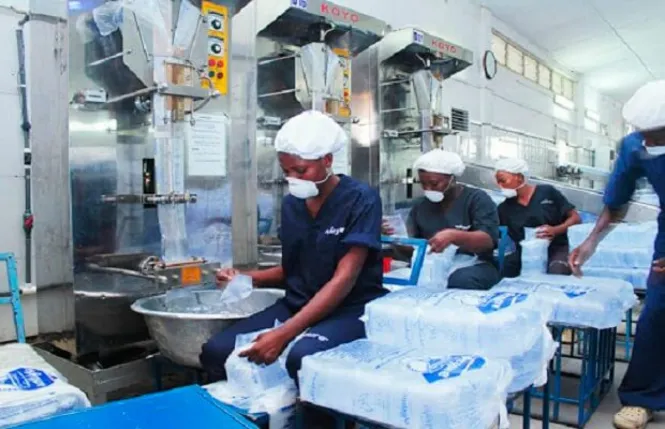
The producer buys raw water (from a borehole, well, or Ghana Water Company Limited supply), treats it (filtration, reverse osmosis, UV or ozone treatment), seals it into plastic sachets, packs the sachets into larger plastic bags (typically 20–30 sachets per bag), and sells to distributors or directly to retailers.
Revenue mechanics:
-
Producer sells a bag of 30 sachets for GHS 4.50–6.00
-
Per-sachet selling price: 15–20 Gp
-
Per-sachet production cost: 5–12 Gp
-
Gross margin per sachet: 3–15 Gp
Example economics (small producer, 10,000 sachets/day):
| Item | Amount (GHS) |
|---|---|
| Daily revenue (10,000 sachets @ 18 Gp) | 1,800 |
| Daily production cost (10,000 @ 10 Gp) | 1,000 |
| Daily gross profit | 800 |
| Monthly gross profit (25 production days) | 20,000 |
| Monthly overheads (rent, labour, transport, etc.) | 6,000–10,000 |
| Monthly net profit | 10,000–14,000 |
A small producer clears GHS 10,000–15,000 monthly net. That is excellent income by Ghanaian small business standards — better than most retail shops, better than a mid-level manager’s salary.
Why then do so many fail? Because the numbers above assume steady production, steady sales, and no major equipment failure. In reality, producers face:
-
Unpredictable water quality (treatment system clogs, membranes fail)
-
Packaging material shortages (imported polyethylene film)
-
Power cuts (treatment and sealing require electricity)
-
Price wars (neighbouring producer drops price by 2 Gp)
When any of these hit, the thin margin disappears.
Model 2: Wholesale Distribution
The wholesaler buys from multiple producers (often small producers without their own distribution networks), consolidates, and sells to retailers (provision shops, street vendors, kiosks, transport terminals).
Revenue mechanics:
-
Buys a bag of 30 sachets for GHS 4.50–5.50
-
Sells to retailer for GHS 5.50–7.00
-
Wholesale margin: GHS 1.00–1.50 per bag (15–25%)
-
Typical daily volume: 500–2,000 bags
Monthly net profit for a serious wholesaler: GHS 8,000–20,000.
The wholesaler’s advantage is working capital and logistics — not production. Many successful water wholesalers started as producers, struggled with equipment maintenance, and pivoted to distribution only.
Model 3: Retail
The retailer — a provision shop, a table by the roadside, a woman carrying a cooler on her head — buys sachets and sells them individually.
Revenue mechanics:
-
Buys a bag of 30 sachets for GHS 5.50–7.00
-
Buys per-sachet cost: 18–23 Gp
-
Sells per sachet: 30–50 Gp
-
Per-sachet retail margin: 7–27 Gp (25–55%)
The retailer makes the highest percentage margin but the lowest absolute profit per unit. A busy street vendor selling 300 sachets daily at 30 Gp each:
-
Daily revenue: GHS 90
-
Cost of goods (300 @ 20 Gp): GHS 60
-
Daily gross profit: GHS 30
-
Monthly net (after spoilage, ice, transport): GHS 600–800
Not a fortune. But for a woman with limited capital, it is steady, daily cash.
The Critical Insight
The sachet water value chain is reverse margined: the smallest operators (retailers) make the highest percentage margin but the lowest absolute profit. The largest operators (producers) make the lowest percentage margin but the highest absolute profit. The sweet spot for an aspiring entrepreneur is wholesale distribution — decent margin, decent volume, no production headaches.
MARKET POSITION & COMPETITION
Why Sachet Water Survives (and Thrives)
Three structural factors make sachet water immune to disruption:
1. The Tap Water Problem
Ghana’s piped water is unreliable. In many neighbourhoods, it runs twice a week. When it runs, it is not always safe to drink. Boiling takes time and fuel. Filters cost money. Sachet water is instant, safe, and cheaper than any alternative except unsafe tap water.
2. The Portability Premium
A sachet fits in a pocket. A bottle does not. For the Accra office worker buying water at a trotro station, for the market trader who cannot leave her stall, for the schoolchild with no water fountain — the sachet is the only practical option.
3. The Cash Velocity Advantage
Sachet water is purchased with coins. In Ghana’s cash-heavy economy, coins are often useless elsewhere (trotro fares are now GHS 2+, shops refuse 5 Gp coins). But sachet water vendors accept any coin. They are, in effect, the last liquidity providers for small-denomination currency.
Competitive Landscape
| Competitor | Price Point (500ml equivalent) | Market Share (by volume) | Strengths | Weaknesses |
|---|---|---|---|---|
| Sachet water (all brands) | 30–50 Gp | 85–90% of packaged water | Cheap, ubiquitous, portable | Plastic waste, quality inconsistency |
| PET bottled water | GHS 1.50–3.00 | 8–12% | Prestige, resealable, perceived quality | Expensive, heavier, larger |
| Household filtration (e.g., Pureit, tabletop filters) | ~5 Gp per litre (amortised) | 1–2% (but growing) | Cheaper long-term, no plastic | High upfront cost, maintenance |
| Boiled tap water | ~2–3 Gp per litre (fuel cost) | Negligible (formal market) | Cheapest | Fuel cost, time, taste |
Sachet water competes primarily against nothing — because nothing else offers safe drinking water at scale for 30 pesewas.
Market Share by Brand (Estimated)
-
Voltic (Coca-Cola): 8–12%
-
Everpure: 4–7%
-
Special Ice: 3–5%
-
Bel-Aqua: 2–4%
-
Standard Water: 2–3%
-
All other brands (thousands): 70–80%
No single brand dominates because water is a low-differentiation product and price is the primary purchase driver. Brand loyalty is minimal. A consumer buys whichever sachet the vendor has that is coldest.
COST STRUCTURE & UNIT ECONOMICS
Production Cost Breakdown (Per Sachet, Medium Producer)
| Cost Component | Amount (Gp) | % of Production Cost |
|---|---|---|
| Raw water (borehole/GWCL) | 0.5–1.5 | 5–15% |
| Electricity (pumping, treatment, sealing) | 1.5–3.0 | 15–30% |
| Polyethylene film (the sachet material) | 3.0–5.0 | 30–45% |
| Treatment chemicals (chlorine, alum, etc.) | 0.5–1.0 | 5–10% |
| Labour | 1.0–2.0 | 10–20% |
| Maintenance (membranes, seals, UV lamps) | 0.5–1.0 | 5–10% |
| Packaging bag (30-sachet outer bag) | 0.3–0.5 per sachet | 3–5% |
| Transport to distributors | 0.5–1.5 | 5–15% |
| Total production cost | 8–15 Gp | 100% |
The Plastic Cost Trap
Polyethylene film is the single largest cost — and it is imported. Most sachet producers buy rolls of film from local distributors who import from China, India, or the Middle East. When the cedi falls against the dollar, film prices rise immediately. Producers must either:
-
Raise prices (risking customers switching to a cheaper competitor)
-
Absorb the increase (shrinking already thin margins)
-
Use thinner film (risking leaks and quality complaints)
Many choose the third option. That is why sachets seem leakier during cedi crises.
Sensitivity Analysis
A 10% increase in film price (driven by a 5% cedi depreciation) increases total production cost by 3–4.5%. On a 10 Gp production cost, that is 0.3–0.45 Gp per sachet. At a production volume of 50,000 sachets/day, that is an extra GHS 150–225 per day — GHS 3,750–5,625 per month. For a medium producer, that is the difference between profit and loss.
DIGITAL STRATEGY & INNOVATION
The sachet water industry is technologically conservative — but not static.
Adoption of Digital Tools
| Tool | Adoption Rate | Purpose |
|---|---|---|
| Mobile money (MoMo) payments | 30–40% of wholesalers | Receiving payments from retailers |
| WhatsApp ordering | 20–30% | Retailers sending orders to producers |
| Simple inventory apps | 5–10% | Tracking daily production and sales |
| Automated production lines | 15–20% of medium/large | Higher speed, lower labour cost |
Notable Innovations
Solar-powered production: A handful of producers — mostly in the north, where sunshine is abundant and grid power is unreliable — have installed solar panels to run treatment and sealing. The upfront cost is high (GHS 100,000–300,000) but the monthly diesel savings are substantial. Payback period: 3–5 years.
QR code tracking: Some larger producers (Voltic, Everpure) have experimented with QR codes on sachet bags for quality tracing and consumer feedback. Adoption is minimal; consumers do not care.
Returnable bag systems: A few environmentally conscious producers offer a deposit-return system for the outer bag (the 30-sachet plastic bag). Retailers return empty bags for a small credit. The model has not scaled.
What Has Not Worked
Direct-to-consumer sachet delivery. Attempts to deliver sachet water to households on subscription have failed. Why? Because sachets are too cheap to justify delivery cost. A household paying GHS 100 per month for sachet water is not worth a delivery driver’s time.
E-commerce integration. You cannot sell a 30 Gp product profitably on Jumia or Tonaton. The commission alone exceeds the margin.
CHALLENGES & RISKS
1. The Plastic Waste Problem
This is not primarily an environmental concern for the industry — it is a regulatory and public relations risk. The government has threatened plastic bag bans multiple times (2017, 2019, 2022). Each time, the industry mobilised to argue that there is no alternative packaging at the same price point. So far, the bans have not materialised.
But the pressure is growing. A future government could impose an eco-levy on plastic sachets, raise the price, and shrink demand. Producers are aware but have no cost-effective alternative.
2. Water Quality Scandals
Every few years, the Food and Drugs Authority (FDA) shuts down dozens of producers for poor water quality. In 2022, 48 producers were closed in Greater Accra alone. The reputational damage spills over to the entire industry. Consumers cannot distinguish a safe sachet from an unsafe one by looking.
3. Electricity
Water treatment and sachet sealing are electricity-intensive. When power fails, production stops. Unlike cold stores, water producers cannot simply start a generator — the electrical load is higher, and many small producers cannot afford a generator large enough for their entire production line. They lose production hours, not just margin.
4. Price Wars
Because water is undifferentiated, competition is almost entirely on price. In any neighbourhood with multiple producers, a price war is inevitable. A producer reducing the bag price by 50 Gp forces neighbours to match. Margins collapse. Some producers survive; many do not.
5. Municipal Water Access
Producers who rely on Ghana Water Company Limited (GWCL) supply face unpredictable water cuts. Producers with their own boreholes have an advantage — but boreholes require permits, and groundwater quality varies by location.
6. Labour Availability
Sachet production requires workers to manually pack sachets into outer bags (though automated packing machines exist, most small producers cannot afford them). Labour is available but not always reliable. Workers leave for slightly higher pay elsewhere. The constant churn affects quality.
7. Raw Material Import Dependency
Polyethylene film, treatment membranes, UV lamps, sealing machine parts — almost everything except water and labour is imported. Cedi depreciation hits the industry harder than almost any other FMCG sector because water’s retail price cannot rise easily. Consumers will not pay 50 Gp for a sachet that cost 30 Gp yesterday.
ECONOMIC & INDUSTRY IMPACT
Employment
| Role | Estimated Number of Workers |
|---|---|
| Production workers | 30,000–50,000 |
| Wholesale distributors | 10,000–15,000 |
| Retail vendors (sachet sellers) | 100,000–150,000 |
| Transport/delivery | 15,000–20,000 |
| Packaging material supply chain | 5,000–8,000 |
| Total direct employment | 160,000–243,000 |
This is larger than Ghana’s formal manufacturing sector workforce. Sachet water is, by headcount, one of the largest employers in the country.
Contribution to Public Health
The shift from unsafe drinking water to sachet water has probably saved more lives than any government health programme in the past twenty years. Before sachets became ubiquitous, waterborne diseases (cholera, typhoid, guinea worm) were far more common. Sachet water is not perfect — quality varies — but it is overwhelmingly safer than untreated well or surface water.
Government Revenue
The sachet water industry contributes to government revenue through:
-
Corporate income tax (larger, registered producers)
-
Personal income tax (salaried workers in larger operations)
-
VAT (registered producers charge VAT; many do not)
-
FDA registration fees
-
GWCL water bills
-
Import duties (polyethylene film, machinery)
However, most of the industry — particularly small and medium producers — operates in the tax shadow. The majority of transactions (wholesale and retail) are entirely cash-based and unreported. The government collects a fraction of the economic value generated.
FUTURE OUTLOOK
Short-to-Medium Term (1–5 years)
The industry will consolidate. Rising production costs (electricity, imported film, labour) will push small producers out. Those who survive will:
-
Invest in automated packing (reducing labour cost)
-
Drill their own boreholes (reducing GWCL dependency)
-
Install solar for pumping (reducing electricity costs)
-
Build brand recognition (moving beyond pure price competition)
Long-Term (5–10+ years)
Three scenarios will shape the industry:
Scenario 1: The Plastic Ban (Probability: 30%)
Government bans single-use plastic sachets. The industry collapses overnight unless an alternative emerges. Possible alternatives: biodegradable film (2–3x current cost, unproven at scale), paper-based sachets (leaks), or a return to bottled water (expensive). The most likely outcome: widespread non-compliance, selective enforcement, and a black market for banned sachets.
Scenario 2: The Household Filter Takeover (Probability: 20%)
Affordable household water filters (GHS 100–300, lasting 12–24 months) become common in low-income households. Sachet demand falls by 40–60%. The industry shrinks to serve only out-of-home consumption (commuters, street buyers, events).
Scenario 3: The Status Quo Extended (Probability: 50%)
No major disruption. Sachet water remains the primary drinking water source for most Ghanaians. The industry grows with population (2–3% annually) but per capita consumption plateaus. This is the most likely outcome — not because it is optimal, but because structural change is expensive and politically difficult.
Strategic Risks to Monitor
-
Municipal water improvements: If Accra’s water supply becomes reliable and safe, sachet demand will fall. This is unlikely within 10 years.
-
Cedi stability: Persistent depreciation will eventually push sachet prices above 50 Gp, at which point some consumers switch to boiling tap water.
-
FDA enforcement: Stricter quality control could close thousands of small producers, accelerating consolidation.
THSB CONCLUSION
Sachet water is not a beautiful business. It is not innovative. It does not attract impact investors or development bank loans. Its environmental footprint is a national disgrace. And yet — it is one of the most important cash businesses in Ghana.
Why? Because it solved a problem that the state could not. For less than the price of a single egg, a Ghanaian can buy safe drinking water anywhere, at any time, in a package that fits in a palm. That is not a miracle. That is economics. Low margins, high velocity, and a distribution network that reaches every corner of the country.
The industry will change. Consolidation will come. Plastic bans may arrive. But the underlying need — safe, affordable, portable water — will not disappear. Whoever solves that next will inherit the cash flow that sachet producers built.
Until then, the freezers at the cold store and the sachets at the roadside stall share something important: they are invisible, essential, and quietly very profitable.
FAQ SECTION
1. Why is sachet water such a big business in Ghana?
Because safe, affordable drinking water is not available from taps. Sachet water fills the gap at a price (30 Gp) that almost any Ghanaian can afford. The industry moves GHS 2.5–3.5 billion annually — larger than many formal sectors.
2. How much does it cost to produce one sachet of water in Ghana?
Production cost ranges from 5 Gp to 12 Gp per sachet, depending on scale, water source, packaging material costs, and electricity. The largest cost is the polyethylene film (3–5 Gp per sachet).
3. How much profit does a sachet water producer make?
A small producer (10,000 sachets/day) can net GHS 10,000–15,000 monthly. A medium producer (30,000–50,000 sachets/day) nets GHS 25,000–50,000 monthly. A large producer (100,000+ sachets/day) nets GHS 80,000–200,000 monthly — but requires significant capital.
4. Why do so many sachet water businesses fail?
Failure is common (40–50% within three years) due to: thin margins that cannot absorb cost shocks (electricity, film prices, cedi depreciation), equipment breakdowns, price wars with neighbours, and quality enforcement closures by the FDA.
5. Do I need a license to produce sachet water in Ghana?
Yes. The Food and Drugs Authority (FDA) requires registration and regular quality testing. The Ghana Water Company Limited (for municipal supply) or Water Resources Commission (for boreholes) also permits. Many small producers operate without proper licenses, but this is illegal and risky.
6. What is the minimum capital to start a sachet water business?
A small tabletop operation (500–3,000 sachets/day) can start with GHS 20,000–35,000. A proper small producer (10,000 sachets/day) needs GHS 60,000–100,000 for equipment, initial stock, and working capital.
7. How does the cedi exchange rate affect sachet water profits?
Strongly. Polyethylene film and treatment materials are imported. When the cedi falls, input costs rise. Producers cannot easily raise retail prices (consumers are price-sensitive), so margins shrink or vanish.
8. Is sachet water safe to drink in Ghana?
Mostly, but not always. The FDA regularly shuts down producers with poor water quality. Consumers cannot tell safe from unsafe by looking. Buying from established brands (Voltic, Everpure, etc.) reduces risk but does not eliminate it.
9. Will the government ban plastic sachets?
The government has threatened bans multiple times but has not acted. A ban is possible but would face massive enforcement challenges and public backlash without an affordable alternative. Biodegradable sachets cost 2–3x more.
10. How do sachet water distributors make money?
Distributors buy bags of 30 sachets from producers (GHS 4.50–5.50) and sell to retailers (GHS 5.50–7.00). A busy distributor moving 1,000 bags daily nets GHS 500–1,500 per day in gross margin, or GHS 8,000–20,000 monthly net.
11. What is the future of sachet water in Ghana?
Consolidation. Small producers will close or be acquired. Large producers will gain market share. The biggest long-term threats are: a plastic ban, affordable household water filters, and improved municipal water supply.
12. How does sachet water compare to bottled water as a business?
Sachet water has lower margins but much higher volumes. Bottled water has higher margins but lower volumes. Sachet water serves the mass market (90%+ of packaged water volume). Bottled water serves middle- and upper-income consumers. Both can be profitable, but sachet water generates more absolute profit for larger operators due to volume.
Source: The High Street Business
Disclaimer: Some content on The High Street Business may be aggregated, summarized, or edited from third-party sources for informational purposes. Images and media are used under fair use or royalty-free licenses. The High Street Business is a subsidiary of SamBoad Publishing under SamBoad Business Group Ltd, registered in Ghana since 2014.
For concerns or inquiries, please visit our Privacy Policy or Contact Page.

Samuel Kwame Boadu is a Ghanaian entrepreneur, writer, and digital consultant passionate about creating impactful stories and business solutions. He is the Founder & CEO of SamBoad Business Group Ltd, a dynamic company with subsidiaries in digital marketing, logistics, publishing, and risk management.