






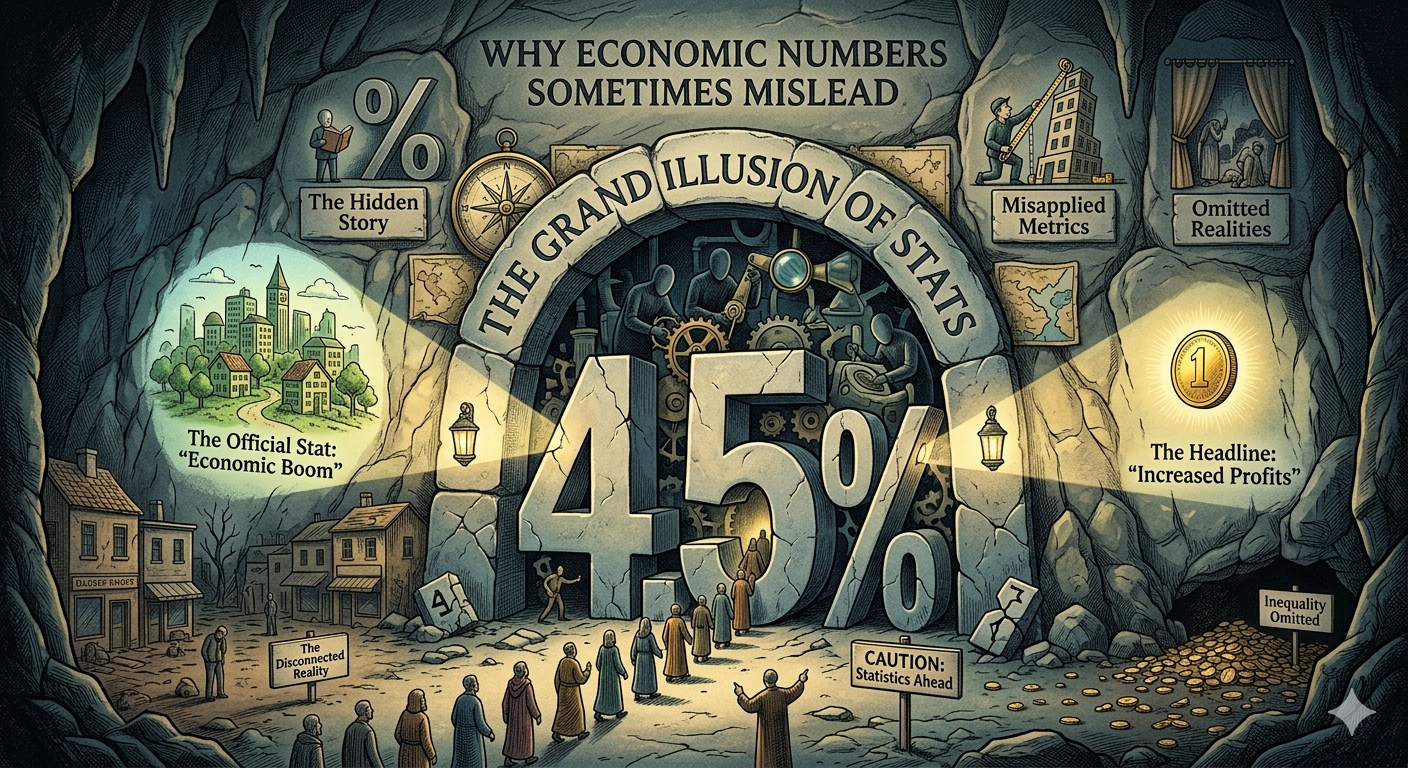
Why Economic Numbers Sometimes Mislead – Economic statistics are useful, but they do not always tell the full story. Learn why economic numbers can sometimes mislead and what they mean for Ghana’s economy and everyday life.
Why Economic Numbers Sometimes Mislead
Economic data shape headlines, guide policy decisions, and influence investment choices. Figures such as GDP growth, inflation, unemployment, and exchange rates are widely used to assess the health of an economy.
Yet numbers do not always capture the full reality on the ground. A country may record strong growth while many households still struggle with high living costs. Inflation may slow, but prices can remain elevated. The cedi may stabilise, while some businesses continue to face difficult operating conditions.
📢 GET DETAILED ARTICLES + JOBS
Join THSB's WhatsApp Channel and never miss a post or opportunity.
In Ghana, understanding what economic numbers do—and do not—reveal is essential for interpreting the true state of the economy.
Numbers Provide Signals, Not the Full Story
Economic indicators are important tools, but they are summaries of complex realities. A single statistic condenses millions of transactions, decisions, and experiences into one figure. While this helps analysts compare trends over time, it can overlook important details such as income inequality, regional differences, and sector-specific challenges.
Numbers are best viewed as indicators rather than complete descriptions of economic wellbeing.
GDP Growth Does Not Guarantee Better Living Standards
Gross Domestic Product (GDP) measures the total value of goods and services produced in an economy. Strong GDP growth may suggest the economy is expanding, but it does not automatically mean everyone benefits.
Growth can be concentrated in sectors such as mining or oil, while unemployment remains high in other areas. If incomes do not rise broadly, many households may not feel the impact of headline growth figures.
Lower Inflation Does Not Mean Prices Are Falling
Inflation measures the pace at which prices are increasing. When inflation declines, prices are still rising, but at a slower rate. This distinction is often misunderstood.
For example, if inflation falls from 25% to 15%, the cost of living is still increasing; the rate of increase has simply moderated. Families may continue to feel pressure even as inflation statistics improve.
Exchange Rate Stability May Mask Underlying Pressures
A stable Ghanaian cedi is generally a positive sign, but it does not necessarily reflect all economic conditions. Businesses may still face high borrowing costs, weak consumer demand, or supply chain constraints. Currency stability is one important indicator, but it is only part of the broader picture.
National Averages Hide Individual Experiences
Economic figures are often presented as national averages. However, average outcomes can conceal significant differences between urban and rural communities, large and small businesses, and high- and low-income households.
An improving economy may benefit some groups more quickly than others, which is why lived experiences can differ from headline statistics.
Revisions Can Change the Picture
Economic data are frequently revised as more complete information becomes available. Initial estimates may later be adjusted upward or downward. This is common with GDP, trade figures, and employment statistics.
As a result, early data should be interpreted with caution rather than treated as final.
Timing Differences Matter
Economic statistics are often released weeks or months after the underlying activity occurs. By the time a figure is published, conditions may already have changed. Businesses and households can therefore experience trends before they appear in official reports. This lag is one reason why perceptions and official numbers may not always align.
Numbers Depend on Measurement Methods
Statistics are shaped by methodologies, assumptions, and data quality. Changes in survey methods, updated base years, or improved data collection can alter results without necessarily reflecting a sudden shift in real-world conditions.
The Ghana Statistical Service continually refines its methods to improve accuracy, but no measurement system is perfect.
Sentiment and Confidence Are Hard to Quantify
Some of the most important economic factors are not fully captured by standard statistics. Business confidence, consumer sentiment, and expectations about the future influence spending, investment, and hiring decisions. These softer indicators can shape economic outcomes even when headline data appear strong.
Why Context Matters
Economic numbers are most useful when interpreted alongside other indicators and real-world conditions. To understand Ghana’s economy, analysts typically examine:
- GDP growth
- Inflation
- Employment trends
- Exchange rate movements
- Public finances
- Business and consumer confidence
- Poverty and living standards
Looking at these measures together provides a more balanced assessment.
What This Means for Ghana
Ghana’s economy may show improvement in some indicators while challenges persist in others. Inflation may ease while borrowing costs remain high. GDP may grow while some sectors recover more slowly. Fiscal conditions may strengthen even as households continue to adjust to earlier price increases. This does not mean the numbers are wrong; it means they require careful interpretation.
The THSB Bottom Line
Economic statistics are essential for understanding trends, but they do not tell the entire story. For Ghana, headline figures such as GDP growth and inflation provide valuable insights, yet the real test of progress is whether living standards improve, jobs are created, and businesses thrive.
Numbers are powerful tools, but they are most meaningful when combined with context, experience, and a broader view of the economy.
Source: The High Street Business
Disclaimer: Some content on The High Street Business may be aggregated, summarized, or edited from third-party sources for informational purposes. Images and media are used under fair use or royalty-free licenses. The High Street Business is a subsidiary of SamBoad Publishing under SamBoad Business Group Ltd, registered in Ghana since 2014.
For concerns or inquiries, please visit our Privacy Policy or Contact Page.

Esther Aku-Sika is a content writer and social media strategist who helps brands and startups grow through intentional storytelling and practical marketing strategies. With a keen eye for trends and audience behavior, she shares business insights, content strategies, and real-life lessons to help entrepreneurs build visibility and turn ideas into income. Through her writing, she simplifies complex concepts and equips readers with actionable steps to grow in today’s digital space.