







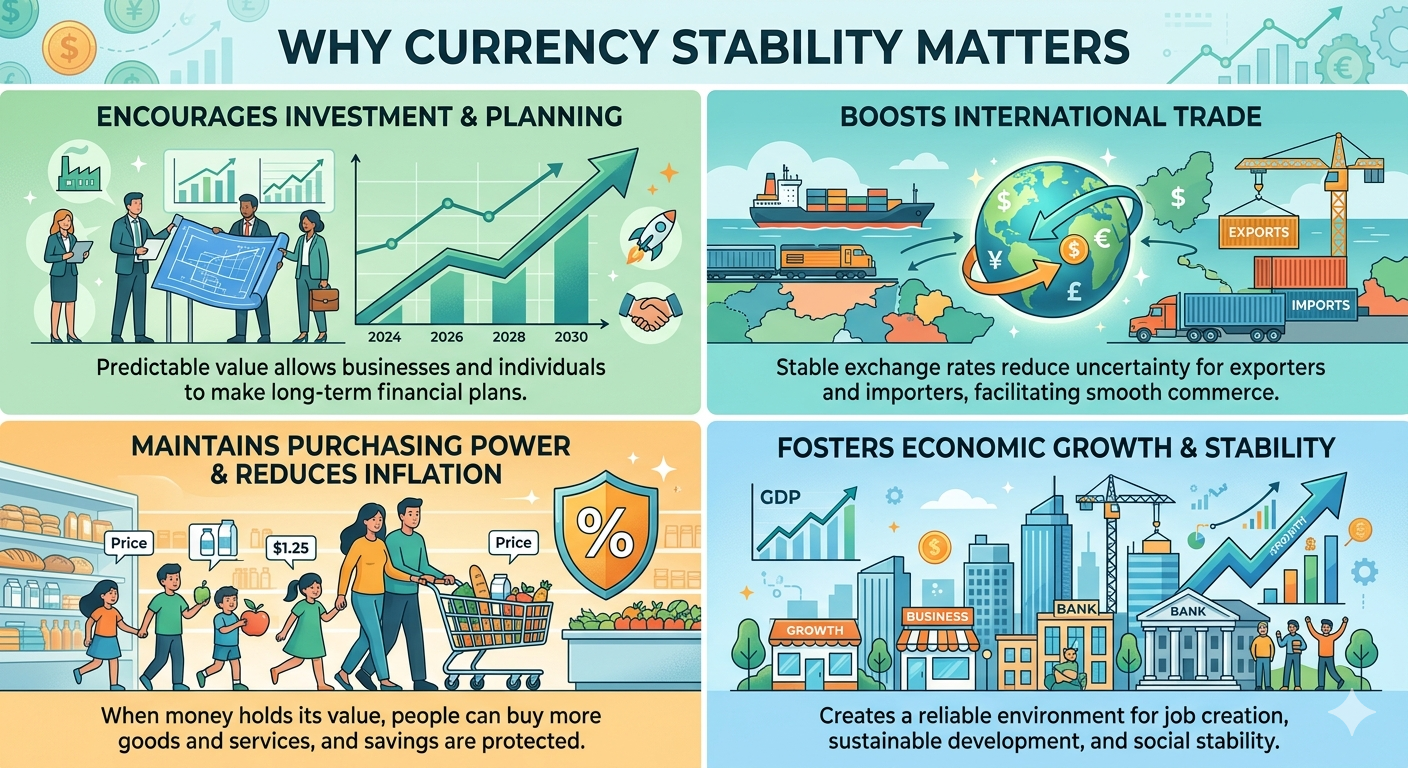
Why Currency Stability Matters – Currency stability affects inflation, trade, investment, and the cost of living. Here’s why a stable Ghana cedi is important for businesses, households, and the economy.
Why Currency Stability Matters
Currency stability plays a major role in the health of every economy. In Ghana, the performance of the cedi affects everything from food prices and fuel costs to imports, investments, and business confidence.
When a currency remains relatively stable, businesses and consumers can plan more effectively. But when exchange rates fluctuate sharply, uncertainty increases across the economy. This is why policymakers, investors, and households closely monitor the value of the Ghana cedi.
📢 GET DETAILED ARTICLES + JOBS
Join THSB's WhatsApp Channel and never miss a post or opportunity.
What Is Currency Stability?
Currency stability refers to a situation where the value of a country’s currency does not experience extreme or unpredictable fluctuations over a short period. A stable currency helps:
- Businesses plan costs and investments
- Consumers manage household budgets
- Investors maintain confidence in the economy
- Governments control inflation pressures
In Ghana, the stability of the cedi is closely linked to overall economic confidence.
Currency Stability and Inflation
One of the biggest reasons currency stability matters is its impact on inflation. Ghana imports many products, including:
- Fuel
- Machinery
- Medicines
- Food products
- Industrial materials
When the cedi weakens significantly against foreign currencies, imported goods become more expensive. Businesses often pass these higher costs on to consumers, leading to rising prices across the economy. A more stable currency can help slow imported inflation and reduce pressure on household spending.
Impact on the Cost of Living
Currency movements directly affect the daily lives of ordinary people. When the cedi loses value:
- Food prices may increase
- Transport costs can rise
- Utility and fuel expenses may go up
- Imported goods become less affordable
For households already facing financial pressure, currency instability can make managing everyday expenses even more difficult.
Why Businesses Need Currency Stability
Businesses rely on stable exchange rates for planning and operations. Many companies in Ghana import:
- Raw materials
- Equipment
- Spare parts
- Consumer products
Sharp currency fluctuations can create uncertainty around:
- Production costs
- Profit margins
- Pricing strategies
- Investment decisions
Stable exchange rates allow businesses to forecast expenses more accurately and operate with greater confidence.
Effects on Investment Confidence
Investors closely monitor the strength and stability of a country’s currency. A stable currency can:
- Encourage foreign investment
- Improve confidence in the economy
- Reduce financial risks
- Support long-term business planning
However, persistent currency volatility may make investors cautious because it increases uncertainty about returns and operating costs.
Trade and Export Competitiveness
Currency stability also affects international trade. A weaker currency can sometimes make exports more competitive because locally produced goods become cheaper for foreign buyers.
However, excessive currency weakness can also:
- Increase import costs for businesses
- Raise production expenses
- Create broader economic instability
Finding the right balance is important for sustainable trade growth.
The Role of the Central Bank
In Ghana, the Bank of Ghana plays a key role in maintaining currency stability. The central bank may use:
- Interest rate policies
- Foreign exchange interventions
- Inflation control measures
- Monetary policy adjustments
to manage economic pressures affecting the cedi. These policies are often aimed at improving investor confidence and controlling inflation.
Global Factors Also Matter
Currency stability is not influenced only by domestic conditions. Global economic trends can also affect the cedi. These may include:
- Rising global fuel prices
- Changes in interest rates abroad
- Commodity price movements
- International financial market conditions
As a result, external economic shocks can influence exchange rate performance even when domestic policies remain stable.
Why Stability Supports Economic Growth
A stable currency creates a more predictable environment for:
- Businesses
- Consumers
- Investors
- Policymakers
This can support:
- Increased investment
- Better financial planning
- Lower inflation pressures
- Stronger economic confidence
Over time, currency stability contributes to broader economic growth and resilience.
THSB Conclusion
Currency stability matters because it affects nearly every part of the economy—from inflation and business operations to household spending and investor confidence.
In Ghana, maintaining a stable cedi remains important for controlling living costs, supporting businesses, and strengthening economic growth. While global and domestic challenges can influence exchange rates, stable currency management is often seen as a key foundation for long-term economic stability.
Source: The High Street Business
Disclaimer: Some content on The High Street Business may be aggregated, summarized, or edited from third-party sources for informational purposes. Images and media are used under fair use or royalty-free licenses. The High Street Business is a subsidiary of SamBoad Publishing under SamBoad Business Group Ltd, registered in Ghana since 2014.
For concerns or inquiries, please visit our Privacy Policy or Contact Page.

Esther Aku-Sika is a content writer and social media strategist who helps brands and startups grow through intentional storytelling and practical marketing strategies. With a keen eye for trends and audience behavior, she shares business insights, content strategies, and real-life lessons to help entrepreneurs build visibility and turn ideas into income. Through her writing, she simplifies complex concepts and equips readers with actionable steps to grow in today’s digital space.