







How Interest Rates Affect Everyday Ghanaians – How do interest rates affect your daily life in Ghana? From loans and savings to prices and jobs, here’s a clear guide to what interest rates really mean for you.
How Interest Rates Affect Everyday Ghanaians
Interest rates often sound like something reserved for economists, bankers, or policymakers sitting in air-conditioned offices. But in reality, they quietly shape the daily decisions of millions of Ghanaians: from the price of food at Makola Market to the cost of a mobile money loan.
At the centre of it all is the Bank of Ghana, which adjusts interest rates to control inflation and stabilise the economy. But what does that mean for the ordinary Ghanaian trying to make ends meet?
📢 GET DETAILED ARTICLES + JOBS
Join THSB's WhatsApp Channel and never miss a post or opportunity.
Let’s break it down in simple, human terms.
What Are Interest Rates, Really?
In the simplest sense, interest rates are the cost of borrowing money, or the reward for saving it. When you take a loan from a bank, the interest rate determines how much extra you’ll pay back. When you save money, it determines how much your money grows over time.
In Ghana, the most important rate is the policy rate set by the central bank. This rate influences how commercial banks set their own lending and savings rates. So when the central bank raises or lowers rates, it sets off a chain reaction across the economy.
READ ALSO: What Interest Rates Changes Mean.
Why Do Interest Rates Change in Ghana?
Interest rates in Ghana often rise or fall depending on inflation: that steady increase in the price of goods and services. When inflation is high, the central bank typically increases interest rates to reduce spending and stabilise prices. When inflation begins to ease, rates may be lowered to encourage borrowing and economic activity.
In recent years, Ghana has seen periods of high inflation, prompting aggressive rate hikes to control rising prices and stabilise the cedi. But these decisions, while necessary, come with real consequences for households and businesses.
Loans Become More Expensive
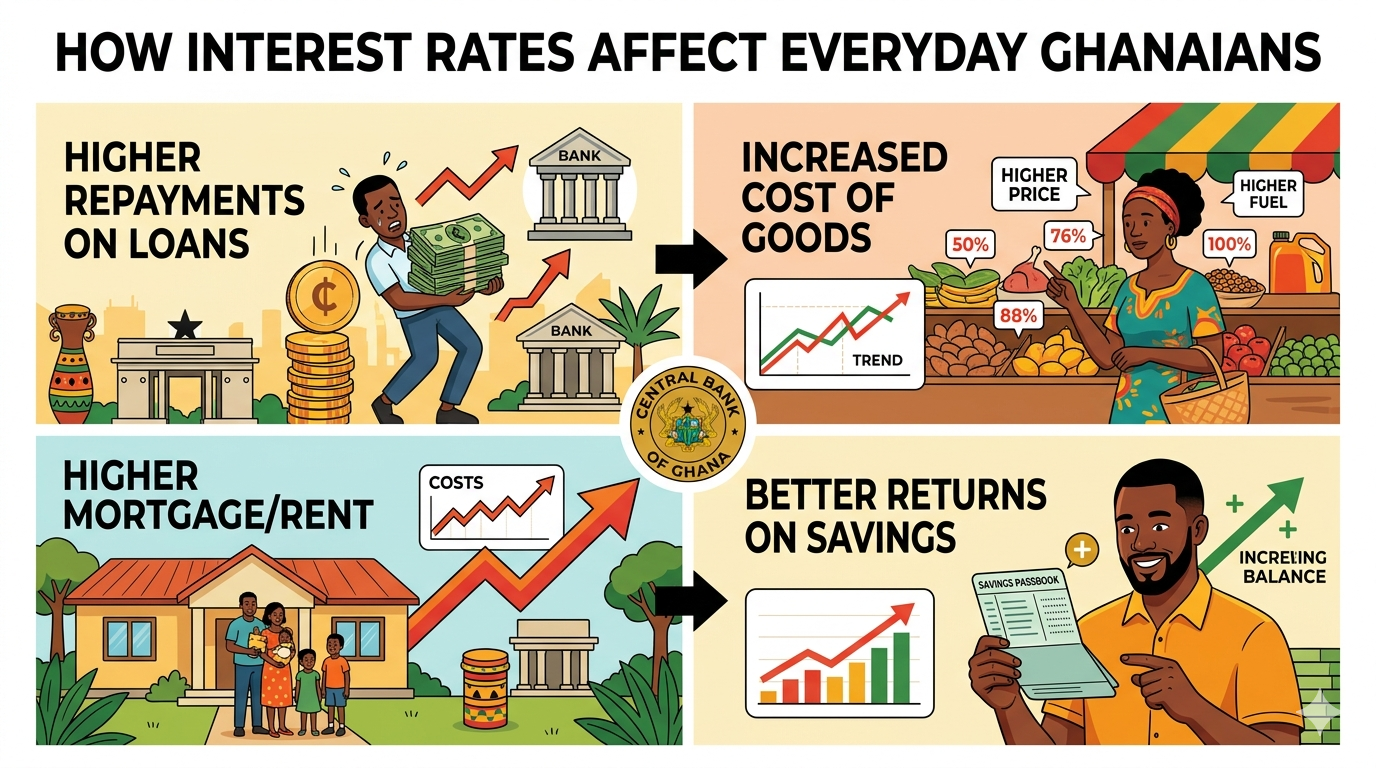
For many Ghanaians, the most immediate impact of rising interest rates is felt through loans. Whether it’s a personal loan, car loan, mortgage, or even mobile lending apps Higher interest rates mean higher monthly repayments.
For small business owners, from tailors to food vendors, this can be especially challenging. Accessing credit becomes more expensive, and in some cases, completely out of reach. This often leads to slower business expansion, reduced hiring, and sometimes even closures.
Savings Can Grow, But Slowly
On the flip side, higher interest rates can benefit savers. Banks may offer slightly better returns on savings accounts and fixed deposits when rates rise. This can encourage people to save rather than spend.
However, in Ghana, the reality is often more complex. Even when savings interest increases, it may not keep up with inflation. This means that while your money is growing on paper, its real value, what it can actually buy, may still be shrinking.
The Cost of Living Still Feels the Pressure
Interest rates and the cost of living are deeply connected. When borrowing becomes expensive:
- Businesses face higher costs
- Production slows
- Prices of goods and services can remain high
For everyday Ghanaians, this shows up in: food prices, transport fares, rent and School fees. Even if inflation begins to fall, the effects of earlier high interest rates can linger, keeping financial pressure on households.
Jobs and Business Growth Are Affected
Interest rates don’t just affect individuals, they influence the entire job market. When rates are high:
- Businesses are less likely to take loans
- Expansion plans are delayed
- Hiring slows down
This can lead to fewer job opportunities, especially for young people entering the workforce.
On the other hand, when rates are reduced, businesses may begin to borrow again, invest, and create jobs, though this process often takes time.
The Impact on the Ghana Cedi
Interest rates also play a role in stabilising the Ghanaian currency. Higher rates can attract foreign investors looking for better returns, which can help strengthen the cedi. A stronger currency can reduce the cost of imports, including fuel and food.
However, if rates are too high for too long, they can slow economic growth, creating a delicate balancing act for policymakers.
RELATED: Why Inflation Is Falling In Ghana.
What It Means for Everyday Decisions
For the average Ghanaian, interest rates shape everyday choices more than we often realise. They influence: whether to take a loan or delay it, whether to save or spend and whether to invest in a business or hold back. In times of high interest rates, many households tighten their budgets, prioritise essentials, and avoid new financial commitments.
A Balancing Act for the Economy
Managing interest rates is never straightforward. The Bank of Ghana must balance: controlling inflation, supporting economic growth and stabilising the currency. Each decision has trade-offs, and its effects are felt differently across society. For a salaried worker, it might mean higher loan repayments. For a trader, it might mean reduced customer spending. For a young entrepreneur, it could mean delayed dreams.
THSB Bottom Line
Interest rates may seem like distant economic jargon, but they are deeply personal. They shape how much you pay on loans, how your savings grow, how businesses operate, and even how expensive your daily life becomes.
In Ghana’s evolving economic landscape, understanding interest rates isn’t just for economists, it’s essential for anyone trying to navigate financial decisions with confidence. Because in the end, behind every percentage point change is a real story: of a family adjusting their budget, a business rethinking its future, or a young person deciding what comes next.
Source: The High Street Business
Disclaimer: Some content on The High Street Business may be aggregated, summarized, or edited from third-party sources for informational purposes. Images and media are used under fair use or royalty-free licenses. The High Street Business is a subsidiary of SamBoad Publishing under SamBoad Business Group Ltd, registered in Ghana since 2014.
For concerns or inquiries, please visit our Privacy Policy or Contact Page.

Esther Aku-Sika is a content writer and social media strategist who helps brands and startups grow through intentional storytelling and practical marketing strategies. With a keen eye for trends and audience behavior, she shares business insights, content strategies, and real-life lessons to help entrepreneurs build visibility and turn ideas into income. Through her writing, she simplifies complex concepts and equips readers with actionable steps to grow in today’s digital space.