









How insurance companies in Ghana actually make money – GH¢7.34bn revenue, GH¢1.24bn profit, and GH¢9.2m in daily claims — but only 1% of GDP insured. Our deep‑dive analysis reveals underwriting profit, investment income, the DDEP hangover, and the fraud tax shaping Ghana’s insurance profitability.
Executive Introduction
On paper, the insurance industry in Ghana is a quiet Goliath. Every day, licensed insurers in the country collectively pay out an average of GH¢9.2 million in claims — GH¢5.2 million for general insurance and GH¢4 million for life policies. Between 2020 and 2024, aggregate Profit After Tax (PAT) more than quadrupled, soaring from GH¢293 million to GH¢1.24 billion, representing a compound growth of 324 per cent over just five years. Total industry revenue in 2024 reached GH¢7.34 billion, up 31 per cent from the previous year. In 2025, the industry recorded real revenue growth of 19.9 per cent, more than double the 7.6 per cent achieved in 2024. The financial numbers are impressive. The stability indicators are robust. But the money flows in ways most customers never see.
The mechanics of how insurance companies actually make money are opaque by design. The industry’s core business — the acceptance of premiums and the payment of legitimate claims — is only half the story. The other half is investment income. Ghanaian life insurers invest approximately 42 per cent of their asset portfolios in government securities, and even more in fixed deposits, equities, and property. The Domestic Debt Exchange Programme (DDEP) of 2022–2023 exposed how dangerously reliant the industry had become on government paper. Before the crisis, over 40 per cent of some insurers’ assets were locked in sovereign bonds — and when those bonds were restructured, returns evaporated.
📢 GET DETAILED ARTICLES + JOBS
Join THSB's WhatsApp Channel and never miss a post or opportunity.
This profile goes inside the financial engine room of Ghana’s insurance industry. It explains the three interlocking revenue streams — underwriting profit, investment income, and reinsurance — that determine whether an insurer makes money or loses it. It examines the combined ratio, the single most important metric of operational efficiency, and why a ratio above 100 per cent is not necessarily fatal if investment returns compensate.

It analyses how the product mix shapes profitability, why motor insurance dominates non-life books but carries thin margins, and why microinsurance is promising but structurally challenging. And it concludes with a frank assessment of where the industry is heading: toward digital distribution, telematics, and risk-based pricing — but still constrained by the 1 per cent penetration ceiling that leaves 98 per cent of Ghanaians uncovered.
For the 50 licensed insurers and reinsurers operating in Ghana, the question is not whether the industry can be profitable. It already is. The question is whether it can scale while maintaining that profitability — and whether the 80 per cent of the workforce in the informal sector will ever be brought into the system that so effectively serves the formal economy.
The Two Engines of Insurance Profitability
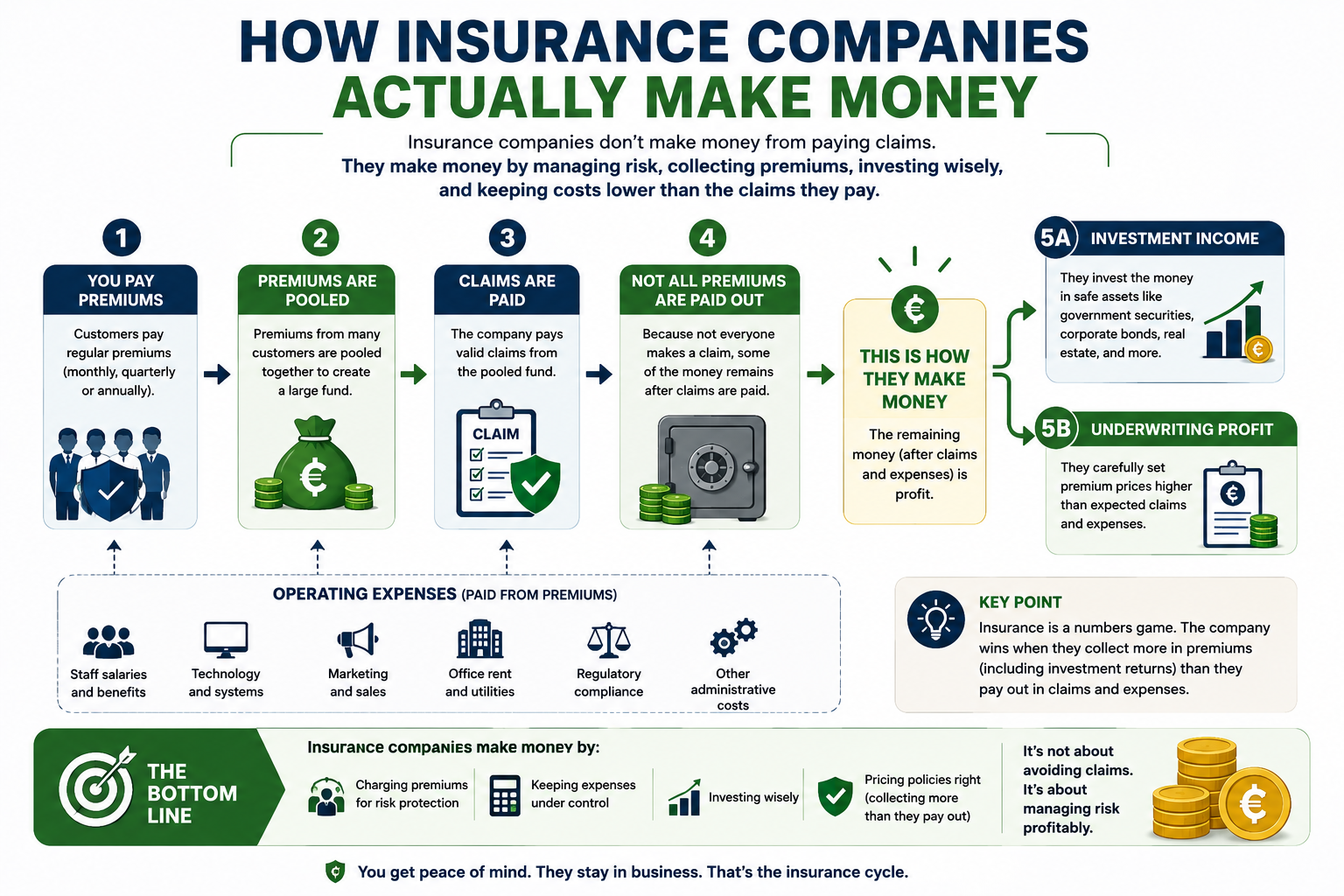
Insurance companies operate on a fundamentally different financial model from banks or investment funds. Their revenue does not come from selling a product in exchange for immediate value. It comes from collecting premiums in advance, holding those funds for a period, paying claims as they arise, and — crucially — investing the float in the meantime.
There are two primary sources of profit: underwriting profit and investment income. Both are essential. Neither alone is sufficient.
Underwriting Profit — The difference between the premiums an insurer collects and the claims and expenses it pays. If an insurer collects GH¢1,000 in premiums, pays GH¢600 in claims, and spends GH¢200 on operating expenses, the underwriting profit is GH¢200. This is the purest measure of an insurer’s competence at pricing and managing risk.
Investment Income — The returns earned on the pool of premiums that has been collected but not yet paid out as claims. This “float” can be substantial. In the life insurance segment, where policies may run for decades, the float accumulates into billions of cedis. In the non-life segment, where policies are shorter, the float is smaller but still significant.
The study of the drivers of profitability in Ghana’s life insurance industry has described investment income as playing a “crucial stabilising role, complementing underwriting profits and enhancing overall financial performance”. The non-life segment, by contrast, benefits from a “relatively healthier earnings structure” in which profitability is driven by both underwriting profits and investment gains.
The distinction matters because the two revenue streams have different risk profiles. Underwriting profit depends on accurate pricing, efficient claims processing, and fraud control — all factors the insurer can directly influence. Investment income depends on external markets — interest rates, bond yields, equity performance, currency stability — factors the insurer cannot control.
In Ghana, where inflation has only recently returned to single digits and the cedi remains volatile, the dependence on investment income is a genuine vulnerability. As the Financial Stability Review has noted, “such dependence underscores potential vulnerabilities to future macroeconomic shocks, reinforcing the need for life insurers to sustain and further strengthen underwriting profitability”.
Underwriting Profit — The Core Business of Risk
At its simplest, underwriting is the art of pricing risk. An insurer estimates the probability and likely cost of a claim, adds a margin for expenses and profit, and sets a premium. If the premium proves sufficient to cover the actual claims and expenses, the insurer makes an underwriting profit. If not, it makes an underwriting loss.

The efficiency of an insurer’s underwriting is measured by the combined ratio — the sum of the claims ratio (claims paid divided by premiums earned) and the expense ratio (operating expenses divided by premiums earned). The combined ratio is “the best measure of an insurer’s underwriting and operational efficiency”. A combined ratio of less than 100 per cent indicates underwriting profitability: the insurer is collecting more in premiums than it is spending on claims and operations. A ratio above 100 per cent signals an underwriting loss, though it may still be offset by investment income.
In 2021, the industry average combined ratio stood at 101 per cent — just above the breakeven line. This represented a significant improvement from 113 per cent in 2020, 123 per cent in 2019, and 142 per cent in 2018. Some insurers consistently outperform this industry average. Activa International posted a combined ratio of 80 per cent in 2021, one of the lowest in the industry. Donewell Insurance recorded 96 per cent. Enterprise Insurance — Ghana’s oldest insurer — achieved 94 per cent, while Ghana Union Assurance came in at 91 per cent. These are not accidents. They are the result of disciplined pricing, strict underwriting criteria, and efficient claims management.
However, the 2021 data predates the full impact of the DDEP and the subsequent inflationary surge. More recent industry data suggests that underwriting discipline remains a challenge. The National Insurance Commission (NIC) has identified “price undercutting in motor and fire classes” as a threat to fair competition and market solvency. When insurers charge premiums below the true cost of risk to win business, they inevitably produce underwriting losses — losses that must be compensated by investment income or risk capital.
The non-life segment, in particular, has struggled with underwriting profitability. The Financial Stability Review notes that the non-life segment’s “reliance on reinsurance for risk transfer implies that a portion of future profitability will be sensitive to global reinsurance pricing cycles”. This means that even well-managed non-life insurers cannot fully control their underwriting margins; they are at the mercy of international reinsurance markets.
Enterprise Insurance provides a revealing case study. In the 2025 financial year, the 102-year-old insurer reported an 11.3 per cent rise in gross written premium and a stellar 73.5 per cent jump in underwriting profit. These numbers suggest a machine operating at peak efficiency. Yet group net income fell 7.8 per cent as soaring actuarial and finance costs ate the profits before they could reach the bottom line. The lesson is that underwriting profit is not net profit. It is the starting point, not the destination.
Profit After Tax Trends (2020–2024)
Period PAT (GH¢ billion) Change
2020 0.293 —
2021 0.480 +64%
2022 0.643 +34%
2023 0.840 +31%
2024 1.240 +48%
Investment Income — The Silent Pillar of Profitability
For many insurers, investment income is not a supplement to underwriting profits — it is the only reason they remain solvent.
Prior to the DDEP, the industry had become dangerously accustomed to earning double-digit returns on government securities with virtually no risk. Pre‑2021 – 2022, insurers could rely on a comfortable, sovereign‑backed investment income stream to compensate for weak underwriting. The restructuring of domestic debt in 2022–2023 shattered that assumption.
The numbers illustrate the scale of the exposure. In 2022, 42 per cent of life insurers’ assets were invested in government securities. The non-life sector was not far behind, with government securities making up the largest share of their assets at 32 per cent in 2024. In the life sector, government securities accounted for 42 per cent, followed by property investments at 21 per cent and bank fixed deposits at 20 per cent. Listed and unlisted equities made up 13.4 per cent of the cumulative total. In the non-life sector, the mix was more diversified: government securities 32 per cent, equities 22.8 per cent, bank deposits 22.3 per cent, and property 16.7 per cent.
When the government announced the DDEP, insurers were forced to exchange high-yielding bonds for lower-yielding instruments with extended maturities. The life sector’s holdings of government securities dropped from 49 per cent of its portfolio in 2022 to 40 per cent in 2023 — a 9 per cent reduction. The non-life sector cut more aggressively, from 38 per cent to 27 per cent, a 13 per cent reduction. But the damage was already done. Investment earnings, once the industry’s “life support”, were severely impaired.
The COVID-19 pandemic and the DDEP together constituted a double shock. The pandemic exposed weaknesses in Ghana’s insurance ecosystem, especially for health and SME risk, where liquidity constraints and coverage gaps became acute. The debt restructuring then wiped out a significant portion of the capital reserves that insurers had built over years. According to the Ghana Insurers Association, insurance firms lost GH¢356 million directly, while the broader warning was that over 7.5 million policies would be affected because more than 40 per cent of insurance premiums are invested in government securities.
Yet the industry adapted. By 2024, profitability had rebounded, supported by stronger investment income. In the life segment, investment income “played a crucial stabilising role, complementing underwriting profits”. In the non-life segment, profitability was driven by “both underwriting profits and investment gains”. The diversified profitability base of non-life insurers made them “better positioned to withstand external shocks while maintaining capital strength”.
The reinsurance sector was the surprise outperformer. While life and non-life insurers struggled with real asset growth, reinsurers recorded a robust 44 per cent nominal increase in assets, double the pace of headline inflation, generating 16 per cent real growth. This suggests the reinsurance sector is not merely surviving but thriving, even in a high-inflation environment.
Reinsurance — The Invisible Risk Transfer Market
Reinsurance is the insurance that insurers buy for themselves. It is the mechanism by which primary insurers transfer portions of their risk portfolios to other insurers — usually larger, more diversified entities — to protect themselves against catastrophic losses.
The mechanics are straightforward. An insurer that writes a GH¢10 million property policy may retain only GH¢2 million of that risk and cede (transfer) the remaining GH¢8 million to a reinsurer. The premium paid to the reinsurer is called the cession. The premium retained by the primary insurer is the retention. The ceding insurer pays the first portion of any claim; once that threshold is exceeded, the reinsurer steps in.
Ghanaian insurers are required by the NIC to reinsure a portion of their risks with domestic reinsurers, including Ghana Reinsurance Company, Mainstream Reinsurance Company, and GN Reinsurance Company. The policy is designed to retain capital within the country and build local underwriting capacity. But the reality is that much of the most complex risk still flows overseas. Overseas reinsurance transfers jumped sharply in 2024, exposing domestic insurers to exchange rate volatility and reducing the share of premium income retained locally.
For Ghanaian insurers, reinsurance is both a protection and a cost. A study examining how premiums ceded to a reinsurer affect the profitability of non-life insurance companies in Ghana found that “reinsurance alone does not affect the profitability of non-life insurance companies, but the combined effect of reinsurance and solvency ratio significantly impact their profitability”. In other words, reinsurance is not an independent profit driver. It is a tool that can enhance stability but also erode margins if not managed carefully.
Dr Ernest Forson Aboagye’s recent work on actuarial modelling for Ghanaian insurers proposes a shift from traditional stop-loss (SL) reinsurance contracts to excess-of-loss (EoL) structures. The argument is that EoL contracts are “more marketable to reinsurers, as they are based on individual claim limits rather than hard-to-estimate cumulative losses”. This makes pricing more transparent and reduces uncertainty. Moreover, “premium costs are generally lower, as EoL does not require exhaustive aggregation of claims across a full policy period — a process that is difficult in markets where claims reporting and data infrastructure remain fragmented”.
The implications for profitability are clear. Better reinsurance structures mean lower ceded premiums and higher retentions. Higher retentions mean more premium income stays with the primary insurer. But the decision is not trivial. Retaining too much risk exposes the insurer to catastrophic losses. Ceding too much risk erodes profitability. The optimal balance is the subject of continuous actuarial refinement.
Product Mix and Segment Profitability — Where the Money Really Comes From
Not all insurance products are equally profitable. The product mix of a Ghanaian insurer is the single most important determinant of its profit margins.
Non-Life Insurance — Motor Dominates, but Margins Are Thin
Motor insurance is the backbone of the non-life sector. In 2024, Motor Comprehensive alone generated GH¢1.48 billion in revenue, while Motor Third-Party added GH¢455 million. Collectively, motor policies accounted for nearly GH¢2.03 billion, representing the lion’s share of non-life premium income. Yet motor insurance is also the most competitive and most fraud-ridden segment. The prevalence of staged accidents, falsified police reports, and inflated repair estimates — which account for an estimated 25 per cent of all claims — compresses margins across the industry.
Fire, theft and property lines contributed GH¢1.45 billion. Accident and liability lines — including Public Liability (GH¢175 million) and Accident & Allied (GH¢225 million) — provided diversification. But the sector’s heavy dependence on motor insurance remains a vulnerability. As one analysis notes, “the sector’s heavy dependence on motor insurance highlights vulnerability to market or regulatory changes”.
Life Insurance — Universal Life and Microinsurance Lead
The life insurance sector reported GH¢3.06 billion in insurance service revenue in 2025, a 34 per cent increase from GH¢2.28 billion in 2024. Thirteen companies were active, up from twelve the previous year, and total industry assets reached GH¢13.3 billion.
Universal Life is the top revenue generator, bringing in GH¢565 million in 2024. These hybrid policies, combining death benefits with investment components, “continue to appeal to middle-income earners seeking long-term savings flexibility”. Whole Life (GH¢319 million) and Endowment (GH¢277 million) retained steady performance, confirming enduring demand for guaranteed long-term savings and protection. Investment-linked policies also maintained a strong position, reflecting Ghanaian savers’ appetite for risk-adjusted returns.
Microinsurance recorded GH¢420 million in revenue, signalling progress in financial inclusion for informal sector workers and low-income populations. This segment is growing rapidly, driven by platforms like aYo Ghana, which has insured over 8.5 million lives and paid more than GH¢35 million in claims. But microinsurance operates on thin margins. The cost structure of mobile-enabled microinsurance is fundamentally different from traditional insurance; acquisition costs are lower, but premiums per customer are a fraction of what traditional policies generate.
The diversity of product strategies within the life sector is striking. As one analysis notes, “Enterprise runs on Whole Life. StarLife depends on Endowment for 71 per cent of its revenue. SIC Life is tied to Universal Life, the one product category that shrank. No two of the top five companies depend on the same product for the majority of their income”. This fragmentation means that profitability across the life sector is not uniform. An insurer’s profit margin is determined as much by its chosen product niche as by its operational efficiency.
The table below summarises the revenue contribution of major insurance classes in 2024, showing both the dominance of motor insurance in the non-life segment and the growing significance of Universal Life and microinsurance in the life segment.
Product Class Revenue (GH¢ million, 2024)
Non-Life Insurance 5,010
Motor Comprehensive 1,480
Motor Third-Party 455
Fire, Theft & Property 1,450
Public Liability 175
Accident & Allied 225
Life Insurance 2,330
Universal Life 565
Microinsurance 420
Group Life 319
Whole Life 319
Endowment 277
Investment-Linked 271
Term Life 250
Credit Life 185
Source: National Insurance Commission Report (2024)
Profit After Tax — The Winners in Ghana’s Insurance Market
Profit concentration in Ghana’s insurance industry is stark. The top performers capture the overwhelming majority of industry earnings, leaving a long tail of marginal and loss-making players.
In the life insurance sector, StarLife Assurance dominates with PAT of GH¢310 million, followed by Enterprise Life at GH¢196 million and Prudential Life at GH¢139 million. The top three life insurers alone account for approximately 52 per cent of the sector’s PAT, leaving the remaining ten active companies to share the rest. Asset concentration is even more pronounced: the top five life insurers control 77 per cent of sector assets, and the top ten account for 97 per cent.
In the non-life sector, SIC Insurance leads with PAT of GH¢56 million, followed by Hollard at GH¢53 million and Enterprise Insurance at GH¢17 million. The top five non-life insurers control 50 per cent of sector assets, and the top ten account for 73 per cent. This suggests a less concentrated — and therefore more competitive — market structure in non-life than in life.
The dominance of a few large players has implications for pricing, innovation, and market entry. The “Market structure, efficiency and profitability of insurance companies in Ghana” study found “conflicting results for SCP hypothesis in the non-life insurance market” but pointed to “an increasing level of competition in both life and non-life insurance industry in Ghana though they still remain concentrated with the life insurance sector having high levels of efficiency compared to the non-life sector”.
The capital adequacy ratios reflect this efficiency differential. Life insurers recorded an average CAR of 325 per cent, while non-life insurers reported 390 per cent, reflecting “robust capital positions across both segments”. But high capital adequacy does not automatically translate into high profitability; it is a measure of solvency, not earnings performance.
Rank Life Insurer PAT (GH¢ million, 2024)
1 StarLife Assurance 310
2 Enterprise Life 196
3 Prudential Life 139
4 SIC Life 77
5 Glico Life 28
Rank Non-Life Insurer PAT (GH¢ million, 2024)
1 SIC Insurance 56
2 Hollard 53
3 Enterprise Insurance 17
4 Vanguard Assurance 16
5 Activa International 13
Source: National Insurance Commission data (2024)
The Fraud Tax — How 25% Claim Fraud Erodes Profitability
No analysis of insurance profitability in Ghana is complete without addressing fraud. According to the NIC, approximately 25 per cent of all insurance claims in Ghana show elements of fraud. This figure has remained stubbornly consistent for years.
The fraud manifests in multiple forms: staged or intentional accidents created solely to claim compensation; falsified police accident reports; inflated repair estimates that multiply genuine costs; multiple claims for the same incident across different insurers; and fake insurance stickers and certificates sold to unsuspecting drivers. Each fraudulent claim artificially inflates the claims ratio, forcing insurers to raise premiums across the board or absorb the losses as reduced profits.
Deloitte Ghana estimates that occupational fraud alone drains approximately 5 per cent of company income annually from Ghanaian insurers. The impact falls disproportionately on the honest policyholder, who pays the same inflated premium as the fraudster. But the impact on profitability is equally severe. Every fraudulent claim that goes undetected is a direct subtraction from underwriting profit. Every hour spent investigating a suspicious claim is an operational expense that increases the expense ratio and worsens the combined ratio.
The NIC’s proposal to establish special courts dedicated to the prosecution of insurance fraud would, if implemented, increase deterrence and reduce the investigation burden on insurers. But for now, fraud remains a persistent drag on industry profitability — and a major reason why motor premiums continue to rise even as other costs stabilise.
The Future of Insurance Profitability in Ghana
Ghana’s insurance industry is at a critical juncture. On one hand, the numbers are robust. Real revenue growth of 19.9 per cent in 2025, PAT up 48 per cent in 2024, capital adequacy ratios well above regulatory minimums, and premium retention in life insurance holding at 95.3 per cent — all indicators of a sector that has weathered the DDEP storm and emerged stronger.
On the other hand, insurance penetration remains stuck at 1 per cent of GDP — unchanged from 2023 to 2024, and well below the West African average of about 3 per cent. The industry serves the formal sector effectively but has barely touched the 80 per cent of the workforce in the informal sector. The product mix remains heavily concentrated in motor and traditional life products, with agricultural insurance generating only GH¢1.96 million in revenue — a rounding error in a GH¢7.34 billion market.
The path forward is being shaped by three forces:
Digital Distribution and Microinsurance — The mobile phone has become the primary distribution channel for insurance. aYo Ghana has demonstrated that low-income Ghanaians will buy insurance when it is affordable, accessible, and simple. DOSH Health Insurance, launched in partnership with MTN MoMo, is extending the same model to health coverage.
These platforms operate on fundamentally different cost structures: distribution costs are near zero, premiums are collected via mobile money, and claims can be initiated via USSD. The challenge is that microinsurance generates low premium volume per customer. Profitability depends on scale — millions of customers each paying small premiums — and on efficient claims processing.
Telematics and Usage-Based Pricing — The NIC’s sandbox programme has enabled innovation in motor insurance pricing. ETAP, Ghana’s first operational insurtech, uses telematics to monitor driving behaviour and adjust premiums accordingly. This model rewards safe drivers with lower premiums and penalises high-risk drivers. Early adopters report fewer fatal accidents because drivers behave more carefully when they know they are being monitored. For insurers, telematics improves risk selection and reduces the incidence of staged accidents, directly boosting underwriting profitability.
Risk-Based Supervision and the New Regulatory Framework — The NIC is transitioning to a Risk-Based Supervision (RBS) framework, aligning Ghana’s regulatory approach with global standards. The framework focuses on “sustainable earnings quality, ensuring that profitability is derived from sound underwriting, prudent pricing, and effective cost management, rather than over-reliance on volatile investment returns”. The implementation of IFRS 17 has also increased transparency in how insurance revenue is recognised, forcing insurers to be more disciplined in their accounting practices.
The table below presents three scenarios for how insurance profitability in Ghana could evolve over the next three to five years, depending on the pace of digital adoption, the trajectory of fraud detection, and the macroeconomic environment.
Scenario, Probability, Key Drivers, Expected Outcome
- Gradual Digital Expansion 65% Steady microinsurance growth; telematics adoption limited to commercial fleets; fraud remains at 20‑25% of claims Penetration rises to 1.5–2% of GDP; profit margins stable; motor insurance remains dominant.
- Accelerated Inclusion Breakthrough 25% Open insurance framework enables seamless digital distribution; telematics becomes standard for auto; credit insurance guarantee scheme succeeds Penetration reaches 2.5–3% of GDP by 2028; agricultural and SME insurance scale; Ghana becomes regional hub
- Stagnation and Erosion 10% Economic shock erodes disposable incomes; fraud escalates; regulatory enforcement lags Penetration remains below 1.5%; profit margins compress; consolidation among smaller insurers
THSB Conclusion
The business of insurance in Ghana is a paradox of scale and scarcity. On paper, the industry is booming: GH¢7.34 billion in revenue, GH¢1.24 billion in profit after tax, GH¢9.2 million in claims paid daily, and real revenue growth of nearly 20 per cent in 2025. The insurance sector has proven resilient, adapting to the DDEP, the inflationary surge, and the disruption of digital distribution.
Yet the underlying numbers tell a different story. Penetration remains stuck at 1 per cent of GDP — a measure of how few Ghanaians are actually covered. The industry’s profitability rests on two pillars: underwriting profit and investment income. The DDEP exposed how vulnerable that second pillar had become. The 25 per cent fraudulent claim rate exposes how vulnerable the first pillar remains.
How insurance companies actually make money is not a mystery. It is a matter of mathematics: premiums must exceed claims and expenses for underwriting profit to exist. Investment returns must be sufficient to compensate for underwriting losses when they occur. Reinsurance must be structured to protect against catastrophe without ceding excessive premium income. Fraud must be detected and deterred. Product mix must be aligned with customer need and actuarial reality.
Ghana’s insurers have demonstrated that they can make money. The PAT figures prove it. The question for the next decade is whether they can scale — whether they can reach the 98 per cent of Ghanaians who currently have no private coverage, while maintaining the underwriting discipline and investment returns that have made the industry profitable.
The technology exists. The regulatory framework is improving. The capital is available. What is missing is trust — and a product mix that genuinely serves the 80 per cent of the workforce in the informal sector. The insurers that solve that puzzle will not only make money. They will transform the very definition of what an insurance company in Ghana can be.
For now, the industry remains a story of two Ghanas: the insured formal sector, where profits are reliable and risk is manageable, and the uninsured majority, where the next wave of growth will be won or lost. The mechanics of insurance profitability are settled. The strategy for scaling them is not. That is the unfinished business of Ghana’s insurance industry — and the greatest opportunity for the companies that get it right.
Frequently Asked Questions (FAQ)
Q1: How do insurance companies in Ghana actually make money?
Insurance companies in Ghana generate profit from two primary sources: underwriting profit (the difference between premiums collected and claims paid) and investment income (returns earned on the float — premiums held before claims are paid). A combined ratio below 100 per cent indicates underwriting profitability, but many insurers rely on investment income to compensate for underwriting losses.
Q2: What is the combined ratio and why does it matter?
The combined ratio is the sum of the claims ratio (claims paid divided by premiums earned) and the expense ratio (operating expenses divided by premiums earned). A ratio below 100 per cent means the insurer is making an underwriting profit; above 100 per cent means it is losing money on its core insurance business before investment income is considered.
Q3: How much profit does Ghana’s insurance industry generate?
Aggregate Profit After Tax (PAT) rose from GH¢293 million in 2020 to GH¢1.24 billion in 2024, a 324 per cent increase over five years. Total industry revenue in 2024 reached GH¢7.34 billion. In 2025, the industry recorded real revenue growth of 19.9 per cent.
Q4: How much do insurers pay out in claims daily?
The National Insurance Commission (NIC) reports that insurers pay an average of GH¢9.2 million in claims daily — GH¢5.2 million for general insurance claims and GH¢4 million for life insurance claims.
Q5: What is the DDEP and how did it affect insurance profitability?
The Domestic Debt Exchange Programme (DDEP) restructured Ghana’s domestic debt in 2022–2023, imposing losses on bondholders — including insurance companies. Prior to the DDEP, life insurers held 42–49 per cent of their assets in government securities. The restructuring reduced yields and extended maturities, forcing insurers to diversify their investment portfolios and rely more heavily on underwriting profitability.
Q6: What percentage of insurance claims in Ghana are fraudulent?
The NIC estimates that approximately 25 per cent of all insurance claims in Ghana show elements of fraud, including staged accidents, falsified police reports, inflated repair estimates, and duplicate claims. Fraud drives up the claims ratio and compresses underwriting margins, contributing to higher premiums for honest policyholders.
Q7: Which insurance products are most profitable in Ghana?
In the non-life sector, motor insurance dominates but carries thin margins due to intense competition and high fraud rates. Fire, theft and property lines offer better margins. In the life sector, Universal Life (GH¢565 million revenue), Microinsurance (GH¢420 million), and Whole Life (GH¢319 million) are the largest revenue generators. Profitability varies significantly by product mix and underwriting discipline.
Q8: What is the capital adequacy ratio of Ghana’s insurers?
Life insurers recorded an average Capital Adequacy Ratio of 325 per cent of the regulatory minimum, while non-life insurers reported 390 per cent. These ratios reflect robust capital positions but do not directly measure profitability; they indicate solvency and the ability to absorb unexpected losses.
Q9: How do reinsurance arrangements affect insurer profitability?
Reinsurance allows insurers to transfer portions of their risk to larger, more diversified entities, protecting against catastrophic losses. However, ceding premiums to reinsurers reduces the premium income retained by the primary insurer. A study found that “reinsurance alone does not affect the profitability of non-life insurance companies, but the combined effect of reinsurance and solvency ratio significantly impact their profitability”.
Q10: Why is insurance penetration so low in Ghana despite industry profitability?
Insurance penetration — gross premiums as a percentage of GDP — has remained stuck at approximately 1 per cent for years, well below the West African average of about 3 per cent. The industry serves the formal sector effectively but has barely reached the 80 per cent of the workforce in the informal sector, where premiums are unaffordable and distribution channels are weak.
Q11: What is the outlook for insurance profitability in Ghana?
The most likely scenario is gradual digital expansion, with microinsurance and telematics‑based pricing driving moderate growth. Penetration is expected to rise to 1.5–2 per cent of GDP by 2028. Profit margins are expected to remain stable, but the industry will face ongoing pressure from fraud, price undercutting, and competition from new entrants.
Q12: Which insurance companies are the most profitable in Ghana?
In the life sector, StarLife Assurance leads with PAT of GH¢310 million in 2024, followed by Enterprise Life (GH¢196 million) and Prudential Life (GH¢139 million). In the non-life sector, SIC Insurance leads with PAT of GH¢56 million, followed by Hollard (GH¢53 million) and Enterprise Insurance (GH¢17 million). Asset concentration is high: the top five life insurers control 77 per cent of sector assets.
Source: The High Street Business
Disclaimer: Some content on The High Street Business may be aggregated, summarized, or edited from third-party sources for informational purposes. Images and media are used under fair use or royalty-free licenses. The High Street Business is a subsidiary of SamBoad Publishing under SamBoad Business Group Ltd, registered in Ghana since 2014.
For concerns or inquiries, please visit our Privacy Policy or Contact Page.

Esther Aku-Sika is a content writer and social media strategist who helps brands and startups grow through intentional storytelling and practical marketing strategies. With a keen eye for trends and audience behavior, she shares business insights, content strategies, and real-life lessons to help entrepreneurs build visibility and turn ideas into income. Through her writing, she simplifies complex concepts and equips readers with actionable steps to grow in today’s digital space.