







Third‑party insurance in Ghana costs GH¢557, while comprehensive runs 5–7% of your car’s value. Our deep‑dive analysis reveals coverage exclusions, the 25% fraud tax, the MID verification system, and a practical framework for choosing the right policy.
Executive Introduction
Motor insurance in Ghana is not optional. Under Section 3(1) of the Motor Vehicles (Third‑Party Insurance) Act, 1958, no vehicle can lawfully be used on a road without a valid policy. The mandate is enforced by the National Insurance Commission (NIC) through the Motor Insurance Database (MID), which allows police to verify coverage instantly. Driving uninsured risks impounded vehicles, hefty fines, and civil and criminal liability. But for the vast majority of Ghanaian drivers, the law is only the beginning of a much more difficult question: which type of cover should I buy?
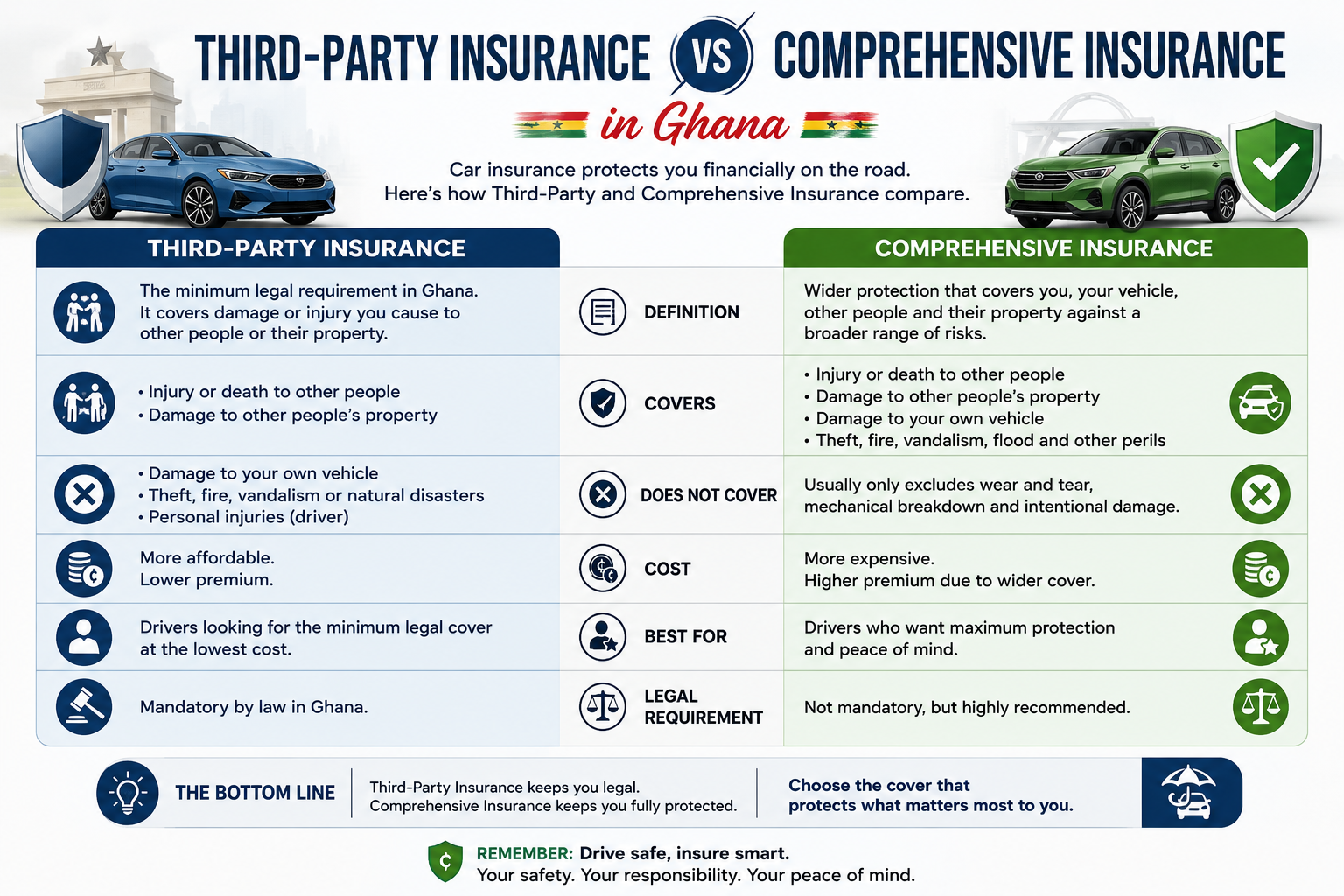
The choice is binary in its simplicity but brutal in its consequences. Third‑party insurance is the minimum legal requirement. It covers damage or injury you cause to other people, their vehicles or their property – but it offers no protection for your own vehicle, your own medical expenses, theft or fire. Comprehensive insurance covers everything third‑party does, plus accidental damage to your own vehicle, theft, fire, and sometimes flood, natural disasters and roadside assistance.
📢 GET DETAILED ARTICLES + JOBS
Join THSB's WhatsApp Channel and never miss a post or opportunity.
The cost difference is substantial: a third‑party policy for a private car rose to GH¢557 in February 2026, while comprehensive cover typically ranges from 5 to 7 per cent of the vehicle’s market value – GH¢1,200–GH¢3,000 or more depending on the car. For a vehicle worth GH¢50,000, that means GH¢2,500–GH¢3,500 annually.

Yet the gap between these two price points is not merely a matter of budget. It reflects a fundamental difference in the distribution of risk. With third‑party, the driver self‑insures against damage to their own vehicle. With comprehensive, the insurer assumes that risk. In a country where road accidents claimed nearly 2,000 lives between January and August 2025, with 16,348 vehicles involved and 10,957 injuries recorded, the decision is not theoretical. Every day, Ghanaian insurers pay out approximately GH¢5.2 million in general insurance claims and GH¢4 million in life claims — a combined daily payout of GH¢9.2 million, according to NIC Commissioner Abiba Zakariah.
This profile explains the business and the consumer reality of third‑party vs comprehensive insurance in Ghana. It examines coverage scopes, cost structures, legal enforcement through the MID, the fraud problem that drives up premiums for everyone, the rise of telematics and usage‑based pricing, and a practical framework for drivers to make the right choice for their circumstances. For the insurance industry, motor cover is the largest single line – representing over 45 per cent of total claims paid in 2023. For the Ghanaian driver, it is the only insurance most will ever buy. Understanding the difference between third‑party and comprehensive is not a luxury. It is a financial survival skill.
The Legal Framework: What the Law Actually Requires
The foundation of Ghana’s motor insurance market is the Motor Vehicles (Third‑Party Insurance) Act, 1958 (Act 42). Section 3 states that “no person shall use or cause or permit any other person to use a motor vehicle unless there is in force a policy of insurance or such a security in respect of third‑party risks”. The law does not require a driver to insure their own vehicle; it only requires that they be able to compensate third parties for injury, death or property damage.
The NIC enforces this mandate primarily through the Motor Insurance Database (MID) . The MID, which took effect on 1 January 2020, is a centralised digital repository of every valid motor policy in the country. It allows instant verification of a vehicle’s insurance status via:
- USSD code *920*57# – anyone can dial the short code, enter a registration number, and receive the vehicle’s insurer and policy expiry date in seconds.
- SMS confirmation – policyholders receive automatic text confirmations.
- QR code scanning – electronic stickers generated from the MID Portal can be scanned to reveal full policy details.
The NIC has described the MID as “a groundbreaking success in revolutionising the motor insurance business in the country”. For law enforcement, the MID has eliminated the fake‑sticker epidemic that once plagued the roads. For passengers, dialling *920*57# before boarding a commercial vehicle has become a standard safety practice. However, the Acting Commissioner of Insurance, Michael Kofi Andoh, has noted that some areas still lack digital infrastructure for immediate access to verification systems.
The Insurance Act, 2021 (Act 1061) updated the regulatory framework, introducing the Ghana Card requirement for all insurance purchases, strengthening sanctions for unlicensed operations (maximum fine of GH¢600,000 or five years’ imprisonment), and enabling the NIC’s sandbox programme for insurtech innovation. The Commission has also proposed the establishment of special courts dedicated to the prosecution of insurance fraud to strengthen deterrence.
Despite these reforms, compliance remains uneven. Many vehicle owners technically hold policies but maintain only the minimum required coverage, often without fully understanding what it entails. Public frustration with delayed claims, disputed liabilities, and under‑compensation continues to undermine confidence, with the insurance process often feeling “slow, opaque, and adversarial – fuelling the perception that insurance exists more as a legal requirement than a reliable safety net”.
Third‑Party Insurance: The Mandated Minimum
Definition and Coverage Scope
Third‑party insurance is the compulsory minimum cover mandated by Act 42. It protects other people – not the policyholder or their vehicle. The policy covers:
- Bodily injury or death caused to a third party
- Damage to a third party’s vehicle
- Damage to third‑party property (for example, walls, street furniture, buildings)
- Legal liabilities arising from an accident
The coverage explicitly excludes:
- Damage to the policyholder’s own vehicle
- The policyholder’s own medical expenses Theft of the insured vehicle
- Fire damage to the insured vehicle
- Accidental self‑damage (hitting a wall, pole or ditch)
The law sets a minimum cap on property damage claims under third‑party policies. As noted by the Consumer Protection and Safety Advocacy Group, this limit was increased from GH¢6,000 to GH¢8,000 – meaning that if a third‑party driver causes damage exceeding this amount, the claimant is entitled to up to GH¢8,000 from the insurer, but any excess must be recovered directly from the at‑fault driver through legal proceedings.

Premium Structure (February 2026 Update)
On 16 February 2026, the NIC approved new third‑party premium rates following an earlier 10 per cent increase that took effect in February 2025. The new rates (GH¢, per annum) are:
Vehicle Category|| Previous Rate (GH¢)|| New Rate (GH¢)
- Motorcycle 302 331
- Private Individual/Corporate 530 557
- Taxi 701 744
- Commercial Passenger (Trotro, 12 persons) 804 919
- Commercial Passenger (Trotro, 15 persons) 840 894
- Commercial Passenger (Trotro, 23 persons) 936 1,194
- General Cartage 866 893
- Articulated/Tankers 1,025 1,052
- Tricycle/Quadricycle (New category) 431
The 10 per cent increase in February 2025 was formally attributed to rising inflation and increased claims costs. However, fraudulent claims – particularly inflated repair estimates and staged accidents – are a significant driver of those rising costs. As a result, the honest driver who has never filed a claim pays the same inflated rate as the serial fraudster.
The Value Proposition – and the Trap
Third‑party insurance is attractive for three reasons:
- Lowest premium – GH¢557 for a private car is affordable for most vehicle owners.
- Legal compliance – it satisfies the minimum requirement, avoiding police fines and impoundment.
- Old or low‑value vehicles – if a car is worth GH¢5,000–GH¢10,000, paying GH¢2,500 for comprehensive may feel disproportionate.
The trap is that the premium savings can be dramatically outweighed by the cost of a single accident. A taxi driver in Kumasi who bought third‑party cover to save costs was involved in a head‑on collision; the NIC confirmed his insurer covered the other driver’s medical bills – but the driver had to repair his own car with GH¢18,000 out of pocket. That amount would have covered comprehensive premiums for almost a decade.
Third‑Party, Fire & Theft: The Middle Option
Some insurers offer a hybrid product – third‑party, fire and theft – that sits between basic third‑party and comprehensive. It adds:
- Fire damage to the insured vehicle
- Theft of the insured vehicle
It still excludes accidental damage to the driver’s own vehicle. This intermediate option is appropriate for drivers who are less concerned about collision damage but worry about vehicle theft or fire. Premiums for this product typically fall between basic third‑party and comprehensive.
Comprehensive Insurance: Full Protection at a Price
Definition and Coverage Scope
Comprehensive insurance is the most extensive motor cover available. It includes everything third‑party covers, plus:
- Accidental damage to the policyholder’s own vehicle
- Theft of the insured vehicle
- Fire damage
- Flood or natural disaster damage (depending on policy terms)
- Vandalism
- Windscreen damage (often under a separate excess or optional coverage)
- Personal accident cover for the driver (optional)
Comprehensive policies typically include optional extras such as roadside assistance, a replacement car during repairs, and legal expenses cover.
Premium Structure
Comprehensive premiums are not set by NIC tariff. Instead, they are calculated as a percentage of the vehicle’s market value – typically 5 to 7 per cent. Additional factors that influence the premium include:
- Vehicle age and condition
- Driver’s age, driving history, and years of experience
- Vehicle usage (private vs commercial)
- Security features (alarm, immobiliser, GPS tracking)
- Voluntary excess – the amount the policyholder agrees to pay towards each claim, which lowers the premium
For a vehicle valued at GH¢50,000, the annual comprehensive premium would be GH¢2,500–GH¢3,500. For a GH¢120,000 SUV, the premium could be GH¢6,000–GH¢8,400 or more. For comparison, third‑party for the same vehicle would be GH¢557 – a difference of approximately GH¢2,000–GH¢3,000.
What Comprehensive Does Not Cover
Even comprehensive insurance has exclusions. Common reasons for claim denial include:
- Driving under the influence of alcohol or drugs.
- Using the vehicle for commercial purposes when insured as private.
- Allowing an unlicensed driver to operate the vehicle.
- Unpaid premiums – coverage ceases immediately on non‑payment.
- False information on the application (for example, understating annual mileage, failing to disclose modifications).
- Overloading the vehicle beyond its legal capacity – the NIC has explicitly stated that overloading voids insurance cover.
- Racing – speed contests or track use.
- Wear and tear – mechanical breakdown is not covered.
Policyholders are also required to report accidents promptly – typically within 24 to 48 hours. Late reporting can void coverage because it prevents the insurer from conducting a timely investigation.
The 5–7% Reality Check
As one industry expert notes, “comprehensive insurance doesn’t mean buying you a new vehicle”. The payout is based on the vehicle’s market value at the time of the loss, not its replacement cost. Depreciation applies. If a 10‑year‑old vehicle is written off, the insurer will pay the current market value, which may be a fraction of what the owner paid.
The Middle Ground: Third‑Party, Fire & Theft
Third‑party, fire and theft coverage occupies the middle ground. It adds fire damage and theft to the third‑party baseline, but still excludes accidental self‑damage. Premiums are higher than basic third‑party but significantly lower than comprehensive. This option is suitable for drivers who are more concerned about vehicle theft than collision damage – for example, owners of older luxury cars with low collision frequency but high theft risk.
Vehicle Value Third‑Party (Annual) Third‑Party, Fire & Theft (Est.) Comprehensive (5–7%)
GH¢10,000 GH¢557 GH¢700–900 GH¢500–700
GH¢30,000 GH¢557 GH¢900–1,200 GH¢1,500–2,100
GH¢50,000 GH¢557 GH¢1,100–1,500 GH¢2,500–3,500
GH¢100,000 GH¢557 GH¢1,300–1,800 GH¢5,000–7,000
GH¢150,000 GH¢557 GH¢1,500–2,100 GH¢7,500–10,500
The table demonstrates a critical insight: the premium advantage of third‑party over comprehensive increases dramatically with vehicle value. For a GH¢150,000 luxury SUV, comprehensive can cost GH¢7,500–10,500 – nearly 20 times the third‑party premium. However, the cost of a single serious accident also increases; repairing a luxury SUV after a collision can exceed GH¢30,000, an expense that would be borne entirely by the owner under a third‑party policy.Market Trends and Enforcement
The MID and Enforcement
The MID has been transformative for the motor insurance market. The Acting NIC Commissioner has called it “a groundbreaking success in revolutionising motor insurance business in the country”. Enforcement officers now use mobile devices to scan QR codes or dial *920*57# to verify policy validity instantly. The MID has also enabled the rollout of electronic motor insurance stickers with QR codes, generated directly from the MID Portal, making physical stickers far less critical for verification.
The NIC has also established a Motor Compensation Fund for road accident victims. This fund provides compensation for injury or death claims when the at‑fault driver is uninsured or cannot be traced.
The Fraud Burden – 25% of Claims Are Fraudulent
Fraud is the single largest driver of premium inflation in the Ghanaian motor market. According to the NIC, approximately 25 per cent of all insurance claims in Ghana show elements of fraud – a figure that has remained stubbornly consistent for years. Fraud manifests in several ways:
- Staged or intentional accidents – groups of fraudsters deliberately cause collisions to claim compensation.
- Falsified police accident reports – fabricated reports supporting illegitimate claims.
- Inflated repair estimates – garages colluding with policyholders to multiply repair costs.
- Multiple claims for a single incident – the same accident reported to multiple insurers.
- Fake insurance stickers and certificates – charlatans selling counterfeit coverage to unsuspecting drivers.
The financial impact is substantial. Deloitte Ghana estimates that occupational fraud alone drains approximately 5 per cent of company income annually from Ghanaian insurers. The NIC’s 10 per cent increase in third‑party motor premiums, effective February 2025, was formally attributed to inflation and rising claims costs – but fraud, particularly inflated repair estimates and staged accidents, is a significant driver of those rising costs. The honest driver pays the same inflated premium as the fraudster. This is the “fraud tax”: an invisible levy that adds an estimated GH¢50–80 per policy for third‑party cover.
The Road Accident Reality
The decision between third‑party and comprehensive is made in the context of Ghana’s alarming road accident statistics. Between January and August 2025:
- 1,937 people died in road crashes.
- 16,348 vehicles were involved in accidents.
- 10,957 persons sustained injuries.
- 9,626 accident cases were reported.
The National Road Safety Authority described this as a “grim picture of Ghana’s worsening road safety crisis”. For the insurer, this claims volume is a business reality. For the driver, it is a probability that a serious accident will occur during their period of ownership. The question is not whether accidents happen – they do, at scale. The question is who pays for the damage.
The NIC’s response has included practical measures such as donating 300 body bags to the MTTD to address fatalities, a stark reminder of the human cost underlying the business of motor insurance.
The Role of Telematics and the NIC Sandbox
Traditional motor insurance pricing in Ghana relies on “outdated variables” – vehicle type, driver age, years of experience, and gender. These factors do not accurately reflect actual driving behaviour or road risk. Telematics – combining telecommunications and informatics – allows insurers to track actual driving habits such as speed, braking patterns, acceleration, cornering skills and time of day.
Telematics enables two usage‑based insurance models:
· Pay‑how‑you‑drive (PHYD) – premiums based on driving quality and safety.
·. Studies show that drivers behave more cautiously when they know they are being monitored, and companies using usage‑based premiums report fewer fatal accidents due to reduced risk‑taking.
The NIC has actively encouraged this innovation. In late 2024, the Commission admitted five insurtech companies into its regulatory sandbox. One of the sandbox participants, ETAP, went on to secure Ghana’s first‑ever operational insurtech licence from the NIC in collaboration with Hollard Insurance Ghana. ETAP uses advanced telematics to gamify the driving experience, with drivers earning “Safe Driving Points” that can be exchanged for shopping vouchers, fuel, cinema tickets and other rewards. CalBank has also partnered with MTN MoMo and BlueSPACE to launch BeINsured, a USSD auto insurance marketplace that enables vehicle owners to purchase policies, pay premiums and process claims without internet access.
Full‑scale telematics adoption remains limited by infrastructure constraints and privacy concerns. But the direction is clear: the future of motor insurance pricing will be based on how you drive, not just on what you drive.
Making the Right Choice: A Practical Decision Framework
The choice between third‑party and comprehensive insurance cannot be reduced to a simple rule. It depends on the driver’s financial circumstances, risk tolerance and asset value.
Choose Third‑Party Only if:
· Your vehicle is old and its market value is very low (under GH¢10,000–GH¢15,000).
· You have substantial savings to cover repair or replacement costs out of pocket.
· You drive infrequently and on low‑risk roads (for example, rural areas with minimal traffic).
· You are willing to accept the risk of a GH¢18,000‑repair bill to save GH¢2,000 on premiums.
Choose Third‑Party, Fire & Theft if:
· You are moderately concerned about vehicle theft or fire but less concerned about collision damage.
· Your vehicle has high theft risk (popular model, no immobiliser) but moderate collision risk.
· You drive in urban areas where theft rates are higher but traffic speeds are lower.
Choose Comprehensive if:
· Your vehicle is relatively new or has significant market value (over GH¢25,000–GH¢30,000).
· You cannot afford a sudden repair bill of GH¢10,000–GH¢30,000.
· You drive frequently, especially on high‑risk highways.
· You use your vehicle for business or income generation and cannot afford downtime.
· You park on the street or in unsecured areas, raising theft risk.
· You want the convenience of roadside assistance and claims handling without disputes.
The Hybrid Approach: Comprehensive with a High Voluntary Excess
Policyholders who want comprehensive protection but want to lower the premium can increase the voluntary excess – the amount they agree to pay towards each claim before the insurer pays. A voluntary excess of GH¢1,000–GH¢2,000 can reduce the annual premium by 15–25 per cent. The trade‑off is that minor claims (GH¢1,000–GH¢2,000) are paid entirely by the policyholder, while major claims (GH¢10,000+) are still covered. This structure is ideal for drivers who can afford small repairs but need protection against catastrophic loss.
The Right Question
The driver who asks “what is the cheapest policy?” has already framed the question incorrectly. The right question is: what is the most cost‑effective way to transfer the risks I cannot afford to retain? For a GH¢150,000 SUV owner, self‑insuring against a GH¢30,000 repair bill is not cost‑effective – it is exposing the household to catastrophic financial risk to save a few thousand cedis. For a GH¢8,000 vehicle owner, paying GH¢2,500 for comprehensive is not cost‑effective – the premium exceeds 30 per cent of the vehicle’s value.
The decision requires honest self‑assessment of financial capacity, not just the premium quoted by the broker.
Common Pitfalls and Claim Denial Reasons
Many claim denials are avoidable. The most common mistakes include:
1. Late accident reporting – waiting days or weeks after an accident gives insurers grounds to argue that causation cannot be established. Report within 24–48 hours.
2. Misunderstanding coverage – third‑party policyholders are shocked to discover their own vehicle is not covered.
3. Excluded circumstances – drunk driving, commercial use on a private policy, unlicensed drivers – all void liability.
4. False information on application – understating mileage, failing to disclose modifications, providing incorrect driver details.
5. Incomplete documentation – missing police reports, repair estimates or proof of ownership.
The case of Kweku Y. Paintsil vs Donewell Insurance Co. Ltd is instructive. Paintsil insured his Mercedes Benz under a comprehensive policy. During a heavy flood in Accra on 3 June 2015, the vehicle was parked at a workshop for routine maintenance and was damaged by the flood. The dispute hinged on whether the flood damage was covered under the policy terms. Comprehensive policies vary; flood coverage is not automatic and policyholders must read the fine print.
The Consumer Protection and Safety Advocacy Group has welcomed the increase in the third‑party property damage limit to GH¢8,000 but continues to advocate for stronger consumer protection in insurance contracts. Policyholders should always read their policy documents and ask specific questions about coverage limits and exclusions before purchasing.
Future Outlook: Three Scenarios for Motor Insurance in Ghana
Scenario One: Gradual Digital Reform (65 per cent probability)
Third‑party and comprehensive insurance remain the two dominant product categories, with the former dominating by volume and the latter by premium value. The MID continues to reduce fake policies. Telematics adoption remains niche, limited to commercial fleets and high‑end private vehicles. Premium undercutting persists because the NIC lacks enforcement bandwidth. Premiums continue to rise with inflation, but the fraud component stabilises as digital verification improves. The gap between third‑party and comprehensive pricing remains wide.
Scenario Two: Telematics Breakthrough (25 per cent probability)
The NIC sandbox produces commercially viable telematics products. ETAP and other sandbox participants expand their usage‑based insurance offerings. Good drivers – including many who currently choose third‑party for cost reasons – find that pay‑how‑you‑drive comprehensive policies are within reach. The pricing gap narrows. Fraud declines as telematics data makes staged accidents harder to fake. Ghana’s motor insurance market becomes a regional leader in usage‑based pricing.
Scenario Three: Fraud Escalation and Premium Spike (10 per cent probability)
Organised fraud networks expand into new areas of the motor market, including staged pedestrian accidents and mass‑scale fake policy distribution. The NIC, facing enforcement capacity constraints, struggles to keep pace. The 25 per cent fraudulent claim rate rises to 35 per cent. Premiums increase sharply across both product categories. Public trust in motor insurance collapses further, and third‑party compliance declines as drivers choose to risk the police fine rather than pay inflated premiums.
The most likely path is Scenario One: slow, incremental digital improvement, but motor insurance remains a compliance‑driven, low‑trust, high‑volume business that no single reform can magically fix. The honest driver will continue to pay the fraud tax for the foreseeable future, and the decision between third‑party and comprehensive will remain a difficult trade‑off between premium affordability and financial risk exposure.
THSB Conclusion
The choice between third‑party and comprehensive insurance in Ghana is not merely a financial calculation. It is a risk allocation decision. Third‑party passes the risk of damage to your own vehicle back to you. Comprehensive transfers that risk to the insurer. The premium difference is the price of that transfer.
For the industry, motor insurance is the largest line, representing over 45 per cent of total claims. The MID has largely solved the fake‑sticker problem. The NIC is pushing digital innovation. Telematics promises a future where premiums are based on how you drive, not just on what you drive.
For the driver, the decision requires brutal honesty about two questions: what is your vehicle worth, and what would you do if you had to repair or replace it out of pocket tomorrow? If the answer is “I cannot afford that”, the comprehensive premium is not an expense – it is a cost of driving. If the answer is “I can self‑insure”, third‑party is a rational choice.
The day Ghana’s road accident statistics improve, the case for third‑party will strengthen. For as long as 16,000+ vehicles are involved in crashes every eight months, the case for comprehensive will remain compelling. The driver who buys third‑party to save GH¢2,000 is placing a bet that they will never be in an accident. The insurer’s claims data suggests that is a losing bet. The question is not whether accidents happen – they do, at scale. The question is who pays when they do.
The honest motorist pays the fraud tax. The responsible motorist buys the coverage they need. The informed motorist reads the fine print. The decision is yours – but make it with your eyes open, and with the full knowledge that GH¢557 buys you the right to drive legally, not the right to drive protected. GH¢2,500–GH¢3,500 buys you the right not to be ruined by a single mistake on the road.
Ghana’s motor insurance market is imperfect. It is distorted by fraud, constrained by low financial literacy, and hampered by the slow pace of technology adoption. But for millions of drivers, it is the only line of defence between a fender bender and financial catastrophe. Understanding the difference between third‑party and comprehensive is not a luxury. It is the difference between walking away from an accident and walking away from your savings.
The vehicle must be insured. The question is how, and at whose risk. The answer to that question is the most important financial decision most drivers will make all year. Choose carefully. And if in doubt, insure comprehensively. The premium may feel expensive today – but the repair bill will feel even more expensive tomorrow.
Frequently Asked Questions (FAQ)
Q1: Is third‑party insurance mandatory in Ghana?
Yes. Under Section 3(1) of the Motor Vehicles (Third‑Party Insurance) Act, 1958, every vehicle must have valid third‑party insurance. Driving without it can lead to impoundment, fines and potential civil/criminal liability.
Q2: What is the difference between third‑party and comprehensive insurance?
Third‑party covers only damage or injury you cause to other people, their vehicles or their property. Comprehensive covers everything third‑party does, plus accidental damage to your own vehicle, theft, fire, and sometimes flood and natural disasters. Comprehensive does not cover the policyholder’s own medical expenses.
Q3: How much does third‑party insurance cost in Ghana?
As of February 2026, the annual third‑party premium for a private car is GH¢557. Taxis pay GH¢744. Motorcycles pay GH¢331. Trotro premiums range from GH¢894 to GH¢1,194 depending on passenger capacity. Full category rates are published by the NIC.
Q4: How much does comprehensive insurance cost in Ghana?
Comprehensive premiums are typically 5–7 per cent of the vehicle’s market value. For a GH¢50,000 vehicle, that is GH¢2,500–GH¢3,500 per year. For a GH¢150,000 SUV, the premium could be GH¢7,500–GH¢10,500. Additional factors such as driver age, vehicle usage and security features also affect the premium.
Q5: What is the Motor Insurance Database (MID)?
The MID is a centralised digital system launched in January 2020 that records every valid motor policy in Ghana. It allows instant verification of a vehicle’s insurance status via USSD short code *920*57#, SMS confirmation, or QR code scanning. The NIC has described it as “a groundbreaking success in revolutionising the motor insurance business”.
Q6: What voids a motor insurance claim in Ghana?
Common claim void reasons include: driving under the influence of alcohol or drugs; using the vehicle for commercial purposes when the policy states private use; allowing an unlicensed driver to drive; unpaid premiums; providing false information on the application; and overloading the vehicle beyond its legal capacity. Late accident reporting (beyond 24–48 hours) can also void coverage.
Q7: What percentage of insurance claims in Ghana are fraudulent?
The NIC estimates that approximately 25 per cent of all insurance claims in Ghana show elements of fraud, including staged accidents, falsified police reports, inflated repair estimates, duplicate claims, and fake insurance stickers. This fraud burden drives up premiums for honest policyholders.
Q8: What is the third‑party property damage limit?
The minimum cap on property damage claims under third‑party policies is currently GH¢8,000. If a third‑party driver causes damage exceeding this amount, the claimant is entitled to up to GH¢8,000 from the insurer. Any excess must be recovered directly from the at‑fault driver through legal proceedings.
Q9: What is telematics and is it available in Ghana?
Telematics uses GPS and black box devices to monitor actual driving behaviour – speed, braking, acceleration, cornering. It enables usage‑based insurance (pay‑how‑you‑drive or pay‑as‑you‑drive), which rewards safe drivers with lower premiums. ETAP, operating with an NIC insurtech licence in collaboration with Hollard Insurance Ghana, offers telematics‑based auto insurance. Full‑scale adoption remains limited but is growing.
Q10: What is third‑party, fire and theft insurance?
It is an intermediate product that covers third‑party liabilities plus fire damage to the insured vehicle and theft. It still excludes accidental damage to the insured vehicle. It is suitable for drivers who are less concerned about collision damage but worry about vehicle theft or fire.
Q11: What should I do immediately after a car accident in Ghana?
Ensure safety first. Report the accident to the police – do not leave the scene without a police report. Take photographs of the scene, vehicle damage and positions of vehicles. Exchange contact and insurance details with other parties involved. Notify your insurer within 24–48 hours. Delay in reporting can jeopardise your claim.
Q12: Which is better – third‑party or comprehensive?
There is no universal answer. Third‑party is better for old, low‑value vehicles where the annual comprehensive premium exceeds 15–20 per cent of the vehicle’s market value. Comprehensive is better for newer, higher‑value vehicles where the owner cannot afford to repair or replace the vehicle out of pocket. The decision depends on vehicle value, financial capacity, risk tolerance, and driving frequency.
Source: The High Street Business
Disclaimer: Some content on The High Street Business may be aggregated, summarized, or edited from third-party sources for informational purposes. Images and media are used under fair use or royalty-free licenses. The High Street Business is a subsidiary of SamBoad Publishing under SamBoad Business Group Ltd, registered in Ghana since 2014.
For concerns or inquiries, please visit our Privacy Policy or Contact Page.

Esther Aku-Sika is a content writer and social media strategist who helps brands and startups grow through intentional storytelling and practical marketing strategies. With a keen eye for trends and audience behavior, she shares business insights, content strategies, and real-life lessons to help entrepreneurs build visibility and turn ideas into income. Through her writing, she simplifies complex concepts and equips readers with actionable steps to grow in today’s digital space.