










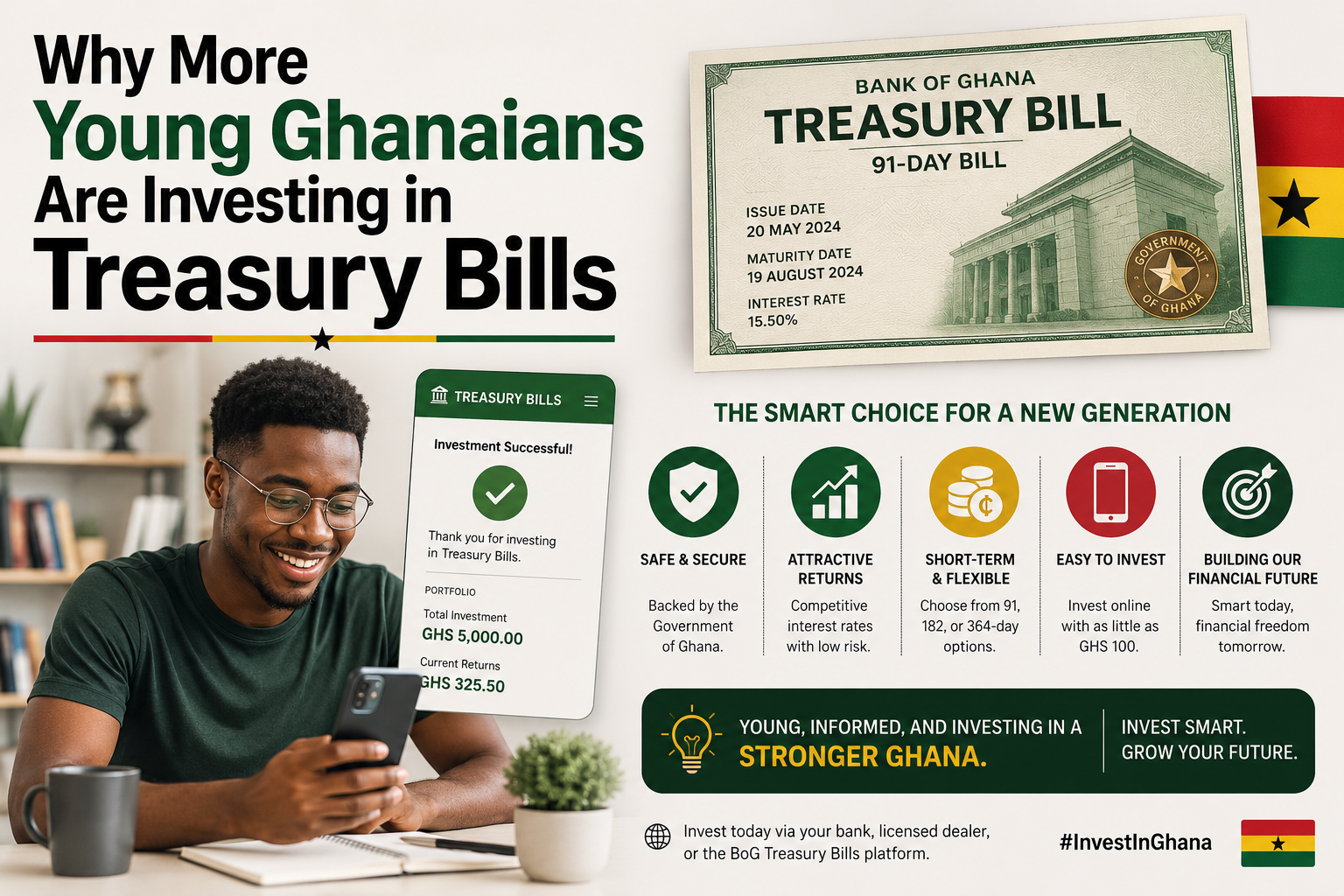

25% of Ghanaians now prefer Treasury bills, but 43% of Gen Z have no investments at all. Our deep‑dive analysis reveals digital access, economic caution and the real barriers facing young investors.
Why More Young Ghanaians Are Investing in Treasury Bills — The Digital Access, Economic Caution and the Reality of the Gen Z Non-Investor
For the first time in a generation, Treasury bills have become a genuine investment destination for young Ghanaians. The story is not about high yields — those have collapsed from 35 per cent in 2023 to below 5 per cent. It is not about aggressive marketing campaigns or flashy fintech apps, though both have played a role. It is about the convergence of three powerful forces: digital access that has lowered the barrier to entry to a minimum of GH₵100, economic caution bred by a crisis that wiped out entire industries and generational preference for safety, liquidity and control.
The numbers, however, tell a more complex story. According to KPMG’s 2025 West Africa Banking Industry Customer Experience Survey, 25 per cent of all Ghanaians now prefer Treasury bills, while 11 per cent choose fixed or term deposits. Among those who do invest, 28 per cent opt for Treasury bills — making them the dominant investment choice in the country. Yet a striking 43 per cent of Gen Z respondents report having no investments at all, the highest level of disengagement across all age groups. Among millennials, 35 per cent have no investments, up from 17 per cent in 2023.
📢 GET DETAILED ARTICLES + JOBS
Join THSB's WhatsApp Channel and never miss a post or opportunity.
This is the paradox at the heart of Ghana’s youth investment story. A growing number of young people are discovering Treasury bills as a safe, accessible entry point into formal investing. But a much larger number remain entirely outside the investment ecosystem — trapped in a “survival economy” of side hustles, gig work and daily cash flow, with little surplus left for long-term financial planning. The same KPMG survey attributes this to a structural squeeze: many in this demographic are prioritising flexible income streams to manage daily costs, leaving too little surplus for instruments that require commitment and patience.

This profile goes inside the phenomenon. It examines who among the youth is investing in Treasury bills, how they are doing it, and why. It explores the digital platforms that have democratised access. It analyses the generational investment gap, the barriers that keep most young Ghanaians out of the market, and what policymakers, financial institutions and young people themselves can do to close it.
Above all, it argues that Treasury bills, despite their falling yields, represent a critical gateway to broader financial inclusion — and that the engagement of Ghana’s youth in the formal investment market is not a nice-to-have, but a national economic imperative.
The Data: Who Is Investing and Who Is Not
The KPMG 2025 West Africa Banking Industry Customer Experience Survey, which drew on insights from over 35,000 retail customers, 5,000 small and medium-sized enterprises and 600 corporates across Ghana and Nigeria, provides the most authoritative snapshot of Ghana’s investment landscape.
The Overall Market: Treasury bills remain Ghana’s most preferred investment option. Twenty‑five per cent of all Ghanaians prefer T‑bills, followed by fixed or term deposits at 11 per cent. Among those who actually invest, 28 per cent choose Treasury bills. The dominance of T‑bills reflects a conservative investment climate shaped by lingering economic uncertainty. Many households are prioritising capital preservation over higher-risk returns, seeking secure and predictable income as the economic recovery remains fragile.
Older Ghanaians: For respondents aged 60 and above, 32 per cent favour commodities such as precious metals, while 30 per cent choose Treasury bills, reflecting a clear preference for tangible assets and predictable returns.
Millennials (ages 26–41): This cohort has been gradually pulling back from investing. The percentage of millennials with no investments has risen from 17 per cent in 2023 to 32 per cent in 2024, and the 2025 survey places that figure at 35 per cent — a three‑year trend of withdrawal. Among those millennials who remain in the market, Treasury bills are again the dominant choice at 28 per cent. The report attributes this to financial pressures such as rent, family obligations and the general cost of living.
Generation Z (born roughly 1997–2012): This cohort shows the highest level of disengagement, with 43 per cent reporting no investments at all — nearly half of Ghana’s youngest adult cohort has opted out of formal wealth‑building entirely. Rather than formal investment vehicles, Gen Z respondents lean toward immediate, flexible income streams: side hustles, short‑term gigs and daily cash flow to cope with rising living costs and economic uncertainty.
However, among Gen Z who do invest, the preference is again strongly toward Treasury bills — 28 per cent of young investors choose T‑bills as their primary vehicle. And notably, the same KPMG report found that Gen Z investors are demonstrating stronger financial discipline than their elders in one respect: 13 per cent save between 21 per cent and 40 per cent of their monthly income, indicating a growing culture of savings among younger investors. The issue is not a lack of savings discipline — it is a lack of surplus income to save in the first place.
The Bottom Line: The market for youth investing in Treasury bills is growing, but from a low base. A dedicated minority of young Ghanaians — tech‑savvy, financially aware, often urban — have discovered T‑bills as a safe entry point. But the majority remain excluded by income constraints, not by a lack of interest in securing their financial future. As the report notes, “Ghanaians are not abandoning the financial system, but they are engaging with it on their own terms”.
The Digital Access Revolution: How GH₵100 Opened the Door
The most transformative factor in bringing young Ghanaians to Treasury bills has been the democratisation of access. Traditional T‑bill investment required a visit to a bank branch, a completed application form, and often a minimum investment of GH₵1,000 or more. That world has been dismantled.
Mobile Money Integration: The Ecobank TBill4All product, launched in 2016, was the first to allow Ghanaians to invest in 91‑day and 182‑day Treasury bills using their mobile money wallet. The service allows customers to remotely register, apply, purchase and rediscount T‑bills directly from their phones. Transfers between mobile money wallets and the Ecobank wallet for purchases are seamless, and the platform has been integrated with the Bank of Ghana’s central T‑bill processing system. For young Ghanaians who already use mobile money for everything from airtime to bill payments, T‑bill investment became a natural extension.
The Rise of Investment Apps: Today, a young Ghanaian with a smartphone and a mobile money account can purchase government securities in under five minutes. Platforms such as CediManager allow users to “purchase relatively low‑risk Government of Ghana securities at the click of a button”, including Treasury bills, cocoa bills, government notes and government bonds. Absa Ghana offers T‑bill purchases through its mobile app and internet banking. Standard Chartered provides Online Fixed Income trading on its SC Mobile app, allowing clients to buy and sell government‑issued bonds and Treasury bills at any time.
Fintech and Non‑Bank Platforms: Companies like ExpressPay are exploring direct T‑bill purchase features within their apps. Fido, a digital lending platform, has expanded into payments and bill management, building user profiles that could eventually facilitate securities investment.
The Minimum Investment Fall: The combination of mobile money integration and fintech innovation has lowered the minimum practical investment for Treasury bills to as low as GH₵100. Young people who previously assumed that investing was for the wealthy can now enter the market with the equivalent of a few weeks’ savings. The SEC Board Chairman, Dr Adu Anane Antwi, has actively encouraged this, stating at a national youth investment programme: “If a young man aged 20 invests GH₵5,000 in Treasury bills today and continuously rolls it over until retirement, that individual could end up a millionaire”.
The Impact of Digital Access: The shift from branch‑based to mobile‑based T‑bill investment has fundamentally altered the demographics of the market. Young investors who would never have walked into a bank branch are now purchasing securities from their phones. The transactional friction that once excluded them has been eliminated. The result is a small but growing cohort of young Ghanaians who have made Treasury bills their first formal investment — often as a stepping stone to broader portfolio diversification.
The Psychology of T‑Bill Investing for Young Ghanaians
Why are young Ghanaians who do invest choosing Treasury bills over equities, mutual funds or real estate? The answer is not simply “they don’t know about other options”, though that is part of it. It is that T‑bills align perfectly with the financial psychology of a generation shaped by crisis.
The Trauma of Recent Crises: Young Ghanaians came of age during a period of extreme economic volatility — inflation above 50 per cent, cedi depreciation that wiped out savings, and the collapse of high‑risk investment schemes that left many families destitute. For this cohort, risk is not an abstract concept. It is lived experience. Treasury bills, backed by the full faith and credit of the government, offer certainty in an uncertain world. As the KPMG report notes, households are prioritising capital preservation over higher‑risk returns, and young investors are no exception.
Liquidity and Control: Many young Ghanaians operate in the informal economy or gig economy, where income is irregular and expenses unpredictable. The 91‑day Treasury bill offers a commitment period short enough to feel manageable. Unlike a pension or a long‑term bond, T‑bills can be liquidated relatively quickly if an emergency arises. The ability to “roll over” or cash out at the end of the period gives young investors a sense of control that longer‑term instruments cannot match.
Low Entry, Low Risk, Low Stress: Treasury bills require no market timing, no stock‑picking skill, no fear of capital loss. The return is known at purchase. The risk is effectively zero. For a young person who is already managing the stress of rent, family obligations and career uncertainty, the simplicity of T‑bills is a feature, not a bug.
The Influence of Financial Literacy Initiatives: The Securities and Exchange Commission, the Ghana Stock Exchange and the Young Investors Network have been actively promoting T‑bills as the safe entry point for young investors. The SEC Board Chairman’s public endorsement — urging young people to “consider safer alternatives such as government‑backed Treasury bills to secure their financial future” — carries weight in a market where trust is fragile. The GSE’s financial literacy programmes have reached over 88,500 students across 108 schools, planting the seed that formal investing is accessible, safe and essential.
The Risk of Over‑Concentration: The downside of this psychology is that young investors who adopt T‑bills may never graduate to higher‑return asset classes. The KPMG survey found that while 34 per cent of respondents expressed openness to higher‑risk investments, knowledge gaps remained a significant barrier to diversification. The challenge for the industry is to use T‑bills as an on‑ramp, not a destination.
The Gen Z Survival Economy: Why 43 Per Cent Have No Investments
The headline — “More young Ghanaians are investing in Treasury bills” — is true for a minority. But the more significant story is the 43 per cent of Gen Z respondents with no investments at all. Understanding why they are not investing is essential to understanding what must change.
The Structural Squeeze: The KPMG survey attributes Gen Z’s disengagement not to apathy but to a structural lack of surplus. Many in this demographic are prioritising flexible income streams and side hustles — short‑term gigs, freelance work, daily cash flow — to manage daily costs, leaving too little for instruments that require commitment and patience. As one analysis put it, young Ghanaians appear “trapped in survival mode, prioritising today’s expenses over tomorrow’s security”.
High Living Costs, Low Wages: For a young graduate earning GH₵1,500 per month, the costs of rent, transport, food and family contributions can consume 90 per cent or more of their income. The remaining GH₵150 may feel too small to invest — or may be needed for emergencies. The KPMG data shows that among Gen Z who do invest, 13 per cent save 21–40 per cent of their monthly income — a high savings rate that suggests that those with sufficient income are indeed investing. The problem is that most do not have sufficient income.
Side Hustles as Investment: For many young Ghanaians, the “investment” is the side hustle itself — the GH₵500 spent on inventory for a small trading business, the GH₵200 for digital skills training, the GH₵300 for a laptop repair kit. These are not formal investments, but they are wealth‑building activities nonetheless. The KPMG survey found that 24 per cent of respondents were investing in skill acquisition and business ventures, and 24 per cent were allocating funds to education and family needs. Young Ghanaians are investing — just not in the instruments that capital markets count.
Low Trust and Financial Literacy: The KPMG survey found that integrity and empathy have emerged as the highest‑rated customer experience pillars in Ghana, reflecting what customers now demand most from financial institutions: transparency and understanding of their circumstances. For young people who have witnessed the collapse of investment schemes and the erosion of savings by inflation, trust in formal financial institutions is low and must be rebuilt deliberately.
The Economic Context: The economic crisis of 2022–2025 did not just reduce incomes — it shattered the assumption that saving was worthwhile. When inflation exceeds 50 per cent, holding cash, even in a bank account, means watching its value dissolve. The return of single‑digit inflation and cedi stability is slowly rebuilding that assumption, but trust recovers slowly. The 2026 KPMG/UNDP budget highlights project GDP growth of 4.8 per cent and maintaining inflation at 8.0 per cent — achievable targets, but still fragile.
The Economics: Why Falling Yields Do Not Deter Young Investors
At first glance, the collapse of T‑bill yields from 35 per cent in 2023 to below 5 per cent in May 2026 should have driven young investors away. In a rational market, a 4.91 per cent return on the 91‑day T‑bill should be less attractive than a stock market that has delivered triple‑digit gains. Yet young investors are still buying.
The explanation lies in the psychology of relative returns. For a young investor with GH₵500, the difference between a 5 per cent return (GH₵25) and a 10 per cent return (GH₵50) is not life‑changing. But the difference between a 5 per cent return and a 50 per cent loss — which many young people experienced in collapsed investment schemes or cedi depreciation — is everything. T‑bills offer certainty. In a cohort where many have been burned, certainty is worth more than the yield spread suggests.
Moreover, for many young Ghanaians, T‑bills are not a growth investment but a preservation and discipline tool. A young person who commits GH₵200 to a 91‑day T‑bill is not expecting to get rich. They are building the habit of saving, protecting their capital from inflation and creating a liquidity buffer for emergencies. The yield is almost incidental.
The SEC’s calculation — GH₵5,000 invested at age 20 and rolled over until retirement could make a millionaire — is based on compounding over decades, not on current yields remaining static. It assumes that the habit, once built, persists. And that is the real value of T‑bills for young investors: not the return they earn today, but the discipline they build for tomorrow.
However, analysts expect that as yields continue to compress, some young investors will eventually rotate into equities and other risk assets. A January 2026 report from Black Star Group argued that “the cash‑heavy, defensive strategies of the past three years are no longer viable”, predicting a structural rotation as real yields on short‑term government instruments narrow. For young investors, the challenge will be to make that rotation without abandoning the savings discipline that T‑bills helped them build.
The Policy and Industry Response: What Is Being Done
Recognising that the generational investment gap is a long‑term threat to capital market development, regulators, banks and fintechs are mobilising.
Financial Literacy Programmes: The Securities and Exchange Commission, the Ghana Stock Exchange and the Young Investors Network have launched the 2025 National Youth Investment and Financial Literacy Programme, which includes an Investment Training Tour to selected universities, a Stock Pitch Competition for tertiary students and a Capital Market Quiz for senior high school students. In 2024 alone, the GSE reached over 88,500 students across 108 schools with financial literacy programmes.
Lowering Entry Barriers: The spread of mobile‑based T‑bill investment platforms has lowered the minimum investment to GH₵100, removing the most obvious barrier to entry for low‑income young people. Fintechs continue to explore further reductions and more seamless integration with mobile money wallets.
Tailored Products: The KPMG report emphasises the need for banks to offer tailored financial literacy programmes and advisory services to help customers explore alternative investments. It notes that with the rise of digital banking, financial institutions have a unique opportunity to boost investment participation through accessible, user‑friendly platforms. Banks that provide personalised investment solutions and education will strengthen customer trust and engagement.
Targeted Outreach: The government’s 24‑Hour Economy Programme, the Development Bank of Ghana’s SME support initiatives, and the Women’s Development Bank are all designed to increase income‑generating opportunities for young people — recognising that the most effective way to increase investment is to increase the surplus available to invest.
The Role of Employers: Some larger employers are beginning to offer payroll‑deducted T‑bill investment options, allowing young employees to build savings automatically. This model, common in more developed markets, has significant potential for expansion in Ghana.
Analysts warn that without targeted financial literacy campaigns, lower entry thresholds for investment products, and income‑generating opportunities that leave young people with something to invest, Ghana’s capital market development will remain constrained by the very demographic that should be driving it. The challenge is not just access to investment products, but restoring confidence, surplus income, and a culture of long‑term planning among Ghana’s younger population.
The Economic Stakes: Why the Youth Investment Gap Matters
The 43 per cent of Gen Z with no investments is not just a social concern — it is a structural threat to Ghana’s long‑term economic development.
Capital Market Depth: A generation that does not invest does not accumulate. A population that parks its savings in three‑month Treasury bills rather than equity or long‑term bonds does not build the domestic capital pools that infrastructure and enterprise development require. Without a pipeline of young investors entering the market, Ghana’s capital markets will remain shallow and illiquid.
Retirement Readiness: The youngest cohort of working Ghanaians will be the first to retire without a significant social safety net. Without the habit of long‑term saving and investing, many face a retirement of financial insecurity. The compounding advantage of starting early — the SEC’s “GH₵5,000 at 20 becomes a millionaire” scenario — is lost if young people do not start at all.
Economic Resilience: Households that have accumulated financial assets are more resilient to economic shocks. The pandemic, the 2022–2025 crisis and the rising cost of living have all demonstrated that households with savings weather storms better. A generation that does not invest is a generation that will be perpetually vulnerable.
Wealth Inequality: The investment gap between those who have surplus to invest and those who do not will translate into a wealth gap over time. Young people from wealthier families, who can invest GH₵5,000 or more, will accumulate assets. Those from poorer families, who cannot, will fall further behind. Without intervention, the already significant wealth inequality in Ghana will widen.
The Opportunity: If Ghana can move the needle on youth investment — even modestly — the multiplier effects are substantial. The SEC’s financial literacy programmes, the expansion of digital access, and the gradual improvement in economic conditions are all moving in the right direction. But the gap between the 43 per cent of Gen Z with no investments and the small minority who are investing in T‑bills remains vast. Closing it will require coordinated action from policymakers, financial institutions, employers and educators.
Future Outlook: Where Is Youth T‑Bill Investment Heading?
The trajectory of youth investment in Treasury bills over the next three to five years will be shaped by three key factors.
The Yield Compression and Rotation: As T‑bill yields continue to compress toward single digits or lower, the opportunity cost of holding T‑bills rather than equities will grow. Analysts expect a rotation from T‑bills to equities in 2026, led by institutional investors. Young investors who have built a T‑bill habit may follow, but only if they are educated about the risks and mechanics of equity investing. The risk is that they stay in T‑bills too long, earning returns that barely outpace inflation.
Digital Access Expansion: The fintech revolution in T‑bill investment is still in its early stages. More platforms, lower minimums, and deeper integration with mobile money wallets are likely. The Bank of Ghana’s open banking directive, once implemented, could allow third‑party fintechs to offer competing T‑bill investment services, driving down costs and expanding access further. The barrier of complexity — knowing how to buy a T‑bill — will continue to fall.
Income Growth and Surplus Expansion: The most important factor, however, is not access or yields — it is income. If Ghana’s economy grows as projected and young people find better‑paying formal employment, the surplus available for investment will expand. The 43 per cent of Gen Z with no investments is primarily an income problem, not a financial literacy problem. If incomes rise, investment will follow.
Three Scenarios:
- High Engagement Scenario (20 per cent probability): Strong economic growth (5–6 per cent GDP), aggressive financial literacy campaigns and fintech innovation combine to bring 20–25 per cent of Gen Z into formal investing by 2028. T‑bills serve as the entry point, but a significant minority graduate to equities and mutual funds.
- Moderate Engagement Scenario (60 per cent probability): Gradual improvement. Economic growth moderates at 4–5 per cent. Fintech access continues to expand, but income constraints keep most young Ghanaians out of formal investing. The Gen Z non‑investment rate falls from 43 per cent to 35 per cent by 2028. T‑bills remain the dominant entry point.
- Low Engagement Scenario (20 per cent probability): Economic shocks (commodity price collapse, cedi depreciation, global downturn) erode incomes and confidence. The non‑investment rate among Gen Z rises toward 50 per cent. Trust in formal financial institutions declines. This scenario would have severe long‑term consequences for capital market development and retirement readiness.
The most likely path is the moderate engagement scenario: slow, incremental progress, not a transformation. The barriers to youth investment — low incomes, high living costs, fragile trust — are structural. They will not be solved by one financial literacy campaign or one fintech app. But the direction of travel is clear: more young Ghanaians are investing in Treasury bills than ever before, and the foundation is being laid for a future in which formal investing is the norm, not the exception, for Ghana’s youth.
THSB Conclusion
The headline “Why More Young Ghanaians Are Investing in Treasury Bills” captures a real and important trend, but it is only half the story. A dedicated minority of young Ghanaians — tech‑savvy, financially aware and often urban — have discovered T‑bills as a safe, accessible entry point into formal investing. They have been enabled by mobile money integration, investment apps and financial literacy programmes. They have been motivated by the trauma of recent crises and the appeal of certainty in an uncertain world.
But the headline obscures a more troubling reality: 43 per cent of Gen Z have no investments at all. These young Ghanaians are not apathetic. They are not financially illiterate. They are trapped in a survival economy where every cedi is allocated to rent, transport, family obligations and the daily cost of living. They invest in side hustles because side hustles are the only investment they can afford. They prioritise flexible income streams because fixed commitments are a luxury they cannot risk.
The challenge for Ghana is to move young people from the survival economy into the investment economy — not by lecture, but by expanding income‑generating opportunities, lowering the barriers to entry even further and building trust through transparency and empathy. The tools are available: mobile‑based T‑bill investment at GH₵100, financial literacy programmes reaching thousands of students, and a regulatory environment that encourages innovation.
Treasury bills will never make a young Ghanaian wealthy. A 4.91 per cent return on GH₵500 is GH₵24.55. But that is not the point. The point is that T‑bills are the training wheels — the first, safest, most accessible step into a world of formal investing. A young person who learns to save and invest in T‑bills can learn to invest in mutual funds, equities and bonds. A young person who never invests in anything will never accumulate anything.
The 43 per cent is not a statistic. It is a warning. And the small but growing number of young Ghanaians buying T‑bills on their phones is a sign that the warning is being heard. The question is whether Ghana’s policymakers, financial institutions and employers will act quickly enough to ensure that the next generation of Ghanaians does not grow up entirely on the outside of the financial system, looking in.
The building blocks are in place: digital access, economic stability and a regulatory environment that prioritises inclusion. But the gap between the 43 per cent and the 28 per cent is vast. Closing it is not just a financial imperative. It is an economic and social one. A generation that does not invest does not build wealth. And a nation whose young people do not build wealth cannot build a prosperous future.
Frequently Asked Questions (FAQ)
Q1: Are more young Ghanaians really investing in Treasury bills?
Yes, but from a low base. Among Ghanaians who invest, 28 per cent choose Treasury bills. Among young investors who are in the market, T‑bills are the dominant choice. However, 43 per cent of Gen Z still have no investments at all.
Q2: What percentage of Ghanaians prefer Treasury bills overall?
According to KPMG’s 2025 West Africa Banking Industry Customer Experience Survey, 25 per cent of all Ghanaians prefer Treasury bills as an investment option, followed by 11 per cent who choose fixed or term deposits.
Q3: Why do young Ghanaians who invest choose Treasury bills over other options?
Young investors choose T‑bills for their safety, liquidity and low entry barrier. T‑bills are government‑backed, can be held for as little as 91 days, and can be purchased for as little as GH₵100 via mobile money. Many young investors have been burned by high‑risk schemes or cedi depreciation, making safety a top priority.
Q4: Why do 43 per cent of Gen Z have no investments at all?
The KPMG survey attributes Gen Z’s disengagement to a structural lack of surplus income. Many in this demographic are prioritising flexible income streams and side hustles to manage daily costs, leaving too little for formal investments that require commitment and patience.
Q5: What is the minimum amount needed to invest in Treasury bills in Ghana?
Through mobile‑based platforms such as TBill4All and CediManager, the minimum investment can be as low as GH₵100. Traditional bank channels may have higher minimums.
Q6: How can a young Ghanaian buy Treasury bills using a mobile phone?
Several options exist. Ecobank’s TBill4All allows T‑bill purchases directly from a mobile money wallet. CediManager is a dedicated investment app. Absa Ghana and Standard Chartered both offer T‑bill purchases through their mobile banking apps. Most platforms require a Ghana Card and a mobile money account.
Q7: What are the current interest rates on Treasury bills?
As of May 2026, the 91‑day Treasury bill yield is approximately 4.91 per cent, the 182‑day bill yields approximately 7.04 per cent, and the 364‑day bill yields approximately 10.38 per cent. These have fallen significantly from peak yields of around 35 per cent in 2023.
Q8: Is the SEC encouraging young people to invest in Treasury bills?
Yes. The SEC Board Chairman, Dr Adu Anane Antwi, has publicly urged young people to consider safer alternatives such as government‑backed Treasury bills. He stated that “if a young man aged 20 invests GH₵5,000 in Treasury bills today and continuously rolls it over until retirement, that individual could end up a millionaire.”
Q9: What financial literacy programmes exist for young Ghanaians?
The SEC, Ghana Stock Exchange and Young Investors Network have launched the National Youth Investment and Financial Literacy Programme, which includes university investment training tours, a stock pitch competition and a capital market quiz for senior high school students. In 2024, the GSE reached over 88,500 students across 108 schools.
Q10: How does Gen Z’s saving behaviour compare to older generations?
The KPMG survey found that 13 per cent of Gen Z save between 21 per cent and 40 per cent of their monthly income — a higher savings rate than many older cohorts. The issue is not a lack of savings discipline, but a lack of surplus income after covering basic living costs.
Q11: Are Treasury bills still a good investment for young people given falling yields?
T‑bills remain an excellent choice for young investors as a first entry point into formal investing. The yield is less important than the habit of saving, the discipline of rolling over investments and the safety of government backing. T‑bills are best viewed as a gateway to broader financial inclusion rather than a growth engine.
Q12: Will young investors eventually move from T‑bills to other asset classes?
Analysts expect a gradual rotation as yields compress. The Black Star Group’s 2026 Economic Outlook argues that “the cash‑heavy, defensive strategies of the past three years are no longer viable”, predicting a structural shift toward equities and other risk assets. For young investors, the key will be to make that transition without abandoning the savings discipline that T‑bills helped build.
Source: The High Street Business
Disclaimer: Some content on The High Street Business may be aggregated, summarized, or edited from third-party sources for informational purposes. Images and media are used under fair use or royalty-free licenses. The High Street Business is a subsidiary of SamBoad Publishing under SamBoad Business Group Ltd, registered in Ghana since 2014.
For concerns or inquiries, please visit our Privacy Policy or Contact Page.

Esther Aku-Sika is a content writer and social media strategist who helps brands and startups grow through intentional storytelling and practical marketing strategies. With a keen eye for trends and audience behavior, she shares business insights, content strategies, and real-life lessons to help entrepreneurs build visibility and turn ideas into income. Through her writing, she simplifies complex concepts and equips readers with actionable steps to grow in today’s digital space.