






GH¢7.3bn in losses, 13 banks undercapitalised, CAR recovered from negative to 18.6%. Our deep-dive analysis reveals how the DDEP permanently reshaped Ghana’s banking sector — from capital destruction to strategic transformation.
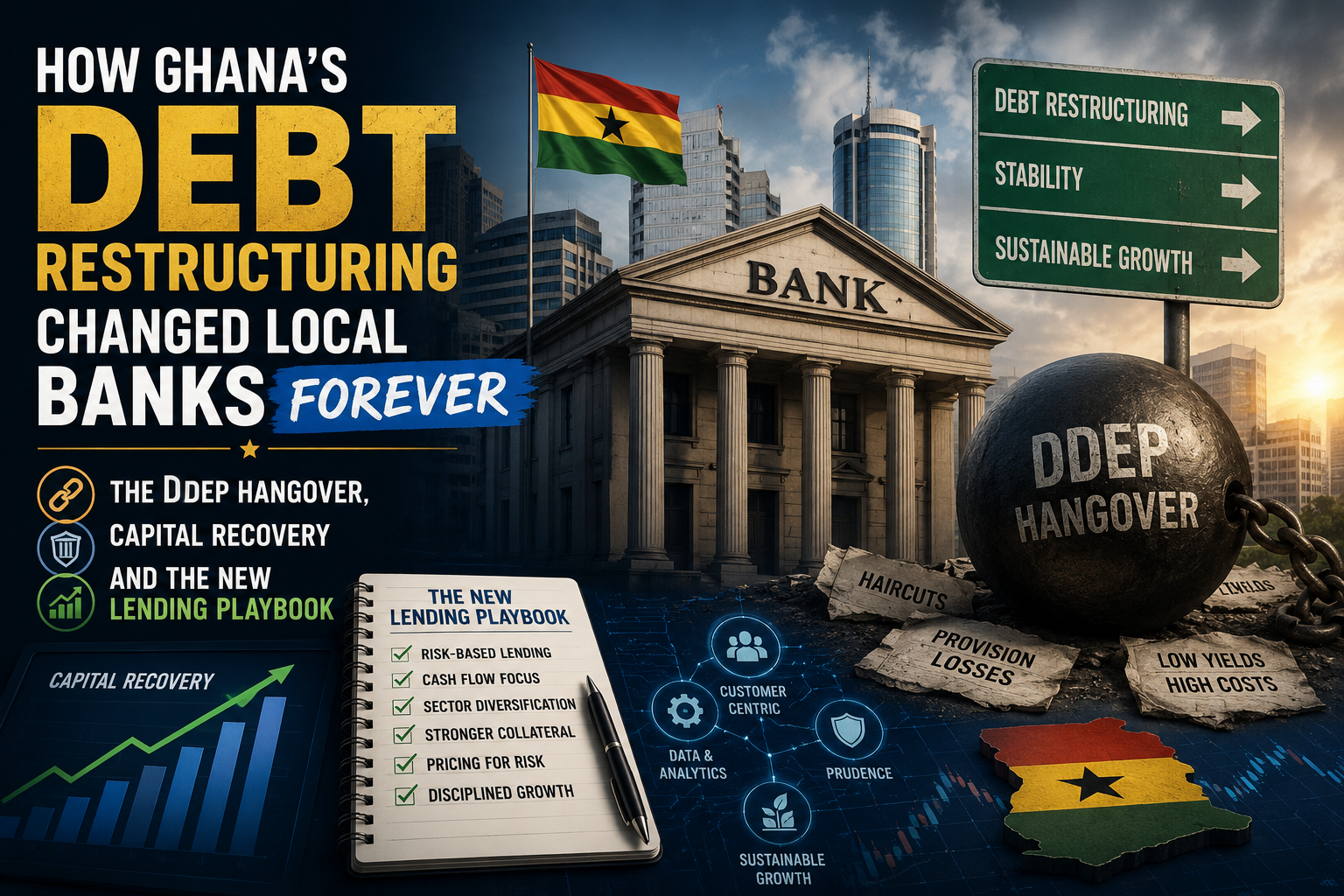
How Ghana’s Debt Restructuring Changed Local Banks Forever — The DDEP Hangover, Capital Recovery and the New Lending Playbook
On a single day in late 2022, Ghana’s banks went from being among the most profitable financial institutions in West Africa to holding billions in government bonds that had effectively been rendered worthless. The Domestic Debt Exchange Programme — a forced restructuring of the country’s domestic debt — was about to hit their balance sheets with a force no stress test had anticipated.
The headline numbers are staggering. A January 2023 study by economist Dr Richmond Akwasi Atuahene and K.B. Frimpong estimated that the banking sector stood to lose GH¢67.88 billion, with an overall net present value loss of approximately 58 per cent. Fitch Ratings warned that the enormous losses imposed on bondholders had “severely damaged the capitalization of the banking industry. For many institutions, capital adequacy ratios plunged below regulatory minimums. The Bank of Ghana itself was not spared, absorbing a 50 per cent haircut on its holdings of domestic debt.
📢 GET DETAILED ARTICLES + JOBS
Join THSB's WhatsApp Channel and never miss a post or opportunity.
The government restructured about GH¢137 billion in domestic bonds, achieving over 95 per cent participation among eligible holders. The alternative would have been catastrophic: public debt had reached 88 per cent of GDP, inflation was above 54 per cent, and the country was effectively locked out of international capital markets. The DDEP was a rescue operation — but it came at an extraordinary cost to the very institutions the government needed to drive economic recovery.

Three years later, the picture is dramatically different. The banking sector’s Capital Adequacy Ratio (CAR) has rebounded from crisis lows to 18.6 per cent, well above the 13 per cent regulatory minimum. Total industry assets have surged to GH¢465.4 billion, deposits have grown to GH¢338.5 billion, and non-performing loans have declined from 22.6 per cent to 18.4 per cent. Banks have written off legacy bad debts, recapitalised through a combination of retained earnings, shareholder injections and government support, and begun lending again. In May 2026, the government returned to the domestic bond market for the first time since the restructuring, raising GH¢3.1 billion in a seven-year bond priced at 12.5 per cent — a sign that investor confidence has been restored.
But the changes run far deeper than aggregate statistics. This profile examines how the DDEP permanently transformed Ghana’s banking sector: the mechanics of the losses, the uneven distribution of pain across state-owned, foreign and private domestic banks, the protracted capital recovery, the lasting shift in lending behaviour, the structural changes to how banks manage sovereign risk, and the outlook for a sector that will never be the same.
The DDEP: What Actually Happened
To understand how the restructuring changed banks forever, one must first understand what the DDEP actually was.
In December 2022, the government announced that holders of domestic bonds would be required to exchange their existing holdings for a package of 12 new bonds with extended maturities ranging from 2027 to 2038 and substantially reduced coupon rates. The existing bonds, which had an average coupon of about 19.1 per cent and a weighted average maturity of 13.8 years, were swapped for new bonds paying an average coupon of 9.1 per cent with an average maturity of 8.3 years. The exchange was nominally voluntary but effectively compulsory; bondholders who did not participate faced the prospect of receiving nothing.
The NPV losses varied by holder category, but the banking sector was hit hardest. The study by Atuahene and Frimpong estimated banking sector losses of GH¢67.88 billion. The losses were concentrated among the 22 universal banks, which held about GH¢50.6 billion of the GH¢87 billion restructured from Treasury bonds, ESLA bonds and Daakye bonds, excluding pension funds, which were largely spared through a separate arrangement.
Initial estimates of banking sector losses were as high as GH¢41.3 billion, but a revision to the discount rate used to calculate NPV losses — from an earlier higher rate to a 16–18 per cent range — reduced the final recognised loss to approximately GH¢7.3 billion. Even this lower figure, however, masked the scale of the damage. The impact on banks’ capital positions and liquidity was severe. Furthermore, as Fitch noted, the restructuring of sovereign debt and the potential for loan quality issues created a cascade of capital pressures.
The Bank of Ghana — as a domestic bondholder — also took a substantial haircut, with reports indicating the central bank absorbed a 50 per cent loss on its holdings of government securities in the first round of the restructuring. The BoG’s 2023 annual report showed that its total liabilities exceeded total assets by GH¢65.36 billion, a direct consequence of the DDEP and associated losses.
In July 2023, the government extended the scope of the restructuring to include dollar-denominated domestic bonds and cocoa bills, deepening the impact on banks that held those instruments. The three-year restriction on new bond issuance, imposed in 2023 to prevent further debt accumulation, locked banks out of the long-end sovereign market entirely, forcing them to rely on short-term Treasury bills for liquidity management.
The Losses: Who Lost What and How It Was Calculated
The distribution of losses across the banking sector was not uniform. According to the revised loss calculations following the agreement on a 16–18 per cent discount rate, the total DDEP impairment losses for the 22 universal banks stood at GH¢7.3 billion. The breakdown was revealing: foreign-owned banks lost GH¢2.995 billion, state-owned banks lost GH¢2.377 billion, and private domestic banks lost GH¢1.911 billion.
Foreign-owned banks, despite their stronger capital buffers and access to parent company support, absorbed the largest absolute losses. This reflects their significant holdings of Ghanaian government bonds before the restructuring, a function of the high yields that had attracted foreign capital to the Ghanaian debt market during the years preceding the crisis. Regional and foreign banks were better positioned to withstand the shock because of the strength of their parent balance sheets, as Fitch noted at the time.

State-owned banks — including the Agricultural Development Bank (ADB) and the National Investment Bank (NIB) — faced a dual challenge: absorbing DDEP losses while also addressing legacy NPLs and, in some cases, governance weaknesses. ADB’s capital adequacy ratio plunged to negative territory, standing at (3.15 per cent) in 2024, well below regulatory requirements. NIB required direct government support to remain solvent.
Private domestic banks, while losing the least in absolute terms, were the most vulnerable to the shock. They lacked the parent company backing of foreign banks and did not have the same access to government recapitalisation support as state-owned institutions. For many private domestic banks, the DDEP losses pushed capital adequacy ratios dangerously close to regulatory minimums — or below them.
Beyond the direct losses on bond holdings, the restructuring created a second-order impact: the reduction in coupon payments from an average of 19.1 per cent to 9.1 per cent permanently reduced banks’ recurring interest income from their government securities portfolios. For banks that had relied on these high-yielding sovereign securities as a reliable source of earnings, this was a structural blow from which they have had to adjust through portfolio rebalancing and a renewed focus on lending.
Capital Destruction and the Race to Rebuild
The DDEP did not merely reduce bank profits. It destroyed capital. For an industry that measures its health in basis points of capital adequacy, the restructuring was a blunt instrument that left a trail of institutions technically insolvent.
The IMF reported that 13 banks recorded capital deficits immediately after the DDEP and required urgent recapitalisation. The Ghana Financial Sector Stability Fund (GFSF), supported by the World Bank, provided crucial assistance to help these institutions restore their CAR to the 13 per cent minimum, utilising retained earnings from prior periods and new capital injections from shareholders.
The recovery has been remarkable. The industry-wide Capital Adequacy Ratio, which had fallen as low as 14 per cent in 2024, rose to 17.5 per cent in 2025 and further to 18.6 per cent in February 2026 — comfortably above the regulatory minimum. Perhaps more significant, the CAR without regulatory reliefs rose sharply from 11.3 per cent to 17.5 per cent, indicating that the sector’s resilience is no longer dependent on temporary regulatory forbearance but on genuine balance sheet strengthening.
The BoG’s stress tests in January 2026 confirmed that the banking sector is now robust to adverse macroeconomic developments, due to strong capital buffers, an improving macroeconomic environment and large holdings of government instruments. The central bank warned, however, that a deterioration in macroeconomic conditions could negatively impact asset quality and increase operational costs, though gains from net interest income would likely offset these pressures.
But aggregate data conceals persistent heterogeneity. The IMF noted that a few banks, including one state-owned institution, remained behind their recapitalisation schedules, facing slower-than-anticipated progress on shareholder capital commitments and elevated NPLs that delayed the recognition of credit impairments and provisions. These institutions are now under intensified BoG monitoring and subject to corrective measures to accelerate their recapitalisation plans.
The ADB Turnaround: A Case Study in Post-DDEP Recovery
The Agricultural Development Bank provides the most dramatic example of a post-DDEP banking resurrection.
In 2024, ADB’s CAR stood at (3.15 per cent) — negative capital adequacy, technically insolvent. The bank had been brought to its knees by a combination of DDEP losses, decades of legacy NPLs, weak governance and a business model heavily reliant on government securities. For many analysts, ADB was the banking sector’s canary in the coalmine: a state-owned institution that could not be allowed to fail but seemed incapable of saving itself.
The turnaround that followed has been described by industry observers as a “resurrection”. ADB received a deposit of GH¢850 million for shares (pending registration), which strengthened its capital position and improved its CAR to 27.17 per cent — a swing of more than 30 percentage points. Aggressive loan recovery efforts yielded GH¢301.4 million from non-performing loans. Net interest income nearly doubled, reaching GH¢1.37 billion, suggesting that despite the focus on recovery, the bank’s lending and investment strategies are yielding higher returns than in previous years.
By 2025, ADB recorded a profit after tax of GH¢367.2 million, a massive leap from the GH¢35 million profit recorded in 2024, with total assets growing 22 per cent to cross the GH¢17 billion mark. The NPL ratio, while still high at 70.53 per cent, improved from 75.26 per cent a year prior, and the bank continues aggressive recoveries as part of its strategy to further strengthen its balance sheet.
ADB’s trajectory demonstrates both the potential for recovery and the scale of the challenge. Even with a CAR above 27 per cent, the bank’s NPL ratio remains at a level that would be catastrophic in any other jurisdiction. ADB is not fully recovered — but it is no longer an existential threat to the system. That, after the DDEP, counts as a victory.
The GCB Phoenix: How Ghana’s Largest Indigenous Bank Emerged Stronger
If ADB is the story of survival, GCB Bank’s post-DDEP performance is a story of transformation and outright dominance. As Ghana’s largest indigenous bank, GCB has not merely recovered from the restructuring; it has used the crisis as a catalyst for strategic reinvention.
The numbers are arresting. In 2025, GCB Bank reported a record Profit Before Tax (PBT) of GH¢3.17 billion — a 67.4 per cent increase from the previous year. Operating income increased 40.9 per cent to GH¢6.3 billion. Customer deposits grew 19.7 per cent to GH¢41.3 billion, driving a 23 per cent expansion in the Bank’s balance sheet to GH¢52.6 billion. The loan book expanded 56.8 per cent year-on-year to GH¢16.39 billion as credit demand recovered alongside Ghana’s broader economic rebound.
The most striking improvement, however, was in asset quality. GCB’s non-performing loan ratio crashed from 14.9 per cent in March 2025 to just 4.9 per cent by March 2026 — a level below the international benchmark of 5 per cent and a rarity among Ghanaian banks. The bank’s credit impairment allowance fell sharply from GH¢1.66 billion in March 2025 to GH¢735.9 million in March 2026, reflecting a comprehensive clean-up of legacy bad debts.
But GCB’s post-DDEP strategy goes beyond balance sheet repair. The bank has actively diversified its revenue away from interest income toward non-funded income — fees, commissions and trading — recognising that the collapse of government bond yields would permanently compress traditional lending margins. Non-funded income rose 58 per cent year-on-year, lifting its share of total revenue to 27.3 per cent from 24.3 per cent in 2024.
The strategic shift has been intentional. GCB’s 2025–2028 medium-term strategy targets a structural shift away from a predominantly retail-funded model toward a more diversified platform spanning wholesale, commercial and transaction banking. It also launched a comprehensive sustainability programme covering climate risk, diversity and governance, alongside flagship initiatives including the Sheagles Soar female leadership development programme.
Shareholders have been richly rewarded. Those who held GCB stock throughout 2025 saw the share price rise from GH¢6.37 to GH¢20.11, a capital gain of 215.7 per cent. A final dividend of GH¢1.00 per share — which had been withheld the previous year due to regulatory concerns — was approved, signalling that the BoG now considers GCB’s capital position and compliance standing sufficiently restored.
The contrast with the immediate post-DDEP period could not be starker. At that time, GCB’s capital buffers were under pressure, its NPLs were elevated and it faced the same uncertainty as every other institution in the sector. By May 2026, GCB was aggressively lending again, its loan book doubling year-on-year, and its Managing Director Farihan Alhassan declared the bank “well positioned to fully meet our clients’ aspirations” even as margin compression from falling interest rates presented new challenges.
The NPL Trap: Why Asset Quality Remains the Greatest Threat
For all the progress on capital adequacy, the non-performing loan ratio remains the sector’s greatest vulnerability and the most persistent legacy of the DDEP era.
The sector-wide NPL ratio improved from 22.6 per cent in February 2025 to 18.4 per cent in February 2026 — a meaningful reduction but still more than triple the international benchmark of 5 per cent. In absolute terms, banks wrote off substantial bad debts, with GH¢394.8 million written off in February 2026 alone.
The IMF has been characteristically blunt. A Technical Assistance Report following a mission to Ghana found that “banks incurred significant losses on domestic government bonds holdings, which weakened their capital positions”, and that despite some improvements, “the private sector NPL ratio remains elevated at 20.8 per cent. The Fund also noted that banks “continue to be highly exposed to domestic sovereign”, meaning that if Ghana were to face another fiscal crisis, the banking sector would be vulnerable once again.
Governor Asiama has set an ambitious target: reducing the NPL ratio to 10 per cent by the end of 2026, supported by a “clear roadmap” that includes enhanced supervision of credit risk management practices, stricter enforcement of loan classification and provisioning requirements, improved credit information sharing and frameworks to support sustainable lending.
But achieving this target will be difficult. Fitch Ratings revealed in September 2025 that only four out of 23 banks had NPL ratios below the 10 per cent threshold, with more than half of banks reporting ratios above 15 per cent. The heterogeneity in asset quality across the sector means that while GCB has achieved a single-digit NPL ratio, many smaller and state-owned banks are still carrying heavy burdens of bad debt.
The BoG’s stress tests in January 2026 also warned that although the banking sector is robust to adverse macroeconomic developments, a deterioration in conditions could negatively impact asset quality, representing an upside risk to the sector. The central bank concluded that the outlook remains stable, contingent on the completion of the recapitalisation programme and the implementation of its NPL regulatory guidelines.
The Portfolio Shift: From Government Securities to Private Credit
The most consequential behavioural change induced by the DDEP has been the forced shift in bank portfolio allocation. For years, banks had enjoyed a comfortable and profitable business model: collect cheap deposits, park the funds in high-yielding government securities, collect the spread, and do minimal lending. The DDEP destroyed that model in two ways: by reducing the value of existing government securities holdings and by permanently lowering the yield on future government paper.
The response has been a slow but unmistakable shift toward private sector lending. Total advances increased by 16 per cent from GH¢95.7 billion to GH¢111 billion in 2025, and the private sector’s share of total outstanding credit rose to about 96 per cent. Cumulative new loan disbursements increased from GH¢80.95 billion in October 2025 to GH¢104.17 billion by December, while nominal private sector credit growth accelerated to over 19 per cent, with real credit growth rising to about 13 per cent compared with 2 per cent the previous year.
Governor Asiama noted at the March 2026 MPC briefing that the improvement in the banking sector was occurring alongside broader macroeconomic stabilisation, with average lending rates declining to 19.2 per cent in February 2026 from 30.1 per cent in February 2025. This significant reduction in lending rates has begun translating into a gradual increase in private sector credit, reversing the credit contraction that characterised much of 2024 and early 2025,” he said.
However, banks have not abandoned government securities entirely. Investments grew sharply by 57.5 per cent to GH¢192.8 billion in early 2026, as banks took advantage of higher money market rates on short-term instruments. The pattern is now one of cautious rebalancing: banks are diversifying their portfolios, but they remain heavily exposed to sovereign risk because, as Governor Asiama acknowledged, the banking system entered 2025 still adjusting to the effects of the DDEP, with capital buffers under pressure, NPLs elevated and confidence requiring rebuilding.
The Bond Market Reopening: A Test of Recovery
On 2 March 2026, the Ministry of Finance announced the expiration of the three-year restriction on new domestic bond issuance imposed in 2023, clearing the way for the government to return to the local bond market. The restriction had been implemented at the height of the debt crisis to prevent further debt accumulation and rebuild investor confidence.
The government’s first post-restructuring issuance was a seven-year cedi-denominated bond, marketed from 30 March with books closing on 1 April and settlement on 7 April. The auction secured GH¢3.1 billion in bids, with the government accepting GH¢2.7 billion of the total. The bond carries a coupon rate of 12.5 per cent and is set to mature on 29 March 2033, priced at a level that is attractive to investors while being sustainable for the government.
The reopening is a carefully calibrated test. The government set a minimum bid of GH¢50,000, opened the bond to both resident and non-resident investors, and appointed six Bond Market Specialists — Absa Bank Ghana, CalBank PLC, Fincap Securities, GCB Bank PLC, One Africa Securities and Stanbic Bank Ghana — to facilitate the process. The bond is expected to be listed on the Ghana Stock Exchange to support secondary market trading.
The Ministry of Finance has been explicit about the conditions that made the reopening possible. Since 2025, the Government has honoured every coupon payment and obligation under the restructured bonds, demonstrating its credibility, fiscal discipline, and commitment to responsible debt management,” the Ministry stated. The lifting of restrictions comes at a time when inflation is low, investor confidence has improved, and the macroeconomic environment is strong, supported by a robust medium-term debt management strategy and significant buffers.
For the banking sector, the bond market reopening has significant implications. It allows banks to once again access longer-dated government securities as part of their portfolio allocation, reducing their reliance on short-term Treasury bills. It signals that the government considers the domestic debt market stable enough to absorb new issuance. And it provides a benchmark for pricing sovereign risk — a crucial signal as banks adjust their risk models in the post-DDEP era.
Between March and June 2026, the government plans to raise GH¢15.231 billion through Treasury bills and bonds to support budget implementation and refinance maturing debt. Authorities also aim to establish benchmark bonds through the issuance programme and to rebuild the sovereign yield curve, which had been distorted by the restructuring and the subsequent freeze.
Government Compensation Ruled Out: The Finality of the Losses
One question has lingered over the banking sector since the DDEP: would the government ever compensate bondholders for their losses? In May 2026, the answer came: no.
Finance Minister Dr Cassiel Ato Baah Forson ruled out compensation for bondholders who incurred losses under the DDEP, stating that there was no legal or contractual basis for the state to reimburse investors who had taken haircuts during the 2022/2023 debt restructuring. I do not recall that there is something of the sort that calls on the people of Ghana for the Ghanaian government to give some form of compensation,” the Minister said, adding that he was “not aware of any clause in the agreements signed with bondholders that would create such a liability for the state.
The government’s position is unambiguous. The losses are final. Banks must continue to absorb them and adjust their business models accordingly, without the prospect of a future bailout that would offset the damage.
The Minister, however, also promised that the fiscal space created by the restructuring would be used to support growth and job creation. He announced that a flagship programme called “the new economy” would be unveiled soon, targeting sectors with high employment potential. IMF Mission Chief for Ghana Ruben Atoyan supported the government’s stance, noting that the debt restructuring was necessary to stabilise the Ghanaian economy and put it on a sustainable path, having helped to create fiscal space for growth.
For banks, the ruling out of compensation confirms what many had privately accepted: the DDEP losses are a permanent impairment to their balance sheets. The only path forward is to grow out of the damage through retained earnings, expanded lending and improved operational efficiency — exactly what GCB and ADB have begun to do.
The Behavioural Legacy: How the DDEP Changed Banking Forever
The DDEP has left permanent marks on Ghanaian banking that will shape the sector for years to come.
Sovereign Risk Is No Longer Ignored: Before the DDEP, Ghanaian banks treated government securities as effectively risk-free, pricing sovereign exposure at zero in their risk models. The restructuring shattered that assumption. Banks now understand — in a way that no textbook or seminar could ever teach — that even sovereign paper can incur losses. Risk management frameworks have been revised accordingly, with banks now more carefully evaluating the trade-offs between yields and sovereign risk.
Diversification Is No Longer Optional: The old model of heavy concentration in government securities is no longer viable. The collapse in yields and the reduction in coupon rates have made government paper far less profitable. Banks have been forced to diversify — into private sector lending, into fee-based income, into digital banking, and into ancillary services. GCB’s strategic pivot toward non-funded income is a leading indicator of where the entire sector is headed.
Capital Buffers Are Being Defended Aggressively: The experience of the DDEP — where banks watched their capital adequacy ratios evaporate almost overnight — has made the sector far more conservative in its capital management. Banks are now more likely to retain earnings rather than distribute them as dividends, as evidenced by GCB’s dividend being withheld in 2024 before being approved in 2025. The cost of being undercapitalised was made painfully clear.
Credit Risk Management Has Been Upgraded: High NPLs remain the sector’s greatest vulnerability, but banks have invested heavily in upgrading their credit risk management systems. The clean-up of bad debts — GH¢394.8 million written off in February 2026 alone — reflects a sector that is no longer willing to carry legacy NPLs on its books indefinitely. Tighter lending standards, stronger early-warning systems and improved loan recoveries are now standard practice.
Confidence Has Been Slowly Rebuilt: The most intangible but perhaps most important change is the restoration of confidence. Deposits grew by 17.8 per cent to GH¢325.3 billion in 2025, reflecting a public that is increasingly willing to entrust its savings to the banking sector. The government’s consistent coupon payments on restructured bonds since 2025 have demonstrated renewed credibility. But the trauma of the DDEP lingers. It will take years — perhaps a full cycle of economic growth — before the events of 2023 fade from institutional memory.
Future Outlook: Three Scenarios for the Post-DDEP Banking Sector
Where is Ghana’s banking sector heading now that the restructuring has been absorbed and the bond market has reopened? Three scenarios are plausible.
Scenario One: Gradual Normalisation (65 per cent probability)
In this base case, the banking sector continues its current trajectory. Capital adequacy remains above 17–18 per cent. NPLs decline gradually toward the Governor’s 10 per cent target by end-2026, though some banks will miss that target. Private sector credit growth stabilises in the 15–20 per cent range. The bond market reopening leads to a gradual rebuilding of the sovereign yield curve, with the government issuing new bonds at coupons in the 12–14 per cent range. Banks continue to diversify into non-funded income and digital banking. Profits remain healthy but no longer achieve the extraordinary growth rates seen in 2025. This scenario assumes continued fiscal discipline, stable inflation, and no major external shocks.
Scenario Two: Accelerated Recovery (25 per cent probability)
If Ghana’s economic growth accelerates beyond current projections — perhaps 6–7 per cent GDP growth driven by gold and agricultural exports — credit demand could surge. Banks with strong capital positions would be well-positioned to capture this demand. Loan growth could exceed 25 per cent annually. NPLs could fall below 10 per cent more quickly than anticipated as improved economic conditions strengthen borrower repayment capacity. The bond market could expand significantly, with the government issuing new bonds across multiple tenors. This optimistic scenario is possible but depends on macroeconomic conditions that are not fully within the control of either banks or regulators.
Scenario Three: Renewed Vulnerability (10 per cent probability)
If Ghana faces another external shock — a sharp decline in gold prices, a spike in global oil prices, or a renewed cedi depreciation — the banking sector’s vulnerabilities could re-emerge. NPLs, already elevated, could rise further as businesses struggle to service their loans. The government’s fiscal position could deteriorate, potentially raising sovereign risk and making bond market issuance more expensive. Banks that have not fully recapitalised could face renewed capital pressures. While the BoG’s stress tests suggest the sector is robust to adverse developments, a sufficiently severe shock could test those conclusions. This is the low-probability, high-impact scenario that keeps policymakers and regulators focused on building buffers and maintaining discipline.
THSB Conclusion
The Domestic Debt Exchange Programme will be remembered as the most consequential event in Ghanaian banking history since the 2017–2019 financial sector cleanup. It was a crisis born of necessity — a government on the brink of default, forced to restructure GH¢137 billion in domestic bonds to keep the economy from collapse. But it was also a crisis that the banking sector did not cause and could not prevent. It was simply told to absorb the losses and keep operating.
And it has. The banking sector’s recovery from the DDEP has been remarkable by almost any measure. Capital adequacy has rebounded from negative territory for some institutions to a system-wide average of 18.6 per cent. Deposits have surged. Private sector lending is growing again. The bond market has reopened, with a new seven-year bond clearing at 12.5 per cent. GCB Bank has delivered record profits and a single-digit NPL ratio. ADB has staged a “resurrection” from negative capital to a CAR of 27 per cent.
But the legacy of the DDEP is not just in the numbers. It is in the permanent changes to how banks operate. They now understand that sovereign securities carry risk. They now know that concentration in government paper is a vulnerability, not a strategy. They now recognise that capital buffers must be defended aggressively. They have learned — through painful, expensive experience — that the old model is broken and that a new model must be built.
The scars remain. NPLs are still too high at 18.4 per cent. Some banks are still struggling to meet capital requirements. The government has ruled out compensation, confirming that the losses are final. The private sector NPL ratio is still above 20 per cent. The banking sector is healthier than it was in 2023, but it is not yet fully healed.
The question now is not whether the banking sector can survive. It has already demonstrated that it can. The question is what kind of banking sector will emerge over the next five years — one that has truly learned the lessons of the DDEP, diversified its portfolios, strengthened its underwriting, and built lasting resilience; or one that slips back into the old habits of heavy sovereign concentration and weak credit risk management.
The DDEP changed Ghana’s banks forever. Whether that change leads to a stronger, more resilient banking sector — or merely a more cautious one — depends on the choices that banks, regulators, and policymakers make in the years ahead. The restructuring saved the country from default. But it also gave Ghana’s banks an education they will never forget. The question is whether they pass the exam that follows.
Frequently Asked Questions (FAQ)
Q1: What was the Domestic Debt Exchange Programme (DDEP) in Ghana?
The DDEP was a government-led restructuring of Ghana’s domestic debt, announced in December 2022, in which holders of domestic bonds were required to exchange their existing holdings for new bonds with extended maturities (from 2027 to 2038) and substantially reduced coupon rates (from about 19.1 per cent to about 9.1 per cent). The programme affected over GH¢137 billion in bonds and achieved over 95 per cent participation.
Q2: How much did Ghana’s banks actually lose from the DDEP?
Initial estimates placed banking sector losses at GH¢67.88 billion, but following an agreement on a revised discount rate (16–18 per cent) for calculating NPV losses, the final recognised impairment loss was approximately GH¢7.3 billion. Foreign-owned banks lost GH¢2.995 billion, state-owned banks GH¢2.377 billion, and private domestic banks GH¢1.911 billion.
Q3: Did the Bank of Ghana itself suffer losses from the DDEP?
Yes. The Bank of Ghana absorbed substantial losses as a domestic bondholder, with reports indicating a 50 per cent haircut on its holdings of government securities. The central bank’s 2023 annual report showed total liabilities exceeding total assets by GH¢65.36 billion.
Q4: Which banks were hit hardest by the DDEP?
Foreign-owned banks experienced the largest absolute losses (GH¢2.995 billion), though they were better able to absorb them due to parent company support. State-owned banks, including ADB and NIB, faced the most severe capital adequacy challenges, with ADB’s CAR falling to (3.15 per cent) in 2024.
Q5: How many banks became undercapitalised after the DDEP?
The IMF reported that 13 banks recorded capital deficits immediately after the DDEP and required urgent recapitalisation. Most have since restored their Capital Adequacy Ratios, though a few state-owned institutions remain behind schedule.
Q6: What is the banking sector’s current Capital Adequacy Ratio (CAR)?
The industry-wide Capital Adequacy Ratio rose to 17.5 per cent in 2025 and further to 18.6 per cent in February 2026, well above the 13 per cent regulatory minimum. The CAR without regulatory reliefs rose sharply from 11.3 per cent to 17.5 per cent, indicating genuine balance sheet strengthening.
Q7: Has the banking sector fully recovered from the DDEP?
While aggregate indicators show significant recovery — assets up to GH¢465.4 billion, CAR at 18.6 per cent, NPLs down from 22.6 per cent to 18.4 per cent — several challenges remain. NPLs remain elevated above 18 per cent, some banks are still behind on recapitalisation, and the private sector NPL ratio is still above 20 per cent. The sector is healthier but not yet fully healed.
Q8: When did Ghana reopen its domestic bond market after the DDEP?
The Ministry of Finance announced the expiration of the three-year restriction on new domestic bond issuance on 2 March 2026. The first post-restructuring bond — a seven-year cedi-denominated instrument — was auctioned on 30 March 2026, raising GH¢3.1 billion in bids at a 12.5 per cent coupon.
Q9: Will the government compensate banks for their DDEP losses?
No. In May 2026, Finance Minister Dr Cassiel Ato Baah Forson ruled out compensation for bondholders who incurred losses under the DDEP, stating that there was no legal or contractual basis for the state to reimburse investors. The losses are final.
Q10: How has GCB Bank performed since the DDEP?
GCB Bank has staged a remarkable recovery, posting a record PBT of GH¢3.17 billion in 2025 (67.4 per cent increase), reducing its NPL ratio from 14.9 per cent to 4.9 per cent, and seeing its share price appreciate 215.7 per cent. The bank has also strategically pivoted to non-funded income, raising its share of revenue to 27.3 per cent.
Q11: What is the current NPL ratio in Ghana’s banking sector?
As of February 2026, the industry-wide NPL ratio stood at 18.4 per cent, down from 22.6 per cent a year earlier. However, the private sector NPL ratio remains elevated at 20.8 per cent, and only four banks had NPL ratios below the international benchmark of 10 per cent as of mid-2025.
Q12: What is the long-term outlook for Ghana’s banking sector after the DDEP?
Most analysts expect gradual normalisation, with CAR remaining above 17 per cent, NPLs declining toward 10 per cent by end-2027, and private sector credit growth stabilising in the 15–20 per cent range. The banking sector has survived the shock and is now fundamentally more diversified and risk-aware — but the psychological and structural scars of the DDEP will shape institutional behaviour for years to come.
Source: The High Street Business
Disclaimer: Some content on The High Street Business may be aggregated, summarized, or edited from third-party sources for informational purposes. Images and media are used under fair use or royalty-free licenses. The High Street Business is a subsidiary of SamBoad Publishing under SamBoad Business Group Ltd, registered in Ghana since 2014.
For concerns or inquiries, please visit our Privacy Policy or Contact Page.

Esther Aku-Sika is a content writer and social media strategist who helps brands and startups grow through intentional storytelling and practical marketing strategies. With a keen eye for trends and audience behavior, she shares business insights, content strategies, and real-life lessons to help entrepreneurs build visibility and turn ideas into income. Through her writing, she simplifies complex concepts and equips readers with actionable steps to grow in today’s digital space.