








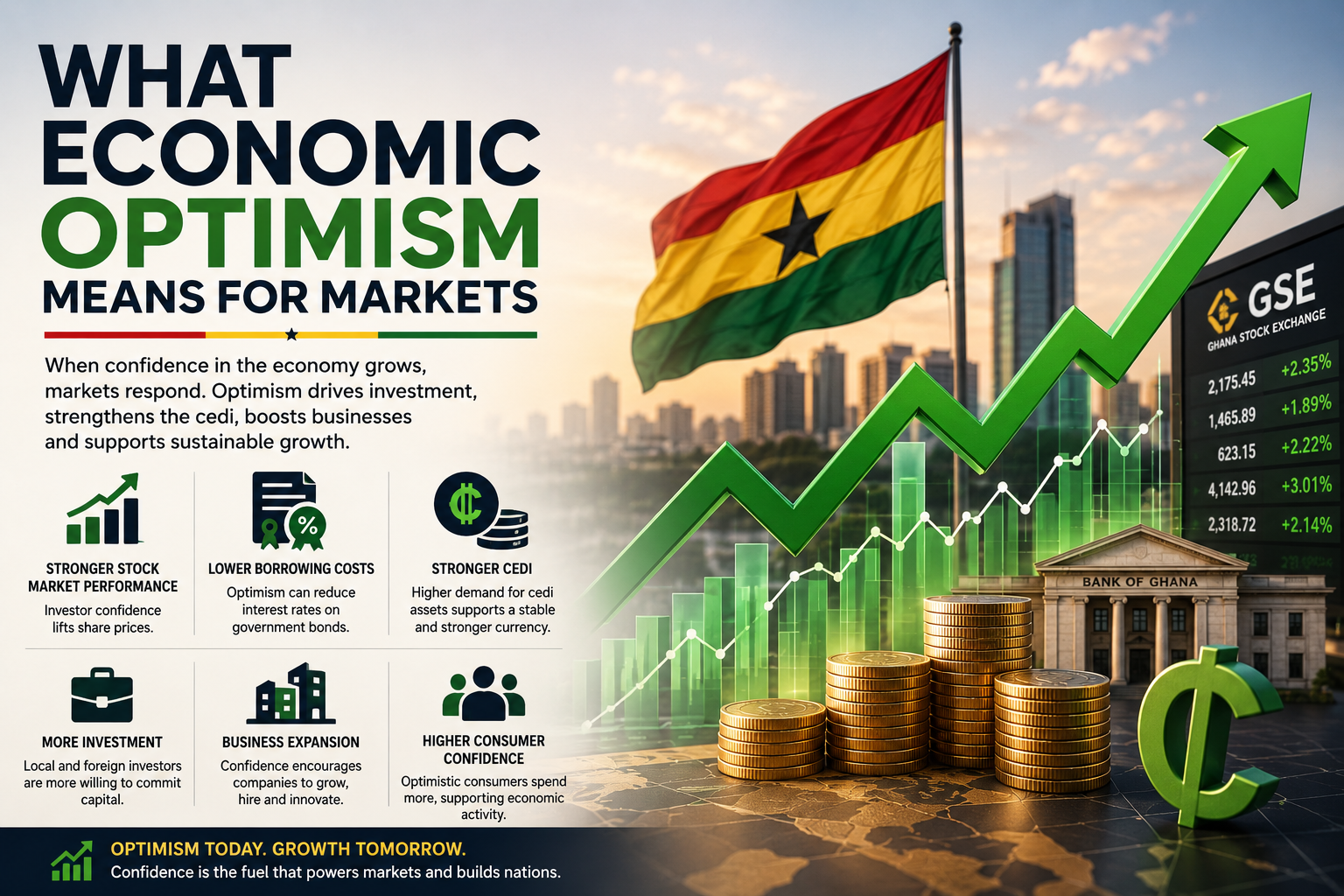
What Economic Optimism Means for Markets: Economic optimism can boost stock markets, strengthen currencies, and encourage business investment. Learn what economic optimism means for Ghana’s markets and why confidence matters.
What Economic Optimism Means for Markets
Markets are driven not only by hard data such as inflation, interest rates, and corporate earnings, but also by confidence. When businesses, investors, and consumers believe the economy is improving, that sense of optimism can influence decisions across the financial system.
In Ghana, economic optimism has become an important factor as inflation moderates, the cedi stabilises, and fiscal reforms begin to restore confidence. While challenges remain, improving sentiment can have a meaningful impact on the stock market, government bonds, exchange rates, and business activity.
📢 GET DETAILED ARTICLES + JOBS
Join THSB's WhatsApp Channel and never miss a post or opportunity.
Understanding Economic Optimism
Economic optimism refers to the belief that economic conditions are likely to improve over time. It is shaped by factors such as lower inflation, stronger growth, stable public finances, and supportive government policies.
When confidence rises:
- Investors are more willing to buy assets.
- Businesses expand operations.
- Consumers spend more freely.
- Banks become more willing to lend.
This positive outlook can create momentum that supports economic growth and strengthens financial markets.
How Confidence Influences Financial Markets
Financial markets respond quickly to expectations.If investors believe the economy is heading in the right direction, they are more likely to buy stocks, government securities, and the local currency. As demand increases, asset prices often rise and borrowing costs can fall.
On the other hand, uncertainty or pessimism can lead investors to sell assets, delay investment decisions, and seek safer alternatives.
In many ways, market performance reflects how people feel about the future as much as it reflects present conditions.
Impact on the Ghana Stock Exchange
The Ghana Stock Exchange tends to benefit when investors expect stronger economic growth. Economic optimism can lift share prices because:
- Companies are expected to earn higher profits.
- Consumer spending may increase.
- Financing conditions may improve.
- Foreign investors may return to the market.
Sectors such as banking, telecommunications, manufacturing, and consumer goods often gain when confidence improves.
Effect on Government Bonds
Government bond markets are highly sensitive to investor sentiment. When confidence in the economy and public finances strengthens, investors are generally more comfortable lending money to the government. This can reduce interest rates on treasury bills and bonds, lowering borrowing costs.
For Ghana, stronger confidence can help attract both domestic and international investors, making it easier to finance development projects and manage debt obligations.
Support for the Ghana Cedi
Economic optimism can also strengthen the Ghanaian cedi. When investors believe Ghana’s economy is improving, they are more likely to hold cedi-denominated assets such as bonds and stocks. Increased demand for these assets boosts demand for the local currency.
A stronger or more stable cedi helps reduce import costs and eases inflationary pressures, benefiting both businesses and consumers.
Encouraging Foreign Investment
International investors closely watch signs of economic progress. Improving inflation trends, fiscal discipline, and policy consistency can encourage foreign direct investment and portfolio flows. Companies may be more willing to build factories, expand operations, or partner with local businesses.
This inflow of capital can create jobs, strengthen foreign exchange reserves, and support broader economic development.
Boosting Business Expansion
Optimism is not limited to financial markets. It also affects everyday business decisions. When companies feel confident about future demand, they are more likely to:
- Hire additional workers
- Increase inventory
- Purchase equipment
- Open new branches
- Launch new products
These actions stimulate economic activity and contribute to higher growth.
Improving Consumer Sentiment
Households play a crucial role in economic performance. If consumers expect prices to stabilise and incomes to improve, they may spend more on goods, services, and housing. This increased spending supports businesses and can raise company earnings.
Higher consumer confidence often reinforces the positive cycle between optimism and market performance.
What Drives Economic Optimism in Ghana?
Several factors can improve sentiment in Ghana’s markets:
- Declining inflation
- Stable exchange rates
- Lower interest rates
- Successful fiscal reforms
- Rising export earnings from gold, cocoa, and oil
- Improved debt sustainability
When these indicators move in the right direction, confidence tends to strengthen.
Risks to Market Optimism
Optimism can fade if economic conditions deteriorate. Potential risks include:
- Unexpected inflation increases
- Sharp cedi depreciation
- Falling commodity prices
- Global economic shocks
- Political uncertainty
Markets can react quickly to new information, which is why maintaining policy credibility is essential.
Why Economic Optimism Matters
Confidence is a powerful economic force. It influences investment, lending, hiring, and spending decisions that shape market outcomes.
For Ghana, renewed optimism can help attract capital, support the cedi, reduce borrowing costs, and encourage business expansion. While optimism alone cannot solve structural challenges, it creates a more favourable environment for growth and reform.
The Bottom Line
Economic optimism reflects growing confidence that the future will be better than the present. When businesses and investors believe Ghana is on a stronger path, markets often respond positively.
The stock market may rise, the cedi may strengthen, and investment may increase. Over time, this improved sentiment can contribute to job creation, stronger businesses, and a more resilient economy.
Source: The High Street Business
Disclaimer: Some content on The High Street Business may be aggregated, summarized, or edited from third-party sources for informational purposes. Images and media are used under fair use or royalty-free licenses. The High Street Business is a subsidiary of SamBoad Publishing under SamBoad Business Group Ltd, registered in Ghana since 2014.
For concerns or inquiries, please visit our Privacy Policy or Contact Page.

Esther Aku-Sika is a content writer and social media strategist who helps brands and startups grow through intentional storytelling and practical marketing strategies. With a keen eye for trends and audience behavior, she shares business insights, content strategies, and real-life lessons to help entrepreneurs build visibility and turn ideas into income. Through her writing, she simplifies complex concepts and equips readers with actionable steps to grow in today’s digital space.