









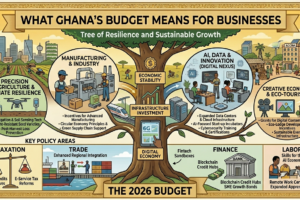

For the entrepreneur looking at Ghana’s business landscape, the numbers tell a compelling story: a startup economy valued at $2.6 billion in 2023, funding surging 95 percent in 2024, and over 400 new ventures emerging in the last decade . Yet for all the promise, a hard truth remains—small and medium-sized enterprises risk losing 20 to 30 percent of their startup capital to regulatory compliance alone .
This is the Ghanaian business paradox: opportunity and barrier existing side by side. The entrepreneur who understands this landscape—who knows which doors to knock on, which costs to anticipate, and which recent reforms can work in their favour—stands a far better chance of building something enduring.
The Real Cost of Compliance
The Institute for Liberty and Policy Innovation (ILAPI) captured a sobering reality in 2025: a startup with GHS 100,000 in capital should expect to spend about 20 to 30 percent of it on business regulation alone . For the self-employed trader working with modest capital, that figure can be devastating.
📢 GET DETAILED ARTICLES + JOBS
Join THSB's WhatsApp Channel and never miss a post or opportunity.
The silver lining? The Office of the Registrar of Companies (ORC) has made business registration more accessible than many realise. A sole proprietorship—the most common structure for individual entrepreneurs—can be registered for as little as GHS 130 . For that modest fee, a business gains legal recognition, name protection, and a foundation for securing contracts and partnerships .
But this is just the entry point. The true cost picture emerges as the business grows. An enterprise with foreign ownership faces GIPC registration fees that start at the cedi equivalent of US$3,500 for joint ventures and reach US$7,000 for trading enterprises . And those are one-time fees—renewals come every two years (under the new GIPA regime, annually), with foreign-owned enterprises paying the cedi equivalent of US$1,400 per renewal .
The financial burden is substantial enough that ILAPI has warned: for every GHS 100,000 in startup capital, three to five potential jobs may be lost to compliance costs alone . This is not a call to avoid compliance—it is a call to plan for it.
The New Investment Landscape: What Has Changed
April 2026 brought one of the most significant shifts in Ghana’s investment framework in over a decade. Parliament passed the Ghana Investment Promotion Authority (GIPA) Act, 2026, replacing the GIPC Act, 2013 . For entrepreneurs, several changes demand attention.
Minimum Capital Requirements Removed
For joint ventures and wholly-owned foreign companies (excluding trading enterprises), minimum capital requirements have been eliminated entirely . This is a seismic shift. Previously, a wholly foreign-owned non-trading enterprise needed US$500,000, while joint ventures required US$200,000 . The new regime lowers the barrier to entry significantly, allowing foreign investors to start with capital that matches their business plan rather than a fixed threshold.
For trading enterprises, the minimum has been reduced from US$1,000,000 to US$500,000, though these businesses must now ensure that 75 percent of their skilled workforce is Ghanaian .
Annual Renewals
Registration renewal moves from every two years to annually. This means more frequent compliance touchpoints—and more frequent fees. Foreign-owned enterprises will now pay the cedi equivalent of US$1,400 annually, up from the previous bi-annual schedule .
Technology Transfer Agreements
The minimum duration for a Technology Transfer Agreement (TTA) has been reduced from 18 to 12 months, and banks are now prohibited from remitting payments for unregistered agreements . This tightens enforcement around intellectual property and technology licensing.
Reserved Activities
The list of sectors reserved solely for Ghanaians has been trimmed. Pool betting/lotteries and recharge card printing have been removed from the reserved list, opening those sectors to foreign participation .
The Entrepreneur’s Roadmap: Step by Step
For the entrepreneur ready to formalise, the path has been simplified in recent years. The ORC now processes name searches instantly—”at the click of a button,” as one official put it . Here is what the process looks like.
Step 1: The Ghana Card and TIN
The Ghana Card PIN now serves as the Tax Identification Number (TIN) for citizens and resident foreigners. Entrepreneurs need only their Ghana Card to begin the registration process . Non-residents must apply for a non-citizen TIN through the Ghana Revenue Authority.
Step 2: Name Reservation
Applicants are advised to come with three preferred names. The ORC conducts an instant search to confirm availability . Once reserved, the name is typically valid for up to 60 days.
Step 3: Document Preparation
For a Company Limited by Shares, the required documents include Form 3C (company profile), the company constitution, consent letters from directors and secretary, statutory declarations, and beneficial ownership declarations . The beneficial ownership requirement—disclosing natural persons who ultimately own or control the company—aligns with global anti-money laundering standards.
Step 4: Submission and Fees
Documents can be submitted through the eRegistrar portal or at any ORC office. Fees vary by entity type. For a Company Limited by Shares, the standard fee is GHS 585, plus stamp duty of 1 percent of stated capital. VIP service is available for expedited processing .
For a sole proprietorship, the cost is as low as GHS 130 .
Step 5: Certificate of Incorporation
With clean documents, incorporation takes 3 to 10 business days. The ORC issues the Certificate of Incorporation, Certified True Copy of the Constitution, and Beneficial Ownership Profiles.
Step 6: GIPA Registration (if foreign-owned)
Businesses with foreign ownership must register with the Ghana Investment Promotion Authority (formerly GIPC). Registration fees vary: joint ventures pay the cedi equivalent of US$3,500, wholly foreign enterprises US$5,250, and trading enterprises US$7,000 .
The good news: the new GIPA Act establishes a formal one-stop shop, making GIPA the designated national focal point for all investment facilitation, including under the AfCFTA Protocol on Investment . This should reduce bureaucratic back-and-forth.
Step 7: Ongoing Registrations
Depending on the nature of the business, additional registrations are mandatory:
-
VAT: Registration is required if annual turnover exceeds the threshold (recently raised to GHS 750,000 for goods suppliers under the new VAT regime)
-
SSNIT: Mandatory for businesses hiring employees
-
Business Operating Permit: Issued by the local assembly where the business operates
-
Sector-specific licences: Food and Drugs Authority for food businesses, Environmental Protection Agency for environmentally impactful operations, Data Protection Commission for data processing
The Financial Reality: Tax and VAT Under the New Regime
The Value Added Tax Act, 2025 (Act 1151), which took effect on 1 January 2026, represents the most comprehensive VAT reform in over a decade . Entrepreneurs should understand what has changed.
The Cascading Effect Eliminated
Previously, the NHIL and GETFund levies were decoupled from VAT, meaning businesses could not reclaim them as input tax credits. That cost was passed through the supply chain and absorbed by consumers. The new law re-couples these levies with VAT, allowing input tax credit claims . For compliant businesses, this means real savings.
Effective Rate Drops to 20 Percent
The effective rate has dropped from 21.9 percent to 20 percent under the unified structure . The 1 percent COVID Health Recovery Levy has been abolished.
Registration Threshold Raised
For goods suppliers, the threshold rises from GHS 200,000 to GHS 750,000 annually . This removes thousands of SMEs from mandatory VAT obligations. For businesses below the threshold, voluntary registration is still allowed .
VAT Flat Rate Scheme Abolished
The 3 percent retailer flat rate is gone. All eligible businesses now operate under one unified structure .
Corporate Tax
The standard corporate tax rate remains 25 percent, though incentives exist for businesses in agriculture, manufacturing, and tourism . Withholding tax applies on dividends, interest, royalties, and service fees.
The Digital Opportunity
Ghana’s digital transformation presents opportunities for entrepreneurs willing to embrace it. The National E-commerce Strategy, validated in June 2025, marks a coordinated national effort to make e-commerce work for all Ghanaians . A multi-stakeholder E-commerce Committee now steers implementation, bringing together public institutions, regulators, private sector associations, and development partners.
The MSME Digital Gateway, launched at Ghana’s national MSME Day celebrations in June 2025, connects small businesses to markets, services, and opportunities . Over 7,500 MSMEs will access business advisory support through the platform. Plans are underway to expand the Gateway to over 100 districts and integrate an e-commerce module allowing entrepreneurs to sell products online.
For entrepreneurs in agritech, the Timbuktoo AgriTech Hub launched in March 2026 provides access to catalytic and commercial capital, incubation support, and ecosystem connections . The initiative brings together innovators, investors, and partners including UNDP, 500 Global, and Seedstars.
The Startup Strategy: A Coordinated Approach
The Association of Ghana Startups, with support from the International Trade Centre, has developed the country’s first Ghana Startup Strategy—a five-year plan designed to help new businesses grow and operate more sustainably .
The strategy addresses a key problem: responsibility for startups was spread across around five ministries, creating fragmentation and inefficiency. The strategy proposes a national coordinating council to align policy and resources, a dashboard to track progress, and a Startup Innovation Bill to give legal backing to the sector .
For entrepreneurs, this means that support systems are becoming more coordinated. The strategy was handed to the Minister for Youth Development and Empowerment in June 2025, with a commitment to lead implementation .
The Operational Challenges: What the Data Shows
The 2025 Business Environment and Competitiveness Survey, capturing responses from over 1,000 firms across 22 industries, revealed the constraints that continue to hold businesses back .
Land and Input Costs
Fifty-seven percent of respondents cited the high cost of land as a significant barrier to growth—making it the top constraint identified in the survey. The same proportion cited the cost of machinery, while 56 percent flagged technology costs . Manufacturers pointed to rising prices of locally sourced raw materials, forcing upward adjustments in pricing.
Access to Finance
While access to capital has improved, SMEs continue to struggle with securing affordable financing .
Energy Costs
Energy supply reliability was seen as better than in previous years, but electricity remains expensive for most businesses .
The Positive Signs
Despite these challenges, businesses acknowledged gains: lower inflation, a more stable cedi, improvements in infrastructure and management skills, and progress on the regulatory front . The proportion of companies who perceive Ghana’s business environment as trailing behind regional competitors fell from 69 percent last year to 58 percent .
Compliance Changes for Small Companies
The ORC Directive No. 5, issued in January 2025, introduced changes that benefit smaller businesses . Under the Companies Act 2019, companies are now classified based on revenue and assets. Small and medium-sized companies benefit from exemptions on filing full annual returns and mandatory external audits .
This reduces administrative burdens and costs, allowing smaller entrepreneurs to focus resources on growth rather than compliance.
Practical Advice for the Ghanaian Entrepreneur
Start with the right structure. A sole proprietorship costs as little as GHS 130 to register <span class=””>. A Company Limited by Shares requires more documentation but limits liability and allows for capital raising. The choice depends on the nature and scale of the business.
Plan for compliance costs. If your startup capital is GHS 100,000, expect 20 to 30 percent to go toward regulatory compliance . Build this into financial projections.
Know your sector’s reserved status. Certain sectors remain restricted to Ghanaians. If foreign ownership is involved, ensure the business activity is permitted.
Take advantage of the new VAT regime. The threshold has risen to GHS 750,000 for goods suppliers, removing many SMEs from mandatory VAT obligations . For businesses above the threshold, the new unified structure allows input tax credit claims—real savings for compliant businesses.
Use the MSME Digital Gateway. This platform offers business advisory support, access to finance information, capacity-building tools, and soon, an e-commerce marketplace .
Build relationships. Ghanaian business culture places a large emphasis on building social connections with prospective business partners rather than immediately pushing to finalise negotiations . Meetings may start later and last longer than customary elsewhere.
Keep good records. Maintaining accurate financial records is essential for tax compliance and for accessing finance .
Stay informed about the Ghana Startup Strategy. The strategy is being implemented, with a Startup Innovation Bill expected to provide legal backing to the sector . Entrepreneurs who understand these developments can position themselves for emerging opportunities.
THSB Conclusion
Ghana offers genuine opportunity for the entrepreneur willing to navigate its regulatory landscape. The reforms of 2025 and 2026—the GIPA Act removing minimum capital requirements, the VAT overhaul reducing cascading taxes, the National E-commerce Strategy creating digital pathways—represent real progress.
Yet the cost of compliance remains a burden, particularly for smaller businesses. The entrepreneur who succeeds is the one who understands this cost, plans for it, and takes advantage of the reforms designed to ease the path.
The Ghanaian business environment is not for the faint-hearted. But for those who understand the terrain—who know which doors to knock on, which costs to anticipate, and which reforms to leverage—the rewards can be substantial. The opportunity, as the old saying goes, is worth the wait.
Source: The High Street Business
Disclaimer: Some content on The High Street Business may be aggregated, summarized, or edited from third-party sources for informational purposes. Images and media are used under fair use or royalty-free licenses. The High Street Business is a subsidiary of SamBoad Publishing under SamBoad Business Group Ltd, registered in Ghana since 2014.
For concerns or inquiries, please visit our Privacy Policy or Contact Page.

Samuel Kwame Boadu is a Ghanaian entrepreneur, writer, and digital consultant passionate about creating impactful stories and business solutions. He is the Founder & CEO of SamBoad Business Group Ltd, a dynamic company with subsidiaries in digital marketing, logistics, publishing, and risk management.