







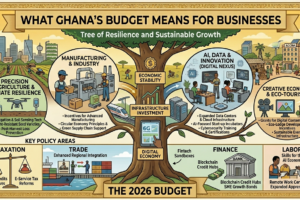

The numbers tell a promising story. Ghana’s economy is on a solid recovery path, with GDP growth reaching 6% in 2025—the fastest since 2019 . Inflation has dropped dramatically from 23.8% to 6.3%, and the cedi has recorded historic gains against major currencies . For the entrepreneur willing to build systematically, the environment has rarely been more favourable.
But let us be clear: starting a business in Ghana is not the hard part. Doing it right is where most people get stuck . This guide is a practical, no-fluff playbook for building a business from the ground up—from validating your idea to formalising operations, accessing markets, and preparing for growth.
Phase One: Before You Register—Validate Your Idea
The Import Opportunity for Diasporans
If you are building from abroad, one of the most practical entry strategies is to study what your resident country currently imports from Ghana . Every country imports food products, crops, ingredients, consumer goods, and intermediates used in manufacturing. Many of these can be produced more competitively in Ghana.
📢 GET DETAILED ARTICLES + JOBS
Join THSB's WhatsApp Channel and never miss a post or opportunity.
The practical steps:
-
Look at imported products around you—there is rising demand for cassava flour in Canada, for example .
-
Talk to the buyers. Walk into stores, speak to manufacturers, email procurement teams. Ask:
-
What quantities do you buy monthly?
-
At what price?
-
If I supply the same quality at a better cost, would you switch?
-
What conditions must be met?
-
-
Secure conditional interest or Letters of Intent (LOIs)—these can massively boost your ability to raise funding .
Validate Before You Invest
A business idea that looks good on paper may not work in the real world. Before committing capital, test your assumptions:
-
Speak to potential customers—not friends and family, but real buyers.
-
Build a minimum viable product—the simplest version that allows you to test your core assumptions.
-
Understand the competitive landscape—who else is doing this, and how are they doing it?
The hard truth: Many entrepreneurs build businesses based on what they think people want, not what they actually need. Reverse that equation.
Phase Two: Choosing the Right Structure
The Simple Path: Sole Proprietorship
For individual entrepreneurs starting small, a sole proprietorship is the most accessible option. Registration costs as little as GH¢130, and you only need a Ghana Card and a Tax Identification Number (TIN) to begin . The name reservation process is now instant—you can confirm availability “at the click of a button” .
The catch: You have unlimited liability. Your personal assets are at risk if the business incurs debt.
The Preferred Path: Company Limited by Shares
For businesses with growth ambitions, liability protection, or foreign ownership, the Company Limited by Shares is the most common and flexible legal structure . It offers limited liability protection, allows for single or multiple shareholders, and is ideal for profit-oriented ventures .
Key requirements:
-
Minimum of two directors (at least one ordinarily resident in Ghana)
-
One shareholder (can be 100% foreign-owned)
-
Company secretary (director can also serve)
-
Registered address in Ghana
-
Company name ending in “Ltd.”
Choosing a Business Name
The ORC may reject your proposed business name for several reasons :
-
Duplication: Too similar to an existing registered entity.
-
Misleading names: Implying unapproved government affiliation or professional accreditation.
-
Offensive content: Culturally insensitive or inappropriate names.
-
Restricted words: “Bank,” “University,” or “Trust” require regulatory approval.
-
Trademark infringement: Violating existing brand names.
Practical advice: Come with three preferred names. The search is instant, so you can confirm availability immediately .
Foreign Ownership Considerations
If your business has any foreign ownership, additional requirements apply. The Ghana Investment Promotion Centre (GIPC) regulates foreign investment . Under the current framework:
-
Joint venture: Minimum contribution of USD 200,000 (as of previous regulations, subject to pending reforms under GIPA Act)
-
Wholly foreign-owned: USD 500,000 minimum; USD 1 million for trading firms
Technology transfer agreements must be registered, with fees capped at 2% for management services, 6% for royalties, and 8% for combined services .
Phase Three: The Registration Process
Step 1: Name Reservation
Submit your preferred business name(s) through the ORC portal or in-person. Pay the name reservation fee (currently GHS 100) . If approved, the name is reserved for 30 working days—you must complete full registration within this period .
Step 2: Prepare Documents
For a Company Limited by Shares, you need:
-
Unique business name
-
Stated capital
-
Registered address
-
TINs of shareholders and directors
-
Contact details
-
Company officers (secretary, auditor)
-
Ownership structure and business objects
Step 3: Submit and Pay
Submit documents through the ORC portal or at ORC offices. The process has been streamlined, and the ORC encourages formalisation as a critical step towards improving record-keeping, enhancing credibility, and creating expansion opportunities .
Step 4: Post-Incorporation Compliance
Securing your Certificate of Incorporation is only the beginning . You must:
-
Register with GRA for taxes and VAT
-
Register with SSNIT for employee pensions
-
Obtain a Business Operating Permit from your local Assembly
-
File Annual Returns with the ORC to remain in good standing
Phase Four: The Growth Mindset
Start Small, Scale Gradually
A common mistake is trying to build an empire overnight. Start with a small but impactful solution. Test your ideas, learn from customer feedback, and scale up when you’re ready . The entrepreneurs who succeed are those who build systems, not just effort.
Build a Strong Network
Connections with other entrepreneurs, mentors, and professionals are vital. Join business associations, attend events, and use platforms like LinkedIn to connect with like-minded individuals who can offer guidance and support .
Stay Financially Disciplined
Managing finances effectively is one of the major keys to business survival. Keep a close eye on cash flow, minimise unnecessary expenses, and reinvest profits into growing your business. Also consider alternative funding sources like grants and competitions .
Focus on Customer Experience
Treat your customers like gold. Providing excellent service and building relationships will set you apart from competitors. Satisfied customers are likely to recommend your business to others, giving you valuable word-of-mouth marketing .
The Opportunity: Why Now?
Ghana’s economic recovery creates a compelling backdrop for new businesses <span class=””>:
| Indicator | 2024 | 2025 |
|---|---|---|
| GDP Growth | 5.7% | 6.1% (first 3 quarters) |
| Inflation | 23.8% | 6.3% (Nov 2025) |
| Public Debt (% GDP) | 61.8% | 45.0% |
| Trade Surplus | $2.8 billion | $8.5 billion (Oct 2025) |
| Reserves | – | $11.4 billion (4.8 months import cover) |
The fastest-growing sectors present clear entry points :
-
Information & Communication: 28.3% growth
-
Public Administration & Defence: 11.8%
-
Education: 11.3%
-
Transport & Warehousing: 10.6%
-
Manufacturing: Contributes 10.5% of GDP growth
Opportunities in Agriculture
The agricultural sector grew 6.8% in 2025, with crops contributing 19.8% of GDP growth . This is where the diaspora import strategy becomes particularly relevant—many products demanded abroad can be sourced from Ghana’s agricultural value chains.
THSB Conclusion
Building a business from scratch in Ghana is entirely possible. It requires discipline, structure, and a willingness to follow the process—but the barriers to entry are lower than many assume. A sole proprietorship can be registered for GH¢130. The name reservation is instant. The economy is growing at 6%.
But the system punishes carelessness. It rewards only those who validate their ideas, choose the right structure, maintain proper records, and build systems that outlast the founder.
As one entrepreneur put it, “It is possible to make it as a young entrepreneur in Ghana” . The question is whether you will build with the discipline the environment demands.
QUICK FACTS BOX
| Element | Detail |
|---|---|
| Sole Proprietorship Registration | From GH¢130 |
| Name Reservation Fee | GHS 100 |
| Name Reservation Period | 30 working days |
| Minimum Directors (Company) | 2 (one resident in Ghana) |
| Minimum Shareholders | 1 (any nationality) |
| GIPC Minimum Capital (JV) | USD 200,000 (subject to pending reforms) |
| GIPC Minimum Capital (Wholly Foreign) | USD 500,000 (subject to pending reforms) |
| GDP Growth (2025) | 6% |
| Inflation (Nov 2025) | 6.3% |
FREQUENTLY ASKED QUESTIONS
1. How much does it cost to register a business in Ghana?
A sole proprietorship can be registered for as little as GH¢130 . A Company Limited by Shares involves higher fees, including name reservation (GHS 100) and stamp duty on stated capital .
2. Do I need a Ghanaian partner to register a business?
No. A Company Limited by Shares can be 100% foreign-owned with a single shareholder of any nationality. However, you need two directors, with at least one ordinarily resident in Ghana .
3. What documents do I need to start the registration process?
You need a Ghana Card and a Tax Identification Number (TIN) . For a company, you also need a unique business name, stated capital, registered address, and details of directors and shareholders .
4. How long does business registration take?
The name reservation is instant—”at the click of a button” . The full registration process typically takes several working days, depending on document completeness.
5. Can I register a business from abroad?
Yes. Diasporans can use the ORC portal, engage a local firm like Global-SIBE Consult, and start by studying what their resident country imports from Ghana to identify opportunities .
6. What are the fastest-growing sectors in Ghana?
Information & Communication (28.3% growth), Education (11.3%), Transport & Warehousing (10.6%), and Manufacturing are key growth areas . Agriculture also presents significant opportunities.
7. What is the GIPC minimum capital requirement?
As of previous regulations: USD 200,000 for joint ventures, USD 500,000 for wholly foreign-owned companies, and USD 1,000,000 for trading firms . The pending GIPA Act may change these requirements.
8. Why should I register my business formally?
Formalisation improves record-keeping, enhances credibility, creates expansion opportunities, and provides access to formal economy benefits . It also protects you from liability and penalties.
9. Can a director be the company secretary?
Yes, for private companies. A director can also serve as the company secretary, provided they meet the qualifications under the Companies Act, 2019 (Act 992). For public companies, stricter rules apply .
10. What are the post-incorporation requirements?
You must register with GRA for taxes, register with SSNIT for employee pensions, obtain a Business Operating Permit from your local Assembly, and file Annual Returns with the ORC to remain in good standing
Source: The High Street Business
Disclaimer: Some content on The High Street Business may be aggregated, summarized, or edited from third-party sources for informational purposes. Images and media are used under fair use or royalty-free licenses. The High Street Business is a subsidiary of SamBoad Publishing under SamBoad Business Group Ltd, registered in Ghana since 2014.
For concerns or inquiries, please visit our Privacy Policy or Contact Page.

Samuel Kwame Boadu is a Ghanaian entrepreneur, writer, and digital consultant passionate about creating impactful stories and business solutions. He is the Founder & CEO of SamBoad Business Group Ltd, a dynamic company with subsidiaries in digital marketing, logistics, publishing, and risk management.