





What Export Growth Means for Local Businesses – Export growth opens new opportunities for Ghanaian businesses by increasing demand, revenue, and global market access. Here’s what it really means for local firms.
What Export Growth Means for Local Businesses
Export growth plays a crucial role in Ghana’s economic development, especially for businesses looking to expand beyond the local market. As global demand rises for commodities and manufactured goods, Ghanaian firms benefit from increased sales, foreign exchange earnings, and new partnerships. Key institutions like the Bank of Ghana and trade frameworks such as the African Continental Free Trade Area are helping shape an environment where exports can thrive.
Expanding Market Opportunities
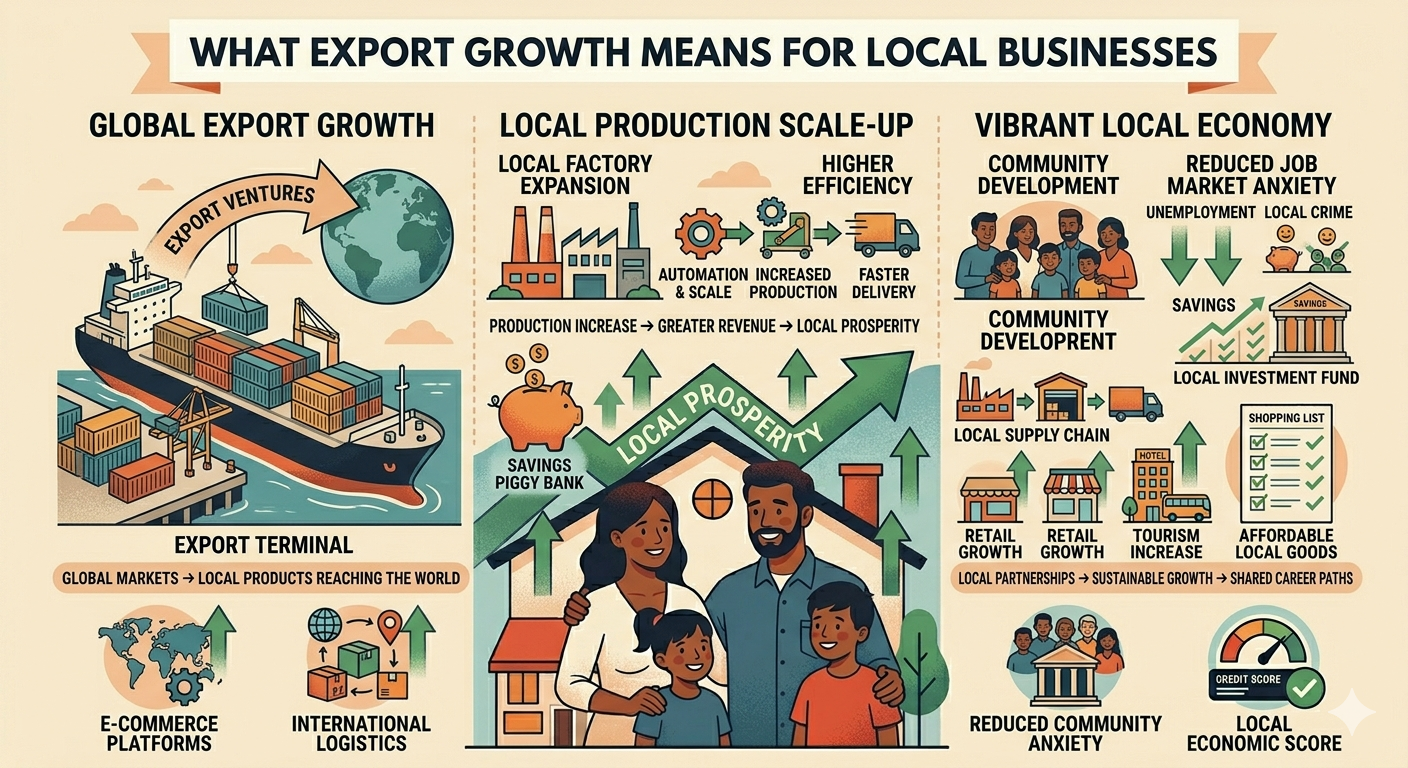
One of the biggest benefits of export growth is access to larger markets. Instead of relying only on local demand, businesses can sell their products to customers across Africa, Europe, Asia, and beyond. This is especially important for industries like agriculture, manufacturing, and textiles.
📢 GET DETAILED ARTICLES + JOBS
Join THSB's WhatsApp Channel and never miss a post or opportunity.
For many Ghanaian firms, exporting means scaling up production and reaching entirely new customer bases.
Increased Revenue and Profit Potential
Export markets often offer higher demand and better pricing opportunities. When businesses sell internationally, they can earn more revenue compared to relying solely on domestic sales. This can improve profitability and support business expansion.
Stronger export performance also helps businesses reinvest in equipment, technology, and workforce development.
Foreign Exchange Earnings
Export growth brings in foreign currency, which is critical for both businesses and the wider economy. For firms that earn in dollars, euros, or other major currencies, export revenue provides financial stability, especially when the local currency fluctuates.
At the national level, these inflows support the Ghanaian cedi and strengthen the country’s foreign reserves, a process closely monitored by the Bank of Ghana.
Job Creation and Business Expansion
As export demand increases, businesses often need to scale up production. This expansion leads to job creation in areas such as manufacturing, logistics, packaging, and marketing. Small and medium-sized enterprises (SMEs) in particular benefit from increased hiring opportunities.
Over time, export-driven growth can help strengthen entire industries and supply chains.
Encouragement of Higher Standards
To compete in global markets, businesses must meet international quality standards. This encourages improvements in product quality, packaging, and efficiency. Companies often invest in better technology and processes to remain competitive abroad.
These improvements also benefit the local market, as higher-quality goods become available domestically.
Access to Trade Agreements and Support
Regional and international trade agreements play a major role in supporting export growth. Through initiatives like the African Continental Free Trade Area, Ghanaian businesses gain easier access to African markets with reduced tariffs and trade barriers.
These agreements make it more affordable and practical for local firms to expand across borders.
Increased Competition and Pressure
While export growth brings opportunities, it also introduces challenges. Businesses must compete with global firms that may have more advanced technology, larger scale, or stronger branding. This can put pressure on local companies to improve efficiency and innovation.
However, this competition often leads to long-term improvements in business performance.
Access to Investment and Partnerships
Successful exporters often attract foreign investment and partnerships. International companies may seek to collaborate with Ghanaian firms that demonstrate strong export potential. This can lead to technology transfer, improved management practices, and access to global supply chains.
Such partnerships help local businesses grow faster and become more competitive.
Risks of Global Market Dependence
Export growth also comes with exposure to global risks. Changes in international demand, price fluctuations, or geopolitical tensions can affect export performance. Businesses that rely heavily on one or two export markets may face instability if conditions change.
Diversification of products and markets is therefore essential.
Conclusion From THSB
Export growth presents significant opportunities for Ghanaian businesses, from increased revenue and job creation to access to global markets.
However, it also requires competitiveness, resilience, and adaptability. With the support of trade frameworks like the African Continental Free Trade Area and stable economic management from institutions such as the Bank of Ghana, local businesses are better positioned to benefit from global trade expansion and long-term growth.
Source: The High Street Business
Disclaimer: Some content on The High Street Business may be aggregated, summarized, or edited from third-party sources for informational purposes. Images and media are used under fair use or royalty-free licenses. The High Street Business is a subsidiary of SamBoad Publishing under SamBoad Business Group Ltd, registered in Ghana since 2014.
For concerns or inquiries, please visit our Privacy Policy or Contact Page.

Esther Aku-Sika is a content writer and social media strategist who helps brands and startups grow through intentional storytelling and practical marketing strategies. With a keen eye for trends and audience behavior, she shares business insights, content strategies, and real-life lessons to help entrepreneurs build visibility and turn ideas into income. Through her writing, she simplifies complex concepts and equips readers with actionable steps to grow in today’s digital space.