








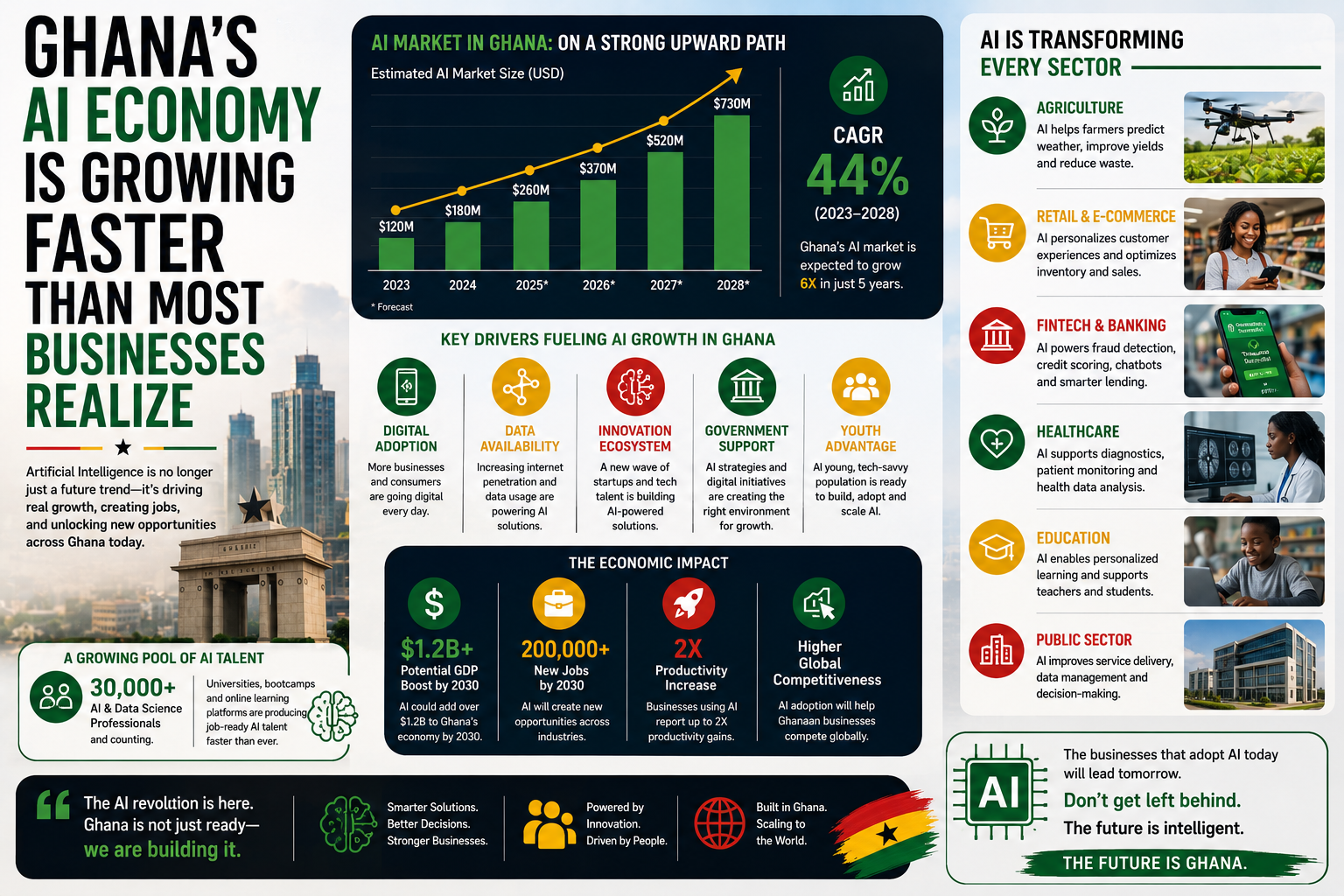

Ghana’s AI Economy Is Growing Faster Than Most Businesses Realize – AI is projected to contribute $45bn to Ghana’s GDP by 2035. $2.2bn in investments, including a $250m computing centre, a $1bn UAE innovation hub, and a $100m AI‑powered agriculture initiative. 68% of banks are already adopting AI. Our deep‑dive analysis reveals the sectors, investments, talent pipeline and three scenarios for Ghana’s AI future.
Executive Introduction
The numbers are no longer speculative. They are concrete, measurable and accelerating. Ghana’s National Artificial Intelligence Strategy, officially launched on 24 April 2026, projects that AI will contribute 500 billion Ghanaian cedis – approximately 250 million to establish a national AI computing centre – a facility President John Dramani Mahama described as the foundation for research, innovation and enterprise development – alongside an additional $20 million for short‑ to medium‑term implementation. A five‑year National AI Fund will launch with GH¢5 billion in seed capital from 2025 to 2030, scaling to GH¢15 billion by 2035.
Yet these public investments represent only a fraction of the capital flowing into Ghana’s AI ecosystem. The government has secured a 100 million over four years to establish Ghana as Africa’s first AI‑powered agricultural hub, scaling AI‑driven satellite monitoring and precision agriculture techniques to reach 86,000 smallholder farmers across 122,000 acres. MTN has signed a landmark agreement to support the government’s ‘One Million Coders’ programme, investing in AI‑capable data centres across Africa to power large language models tailored to the African context. Ghanaian AI startup Aya Data has secured $900,000 in seed funding, while Google has opened its first AI Community Centre in Accra, committed $37 million to AI development across Africa, and signed an MoU with the Ministry of Education to integrate AI‑driven learning tools into Ghana’s schools.
📢 GET DETAILED ARTICLES + JOBS
Join THSB's WhatsApp Channel and never miss a post or opportunity.
This profile examines the full scope of Ghana’s emerging AI economy. It analyses adoption rates across key sectors – agriculture, banking, telecom, healthcare, energy, mining and logistics – the policy framework that is enabling the transformation, the investment landscape, the talent pipeline, the challenges that remain and the three scenarios that will determine whether Ghana achieves its ambition of becoming West Africa’s AI hub by 2033. The AI economy is not a future projection. It is being built today – and most Ghanaian businesses have not yet noticed.

The Adoption Reality – How AI Is Already Being Used Across Ghana
Ghana’s overall AI adoption rate stands at 9.3 per cent, placing it in a tie with Nigeria as the second‑highest on the continent, behind only South Africa. More than three‑quarters of young Africans now report using AI tools weekly, underscoring strong digital engagement and demographic readiness. According to a PwC Ghana 2025 Banking Survey, 68 per cent of bank CEOs reported some level of AI adoption, with measurable impact on revenue and profitability. Early gains from AI and generative AI deployment were credited with contributing to the sector’s strong 2025 results, including net interest income of GH¢28.65 billion and profit before tax of GH¢21.87 billion. The survey revealed that nearly 70 per cent of CEOs confirmed their institutions deployed GenAI solutions in 2024 primarily to improve customer engagement and streamline back‑office functions. Some 59 per cent of Ghanaian CEOs expected GenAI to increase their company’s profit in 2025, and 66 per cent confirmed they would continue to embed GenAI across their companies.
In the telecom sector, MTN Ghana has used AI to boost its subscriber base and enhance customer experience. The company is leveraging AI in fintech operations, fraud detection and network optimisation. In Q1 2025, AI‑powered customer value management initiatives helped drive a 5.2 per cent increase in its subscriber base and contributed to robust service revenue growth. MTN is also investing in AI‑capable data centres across Africa to enhance innovation, ensure local data sovereignty and power large language models tailored to the African context. In mobile money, AI has been deployed to detect and block fraudulent messages before they reach customers, shifting from rule‑based applications to behavioural analysis.
In agriculture, the transformation is even more tangible. FarmSense, an AI‑powered platform developed by Ghanaian startup Sesi Technologies, allows farmers to analyse soil composition and apply fertilisers with precision, while modern tractors and irrigation systems are equipped with AI to optimise water and nutrient use. Degas Ltd’s $100 million investment is scaling AI‑driven satellite monitoring and precision agriculture techniques to boost yields, reduce risk and enable smallholder farmers to access fairly priced finance.
In healthcare, a remote imaging AI‑assisted diagnostic system was launched in December 2025 by the Health Community of West Africa (HCOWA) and Chengdu UESTC Goldisc Health Data Technology, marking the first time Ghana has produced AI‑generated radiology and ultrasound reports. Ghanaian scientists led by US‑based computer scientist Felix Davis have emerged as one of the world’s leading telehealth service providers, deploying an intelligent, AI‑powered virtual health assistant that provides immediate, reliable information, symptom assessment and guidance to appropriate care pathways.
In logistics, the Publican AI system has been introduced to streamline import clearance procedures at Ghana’s ports, eliminating human discretion and improving consistency and fairness in customs operations. President Mahama has revealed that the state‑of‑the‑art AI system now running Tema Port was developed by young Ghanaians. In the energy sector, the Africa Sustainable Energy Centre (ASEC) has called for AI‑driven reforms to address persistent power outages, with experts predicting transformer faults before they escalate. In mining, the government plans to introduce AI‑generated technology to map mineral prospects precisely and a track‑and‑trace system for gold exports, while the Chamber of Mines is building a $1.2 million AI, robotics and materials testing laboratory at the University of Mines and Technology (UMaT).
The table below summarises AI adoption and investment across key sectors of Ghana’s economy.
Sector/ Key AI Applications/ Notable Investments / Initiatives
- Banking & Fintech Fraud detection, credit scoring, customer service chatbots, underwriting 68% of banks adopting AI; MTN AI‑capable data centres; PwC estimates GH¢28.65bn net interest income
- Agriculture Soil analysis, precision farming, satellite monitoring, yield prediction Degas $100m; FarmSense (Sesi Technologies); 86,000 farmers targeted
- Healthcare Telemedicine, AI‑assisted diagnostics, virtual health assistants, remote imaging HCOWA‑Goldisc diagnostic system; Felix Davis telehealth platform; KNUST digital health app
- Telecom Customer analytics, fraud detection, network optimisation, fintech security MTN AI‑powered CVM; One Million Coders partnership; AI data centres
- Logistics & Ports Import clearance automation, supply chain resilience, last‑mile delivery optimisation Publican AI system at Tema and Takoradi; DHL Ghana last‑mile AI
- Energy Predictive maintenance, fault detection, renewable energy integration, grid management ASEC AI‑driven reforms; AI4SD transformer fault prediction; KNUST hybrid system optimisation
- Mining Mineral exploration mapping, track‑and‑trace, AI‑powered drone surveillance Chamber of Mines $1.2m UMaT lab; AI integration in drone footage for galamsey detection
- Education AI literacy, coding skills, personalised learning, local language AI tools One Million Coders; Google MoU; Google AI Community Centre Accra
The Policy Engine – The National AI Strategy and the Emerging Technologies Bill
The National AI Strategy, launched on 24 April 2026 with President Mahama presiding, is the central pillar of Ghana’s AI ambition. The strategy is built around eight pillars: expanding AI education and training; empowering youth for AI jobs of the future; strengthening digital infrastructure; enhancing data governance; building a collaborative AI ecosystem; accelerating sectoral AI adoption; promoting applied research and public sector deployment; and embedding ethical and accountable AI through a dedicated Responsible AI Authority. The strategy explicitly identifies financial services, healthcare, agriculture, energy, manufacturing, logistics and public sector service delivery as priority sectors for AI deployment.
Financially, the strategy is backed by a 20 million implementation fund, alongside a five‑year National AI Fund that will launch with GH¢5 billion from 2025 to 2030, scaling to GH¢15 billion by 2035. The strategy projects that AI will contribute 200 billion Ghanaian cedis to GDP by 2030, rising to 500 billion Ghanaian cedis by 2035. This projection, contained in the 84‑page strategy document, assumes successful implementation of all pillars and sustained investment from both public and private sources.
The government is also advancing a legislative framework to govern emerging technologies. In November 2025, the Ministry of Communication, Digital Technology and Innovations announced plans to introduce an Emerging Technologies Bill in 2026 to establish a comprehensive legal and regulatory framework for AI, blockchain and other emerging technologies. The Bill proposes the creation of an Emerging Technologies Agency, which would include an Artificial Intelligence Division, and aims to provide legal certainty for AI developers, investors and users.
The Bank of Ghana has been an early mover in establishing AI governance for the financial sector. In June 2025, the central bank announced new policy measures to boost the digital financial ecosystem, including the formation of a working group to develop policy recommendations on the use of AI in credit scoring, fraud detection and financial decision‑making. The BoG has also established a FinTech and Innovation Department and a Data Analytics and Artificial Intelligence Department, and is investing in AI‑driven supervisory tools and operationalising a Cyber Threat Intelligence Platform to facilitate information sharing between banks and fintechs.

Ghana retained its position as the world’s top‑ranked country for mobile money regulation, scoring 96.10 per cent on the 2025 GSMA Mobile Money Regulatory Index. This strong regulatory foundation provides a conducive environment for AI‑powered financial services, as the convergence of mobile money and AI creates opportunities for credit scoring, fraud detection and personalised financial products.
The table below summarises key policy and strategic milestones in Ghana’s AI journey.
Policy / Initiative Status / Date Key Provisions / Funding
- National AI Strategy Launched 24 April 2026 8 pillars; 2025‑2035; GH¢5bn‑GH¢15bn AI Fund
- AI Computing Centre Announced April 2026 $250 million national facility
- AI Implementation Fund Announced April 2026 $20 million short‑to‑medium term
- Emerging Technologies Bill Planned for 2026 Establishes Emerging Technologies Agency; AI Division
- Bank of Ghana AI Working Group June 2025 Policy recommendations on AI in credit scoring, fraud detection
- BoG FinTech & Innovation Dept Established 2025 Accelerating digital transformation
- BoG Data Analytics & AI Dept Established 2025 Internal AI deployment and supervision
- GSMA Regulatory Index 2025 Published 2025 Ghana #1 globally (96.10%)
- Open Banking Framework By end‑2026 Enabling third‑party fintech access to bank data
The Investment Wave – $2.2bn and Counting
The investment landscape for AI in Ghana is transforming rapidly. Public commitments, private capital and international partnerships are converging to create a funding environment that would have been unimaginable three years ago.
The largest single commitment is the $1 billion strategic partnership with the United Arab Emirates to build Africa’s largest integrated innovation and AI hub. The project, located in Ningo‑Prampram in the Greater Accra Region, is scheduled to begin construction in 2026. To support long‑term ecosystem development, $250 million has been allocated to innovation, talent and capital formation within the partnership, including $75 million for a Ghana‑UAE innovation fund.
The government’s $250 million AI computing centre is the second major public investment, designed to provide the raw processing power that AI applications require. The centre is expected to host cloud infrastructure for AI model training, support research institutions and private sector developers, and serve as the computational backbone for the entire AI ecosystem.
International partnerships are adding substantial private capital. Degas Ltd’s $100 million commitment over four years to establish Ghana as Africa’s first AI‑powered agricultural hub is already being deployed, with the company targeting 86,000 smallholder farmers across 122,000 acres. Google has committed $37 million to AI development across Africa, opened its first AI Community Centre in Accra, and signed an MoU with the Ministry of Education to integrate AI‑driven learning tools into Ghana’s schools.
The Ghanaian startup ecosystem is also attracting venture capital. Aya Data, a Ghanaian AI startup focused on leveraging AI for African challenges, secured $900,000 in seed funding in January 2026 to advance its mission, including the enhancement of AyaGrow, an AI‑powered tool designed to assist both smallholder and commercial farmers. The Venture Capital Trust Fund (VCTF) will launch a specialised financing facility in 2026 to support early‑stage digital enterprises and climate‑smart innovations.
On the corporate front, MTN has signed a landmark agreement to support the ‘One Million Coders’ programme, equipping young Ghanaians with AI, coding and digital skills. MTN is investing in AI‑capable data centres across Africa to power large language models tailored to the African context, ensuring local data sovereignty and supporting the government’s digitalisation agenda. The MTN building, donated to the government, will become one of Ghana’s centres of excellence for artificial intelligence and software development.
The table below summarises the major investment commitments driving Ghana’s AI economy.
Investor / Partner Commitment/ Focus Area/ Status
- UAE strategic partnership $1 billion Africa’s largest AI/innovation hub Construction 2026
- Government of Ghana $250 million AI computing centre Announced April 2026
- Government of Ghana $20 million AI strategy implementation Announced April 2026
- Degas Ltd (Japan) $100 million AI‑powered agriculture hub Four‑year commitment
- Google $37 million AI development across Africa Active
- Aya Data (startup) $900,000 AI for African challenges Seed funding Jan 2026
- Chamber of Mines $1.2 million AI, robotics lab at UMaT Construction underway
- MTN Group Undisclosed AI‑capable data centres, One Million Coders Active
- VCTF Digital Innovation Fund Undisclosed Early‑stage digital enterprises Launching 2026
The Talent Pipeline – One Million Coders and the AI Workforce
Ghana’s AI ambition depends on its people. The ‘One Million Coders’ programme is the flagship initiative designed to equip Ghana’s youth with practical digital and AI skills at scale. The programme aims to train one million Ghanaians in emerging technology fields including AI, cybersecurity, data forensics and cloud computing. In 2026 alone, President Mahama announced that 300,000 young Ghanaians will be trained under the programme. Fifty digital hubs will be established nationwide to support the training, ensuring access across all regions.
MTN has committed to supporting the programme, with the MTN building in Accra to become a centre of excellence for artificial intelligence and software development. Google has opened its first AI Community Centre in Accra, positioning Ghana as a key hub for AI education, research and innovation. The centre’s activities focus on AI literacy, community technology, social impact and the arts. Google is also collaborating with the University of Ghana and the Global Disability Innovation Hub to develop speech recognition and AI tools in Ghanaian local languages, improving education accessibility and digital services.
The education sector is integrating AI into the curriculum at multiple levels. President Mahama has announced that AI will be embedded across Ghana’s education system to prepare children for the digital age. The Ministry of Education signed an MoU with Google in May 2026 to advance AI‑driven learning, with Google’s education tools to be deployed on a zero‑rated basis – meaning no data costs for users – ensuring access for all learners regardless of location or income. The partnership includes curriculum‑aligned content and resources on the responsible use of AI in teaching and learning. The Ministry has also assured inclusion of local languages including Ga and Adangbe in the AI education tool, addressing early concerns about language exclusion.
At the tertiary level, the University of Mines and Technology (UMaT) is establishing a Mining Robotics and Engineering Materials Testing Lab to advance AI‑driven mine automation technologies. The Chamber of Mines is funding a $1.2 million AI, robotics and materials testing laboratory at UMaT. The Kwame Nkrumah University of Science and Technology (KNUST) is partnering with the Ministry of Employment and Labour Relations to embed digital and AI‑relevant competencies into vocational and technical training. The AI4SD Project is deploying advanced AI tools across agriculture, health and education in line with the Sustainable Development Goals.
The table below summarises key initiatives building Ghana’s AI talent pipeline.
Initiative Target / Reach /Focus Area /Status
- One Million Coders Programme 1,000,000 Ghanaians AI, cybersecurity, data forensics, cloud computing 300,000 targeted for 2026
- Google AI Community Centre, Accra Unlimited public access AI literacy, community tech, social impact Opened July 2025
- Google zero‑rated education tools All Ghanaian schools AI‑driven learning, teacher training, curriculum MoU signed May 2026
- MTN Centre of Excellence MTN building, Accra AI and software development Donated to government
- UMaT Mining AI/Robotics Lab Tertiary students AI‑driven mine automation Construction underway
- 50 digital hubs Nationwide Digital skills training Rolling out
- KOICA‑WFP AI training 70 youth trained AI for agriculture and food security Completed 2025
- DIPPER Lab‑NEIP partnership 10,000 youth AI, IoT, blockchain entrepreneurship Active
The Challenges That Remain – Data, Connectivity, Trust and Talent
For all the promise of AI, Ghana’s economy faces structural constraints that no algorithm can solve.
The first is data fragmentation. For AI to function effectively, it requires massive amounts of integrated data from multiple sources – banks, mobile money operators, utility companies, government agencies. The Bank of Ghana’s open banking framework, planned by end‑2026, is designed to address this fragmentation, but implementation remains uncertain. Without seamless data sharing, AI models will be trained on incomplete data, producing inaccurate or biased outcomes.
The second is connectivity and data costs. AI applications require low latency and high bandwidth. Former Vice‑President Dr Mahamudu Bawumia has cautioned that the high cost of mobile data remains a major obstacle to Africa’s participation in the global AI revolution. Ghana’s 5G rollout, led by Next‑Gen InfraCo (NGIC), is still in its early stages, and the government has revoked NGIC’s exclusivity clause, opening 5G spectrum to competitive bidding in an effort to accelerate deployment. But the gap between coverage targets and actual rollout remains significant.
The third is the trust deficit. A 2025 global survey found that 92 per cent of Ghanaians regard AI tools as important – the highest level of enthusiasm of any country surveyed. Yet trust in automated systems is fragile. A single algorithmic error – a loan wrongly denied, a transaction wrongly flagged as fraudulent – can erode confidence in AI systems across the entire sector. The Bank of Ghana has warned that innovation must be supported by strong governance systems, cybersecurity safeguards and consumer protection measures.
The fourth is the talent gap – not just in numbers, but in depth. Building and maintaining AI systems requires data scientists, machine learning engineers and cloud infrastructure specialists – roles that are in short supply globally and even scarcer in Ghana. The ‘One Million Coders’ programme is a necessary first step, but training entry‑level coders is not the same as developing senior AI engineers. Without a sustained pipeline of advanced AI talent, Ghana’s ability to deploy cutting‑edge AI systems will be constrained by human capital, not financial capital.
The fifth is the risk of exacerbating inequality. AI deployment in Ghana is currently concentrated in Accra and a few regional capitals. If AI adoption remains concentrated in urban areas and among larger enterprises, the technology could widen the gap between the formal and informal sectors, between the banked and the unbanked, between those who have access to AI‑powered services and those who do not. Ensuring that AI serves all Ghanaians, not just a privileged few, is the central governance challenge of the decade.
Future Outlook – Three Scenarios for Ghana’s AI Economy
The trajectory of Ghana’s AI economy will be shaped by three variables: the speed of infrastructure deployment, the effectiveness of talent development and the quality of regulatory implementation.
Scenario One: Gradual Integration (65 per cent probability).
In this base case, AI adoption continues steadily but unevenly. The computing centre is operational by 2028, supporting AI research and development. The One Million Coders programme produces a modest expansion of the talent pool, but skill shortages remain a binding constraint. Open banking is implemented gradually, enabling some data sharing but not a fundamental restructuring of credit markets. AI adoption in agriculture, health and logistics expands, but Ghana does not achieve its ambition of becoming West Africa’s AI hub by 2033. The AI contribution to GDP reaches GH¢200 billion by 2030 – the lower end of the government’s projection – and GH¢400 billion by 2035.
Scenario Two: Accelerated Breakthrough (25 per cent probability).
The computing centre is operational by 2027, attracting foreign investment in AI research and development. The One Million Coders programme produces a genuine pipeline of advanced AI talent. Open banking and data‑sharing frameworks are implemented aggressively, enabling seamless integration across banks, telcos and fintechs. The $1 billion UAE innovation hub is fully operational, attracting global tech companies to establish regional headquarters in Ghana. AI adoption accelerates across all priority sectors, and Ghana becomes a recognised regional leader in responsible AI. The AI contribution to GDP reaches GH¢250‑300 billion by 2030 and GH¢500 billion by 2035 – achieving or exceeding the government’s target.
Scenario Three: Stagnation and Fragmentation (10 per cent probability).
The computing centre faces technical and financial challenges, and its operational timeline slips. Open banking is delayed indefinitely. The talent pipeline fails to materialise, with trained AI professionals leaving for better‑paid opportunities abroad. Data fragmentation persists, and AI models are trained on incomplete data, producing biased or inaccurate outcomes. Consumer trust in automated systems erodes following high‑profile algorithmic failures. Ghana’s AI economy lags behind regional peers, and the promise of AI‑driven transformation remains unfulfilled.
The most likely path is Scenario One: gradual integration, not a breakthrough. The technology is advancing rapidly, but the structural constraints – data fragmentation, infrastructure gaps, talent shortages – will limit the speed of transformation. However, even gradual integration represents a significant improvement over the status quo. A Ghana where AI is deployed in banking, agriculture, health, energy and logistics – even if not at the speed of global leaders – is a Ghana that is fundamentally transforming its economy.
The table below summarises the three scenarios for Ghana’s AI economy.
Scenario /Probability /AI GDP Contribution by 2035 Key Conditions
- Scenario One: Gradual Integration 65% GH¢400 billion Computing centre operational 2028; modest talent pool; partial open banking; incremental AI adoption
- Scenario Two: Accelerated Breakthrough 25% GH¢500 billion+ Computing centre operational 2027; genuine talent pipeline; aggressive open banking; $1bn hub fully operational
- Scenario Three: Stagnation and Fragmentation 10% Below GH¢300 billion Computing centre delayed; open banking stalled; talent drain; trust erosion
Conclusion
Ghana’s AI economy is not a future projection. It is being built today. The numbers are concrete: $250 million for a computing centre, $1 billion for an innovation hub, $100 million for AI‑powered agriculture, $900,000 for a Ghanaian AI startup, $37 million from Google. The policy framework is in place: a National AI Strategy spanning 2025‑2035, an Emerging Technologies Bill before Parliament, a Bank of Ghana working group on AI in credit scoring and fraud detection, a GSMA regulatory ranking that places Ghana first globally for mobile money governance. The adoption statistics are measurable: 9.3 per cent overall AI adoption, 68 per cent of banks already deploying AI, 59 per cent of CEOs expecting AI to increase profits, 92 per cent of Ghanaians believing AI tools are important – the highest enthusiasm of any country surveyed.
Yet the speed of transformation is not guaranteed. Data fragmentation, infrastructure gaps, talent shortages and trust deficits could all slow the pace of AI adoption. The $2.2 billion in committed investment could be delayed or diverted. The ‘One Million Coders’ programme could produce entry‑level graduates without the advanced skills needed to build cutting‑edge AI systems. The computing centre could take years to become operational. The technology is ready. The capital is being mobilised. The policy direction is clear. But the distance between ambition and achievement is measured not in algorithms or investment dollars, but in the speed of implementation.
The question for Ghanaian businesses is not whether AI will transform their industries. It already is. Banks are using AI for credit scoring and fraud detection. Farmers are using AI for precision agriculture. Hospitals are using AI for diagnostic imaging. Ports are using AI for customs clearance. Telecom operators are using AI for network optimisation and customer analytics. The transformation is underway – but it is uneven, concentrated and still largely invisible to most business leaders.
The businesses that will thrive in Ghana’s AI economy are not necessarily those with the largest budgets or the most advanced technical teams. They are the businesses that recognise that AI is not a technology to be adopted, but a capability to be built – through data integration, through talent development, through strategic partnerships, and through a clear understanding of the problems that AI can solve for their customers. The $500 billion cedis that AI is projected to contribute to Ghana’s GDP by 2035 is not a prediction. It is a potential – a potential that will be realised only if Ghana’s businesses, policymakers and educators act with the urgency that the opportunity demands.
Ghana’s AI economy is growing faster than most businesses realise. The question is whether those businesses will catch up – or whether they will be left behind, watching from the side as a new economic engine revs without them. The technology is ready. The capital is flowing. The policy is in place. The missing ingredient is not investment or infrastructure. It is awareness – and the determination to act on it, before the competition does. The window is open. The race has begun. And the finish line is a Ghana where AI is not a novelty, but an infrastructure as fundamental as the mobile phone, the mobile money wallet and the road network. That Ghana is not a fantasy. It is being built right now. And most businesses have not even noticed.
Quick Facts Box
Category || Details
- National AI Strategy Launch 24 April 2026; President Mahama presiding
Strategy Period 2025‑2035 (10 years) - Eight Pillars AI education, youth jobs, digital infrastructure, data governance, ecosystem, sectoral AI, research, ethical AI
- Priority Sectors Financial services, healthcare, agriculture, energy, manufacturing, logistics, public service
- AI GDP Target (2030) 200 billion Ghanaian cedis
- AI GDP Target (2035) 500 billion Ghanaian cedis (approx. $45 billion)
- AI Computing Centre $250 million
- AI Implementation Fund $20 million
- National AI Fund GH¢5bn (2025‑2030); GH¢15bn (2030‑2035)
- UAE Innovation Hub $1 billion; Ningo‑Prampram; construction 2026
- Ghana AI Adoption Rate (2025) 9.3% (tied 2nd in Africa)
- Bank CEO AI Adoption (PwC 2025) 68%
- CEOs Expecting AI Profit Increase 59%
- CEOs Continuing GenAI Investment 66%
- Ghanaians Regarding AI as Important 92% (global survey)
- Mobile AI Chatbot Market Share (Mar 2025) ChatGPT 92.86%; Gemini 4.76%; Perplexity 2.38%
- One Million Coders Programme Target: 1,000,000 trained; 300,000 in 2026
- MTN AI‑Capable Data Centres Across Africa; local data sovereignty; LLMs tailored to African context
- Mobile Money Regulatory Index Ghana #1 globally (96.10%)
- Open Banking Framework By end‑2026
- BoG AI Governance Working group on AI in credit scoring, fraud detection; AI‑driven supervisory tools; Cyber Threat Intelligence Platform
- Key Regulators Ministry of Communication, Digital Technology and Innovations; Bank of Ghana (BoG); NCA
Frequently Asked Questions (FAQ)
Q1: How fast is Ghana’s AI economy growing?
Ghana’s AI economy is expanding rapidly, with the National AI Strategy projecting a contribution of 500 billion cedis (approximately $45 billion) to GDP by 2035. The government has committed $250 million for a national AI computing centre and $20 million for strategy implementation, while international partners have committed over $1.1 billion in additional investment.
Q2: What is the National AI Strategy and when was it launched?
The National Artificial Intelligence Strategy was officially launched on 24 April 2026, with President John Dramani Mahama presiding. The ten‑year blueprint (2025‑2035) is built around eight pillars covering AI education, youth employment, digital infrastructure, data governance, ecosystem development, sectoral AI adoption, applied research and public sector deployment, and ethical AI governance.
Q3: How much is Ghana investing in AI infrastructure?
The government is investing $250 million in a national AI computing centre, described by President Mahama as the foundation for research, innovation and enterprise development. An additional $20 million has been earmarked for short‑to‑medium‑term implementation of the National AI Strategy. The government has also secured a $1 billion strategic partnership with the UAE to build Africa’s largest integrated innovation and AI hub.
Q4: What is Ghana’s AI adoption rate compared to other African countries?
Ghana’s overall AI adoption rate stands at 9.3 per cent, tied with Nigeria for the second‑highest on the continent behind South Africa. According to the PwC Ghana Banking Survey 2025, 68 per cent of bank CEOs reported some level of AI adoption, and 59 per cent of Ghanaian CEOs expect GenAI to increase their company’s profit in 2025.
Q5: How is AI being used in Ghana’s agriculture sector?
AI is transforming agriculture through precision farming, soil analysis, satellite monitoring and yield prediction. FarmSense, developed by Ghanaian startup Sesi Technologies, provides AI‑powered soil analysis and crop recommendations. Degas Ltd has committed $100 million over four years to establish Ghana as Africa’s first AI‑powered agricultural hub, scaling AI‑driven satellite monitoring and precision agriculture to reach 86,000 smallholder farmers across 122,000 acres.
Q6: What is the ‘One Million Coders’ programme?
The ‘One Million Coders’ programme is Ghana’s flagship initiative to equip young Ghanaians with practical digital and AI skills at scale. It targets training one million citizens in emerging technology fields including AI, cybersecurity, data forensics and cloud computing. In 2026 alone, 300,000 young Ghanaians are expected to be trained. Fifty digital hubs are being established nationwide to support the training.
Q7: How is the Bank of Ghana regulating AI in financial services?
The Bank of Ghana has established a working group to develop policy recommendations on the use of AI in credit scoring, fraud detection and financial decision‑making. It has also created a FinTech and Innovation Department and a Data Analytics and Artificial Intelligence Department. The central bank is investing in AI‑driven supervisory tools and operationalising a Cyber Threat Intelligence Platform to facilitate information sharing between banks and fintechs.
Q8: Which sectors are prioritised for AI adoption in Ghana?
The National AI Strategy identifies seven priority sectors for AI deployment: financial services, healthcare, agriculture, energy, manufacturing, logistics, and public sector service delivery. Within these sectors, specific applications include fraud detection and credit scoring in banking; diagnostic imaging and telemedicine in healthcare; precision farming and yield prediction in agriculture; predictive maintenance and grid management in energy; and customs clearance and supply chain optimisation in logistics.
Q9: What is the AI computing centre and why does it matter?
The AI computing centre is a $250 million national facility designed to provide the raw processing power that AI applications require. It will host cloud infrastructure for AI model training, support research institutions and private sector developers, and serve as the computational backbone for Ghana’s entire AI ecosystem. It is expected to be a critical enabler for both public sector AI deployment and private sector innovation.
Q10: How does Ghana’s AI enthusiasm compare globally?
A 2025 global survey found that 92 per cent of Ghanaians regard AI tools as important – the highest percentage of any country surveyed. By comparison, only 23 per cent in France and 32 per cent in Sweden think the same. This high level of public enthusiasm is a significant asset for AI adoption, reducing resistance to automation and digital transformation.
Q11: What are the biggest barriers to AI adoption in Ghana?
The most significant barriers are data fragmentation (lack of integrated data from multiple sources), infrastructure gaps (high data costs, limited 5G coverage), talent shortages (insufficient advanced AI engineers), and trust deficits (fragile public confidence in automated systems). The government’s open banking framework, the 5G rollout, the ‘One Million Coders’ programme and the Bank of Ghana’s AI governance framework are all designed to address these barriers.
Q12: What is the outlook for AI in Ghana?
The most likely scenario is gradual integration, with AI adoption continuing steadily but unevenly across sectors. The computing centre is expected to be operational by 2028, and the AI contribution to GDP is projected to reach GH¢200‑250 billion by 2030. A genuine breakthrough – achieving the government’s GH¢500 billion target by 2035 – would require accelerated infrastructure deployment, a genuine pipeline of advanced AI talent, and aggressive implementation of open banking and data‑sharing frameworks. Ghana’s high public enthusiasm for AI, its top‑ranked mobile money regulatory framework and its substantial investment commitments all position it well for continued growth.
Disclaimer: Some content on The High Street Business may be aggregated, summarized, or edited from third-party sources for informational purposes. Images and media are used under fair use or royalty-free licenses. The High Street Business is a subsidiary of SamBoad Publishing under SamBoad Business Group Ltd, registered in Ghana since 2014.
For concerns or inquiries, please visit our Privacy Policy or Contact Page.

Esther Aku-Sika is a content writer and social media strategist who helps brands and startups grow through intentional storytelling and practical marketing strategies. With a keen eye for trends and audience behavior, she shares business insights, content strategies, and real-life lessons to help entrepreneurs build visibility and turn ideas into income. Through her writing, she simplifies complex concepts and equips readers with actionable steps to grow in today’s digital space.