










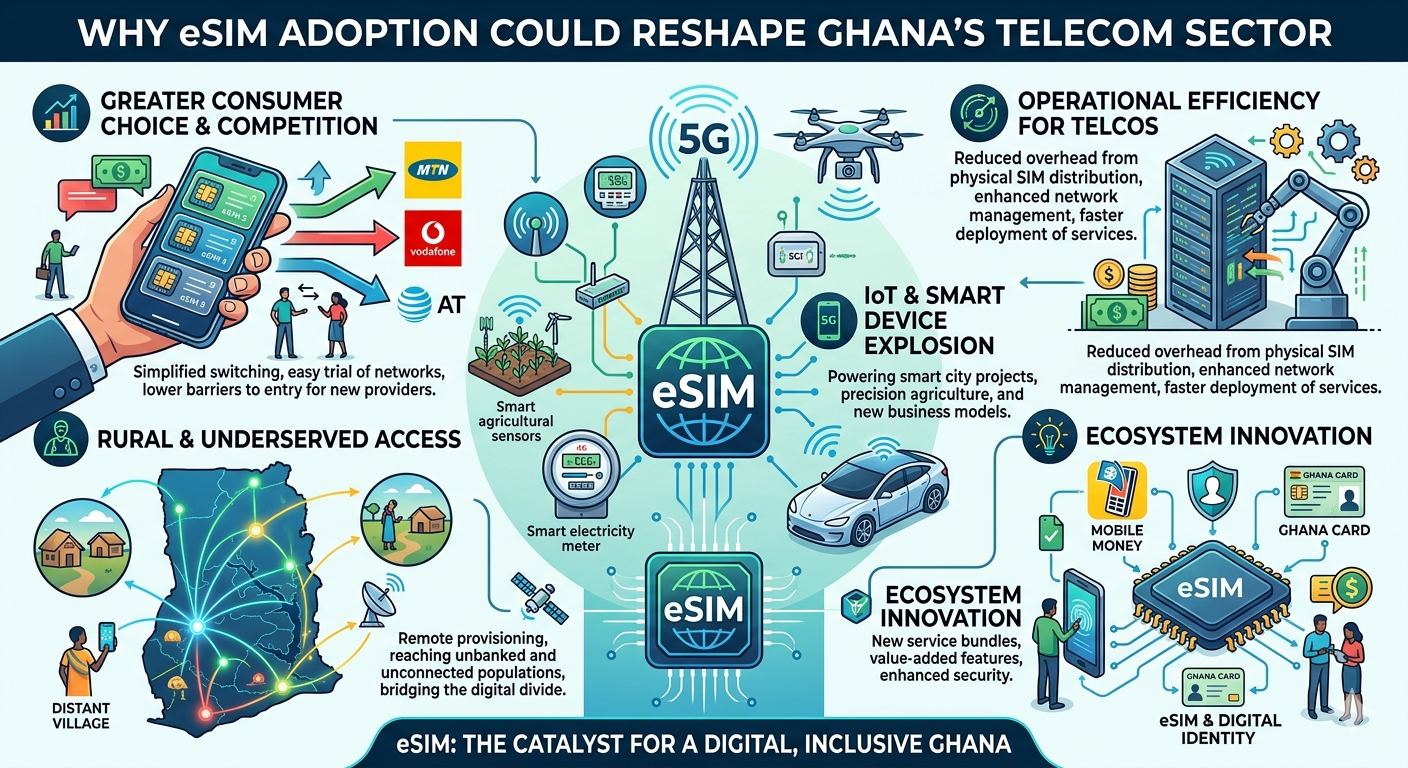

Why eSIM Adoption Could Reshape Ghana’s Telecom Sector — Ghana has 41.8m mobile connections, and eSIM technology is poised to transform how Ghanaians connect. MTN, Telecel and AT all offer eSIM services. Our deep‑dive analysis reveals the cost savings, environmental benefits, competitive dynamics, regulatory framework and three scenarios for eSIM adoption in Ghana.
Executive Introduction
The plastic SIM card is one of the most ubiquitous objects on the Ghanaian planet. At the end of 2025, Ghana had approximately 41.8 million cellular mobile connections — a figure that exceeds the country’s total population because many Ghanaians maintain multiple SIMs across different devices. Every single one of those connections is enabled by a physical piece of plastic — manufactured, shipped, distributed, activated, and eventually discarded. That is a staggering logistical operation costing telecom operators millions of cedis annually and generating an environmental footprint that is rarely measured.
But that model is changing. Embedded SIM (eSIM) technology — a digital SIM chip soldered directly into a device at the point of manufacture — is quietly transforming how Ghanaians connect to mobile networks. Instead of inserting a physical card, users download a digital profile over the air. Instead of visiting a shop to swap SIMs, they switch networks with a few taps on their screen. Instead of discarding plastic cards, they generate no physical waste at all.
📢 GET DETAILED ARTICLES + JOBS
Join THSB's WhatsApp Channel and never miss a post or opportunity.
In November 2022, AT Ghana (formerly AirtelTigo) made history as the first mobile network operator in Ghana to launch eSIM services. MTN Ghana followed shortly thereafter, launching its own eSIM service in December 2022 and recently appealing to customers to adopt e‑SIMs as part of a broader environmental sustainability drive. Telecel Ghana (formerly Vodafone Ghana) also offers eSIM service to both new and existing customers, with activations available at all its retail outlets.

The technology is here. The operators are on board. The regulatory framework is being updated to accommodate eSIMs alongside physical SIMs in the new SIM registration regime. Yet adoption in Ghana remains in its early stages — constrained by limited awareness, device compatibility gaps, and the entrenched habits of a market that has used plastic SIMs for decades.
This profile examines why eSIM adoption could fundamentally reshape Ghana’s telecom sector. It explores the operational and environmental benefits that are driving operator investment, the competitive dynamics that eSIM enables, the regulatory terrain that will determine its trajectory, and the barriers — from device costs to consumer inertia — that must be overcome before the virtual SIM becomes the new normal. For the telecom operators, eSIM is not merely a technological upgrade. It is a strategic lever for reducing costs, retaining customers, and capturing the next generation of connected devices. For Ghana, it is a chance to leapfrog an entire generation of physical infrastructure. The question is not whether eSIM will come to Ghana. It is whether Ghana is ready for what comes next.
The eSIM Ecosystem — How It Works and Why It Matters
An eSIM is not a different kind of SIM card. It is the elimination of the SIM card as a physical object. The technology embeds a small, rewritable chip directly into a device’s motherboard at the factory. This chip — governed by the GSMA’s global Remote SIM Provisioning (RSP) standard — can be loaded with multiple operator profiles, rewired remotely, and managed entirely through software.
For a Ghanaian consumer, the practical difference is significant. With a traditional plastic SIM, switching operators requires purchasing a new SIM card, visiting a shop for biometric capture, and physically replacing the card in the device. With an eSIM, the same process can be completed entirely through the device’s settings menu — downloading a new profile, activating it, and discarding the old one without ever handling plastic.
The user benefits are most apparent for multi‑device consumers. A professional with a personal phone, a work phone, a tablet and a smartwatch can manage all four connections from a single interface. A frequent traveller can activate a local eSIM upon arrival in another country without visiting a shop. A consumer who loses their phone can deactivate their eSIM remotely and re‑download it to a new device instantly — eliminating the need for a physical SIM swap.
For telecom operators, the value proposition is equally compelling. The logistics of manufacturing, distributing and activating plastic SIM cards are expensive. Each physical SIM must be manufactured, packaged, shipped to distribution points, tracked through inventory systems, and eventually disposed of. eSIM eliminates that entire supply chain. A 2025 MTN stakeholder forum in Elmina highlighted that e‑SIM will “help a lot in terms of the material resources you need to produce and insert a physical SIM card,” with MTN’s General Manager emphasising that “no need for SIM swaps” and “seamless changes of devices” are the future of customer experience.
The environmental case is also powerful. Ghana generates tens of millions of plastic SIM cards annually — each used for a few years, then discarded. eSIM produces no physical waste at all. MTN has framed its e‑SIM push as part of a broader sustainability drive, noting that “the combination of solar energy adoption and the introduction of e‑SIM technology reflects MTN’s broader goal to reduce its ecological footprint”.
The Competitive Landscape — MTN, Telecel and AT in the eSIM Race
The three operators have approached eSIM with different strategies, reflecting their market positions and technological priorities.
AT Ghana — The First Mover
AT Ghana (formerly AirtelTigo) claims the distinction of being Ghana’s first eSIM operator. In November 2022, then‑CEO Leo Skarlatos announced that AT had become “the first network operator in Ghana to offer eSIM service,” describing the launch as part of the “digital revolution sweeping through the telecoms and smartphones space”. The service allows eSIM‑compatible devices to transform from single‑SIM to dual‑SIM devices, enabling users to run two different numbers or carriers on the same phone. The upgrade was offered free for existing customers.
AT’s eSIM service remains available, but the operator’s broader market position is precarious. AT’s market share has declined to approximately 7.9 per cent of mobile subscriptions — roughly 3.15 million customers — compared with MTN’s 73.9 per cent (30.2 million) and Telecel’s 18.3 per cent (7.29 million). The government has mandated that all of AT’s customers be migrated to Telecel’s network by the first quarter of 2026, raising questions about the longevity of AT’s eSIM offering.
MTN Ghana — The Sustainability Champion
MTN Ghana launched its eSIM service in December 2022, offering a free 10GB data bundle upon activation. Today, both new and existing MTN customers can sign up for eSIM on any MTN Ghana mobile plan. The onboarding journey is strictly digital, completed via the myMTN App, though new customers are still required to visit an MTN service centre for biometric capture to complete SIM registration.
MTN has been the most vocal proponent of eSIM’s environmental benefits. At a November 2025 stakeholders’ forum, the company announced plans to “introduce e‑SIM technology, which is expected to revolutionise customer experience while minimising environmental impact”. The company highlighted that its sustainability drive — including solar energy projects at its data centres — has already yielded “positive results for both its business operations and the environment.
MTN Ghana’s market dominance gives it a substantial advantage in driving eSIM adoption. With 30.2 million subscribers, any technology that MTN promotes reaches a customer base three times larger than both competitors combined. The company’s recent 30th anniversary promotion encouraged customers to “launch the myMTN App, scan, activate, connect your eSIM” — a direct call to action that signals the operator’s commitment to driving adoption.
Telecel Ghana — The Accessible Challenger
Telecel Ghana (formerly Vodafone Ghana) offers eSIM service to both new and existing customers, with activations available at any Telecel Retail Shop, Community Shop, or Experience Centre. Customers must bring their Ghana Card and — if converting an existing line — their current SIM card. The process involves biometric verification, receipt of a QR code, and activation on the device.
Telecel’s eSIM offering is part of a broader investment push. The company recorded nearly 30 per cent revenue growth in 2025 and declared profits for the first time in years. It plans to increase network infrastructure investment by 150 per cent in 2026, with a focus on improving service quality and reliability — factors that are essential for eSIM users who expect seamless connectivity across devices.
Telecel’s competitive advantage is its accessible pricing and willingness to serve customers outside the premium segment. While MTN markets eSIM as a premium, sustainability‑focused feature, Telecel treats it as a standard service offering — available to any customer who walks into a shop with a compatible device. As the market consolidates with Telecel absorbing AT’s customer base, the combined entity’s eSIM strategy will be critical to its ability to challenge MTN’s dominance.
The Regulatory Backbone — Ghana Card Integration and the NCA Framework
The National Communications Authority (NCA) is actively updating Ghana’s regulatory framework to accommodate eSIMs alongside physical SIMs. The new SIM registration regime, briefed to Parliament in March 2026, includes “support for both Android and iOS devices, self‑registration options for embedded SIM (eSIM) and physical SIM cards, and remote SIM delinking capabilities”.
The framework makes the Ghana Card the primary identification document for SIM registration. SIM cards will only be activated after successful real‑time biometric verification against the National Identification Authority database, “ensuring every active line is linked to a verified identity”. The system also integrates device verification through the Central Equipment Identity Register, “enabling authorities to track and block stolen or counterfeit handsets”.
The NCA has also reviewed its licensing framework to explicitly include eSIM distributors. Entities that distribute SIM cards, “including both traditional physical SIM cards and eSIMs,” are now captured under the SIM & Mobile Money Agent Services licence category. This regulatory clarity is essential for the growth of the eSIM ecosystem. Without clear rules for distribution, activation and verification, eSIM adoption would be constrained by legal uncertainty. The new framework removes that barrier.
Crucially, the new system includes self‑registration options for eSIM, meaning that — once fully rolled out — a consumer could activate an eSIM entirely remotely, without ever visiting a physical shop. This is a fundamental shift from the current model, which requires in‑person biometric capture. If fully implemented, remote eSIM registration would dramatically lower the cost of customer acquisition for operators and make it possible to serve customers in areas where physical distribution is weak.
The Global and African Context — Where Ghana Stands
Ghana’s eSIM journey does not exist in isolation. Across Africa and the globe, the technology is gaining momentum — but at different speeds and scales.
The global consumer eSIM market was valued at approximately $1.22 billion in 2023 and is expected to reach $6.29 billion by 2030, growing at a CAGR of 20 per cent from 2024 to 2032. The Trusted Connectivity Alliance (TCA) estimates that the total available market for traditional SIMs was 3.5 billion units in 2025, with TCA members increasing their delivered SIM volumes by 6 per cent year‑on‑year across both mature and developing markets.
In Africa, the eSIM market is smaller but growing steadily. The Africa eSIM market size is estimated at $280.18 million in 2025 and is expected to reach $334.35 million by 2030, at a CAGR of 3.6 per cent. Smartphones and feature phones accounted for 76.66 per cent of Africa’s eSIM market share in 2024, with wearables projected to expand at a 12.19 per cent CAGR through 2030. 4G and LTE networks accounted for 81.32 per cent of the market in 2024, reflecting that eSIM adoption is still largely a 4G phenomenon, not yet driven by 5G.
The continent’s adoption patterns vary widely. South Africa led with 19.20 per cent of the Africa eSIM market share in 2024, while Kenya recorded the highest growth at 6.90 per cent CAGR. The GSMA counts 27 operators with commercial 5G in 16 African states, yet fewer than 10 offer eSIM, showing that “radio upgrades alone do not trigger digital SIM take‑up”. This finding is directly relevant to Ghana. The country’s 5G rollout, led by Next‑Gen InfraCo (NGIC), is still in its early stages. The fact that eSIM adoption is not automatically driven by 5G means that Ghana’s operators cannot simply wait for network upgrades to boost eSIM uptake. They must actively promote the technology as a distinct value proposition — independent of 5G.
For Ghana specifically, the market research firm 6Wresearch has identified key drivers including “increasing smartphone penetration, expanding 4G network coverage, and the government’s push for digitalization”. The report notes that eSIM adoption is “particularly gaining traction among tech‑savvy consumers, IoT device users, and frequent travellers seeking seamless connectivity” — segments that are growing in Ghana but remain relatively small.
The GSMA Intelligence data on Ghana’s connection growth is also relevant. Mobile connections in Ghana increased by 3.6 million (9.3 per cent) between the end of 2024 and the end of 2025, reaching 41.8 million. The rise of eSIMs was cited as making it “even easier” for individuals to maintain multiple connections, with “119 per cent of the total population” in terms of mobile connections. This suggests that eSIM is already contributing to the growth of the multi‑SIM phenomenon — and that as adoption increases, the ratio of connections to population may rise further.
The Market Size and Growth Projection — Small Now, Significant Later
Precise figures for Ghana’s eSIM market are not publicly available, but the growth trajectory can be inferred from several indicators.
The global eSIM market is projected to reach $16.3 billion by 2027, largely driven by increased adoption in consumer devices. Ghana’s share of that market will be a fraction, but the local growth rate may exceed global averages due to the country’s high mobile penetration (119 per cent of population) and the government’s aggressive digitalisation agenda.
Ghana’s smartphone market is growing steadily, with “a growing demand for affordable smartphones with features such as larger displays, better camera quality, and longer battery life”. As more Ghanaians acquire modern smartphones — particularly the iPhone SE (3rd generation) and iPhone 12 models and later, which support eSIM — the addressable market for eSIM expands.
The key constraint is device compatibility at the lower end of the market. Across Africa, approximately 68 per cent of new devices are still sold at retail below $150, a price band in which OEMs often forgo eSIM to keep bill‑of‑materials costs down. This is a significant barrier in Ghana, where the mass market is price‑sensitive. Until affordable eSIM‑compatible devices are widely available, adoption will be concentrated among premium smartphone users.
6Wresearch projects steady growth for the Ghana eSIM market through 2031, driven by “increasing smartphone penetration, rising demand for connected devices, and the expansion of 5G networks”. The report notes that “opportunities in the Ghana eSIM market include partnerships between MNOs and device manufacturers to promote eSIM adoption” — a crucial point, as operator‑OEM collaboration is essential to expanding the installed base of eSIM‑compatible devices.
The Barriers to Adoption — Awareness, Devices and Consumer Inertia
Despite the clear advantages of eSIM and the commitment of all three operators, adoption in Ghana remains low. The barriers are not technological — they are educational, economic and behavioural.
Lack of Awareness
The most immediate barrier is that most Ghanaians do not know what an eSIM is. The 6Wresearch report identifies “the lack of widespread awareness and understanding of eSIM technology among both consumers and businesses” as a major challenge, noting that “this lack of awareness has resulted in slower adoption rates and hesitancy to switch from traditional physical SIM cards to eSIMs”.
This is not a Ghana‑specific problem. Across Africa, patchy regulatory frameworks and limited consumer education have delayed mass onboarding. The solution is sustained public education campaigns — but to date, only MTN has made a concerted effort to promote eSIM, and even that has been limited.
Device Compatibility Gaps
The second barrier is device availability. Not all phones sold in Ghana support eSIM. Apple iPhones from the XS, XR, SE (3rd generation) and 12 series onward support eSIM. Many newer Android devices from Samsung, Google and others also support eSIM — but budget devices, which constitute the majority of the Ghanaian market, typically do not.
Consumers can check compatibility by dialling *#06# on their phones. If the device supports eSIM, a barcode with ‘EID’ (eSIM ID) will appear at the beginning of the code. But most consumers do not know this, and even among those with compatible devices, many are unaware that they have the capability.
The compatibility gap is exacerbated by the secondary market. Many Ghanaians purchase used or refurbished phones, which may have eSIM capabilities locked or disabled by previous carriers. Without clear industry standards for unlocking, this segment of the market will remain difficult to serve.
Consumer Inertia and the Intangibility Problem
Perhaps the most subtle barrier is psychological. The physical SIM card is tangible. Consumers can see it, hold it, and understand that it is what connects them to the network. An eSIM is invisible. It exists as software. For a generation of consumers who have learned to trust physical objects, the shift to an intangible SIM requires a leap of faith.
There is also the switching cost — not in monetary terms, but in mental energy. The current process for obtaining an eSIM in Ghana still requires a shop visit for most operators. Many consumers do not see enough benefit to justify even that modest effort. As one industry observer noted, “the current state of eSIM adoption in the country” remains limited because consumers are not yet convinced that the benefits outweigh the inconvenience.
The new SIM registration regime’s support for remote eSIM activation could change this. If consumers can activate an eSIM entirely from their phone — without visiting a shop — the convenience equation shifts dramatically. But that framework is not yet fully operational, and its rollout timeline is uncertain.
Regulatory and Operational Friction
The current requirement for in‑person biometric capture for eSIM activation is a significant friction point. While this is necessary for compliance with Ghana’s SIM registration laws, it undermines one of eSIM’s primary value propositions: the ability to activate service remotely.
The government has acknowledged this tension. The new framework includes “self‑registration options for embedded SIM (eSIM) and physical SIM cards” — a provision that, if implemented, would allow remote activation. However, the framework also requires real‑time biometric verification against the NIA database, and it is not yet clear how remote biometric capture will be achieved.
Until this question is resolved, eSIM activation in Ghana will continue to require a physical visit to a service centre. That requirement is not fatal — many consumers will still make the trip — but it is a barrier that will keep adoption below its potential.
The Future Outlook — Three Scenarios for eSIM in Ghana
The trajectory of eSIM adoption in Ghana will be shaped by three variables: the pace of device proliferation, the effectiveness of consumer education, and the implementation of remote registration.
Scenario One: Gradual Urban Adoption (65 per cent probability)
In this base case, eSIM adoption grows steadily among premium smartphone users in Accra, Kumasi and other major cities. MTN leads the charge, using its market dominance and sustainability messaging to attract environmentally conscious consumers. Telecel serves the secondary market, offering eSIM as a standard feature without aggressive promotion. AT’s eSIM offering fades as its customer base is absorbed into Telecel. Device compatibility expands slowly, as budget phones gradually incorporate eSIM over 3‑5 years. The remote registration framework is implemented but not seamlessly integrated. By 2030, eSIM penetration reaches 10‑15 per cent of mobile connections — a significant but not transformative share.
Scenario Two: Accelerated Breakthrough (25 per cent probability)
The remote registration framework is implemented effectively, allowing consumers to activate eSIM entirely from their phones using Ghana Card biometric verification. Operators launch aggressive eSIM‑only plans with pricing advantages over physical SIMs. Device manufacturers, responding to operator demand, incorporate eSIM into budget phones faster than expected. The government mandates eSIM capability for all phones imported after a certain date. Travel and tourism demand — particularly from diaspora visitors — drives cross‑border eSIM adoption. By 2030, eSIM penetration reaches 30‑40 per cent of mobile connections, and Ghana becomes a regional leader in eSIM adoption.
Scenario Three: Stagnation and Fragmentation (10 per cent probability)
The remote registration framework is delayed indefinitely, leaving in‑person activation as the only option. Operator marketing efforts stall. Consumer awareness remains low. Device compatibility improves only at the premium end, with budget phones remaining eSIM‑free for the foreseeable future. Fraud concerns — particularly the risk of unauthorised eSIM downloads — lead regulators to impose tighter restrictions, further slowing adoption. eSIM remains a niche product for tech enthusiasts and frequent travellers, never reaching the mass market. By 2030, eSIM penetration remains below 5 per cent.
The most likely path is Scenario One: gradual urban adoption, with eSIM becoming a standard feature of premium plans but not yet reaching the mass market. The device gap, the awareness gap and the residual friction of in‑person activation will limit the speed of adoption. However, the structural drivers — operator cost savings, environmental benefits, and the long‑term shift toward software‑defined everything — remain powerful. Ghana will get there. It may just take longer than the optimists predict.
Conclusion
The plastic SIM card has served Ghana well. For decades, it has been the physical token that connects citizens to the digital economy. But its limitations are becoming apparent with each passing year: the manufacturing and distribution costs, the environmental waste, the friction of replacement, the barrier to multi‑device ownership.
eSIM solves all of these problems. It eliminates the physical card, replacing it with software. It reduces operator costs, removing an entire supply chain. It enables seamless switching between devices and networks. It eliminates plastic waste. And it is already here — available from MTN, Telecel and AT, compatible with modern smartphones, supported by Ghana’s regulatory framework.
Yet adoption remains in its early stages. Most Ghanaians still do not know what an eSIM is, or that their phone might already support it. Most still do not see enough value in switching to justify the effort of visiting a shop. Most still buy budget phones that do not include eSIM capability. The technology is ready. The market is not.
The government’s new SIM registration regime, with its support for eSIM self‑registration, could be the catalyst that changes this. If consumers can activate an eSIM entirely from their phone — linking it to their Ghana Card, verifying their biometrics, and downloading a profile without ever stepping into a shop — the convenience equation flips decisively in eSIM’s favour. That day is not here yet. But it is coming.
For MTN Ghana, eSIM is a sustainability play and a customer retention tool — a way to deepen its relationship with premium customers while reducing its ecological footprint. For Telecel, it is a standard feature offered to all customers, a small but meaningful part of its broader turnaround. For the regulators, it is a technology to be accommodated, not championed.
For the Ghanaian consumer, the choice is increasingly clear. The eSIM is not a futuristic concept. It is a practical upgrade available today. It is more convenient, more secure, and more sustainable than the plastic card in your phone. The question is not whether the eSIM will replace the physical SIM in Ghana. It will. The question is how long that transition will take — and who will lead it.
The plastic SIM card will not disappear overnight. It will coexist with eSIM for years, serving the millions of Ghanaians on budget devices and those who prefer the tangibility of a physical card. But the direction of travel is unmistakable. The future of mobile connectivity in Ghana is digital, not physical. And the eSIM is the key that unlocks that future.
Quick Facts Box
Category || Details
- Technology Embedded SIM (eSIM) / Embedded Universal Integrated Circuit Card (eUICC)
- Ghana Mobile Connections (end‑2025) 41.8 million (119% of population)
- Annual Mobile Connection Growth (2024‑2025) 3.6 million (+9.3%)
- Broadband Connections (% of total) 96.0% (3G/4G/5G)
- Global eSIM Market (2023) USD 1.22 billion
- Global eSIM Market (2030 forecast) USD 6.29 billion (CAGR 20%)
- Africa eSIM Market (2025) USD 280.18 million
- Africa eSIM Market (2030 forecast) USD 334.35 million (CAGR 3.6%)
- Global eSIM Market (2027 forecast) USD 16.3 billion
- MTN Ghana Mobile Subscribers (2026) 30.2 million (73.9% market share)
- Telecel Ghana Subscribers 7.29 million (18.3%)
- AT Ghana Subscribers 3.15 million (7.9%)
- First Ghana eSIM Launch AT Ghana (formerly AirtelTigo), November 2022
- MTN eSIM Launch December 2022
- Telecel eSIM Availability Yes (via retail shops)
- Device Compatibility Check Dial *#06# to check for EID (eSIM ID)
- Required ID for Registration Ghana Card (mandatory)
- Regulatory Body National Communications Authority (NCA)
- Key Legislation Draft Number Registration Regulations, 2025 (replaces L.I. 2006)
- Remote Registration Feature Self‑registration for eSIM and physical SIM supported in new framework
- CEIR Integration, Central Equipment, Identity Register for device tracking
Frequently Asked Questions (FAQ)
Q1: What is an eSIM and how does it differ from a traditional SIM card?
An eSIM (embedded SIM) is a digital SIM chip that is soldered directly into a device’s motherboard at the point of manufacture. Unlike a traditional plastic SIM card, it cannot be removed. Instead, users download a digital profile over the air to activate service. eSIMs support multiple profiles, allowing users to switch between operators without physically swapping cards.
Q2: Which mobile networks in Ghana offer eSIM?
All three major operators offer eSIM. AT Ghana (formerly AirtelTigo) launched first in November 2022. MTN Ghana launched in December 2022. Telecel Ghana also offers eSIM service at its retail shops. All three support eSIM for both new and existing customers.
Q3: How do I know if my phone supports eSIM?
Dial *#06# on your phone. If your device supports eSIM, a barcode with ‘EID’ (eSIM ID) will appear at the beginning of the code sequence. If no EID appears, your device does not support eSIM. Compatible devices include newer iPhone models (XS, XR, SE 3rd generation, and 12 series onward) and many recent Android devices.
Q4: How much does an eSIM cost in Ghana?
The eSIM service itself is typically free. Operators do not charge extra for the eSIM profile. However, you will still pay standard charges for data, voice and SMS plans. MTN offered a free 10GB data bundle as a launch promotion; current promotions vary by operator.
Q5: Can I use both a physical SIM and an eSIM on the same phone?
Yes. Most eSIM‑compatible phones support dual‑SIM functionality, allowing you to use one physical SIM and one eSIM simultaneously. This is useful for separating personal and work numbers, or for maintaining a local number alongside an international plan.
Q6: How do I activate an eSIM in Ghana?
The process varies by operator but generally follows these steps: visit an operator service centre (or use their app, depending on the operator), provide your Ghana Card for biometric verification, request an eSIM profile, receive a QR code, scan the QR code on your phone, and follow the activation prompts. Remote activation is expected to become available under the new SIM registration framework.
Q7: Is the Ghana Card required for eSIM registration?
Yes. Under the new SIM registration framework, the Ghana Card is the mandatory identification document for all citizens. SIM cards — including eSIMs — will only be activated after successful real‑time biometric verification against the National Identification Authority database, ensuring every active line is linked to a verified identity.
Q8: Can I activate an eSIM remotely without visiting a shop?
Currently, most operators require an in‑person visit for biometric capture. However, the new SIM registration framework includes “self‑registration options for embedded SIM (eSIM) and physical SIM cards” — a provision that would enable remote activation. The rollout of this feature is pending the passage of the relevant legislative instrument.
Q9: How does eSIM affect mobile money and banking services?
eSIM functions exactly like a traditional SIM for all services, including mobile money (MoMo) and banking. Your phone number remains the same, and all services tied to that number continue to work. There is no difference in functionality between an eSIM and a physical SIM for these applications.
Q10: What happens if I lose my phone or it is stolen?
An eSIM can be deactivated remotely by contacting your operator. Once deactivated, it cannot be used by anyone else. When you obtain a replacement device, you can download your eSIM profile again — no physical SIM card required. The Central Equipment Identity Register (CEIR) operated by the NCA also allows authorities to track and block stolen or counterfeit handsets.
Q11: Is eSIM more secure than a physical SIM card?
Generally, yes. Because the eSIM is soldered into the device and cannot be physically removed, it is harder for thieves to extract and use in another phone. MTN notes that eSIMs “often include improved security features compared to traditional SIM cards.” However, the same security protocols — including PIN protection and remote deactivation — apply to both types.
Q12: What is the outlook for eSIM adoption in Ghana?
The most likely scenario is gradual urban adoption, with eSIM becoming a standard feature of premium plans but not yet reaching the mass market by 2030. Device compatibility, awareness gaps and the residual friction of in‑person activation will limit adoption speed. However, if the remote registration framework is implemented effectively and device manufacturers incorporate eSIM into budget phones, adoption could accelerate significantly. The direction of travel is clear — but the timeline depends on policy and market decisions.
Disclaimer: Some content on The High Street Business may be aggregated, summarized, or edited from third-party sources for informational purposes. Images and media are used under fair use or royalty-free licenses. The High Street Business is a subsidiary of SamBoad Publishing under SamBoad Business Group Ltd, registered in Ghana since 2014.
For concerns or inquiries, please visit our Privacy Policy or Contact Page.

Esther Aku-Sika is a content writer and social media strategist who helps brands and startups grow through intentional storytelling and practical marketing strategies. With a keen eye for trends and audience behavior, she shares business insights, content strategies, and real-life lessons to help entrepreneurs build visibility and turn ideas into income. Through her writing, she simplifies complex concepts and equips readers with actionable steps to grow in today’s digital space.