







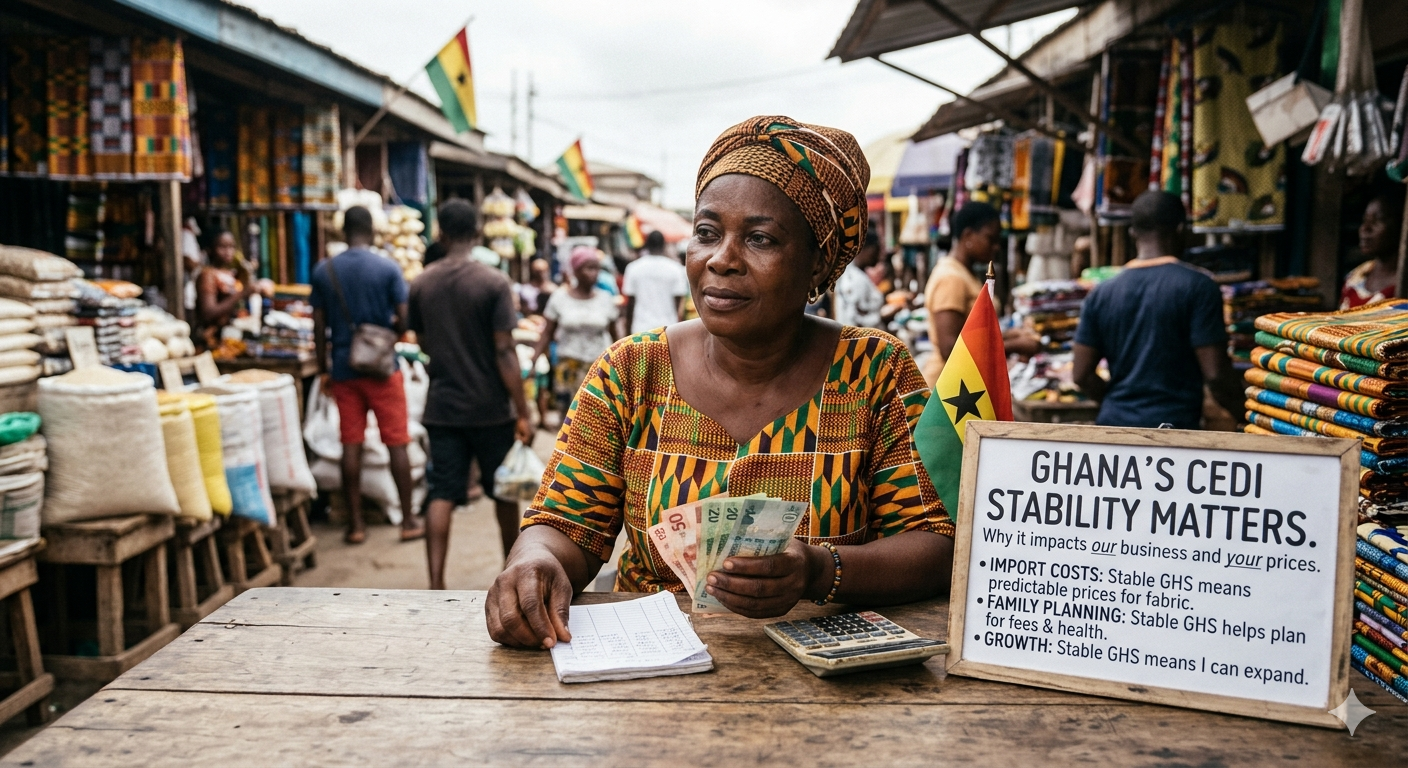
The cedi has depreciated 8.4% in 2026 after a 40% gain in 2025. Our deep-dive analysis reveals how currency movements impact import costs, interest rates, and business margins — and why cedi stability is your most important business input.
Why Ghana’s Cedi Stability Matters More Than Most Businesses Think
The Ghana cedi has just completed its most remarkable year in a generation. After a prolonged period of relentless depreciation that saw the currency collapse past GH¢15 to the US dollar in late 2024, the cedi staged a stunning reversal in 2025, appreciating by over 40 per cent. It recorded its first annual gain against the dollar since at least 1994. Inflation, which peaked above 54 per cent in late 2022, plunged to a historic 3.4 per cent in April 2026 — the lowest level since Ghana’s CPI rebasing in 2021. The Monetary Policy Rate was slashed from a crisis-era 30 per cent to 14 per cent. On paper, the story is one of triumphant stabilisation.
Yet any business owner who attempted to hedge their dollar exposure, negotiate a supplier contract, or price a six-month sales catalogue in early 2026 will tell you: the reality beneath the headlines is more complicated. The year-to-date depreciation against the US dollar stood at 8.4 per cent by mid-May 2026, significantly higher than the 2.5 per cent recorded during the same period in 2025. The currency weakened from an average mid-rate of GH¢10.95 to the dollar in January 2026 to GH¢11.4125 by mid-May. By late May, LSEG data showed the cedi trading at 11.56 to the dollar.
📢 GET DETAILED ARTICLES + JOBS
Join THSB's WhatsApp Channel and never miss a post or opportunity.
The cedi’s path matters — not as an abstract macroeconomic indicator, but as the single most powerful determinant of business costs, consumer prices, borrowing rates and the real disposable income of Ghanaian households.
This profile explains why. It examines how currency movements transmit through the economy, from fuel prices and import duties to interest rates and loan default risk. It explores the sectoral winners and losers of a stronger or weaker cedi. It analyses the Bank of Ghana’s policy toolkit — from gold purchases to interest rate management — and the limits of each tool. And it argues that for Ghanaian businesses, understanding the cedi is not a luxury for treasury departments. It is a survival skill.
The Cedi in Numbers: How Ghana’s Currency Has Actually Performed
The numbers tell a story of two currencies: the cedi of 2025 and the cedi of early 2026.
The 2025 Recovery: The cedi appreciated by over 40 per cent against the US dollar in 2025, its first annual gain since at least 1994. By the end of the year, the currency had strengthened from crisis-era lows above GH¢15 to the dollar to around GH¢10.45, stabilising in early 2026 before renewed pressures emerged.
The 2026 Reversal: The first five months of 2026 have seen an 8.4 per cent depreciation against the dollar, according to the Bank of Ghana’s May 2026 Summary of Economic and Financial Data. The currency weakened from an average mid-rate of GH¢10.95 to the dollar in January to GH¢11.4125 by mid-May, with the pace of depreciation accelerating from 4.6 per cent in January to 6.6 per cent in April and 8.4 per cent by May. On the interbank market, the cedi was trading around GH¢11.28 per dollar by early May, according to Databank Research.
Why the divergence? The 2025 appreciation was driven by exceptional factors: record gold prices (projected to average US$3,700 per ounce in 2026), the BoG’s aggressive gold purchase programme, the completion of the IMF programme’s key milestones, and a broader emerging market rally. The 2026 reversal reflects normalisation — seasonal corporate demand for dollars, dividend repatriation pressures, and the fading of one-off stability gains.
The Forecasts: Fitch Solutions projected an 8 per cent cedi depreciation in 2026, noting the expected depreciation remains below the long-term average of 10.2 per cent recorded between 2010 and 2025. Databank Research predicted a 7.20 per cent year-end depreciation to GH¢12.85 per dollar. EM Advisory projected a more modest path to GH¢12.0 per dollar, citing strong reserve buffers of US$13.8 billion — equivalent to 5.7 months of import cover — as a key stabilising factor. By late May, some analysts had revised expectations toward a 12.4–12.9 range from firmer import demand and repricing.
The Bottom Line: The cedi is no longer in freefall. But it is not stable in the sense that businesses can ignore it. A projected 7–8 per cent annual depreciation, if realised, means that over the course of a year, a business importing GH¢10 million worth of goods will see its cedi cost rise by GH¢700,000 to GH¢800,000 without any change in dollar pricing. That is not a crisis. But it is a serious margin compression.
The Transmission Mechanism: How Cedi Movements Actually Affect Your Business
Understanding why cedi stability matters requires understanding precisely how currency movements transmit to business costs and consumer prices. The transmission chain has six distinct links.
1. Direct Import Costs (The Most Immediate Impact)
Ghana is a net importer of almost everything that matters for economic activity: refined petroleum products, raw industrial materials, machinery, pharmaceuticals, food staples and intermediate goods. The country’s import bill in 2025 exceeded US$20 billion. When the cedi weakens, the cedi cost of every dollar-denominated import rises mechanically.
For importers, the effect is immediate. The GNCCI CEO noted that the cedi’s strengthening in early 2026 was beginning to ease the cost of imports, as businesses required fewer cedis to access foreign exchange, while also reducing import duties calculated in cedi equivalents. The reverse is equally true: when the cedi weakens, import costs rise, duties rise, and margins compress — unless selling prices rise, which then feeds inflation.
The Ghana Union of Traders’ Association (GUTA) acknowledged that the relative cedi stability in early 2026 allowed importers to plan better — a luxury they had not enjoyed in previous years of severe volatility.
2. Fuel Prices (The Invisible Tax on Everything)
Ghana imports refined petroleum products and crude inputs priced in dollars. When the cedi depreciates, importers require more local currency to settle transactions, and that cost is passed directly to consumers. A weakening cedi explains why per-litre fuel prices climbed close to GH¢12 in early 2026 — a combination of global oil price pressures and currency effects. Since fuel is a direct input into electricity generation, transportation, manufacturing and agriculture, every cedi lost against the dollar ripples through the entire cost structure of the economy.
The government has intervened, introducing a fuel price relief mechanism in April 2026 that involves the state absorbing GH¢2 per litre on diesel and GH¢0.36 per litre on petrol. But such interventions are fiscal cushions, not structural solutions. They are also subject to political and fiscal sustainability limits.
3. Interest Rates and Borrowing Costs
The Bank of Ghana’s ability to lower borrowing costs is directly constrained by cedi stability. When the currency is under pressure, the BoG must maintain interest rates at levels that attract foreign portfolio capital and discourage residents from converting cedis into dollars. The cedi’s 8.4 per cent year-to-date depreciation in May 2026 — compared to just 2.5 per cent in the same period of 2025 — helps explain why the BoG held the Monetary Policy Rate steady at 14 per cent in May, rather than continuing its easing cycle. Lending rates, though down from crisis-era peaks, remain above 19 per cent for most SME borrowers.
4. Inflation Dynamics (The Pass-Through Effect)
Economists call it “exchange rate pass-through” — the degree to which cedi depreciation translates into higher consumer prices. Ghana’s pass-through is historically high because of the economy’s import intensity. Every 10 per cent depreciation adds roughly 3–4 percentage points to inflation over a 12-month period, according to central bank estimates.
The recent inflation uptick to 3.4 per cent in April 2026 — ending 15 consecutive months of disinflation — was partly driven by higher fuel prices and exchange rate effects. Fitch expects inflation to rise gradually toward the end of 2026 as exchange rate effects fade and higher oil prices feed into local prices.
5. External Debt Service (The Government’s Burden)
Ghana’s public debt, though reduced from 65 per cent to 45 per cent of GDP, still carries a significant foreign currency component. The budget allocates substantial resources to external debt service. A weaker cedi means more cedis are required to service each dollar of external debt, diverting fiscal resources away from development spending and potentially increasing domestic borrowing — which in turn crowds out private sector credit.
6. Real Incomes and Consumer Demand (The Spending Squeeze)
When the cedi weakens and inflation rises, real household incomes fall. Workers whose wages are denominated in cedis see their purchasing power erode. Consumer spending contracts. For businesses that rely on domestic demand — retail, hospitality, construction — the effect of a weak cedi is not just higher input costs but also lower revenues. This double squeeze is why currency stability matters for even the most domestically oriented businesses.
The BoG’s Toolkit: How the Central Bank Actually Manages the Cedi
The Bank of Ghana has a range of tools to influence the cedi’s path, but each has limits and trade-offs.
1. Monetary Policy Rate (The Blunt Instrument)
When the BoG raises the policy rate, borrowing becomes more expensive in cedis, which encourages foreign capital inflows (investors buy cedis to invest in higher-yielding assets) and discourages residents from converting cedis into dollars. The BoG cut the policy rate aggressively from 27 per cent in late 2024 to 14 per cent by March 2026, the lowest level since October 2021. But further cuts are now constrained by cedi pressures. Databank expects the BoG to maintain a “cautious easing cycle” for the rest of 2026, with mild depreciation enough to keep the central bank on alert.
2. Foreign Exchange Interventions (The Direct Approach)
The BoG can sell dollars from its reserves directly into the market to meet demand and stabilise the cedi. The central bank signalled plans for US14.15 billion, covering 5.7 months of imports — a historically strong buffer. But reserves are not infinite. Heavy intervention depletes the buffer and can create expectations of further depreciation, encouraging speculative demand for dollars.
3. The Gold Purchase Programme (Ghana’s Structural Innovation)
The most distinctive element of Ghana’s currency management strategy is the Domestic Gold Purchase Programme (DGPP), first introduced under the previous administration and expanded under the current government. The programme operates by purchasing gold from small-scale and artisanal miners in the domestic market, paying in cedis at the prevailing forex bureau exchange rate.
The gold is then used to purchase foreign currency, building reserves without the need for excessive borrowing. Before the programme, Ghana’s total gold reserves were about 8 tonnes. The programme has helped stabilise the cedi and rebuild external buffers, with gold reserves rising to 19.2 metric tons by February 2026.
The government has gone further. From March 2026, the newly established Ghana Gold Board (GoldBod) assumed full responsibility for off-take agreements and sales of all artisanal small-scale mining (ASM) gold, with a target of over US$20 billion in annual forex from gold reforms. The government also announced plans for large-scale gold mines to sell at least 30 per cent of their annual output to the central bank to increase local refining and boost foreign-exchange reserves.
4. Forward Guidance and Market Communication (The Psychology of Stability)
Central bank Governor Dr Johnson Asiama has been explicit: the country is “unlikely to return to the period of persistent cedi depreciation” that characterised the crisis years. Early in 2026, when the cedi depreciated 4 per cent in January, he downplayed concerns: “The four percent depreciation of the cedi in January 2026 is not a worry,” emphasising the Bank’s confidence in its existing policy framework.
The BoG has also flagged market expectations as key to sustaining cedi stability. The currency’s path in 2026 will hinge not just on reserves or inflows, but on “the discipline, transparency, and consistency of fiscal and monetary policy, and the confidence that market participants place in them.
The Real Winners and Losers: Sectoral Impacts of Cedi Movements
Currency movements are not uniformly good or bad. Different sectors of the Ghanaian economy win and lose depending on the cedi’s direction.
Winners from a Weaker Cedi (Depreciation)
- Exporters: Gold miners, cocoa producers, and other exporters earn revenue in dollars while paying costs in cedis. A weaker cedi increases their cedi profits. Ghana is projected to benefit from substantial dollar inflows from a 7.1 per cent increase in gold output, particularly from the Bibiani, Chirano and Namdini mines, with gold export receipts forecast to rise 12.9 per cent to US$23.7 billion.
- Cocoa Farmers: Cocoa prices are set in dollars, and a weaker cedi increases the cedi value of each cocoa sale — though the government’s administered producer price can moderate this benefit.
- Tourism Sector: A weaker cedi makes Ghana cheaper for international tourists, potentially boosting arrivals and dollar receipts.
Winners from a Stronger Cedi (Appreciation)
- Importers and Distributors: Businesses that bring in finished goods, raw materials and machinery benefit directly from lower cedi costs.
- Consumers: A stronger cedi reduces import-driven inflation, protecting real incomes and purchasing power.
- Borrowers: A stable or strengthening cedi allows the BoG to lower interest rates more aggressively, reducing borrowing costs for businesses and households.
- Manufacturers Using Imported Inputs: Even locally oriented manufacturers often rely on imported components, packaging or machinery. A stronger cedi reduces those costs.
The Manufacturing Paradox (The Complex Middle)
Ghana’s manufacturing sector occupies a contested position in the currency debate. Manufactured exports account for only about five per cent of total merchandise exports, compared with an average of about 60 per cent for lower middle-income countries. This weak export performance suggests that currency depreciation has not, historically, succeeded in driving industrial growth.
Former Health Minister Bernard Okoe Boye warned that the strong cedi policy of early 2026 was “hurting local production and undermining job creation,” arguing that it had become “more profitable to import goods into Ghana than to produce the goods here.” A strengthening cedi reduces the price of imports, making foreign goods cheaper relative to locally produced alternatives.
However, other voices argue that a weak cedi is not a solution. As economist Nii Moi noted, Ghana’s manufactured export underperformance persists “even after years of cedi weakening.” The trade minister has urged stakeholders to reduce reliance on imports, arguing that substituting imports with locally driven solutions would help stabilise the cedi. Dr Nsiah-Poku added that manufacturers are “still recovering from heavy losses incurred during the period of a weak currency,” meaning the gains from a stronger currency are not yet visible at the firm level as they are being used to repair balance sheets rather than pass through to lower prices.
The Gold Factor: Why Ghana’s Largest Export Is Also Its Biggest Vulnerability
Gold is Ghana’s economic superpower and its greatest single point of vulnerability. The country is Africa’s top gold producer, and the sector’s performance in 2026 has been extraordinary.
Gold exports reached US3,700 per ounce in 2026, according to Fitch Commodities projections. Fitch forecasts gold export receipts will rise 12.9 per cent to US$23.7 billion.
The gold sector shields the cedi in two ways. First, it generates substantial dollar inflows that support the BoG’s reserve accumulation. Second, the BoG’s gold purchase programme directly adds to reserves while reducing the need for external borrowing.
But the IMF has warned that Ghana’s economy is highly sensitive to gold prices. A sharp gold price correction triggered by US inflation or geopolitical tensions would put immediate pressure on Ghana’s external accounts, reserves and the cedi. Fitch itself cautioned that such a correction is possible.
Moreover, the transition to GoldBod carries implementation risk. The programme is complex, involving end-to-end off-take agreements, hedging programmes, and coordination with the central bank and ministry of finance. Any disruption in gold purchases or sales would directly affect the BoG’s reserve accumulation capacity.
The government’s plan to acquire 30 per cent of large-scale gold mines’ output for local refining — announced in May 2026 — could further strengthen reserves if implemented effectively. As one BoG official explained, the gold programme was introduced “at a time when Ghana faced acute vulnerability, with thin foreign exchange buffers and fragile confidence,” and was designed to “stabilise the currency and rebuild reserves by leveraging the country’s natural endowment.
The Fiscal Dimension: Why Government Borrowing Is Also a Currency Story
The relationship between fiscal policy and the cedi is often underestimated. When the government borrows heavily in domestic markets, it absorbs local currency liquidity that could otherwise be used by businesses. But more directly, sustained fiscal deficits can put downward pressure on the cedi by increasing the money supply and reducing confidence in the government’s ability to manage its finances.
Ghana’s fiscal position has improved dramatically. The public debt-to-GDP ratio fell from about 65 per cent to 45 per cent within a year. The primary surplus hit 2.9 per cent of GDP in 2025. Fitch expects Ghana to achieve its primary surplus target of 1.5 per cent of GDP in both 2026 and 2027.
Economists have told the government that cedi stability hinges on fiscal discipline. Dr Acheampong expressed confidence that Ghana could maintain cedi stability post-IMF, pointing to the government’s commitment to fiscal discipline and ongoing reforms. However, others have cautioned that it is “too early to say cedi stability is sustainable,” urging that real discipline only be judged when the IMF programme ends and Ghana must stand alone.
The government’s flagship 24-Hour Economy Authority Bill was passed in February 2026, designed to transform Ghana into a round-the-clock economy and reduce reliance on imports. Proponents argue that a 24-hour economy would reduce pressure on the cedi by curbing the country’s import dependency — in 2024 alone, Ghana imported about US$2 billion worth of food, while manufacturing contributes less than 12 per cent of GDP and factories operate at only about 42 to 46 per cent of capacity. But its implementation will determine whether it contributes to cedi stability or merely adds another layer of fiscal spending.
External Vulnerabilities: The Things Ghana Cannot Control
Even with perfect domestic policy, Ghana remains exposed to external shocks beyond its control.
Global Oil Prices: Ghana imports virtually all its refined petroleum products. Every dollar increase in the global oil price adds directly to the import bill and puts pressure on the cedi. The current intervention — state absorption of fuel costs — is a temporary buffer, not a permanent solution. The Israel-Iran conflict, which escalated in early 2026, has added risk to oil price projections.
US Monetary Policy: When the US Federal Reserve raises interest rates or signals a hawkish stance, emerging market currencies including the cedi come under pressure. Higher US rates make dollar assets more attractive, encouraging capital outflows from Ghana. The opposite is also true: expected global disinflation could reduce external financing costs, supporting portfolio flows and easing pressure on the cedi.
Commodity Price Volatility: Ghana’s export basket is concentrated in gold and cocoa. A correction in either — particularly gold — would immediately affect the trade balance and put pressure on reserves. The IMF has cautioned that foreign exchange reserve coverage in 2026 could decline by 1.1 months of imports compared to baseline in a negative gold price scenario.
Geopolitical Risk: The ongoing conflict in the Middle East, Iran war risks, and broader geopolitical tensions have created an environment where emerging market currencies are treated with additional caution by global investors.
EM Advisory noted that 2026 “is the year Ghana must solidify external resilience, leveraging reserves, gold refining, and fiscal prudence to maintain macroeconomic stability.
The Overlooked Cost: The Human Impact of Cedi Volatility
Amid the macroeconomic analysis, it is easy to forget that cedi movements have direct human consequences — particularly for the most vulnerable.
Real Income Erosion: For salaried workers earning GH¢3,000 per month, an 8 per cent depreciation means their purchasing power against imports has fallen by GH¢240 per month. For households that rely on imported food, medicines or fuel, the squeeze is immediate. The GNCCI CEO noted that macroeconomic gains had not yet fully impacted businesses or households.
SME Squeeze: The 95 per cent of businesses that cannot access formal bank loans due to collateral constraints are disproportionately affected by cedi movements. They cannot hedge. They cannot access forward contracts. They absorb the full impact of depreciation as higher input costs and hope to pass them through to customers without losing market share. The KPMG survey found that while macro indicators are moving in the right direction, the impact on the real economy remains limited.
Informal Sector Exposure: The informal sector, where most Ghanaians work and live, is particularly exposed. Market queens and small-scale traders operate with thin margins and limited access to financial instruments. When the cedi weakens, they cannot adjust prices overnight. They absorb losses until they can recalculate and repost — a process that can take weeks.
Mental Load: Persistent currency uncertainty imposes a cognitive burden. Business owners who must constantly recalculate margins, renegotiate supplier terms and second-guess pricing decisions cannot focus on growth, innovation or customer service. They are in survival mode. That is not a macroeconomic statistic, but it is a real economic cost.
The “remarkable turnaround” following years of sustained depreciation that “significantly increased operating costs for import-dependent businesses” has provided relief for some. But the gains have not been evenly distributed. Many businesses, particularly SMEs, are still recovering from the losses incurred during the weak-currency period, and the stability dividend has yet to reach them in full.
Why Businesses Need to Care: Practical Implications
For Ghanaian business owners, cedi stability is not an abstract policy concern. It has five concrete implications for day-to-day operations.
1. Margin Predictability: A stable cedi allows businesses to set prices, negotiate contracts and plan inventory with reasonable confidence. The GNCCI CEO noted that businesses now require “fewer cedis to access foreign exchange,” stabilising their cost structures. The ability to import with confidence — knowing that the exchange rate in six months will not be radically different — improves operational efficiency and reduces the need for costly hedging.
2. Borrowing Cost Trajectory: The BoG has signalled that lending rates could fall further, possibly into single digits by late 2026, provided inflation remains contained and external conditions are stable. But this path depends critically on cedi stability. If depreciation accelerates, the BoG will pause or reverse its easing cycle, and businesses will continue to face elevated borrowing costs.
3. Strategic Hedging Options: Businesses with significant foreign exchange exposure have options, but they require planning. Forward contracts allow businesses to lock in exchange rates for future transactions, eliminating uncertainty. Multi-currency pricing and contracts allow businesses to denominate sales or purchases in stable currencies. Hedging instruments allow businesses and institutions to lock in prices for future energy purchases or protect against adverse currency movements, reducing exposure to sudden price spikes.
As one advisory note put it, implementing effective cedi depreciation hedging strategies — such as forward contracts, natural hedging and strategic procurement — can significantly reduce financial risk.
But many SMEs lack the scale or sophistication to access these instruments. Professional currency hedging advisory services exist for larger firms, but smaller businesses remain exposed.
4. Investment Timing: A stable cedi reduces the risk of investing in long-term capital assets. When the currency is volatile, businesses delay equipment purchases, expansion plans and hiring decisions, waiting for clearer signals. The removal of that uncertainty — or at least its reduction — unlocks investment that would otherwise be deferred. Investors, however, have become more selective as Ghana’s recovery reshapes capital flows, and confidence in the cedi is a key factor in their assessments.
5. Competitive Positioning: For businesses competing with imports, the direction of the cedi determines whether they gain or lose market share. A weaker cedi protects local producers by making imports more expensive. A stronger cedi benefits importers and distributors but squeezes domestic manufacturers. Understanding where the cedi is heading — and why — is essential for strategic positioning.
The Cedi Is a Business Input: Ultimately, the cedi is not just the unit of account. It is a business input, just like labour, raw materials, energy and finance. And like any input, its price matters. Businesses that understand the drivers of cedi movements can anticipate cost changes, adjust pricing proactively, and protect margins. Businesses that ignore the cedi will be surprised — repeatedly — by margin compression they did not see coming. The cedi’s relative calm has restored predictability for some, but in the complex world of Ghanaian business, the watchword remains vigilance.
Future Outlook: Three Scenarios for the Cedi
Where is the cedi heading for the remainder of 2026? Three scenarios are plausible.
Scenario One: Managed Depreciation (70 per cent probability)
In this base case, the cedi depreciates 7–9 per cent for the full year, broadly in line with Fitch and Databank projections. The currency ends 2026 in the GH¢11.8–12.8 range against the dollar. Depreciation is gradual, seasonal and manageable. Reserves remain comfortable at 5+ months of import cover. The BoG continues its cautious easing cycle, cutting the policy rate to 13–13.5 per cent by year-end. This scenario requires no major external shocks and sustained fiscal discipline.
Scenario Two: Stability Surprise (20 per cent probability)
If gold prices remain elevated (above US$3,700 per ounce), cocoa prices recover, and the BoG’s intervention strategy succeeds beyond expectations, the cedi could end 2026 closer to GH¢11.0–11.5, with depreciation below 5 per cent for the year. This would allow the BoG to cut rates more aggressively, potentially bringing lending rates toward single digits by late 2026. This scenario is optimistic but not impossible, given Ghana’s strong reserve position.
Scenario Three: Renewed Pressure (10 per cent probability)
If oil prices spike, geopolitical tensions escalate, or gold prices correct sharply, the cedi could breach GH¢13–14 by year-end, with full-year depreciation exceeding 15 per cent. In this case, the BoG would be forced to raise rates, undoing much of the progress of the past 18 months. The SME financing gap would widen. Import-driven inflation would return. This is the scenario that keeps policymakers awake.
The most likely path is Scenario One: a slow, modest depreciation that Ghana’s external buffers can comfortably absorb. The BoG has the tools to manage the cedi’s path, but it does not control global gold prices, oil markets or the US Federal Reserve. The cedi’s stability is not guaranteed — it is conditional on continued fiscal discipline, external resilience and the confidence of market participants.
THSB Conclusion
Cedi stability matters more than most businesses think because the cedi is not separate from the economy — it is the economy’s transmission belt. Every cedi that weakens against the dollar raises import costs, fuels inflation, constrains interest rate cuts, erodes real incomes and squeezes margins. Every percentage point of stability buys predictability, lowers borrowing costs and protects the real incomes of Ghanaian households.
The good news is that Ghana’s cedi position today is dramatically better than two years ago. Reserves stand at a record US$14.15 billion, covering 5.7 months of imports. The gold purchase programme provides a structural source of reserve accumulation that did not exist before. Inflation has collapsed from over 50 per cent to 3.4 per cent. The policy rate has fallen from 30 per cent to 14 per cent. The IMF programme has been successfully implemented, and Ghana’s debt-to-GDP ratio has been cut from 65 per cent to 45 per cent.
But the cedi’s 8.4 per cent depreciation in the first five months of 2026 — compared to just 2.5 per cent in the same period of 2025 — is a reminder that stability is not permanence. The currency faces seasonal pressures, external vulnerabilities and the natural gravitational pull of an import-dependent economy.
For Ghanaian businesses, the implications are clear. The cedi is not a macroeconomic abstraction. It is a business input. Its price matters. And like any input, its cost can be managed — through hedging, pricing strategy, and a clear understanding of the forces that drive it. Businesses that ignore the cedi will continue to be surprised by margin compression, cost volatility and eroding competitiveness. Businesses that understand it can plan, protect and grow, regardless of which direction the currency moves.
The era of 50 per cent inflation and 30 per cent interest rates is over. Ghana has turned a corner. But on the cedi front, the destination is not yet certain. And for the thousands of Ghanaian businesses that depend on predictable costs, stable prices and affordable credit, that uncertainty is the single most important fact of their economic lives.
Frequently Asked Questions (FAQ)
Q1: How has the Ghana cedi actually performed in 2026?
The cedi has depreciated by 8.4 per cent against the US dollar in the first five months of 2026, according to Bank of Ghana data. It weakened from an average mid-rate of GH¢10.95 in January to GH¢11.4125 by mid-May, and was trading around GH¢11.56 per dollar by late May.
Q2: Why is the cedi depreciating after a strong 2025?
The 2025 appreciation was driven by exceptional factors: record gold prices, the BoG’s aggressive gold purchase programme, successful IMF milestones, and a broader emerging market rally. The 2026 depreciation reflects normalisation: seasonal corporate demand for dollars, dividend repatriation pressures, and the fading of one-off stability gains.
Q3: Is the cedi stable or not?
The answer depends on the time horizon. Compared to the crisis years of 2022–2024, the cedi is remarkably stable. The BoG has called the marginal depreciation “not a worry” and “not a threat to stability.” But the 8.4 per cent year-to-date depreciation — compared to just 2.5 per cent in the same period of 2025 — is a significant increase in pressure.
Q4: How does a weaker cedi affect my business?
Directly through import costs (every dollar-denominated import becomes more expensive), indirectly through fuel prices (which affect everything from electricity to transportation), and through interest rates (the BoG must keep rates higher to defend the cedi). For businesses that rely on domestic demand, there is also a consumption squeeze as real household incomes fall.
Q5: What sectors benefit from a weaker cedi?
Exporters — particularly gold miners and cocoa producers — benefit because they earn revenue in dollars while paying costs in cedis. The tourism sector also benefits, as Ghana becomes cheaper for international visitors.
Q6: What sectors benefit from a stronger cedi?
Importers and distributors benefit directly from lower cedi costs. Consumers benefit through lower import-driven inflation. Borrowers benefit because a stable cedi allows the BoG to lower interest rates more aggressively. Manufacturers using imported inputs also benefit.
Q7: Is a strong cedi always good for Ghana?
No. A strong cedi can hurt local manufacturing by making imported goods cheaper relative to locally produced alternatives. Former Health Minister Bernard Okoe Boye warned that a strong cedi policy was “hurting local production and undermining job creation.” However, weak-currency proponents face the counterargument that manufactured exports account for only about five per cent of total merchandise exports, suggesting depreciation has not historically driven industrial growth.
Q8: What is the BoG’s gold purchase programme and how does it help the cedi?
The programme purchases gold from small-scale miners, paying in cedis, and uses the gold to purchase foreign currency. This builds reserves without excessive borrowing and has helped stabilise the cedi. Before the programme, Ghana’s gold reserves were about 8 tonnes; they rose to 19.2 metric tons by February 2026.
Q9: How much foreign exchange reserves does Ghana have?
Gross international reserves stood at US$14.15 billion as of mid-2026, covering 5.7 months of imports — a historically strong buffer that the central bank can deploy to stabilise the cedi when needed.
Q10: What are the biggest risks to cedi stability?
Global oil prices (Ghana is a net importer of refined petroleum), US monetary policy (higher US rates attract capital away from emerging markets), gold price volatility (a sharp correction would reduce dollar inflows), and geopolitical tensions (which create an environment of emerging market caution).
Q11: Can businesses protect themselves from cedi volatility?
Yes. Larger businesses can use forward contracts to lock in exchange rates for future transactions, multi-currency pricing, natural hedging and strategic procurement. As one advisory note put it, implementing effective cedi depreciation hedging strategies can “significantly reduce financial risk.” However, many SMEs lack the scale or sophistication to access these instruments.
Q12: What is the outlook for the cedi for the rest of 2026?
Most analysts project a mild to moderate depreciation of 7–9 per cent for the full year, with the cedi ending 2026 in the GH¢11.8–12.8 range against the dollar. This assumes no major external shocks and continued fiscal discipline. However, a sharp gold price correction, oil price spike or geopolitical escalation could push the cedi toward GH¢13–14 by year-end.
Source: The High Street Business
Disclaimer: Some content on The High Street Business may be aggregated, summarized, or edited from third-party sources for informational purposes. Images and media are used under fair use or royalty-free licenses. The High Street Business is a subsidiary of SamBoad Publishing under SamBoad Business Group Ltd, registered in Ghana since 2014.
For concerns or inquiries, please visit our Privacy Policy or Contact Page.

Esther Aku-Sika is a content writer and social media strategist who helps brands and startups grow through intentional storytelling and practical marketing strategies. With a keen eye for trends and audience behavior, she shares business insights, content strategies, and real-life lessons to help entrepreneurs build visibility and turn ideas into income. Through her writing, she simplifies complex concepts and equips readers with actionable steps to grow in today’s digital space.