










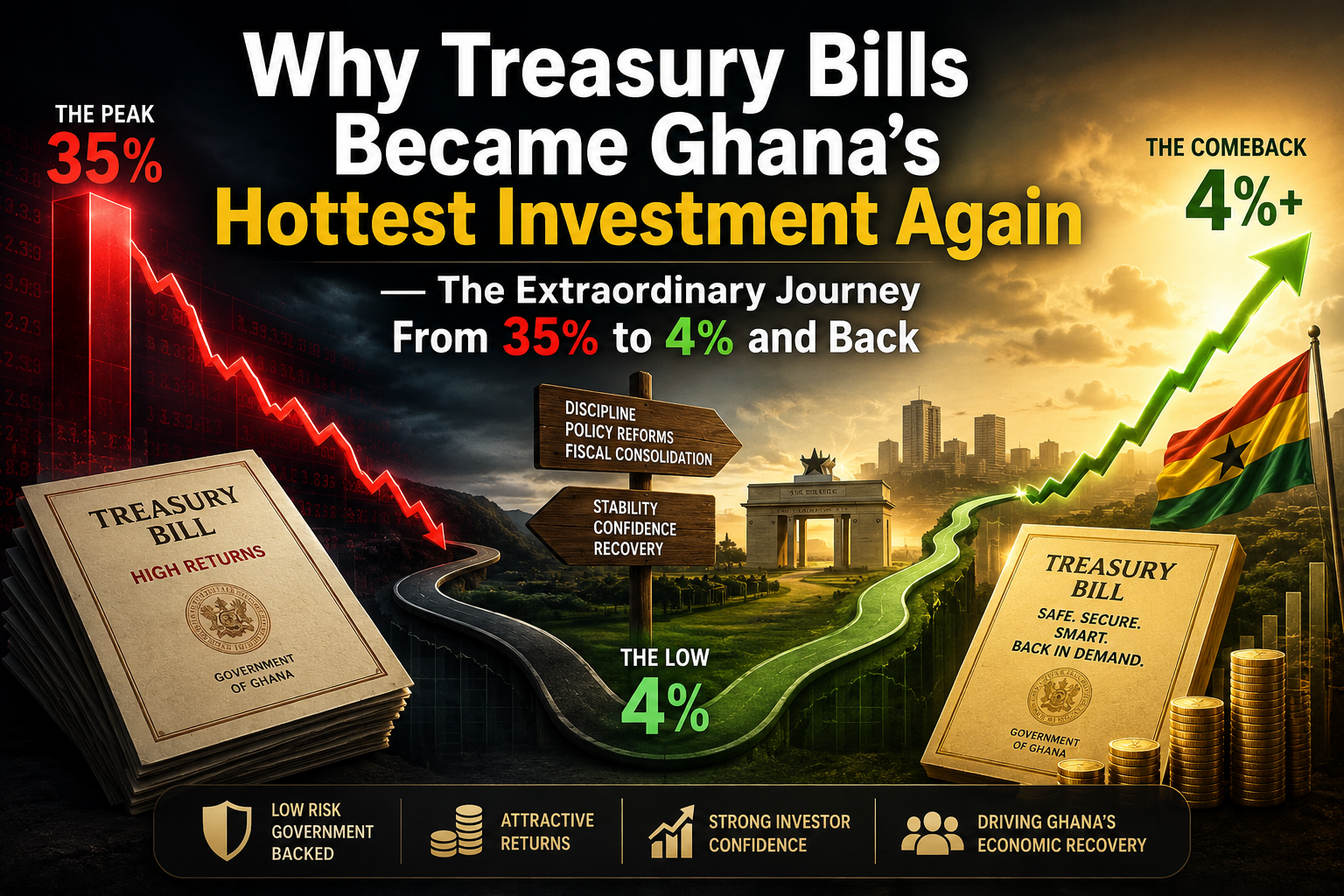

Why Treasury Bills Became Ghana’s Hottest Investment Again — T-bill yields collapsed from 35% to 4.91% — yet investors are oversubscribing by 35%. Our deep-dive analysis reveals the post-DDEP trust recovery, yield curve dynamics, and what comes next for Ghana’s hottest fixed-income market.
Why Treasury Bills Became Ghana’s Hottest Investment Again — The Extraordinary Journey From 35% to 4% and Back
If you had placed GH₵100,000 into a 91-day Treasury bill in late 2022, you would have earned roughly GH₵8,700 in interest over three months. That same GH₵100,000 invested in May 2026 will return approximately GH₵1,200. The yield collapsed from a crisis-era 35 percent to just 4.91 percent. And yet, Ghanaian investors cannot get enough of them.
In the first week of May 2026, the government raised GH₵5.48 billion against a target of GH₵4.30 billion — an oversubscription of nearly 35 percent. Just weeks earlier, in the depths of April, the same market had recorded six straight undersubscribed auctions, with bids falling 30 percent short of the government’s target at one point. What explains this whiplash? And why, when a 91-day bill now returns less than 5 percent annualised — barely above the rate of inflation — are investors still lining up?
📢 GET DETAILED ARTICLES + JOBS
Join THSB's WhatsApp Channel and never miss a post or opportunity.
The answer tells a larger story about Ghana’s post-DDEP economic recovery: the return of trust, the recalibration of risk appetite, and the unexpected consequences of the country’s most aggressive monetary easing in a generation. This is not merely a story about government securities. It is a story about how a traumatised investing public learned to trust sovereign paper again — and what happens when that trust begins to waver.

This deep intelligence profile unpacks the mechanics, the psychology, and the market forces driving Ghana’s T-bill resurgence, with implications for every investor, banker, and policymaker watching Africa’s most closely watched fixed-income market.
THE EXTRAORDINARY NUMBERS: A MARKET IN TWO HALVES
The first four months of 2026 captured two entirely different markets. To understand why T-bills became hot again, one must first understand why they cooled.
From January to mid-March, the market posted 11 consecutive oversubscribed auctions. At its peak in mid-February, investors submitted GH₵22.67 billion in bids against a government target of just GH₵6.42 billion — an oversubscription of over 250 percent. Banks, pension funds, asset managers, and even retail investors were fighting for a piece of sovereign paper.
Then, from late March through April, the market turned ice-cold: six straight undersubscribed auctions, culminating in Tender 2002, where bids of GH₵5.31 billion fell nearly 30 percent short of the GH₵7.57 billion target. By the final auction of April, the government was raising just GH₵4.44 billion against a target of GH₵5.01 billion — a 10.4 percent shortfall.
What changed in those few weeks? One word: yields.
At the beginning of 2026, the 91-day bill offered 11.12 percent. By the end of April, it had collapsed to 4.92 percent. The 364-day bill fell from 12.93 percent to 10.20 percent over the same period. Investors who had grown accustomed to double-digit risk-free returns suddenly found themselves staring at single-digit yields — lower than many had ever seen in their investing lifetimes. Many decided to wait and see.
Then May arrived. Yields began climbing again. The 91-day bill inched up to 4.91 percent (still historically low), the 364-day bill jumped 25 basis points to 10.38 percent — and investors rushed back in. The lesson was clear: in Ghana’s fixed-income market, even small yield movements trigger massive capital flows.
THE DDEP AFTERMATH: HOW TRUST WAS BROKEN AND REBUILT
No analysis of Ghana’s T-bill resurgence is complete without understanding the Domestic Debt Exchange Programme (DDEP) of 2023. The restructuring imposed losses estimated between 50 and 90 percent on many bondholders — pensioners, banks, and institutional investors alike. Overnight, the unthinkable happened: Ghana’s sovereign debt was no longer “risk-free.
What followed was a flight to safety — but where? The domestic bond market was effectively frozen. The government imposed restrictions on new domestic bond issuance, a measure introduced at the height of the debt crisis in 2023. For nearly three years, Treasury bills became the only government-backed instrument available to most domestic investors. Pension funds, whose regulatory mandates require significant allocations to government securities, had nowhere else to go.
That all changed on March 2, 2026, when the Ministry of Finance announced the expiration of the DDEP-induced restrictions. Ghana could now issue new long-term domestic bonds for the first time since the restructuring. The announcement was accompanied by a crucial confidence signal: the government stated it had “honoured every coupon payment and obligation under the restructured bonds” since 2025.

For the first time since the debt crisis, investors had a credible reason to believe that Ghana’s government could be trusted to honour its paper again.
THE INVESTOR LOGIC: WHY 4 PERCENT STILL MAKES SENSE
To an outside observer, the idea that sophisticated investors would rush to lock in a 91-day yield of 4.91 percent — when inflation stands at 3.4 percent — may seem irrational. The real return (yield minus inflation) is barely positive. But in Ghana’s context, the logic is sound.
First, safety. The equity market may be offering spectacular returns — the GSE Composite Index delivered a year-to-date return of approximately 56.6 percent as of early March 2026, and market capitalisation hit a record GH₵251 billion — but with those returns come volatility. Treasury bills offer absolute certainty of principal and interest, backed by the full taxing authority of the Republic of Ghana. For pension funds managing retirement savings, that certainty is non-negotiable.
Second, regulatory mandate. The National Pensions Regulatory Authority (NPRA) requires pension funds to hold approximately 35 percent of their assets in money market instruments, including Treasury bills. Banks, too, are required to maintain certain liquidity ratios, for which T-bills are the preferred asset. This regulatory floor ensures that even when yields fall, institutional demand never completely disappears.
Third, the alternatives. Bank fixed deposits are yielding less than T-bills. Real estate requires significant capital and offers limited liquidity. The dollar — historically a hedge for Ghanaian investors — has been volatile, and with the cedi’s year-to-date depreciation at 7.8 percent as of early May, dollar-denominated holdings have lost value in cedi terms. In this environment, a 4.91 percent risk-free return begins to look perfectly rational.
THE YIELD CURVE AND THE INVESTOR REBALANCING
Perhaps the most sophisticated behaviour in the current market is the way investors are moving across the yield curve. The data tells a clear story of duration preference shifting with rates.
In January 2026, when yields were high across all tenors, investors strongly preferred the 364-day bill, submitting a record GH₵15.18 billion in bids. Locking in 12.93 percent for a full year made sense. By April, with the one-year yield down to 10.20 percent, investors had lost interest in committing funds for longer periods. Bids for the 364-day bill collapsed by 79.4 percent to just GH₵3.12 billion.
Instead, capital rotated into the shortest end of the curve — the 91-day bill — which attracted GH₵2.8 billion in bids in the final April auction, almost all of which were accepted. Investors were effectively saying: we will accept lower returns in exchange for maximum liquidity. They wanted to preserve the ability to redeploy capital quickly if yields rose again — which, by mid-May, they did.
This behaviour — known in fixed-income markets as “riding the yield curve” — reveals a sophisticated investor base that understands duration risk and is actively managing it. When yields rise, capital flows to the long end to lock in higher rates. When yields fall, capital retreats to the short end for flexibility.
THE MACRO CONSTRAINTS: WHY YIELDS MAY HAVE BOTTOMED
The key question for every investor is whether the current yields — 4.91 percent on the 91-day, 7.04 percent on the 182-day, 10.38 percent on the 364-day — represent a floor or a plateau on the way back up.
Several factors suggest yields have bottomed.
First, inflation has stopped falling. After 16 consecutive months of disinflation, headline inflation ticked up to 3.4 percent in April 2026 from 3.2 percent in March. The increase was driven by higher fuel prices and services inflation. If inflation continues to rise — as the IMF projects, toward 8 percent by year-end — real yields could turn negative, forcing the government to raise nominal rates to attract buyers.
Second, the cedi is under renewed pressure. The currency weakened from an average of GH₵10.95 to the dollar in January to approximately GH₵11.41 by mid-May — a year-to-date depreciation of 8.4 percent. Compared to the 2.5 percent depreciation recorded over the same period in 2025, the deterioration is stark. If the cedi continues to weaken, the BoG may be forced to raise rates to defend the currency, which would pull T-bill yields higher.
Third, the government’s borrowing needs remain substantial. Ghana faces US2 billion in 2027. While the return to the domestic bond market (the first post-DDEP issuance was a seven-year bond at a 12.5 percent coupon) will help reduce reliance on short-term T-bills, the government will still need to roll over approximately GH₵137 billion in Treasury bills annually. That persistent demand for capital will put a floor under yields.
THE NEW COMPETITION: WHY BANKS ARE LOOKING ELSEWHERE
An important development that will shape the T-bill market in the coming months is the rise of alternative fixed-income instruments, particularly the Bank of Ghana’s Open Market Operations (OMO) bills.
As T-bill yields fell in early 2026, banks began shifting funds into OMO bills, which were clearing at approximately 10.5 percent — significantly higher than T-bills of comparable tenor. The 56-day OMO bill, in particular, became a major tool for active liquidity absorption, with the cost of these operations reaching GH₵16.73 billion in 2025.
This dynamic creates a delicate balancing act for the BoG. If it continues to issue OMO bills at rates significantly above T-bill yields, it will drain liquidity from the T-bill market and force the government to raise its own yields to compete. But if it lowers OMO rates, it risks losing control of excess liquidity, which could reignite inflation.
For T-bill investors, the implication is clear: yields are likely to be set not just by government borrowing needs, but by the spread between T-bills and competing risk-free instruments like OMO bills. As long as the BoG is willing to pay 10.5 percent for 56-day paper, the government cannot expect investors to accept 4.9 percent for 91-day paper forever.
THE RETAIL REVOLUTION: WHO IS BUYING T-BILLS NOW?
Institutional investors — banks, pension funds, asset managers — dominate the T-bill market. But retail participation is growing, and the demographic profile is revealing.
According to KPMG’s 2025 West Africa Banking Industry Customer Experience Survey, 25 percent of all Ghanaians now prefer Treasury bills as an investment vehicle. Among those who do invest, the numbers are even higher: millennials who invest show a 28 percent preference for T-bills, and that figure rises to 30 percent among the general investing population.
However, there is a striking generational divide. Forty-three percent of Gen Z respondents reported having no investments at all — the highest disengagement rate across all age groups. This suggests that while older and middle-aged Ghanaians have flocked to T-bills as a safe haven, younger Ghanaians remain largely outside the formal investment ecosystem.
The implications for the market are significant. As older investors retire and draw down their savings, T-bill demand could soften unless younger cohorts are brought into the market. The government and financial institutions have a clear incentive to expand financial literacy and make T-bill investments more accessible to the mobile-first generation — perhaps through digital platforms, micro-investment products, or integration with mobile money wallets.
FUTURE OUTLOOK: WHERE ARE T-BILL YIELDS HEADING?
Looking ahead to the remainder of 2026 and into 2027, three scenarios are plausible.
Scenario One: Gradual Yield Normalisation (60 per cent probability)
In this base case, T-bill yields rise modestly over the remainder of 2026 as inflation edges higher and the BoG holds rates steady. The 91-day bill would likely settle in the 5–7 per cent range, the 182-day bill in the 7–9 per cent range, and the 364-day bill in the 11–13 per cent range. This outcome assumes continued fiscal discipline, no major external shocks, and a stable cedi.
Scenario Two: Sharp Yield Spike (25 per cent probability)
If the cedi depreciation accelerates beyond 15 per cent year-to-date, or if inflation rises more sharply than expected (toward 6–8 per cent), the BoG may be forced to raise the policy rate — perhaps back toward 18–20 per cent. In this case, T-bill yields could return to double digits across all tenors, with the 364-day bill potentially reaching 15–18 per cent. This scenario would be painful for the government, which has grown accustomed to cheap borrowing, but attractive for investors hunting yield.
Scenario Three: Continued Yield Compression (15 per cent probability)
If inflation remains below 4 per cent, the cedi stabilises, and the BoG continues its easing cycle, T-bill yields could fall further — potentially pushing the 91-day bill toward 3 per cent and the 364-day bill toward 8 per cent. This would be good news for the government’s borrowing costs but difficult news for conservative investors relying on T-bill income. In this scenario, capital would flow aggressively into equities and corporate bonds in search of yield.
The most likely path is Scenario One: a slow, modest rise in yields as the macroeconomic environment normalises. The era of 35 per cent T-bills is over. But the era of 4 per cent T-bills may also be short-lived.
CONCLUSION: THE RETURN OF TRUST, THE LIMITS OF DEMAND
Treasury bills became Ghana’s hottest investment again for reasons that go far beyond simple arithmetic. They became hot because the DDEP froze the bond market, leaving T-bills as the only sovereign game in town. They became hot because inflation collapsed, making nominal yields attractive in real terms. They became hot because the government proved, through 18 months of consistent coupon payments, that it could be trusted again.
But the April undersubscription scare revealed the limits of that trust. Investors are not loyal. They are rational. When yields fell below 5 per cent on short-term paper, they walked away. When yields rose again in May, they walked back. The T-bill market in 2026 is not a story of blind faith in sovereign credit. It is a story of sophisticated, price-sensitive capital moving with discipline across the yield curve.
For the government, the lesson is clear: you cannot take investor demand for granted. The bond market reopening offers an opportunity to extend maturities and reduce rollover risk, but only if yields are priced attractively enough to compete with OMO bills, equities, and other instruments.
For investors, the opportunity is straightforward: T-bills are once again a reliable, liquid, low-risk component of a diversified portfolio. But the days of double-digit risk-free returns are not coming back anytime soon. The hunt for yield has begun again — and it will take investors beyond the Treasury bill market, into bonds, equities, and perhaps even the real economy itself.
The hottest investment in Ghana today may be T-bills. Tomorrow, that heat may have moved elsewhere.
FREQUENTLY ASKED QUESTIONS (FAQ)
Q1: Why have Treasury bill yields fallen so dramatically in Ghana?
Yields have fallen because the Bank of Ghana cut the Monetary Policy Rate from 30 per cent to 14 per cent as inflation collapsed from over 54 per cent to 3.4 per cent. Lower policy rates reduce the government’s borrowing costs across all instruments, including T-bills.
Q2: If yields are so low, why are investors still buying T-bills?
Investors value T-bills for their safety, liquidity, and regulatory mandate. For pension funds and banks, T-bills are a required component of their portfolios. For retail investors, T-bills offer certainty of principal in an uncertain environment.
Q3: What is the DDEP and how did it affect the T-bill market?
The Domestic Debt Exchange Programme (DDEP) restructured Ghana’s domestic debt in 2023, imposing losses of 50–90 per cent on bondholders. The government then restricted new bond issuance for nearly three years, making T-bills the primary sovereign instrument available — driving massive demand.
Q4: When did Ghana reopen its domestic bond market?
The government lifted DDEP-induced restrictions on March 2, 2026, allowing new domestic bond issuance for the first time since the 2023 crisis. The first post-restructuring bond was a seven-year instrument with a 12.5 per cent coupon.
Q5: What is the difference between a Treasury bill and a government bond?
T-bills are short-term instruments (91, 182, or 364 days) issued at a discount to face value with no coupon payments. Bonds are longer-term instruments (2–10+ years) that pay periodic interest (coupon) and return principal at maturity.
Q6: Can individuals buy Treasury bills in Ghana?
Yes. Individuals can purchase T-bills through commercial banks, licensed brokerage firms, or the Bank of Ghana’s retail platform. The minimum investment is typically GH₵100, though some institutions may set higher minimums.
Q7: How much did the government raise from T-bills in early 2026?
Between January and April 2026, the government raised approximately GH₵120.2 billion from the T-bill market, out of total investor bids of GH₵181.5 billion.
Q8: Why did the T-bill market record undersubscribed auctions in April 2026?
Yields fell sharply from January highs — the 91-day bill dropped from 11.12 per cent to 4.92 per cent — making T-bills less attractive to investors who had grown accustomed to double-digit returns. Many chose to wait for yields to rise again.
Q9: What are OMO bills and why do they matter for T-bills?
OMO (Open Market Operations) bills are issued by the Bank of Ghana to absorb excess liquidity from the banking system. In early 2026, OMO bills were clearing at approximately 10.5 per cent — significantly higher than T-bills — creating competition for investor capital.
Q10: Will T-bill yields rise again in 2026?
Most analysts expect yields to rise modestly in the second half of 2026 as inflation edges higher and cedi depreciation pressures the BoG to maintain or raise rates. However, a return to the 35 per cent yields of the crisis era is extremely unlikely.
Q11: How does cedi depreciation affect T-bill investments?
For Ghanaian cedi-based investors, cedi depreciation does not directly affect T-bill returns, which are paid in cedis. However, significant depreciation could trigger BoG rate hikes, which would push T-bill yields higher. For foreign investors, cedi depreciation erodes the dollar value of T-bill returns.
Q12: Are Treasury bills still a good investment in 2026?
T-bills remain an excellent choice for conservative investors seeking capital preservation and liquidity. However, for investors seeking higher returns, the current low-yield environment suggests a diversified portfolio — including bonds, equities, and perhaps alternative assets — may be more appropriate.
Source: The High Street Business
Disclaimer: Some content on The High Street Business may be aggregated, summarized, or edited from third-party sources for informational purposes. Images and media are used under fair use or royalty-free licenses. The High Street Business is a subsidiary of SamBoad Publishing under SamBoad Business Group Ltd, registered in Ghana since 2014.
For concerns or inquiries, please visit our Privacy Policy or Contact Page.

Esther Aku-Sika is a content writer and social media strategist who helps brands and startups grow through intentional storytelling and practical marketing strategies. With a keen eye for trends and audience behavior, she shares business insights, content strategies, and real-life lessons to help entrepreneurs build visibility and turn ideas into income. Through her writing, she simplifies complex concepts and equips readers with actionable steps to grow in today’s digital space.