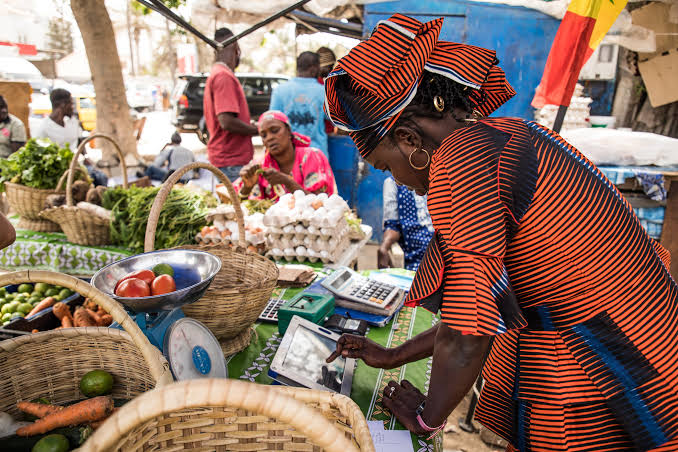









Why Ghana’s Interest Rates Remain High Despite Inflation Cooling – Inflation has fallen to 3.4% but Ghanaian businesses still face lending rates above 20%. Our deep-dive analysis reveals four structural reasons why interest rates remain high, from fiscal dominance to cedi constraints.
Ghana has just completed one of the most dramatic disinflation episodes in African economic history. Headline inflation fell from above 54 per cent in December 2022 to 3.2 per cent in March 2026, then edged up marginally to 3.4 per cent in April. Over the same period, the Bank of Ghana slashed its Monetary Policy Rate from a crisis-era peak of 30 per cent in late 2023 to 14 per cent by March 2026 — the lowest level since October 2021.
On paper, this looks like textbook monetary easing: inflation cools, central bank cuts rates, borrowing costs follow. But in practice, a stubborn reality confronts Ghanaian businesses, households and investors. Average commercial bank lending rates remain elevated above 20 per cent in early 2026. The Ghana Reference Rate — which guides base lending rates for commercial banks — fell to 10.03 per cent in May 2026, yet the transmission from central bank cuts to what an Accra-based manufacturer actually pays for a working capital loan remains frustratingly slow.
📢 GET DETAILED ARTICLES + JOBS
Join THSB's WhatsApp Channel and never miss a post or opportunity.
This gap between headline policy numbers and real-world borrowing costs is not a failure of BoG policy. It is the consequence of deeper structural forces — fiscal dominance, cedi fragility, banking sector risk aversion, and the unresolved legacy of Ghana’s debt restructuring — that have created what we call the Ghana Rate Trilemma. Understanding why interest rates remain high despite cooling inflation is essential for every business owner managing finance costs, every investor scanning the fixed-income market, and every policymaker trying to sustain the recovery.
This profile dissects the puzzle piece by piece.
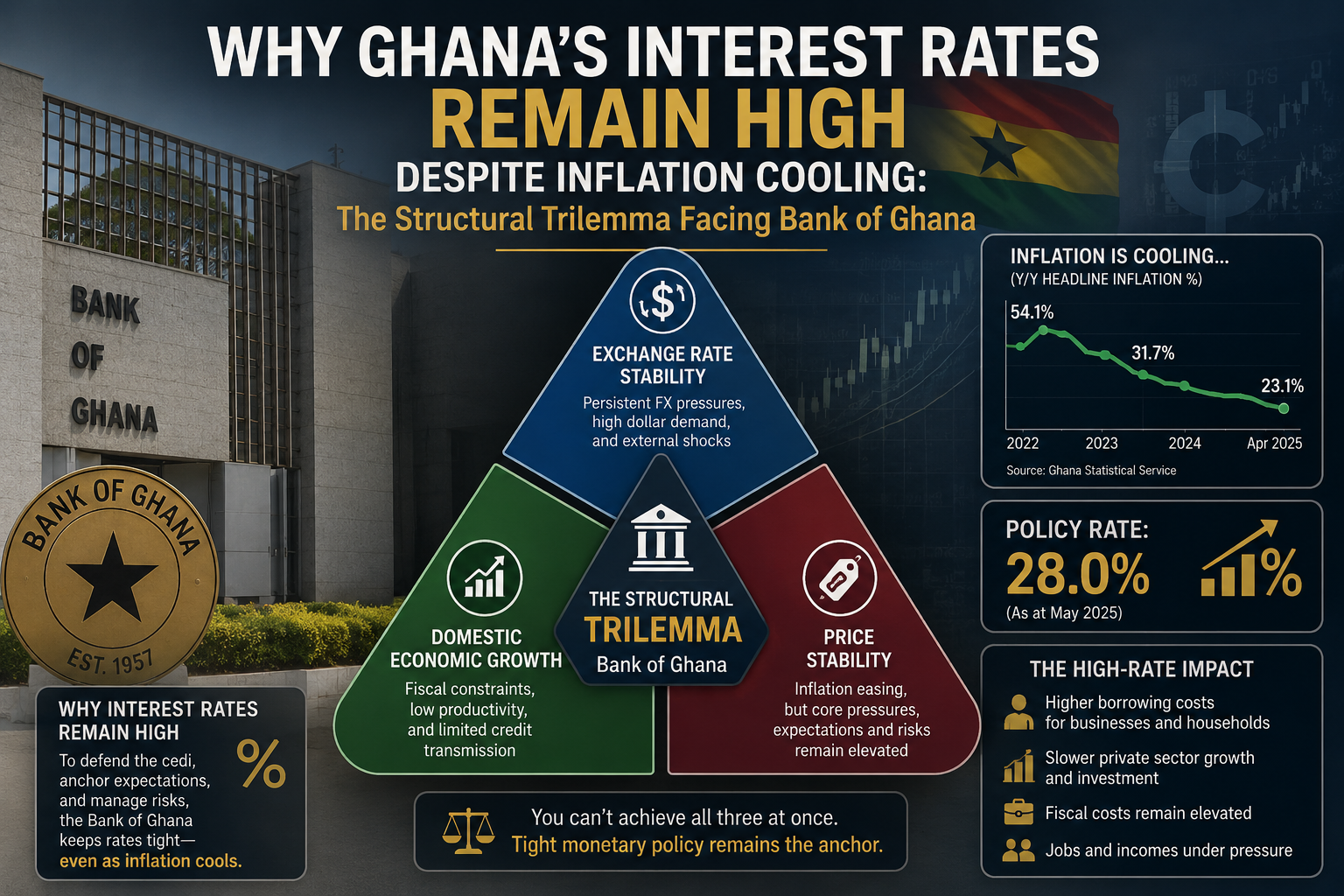
Why Ghana’s Interest Rates Remain High Despite Inflation Cooling: The Structural Trilemma Facing Bank of Ghana
The Bank of Ghana is the country’s central bank, established under the Bank of Ghana Act 2002 (Act 612) and subsequently amended. Its primary mandate is price stability — keeping inflation within a medium-term target band of 6 to 10 per cent — alongside supporting broader economic growth and maintaining a stable financial system.
Since the 2022–2024 economic crisis, which saw inflation breach 50 per cent and the cedi lose more than half its value, the BoG has operated under intense scrutiny. The central bank has been simultaneously responsible for:
- · Taming inflation through aggressive monetary tightening
· Stabilising the cedi through foreign exchange interventions
· Managing liquidity in the banking system
· Supervising a financial sector still recovering from the Domestic Debt Exchange Programme (DDEP)
· Maintaining its own balance sheet amid significant losses from open market operations
Dr Johnson Pandit Asiama, who took over as Governor in February 2025, has pursued a clear but challenging strategy: engineer a low-interest-rate environment without reigniting inflation, destabilising the cedi, or causing capital flight from Ghana’s reopening domestic bond market.
By May 2026, headline inflation had fallen below the BoG’s target band — a remarkable achievement but one that presents its own complications. The BoG’s 130th Monetary Policy Committee meeting, convening this week in Accra, will assess whether the unexpected April uptick to 3.4 per cent is a temporary blip or the beginning of a new inflationary drift.
The Puzzle: Inflation Is Down, So Why Are Rates Still High?
To understand the current rate environment, we first need to establish the facts accurately. Ghana has seen genuine and substantial monetary easing over the past 18 months. The headline numbers are not misleading — they just do not tell the whole story.
What Has Fallen (Significantly)
- Indicator Peak (2023/2024) Current (May 2026) Movement
Headline inflation ~54% (Dec 2022) 3.4% (Apr 2026) ↓ 50+ ppt
Monetary Policy Rate 30% 14% ↓ 16 ppt
Ghana Reference Rate ~35% (2023) 10.03% (May 2026) ↓ 25 ppt
Average bank lending rate ~31% ~22% ↓ 9 ppt
Average commercial bank lending rates fell from about 30.5 per cent in late 2024 to 22.2 per cent by early 2026. Treasury bill yields have collapsed from crisis-era highs of 35 per cent into single digits, with the 91-day bill trading around 7 per cent, the 182-day bill at approximately 6.6 per cent, and the 364-day bill around 10.2 per cent as of May 2026.
These are not small changes. A business that was paying 35 per cent on a Treasury bill investment two years ago now earns less than 10 per cent. A borrower who faced 30 per cent lending rates now faces around 22 per cent. But the question remains: why is this number not closer to 14 per cent or even lower, given that the BoG’s policy rate — the rate at which it lends to commercial banks — is now 14 per cent?
The answer lies in four structural transmission blocks that standard monetary economics does not fully account for in the Ghanaian context.
Four Structural Barriers to Rate Transmission
1. Fiscal Dominance: The Government’s Insatiable Appetite for Domestic Borrowing
The most significant factor keeping rates elevated is the government’s continued heavy reliance on domestic borrowing to finance its operations. Despite significant fiscal consolidation — with the overall deficit narrowing to about 1 per cent of GDP on a primary balance basis — the government still needs to roll over and raise substantial funds domestically.
Between January and April 2026 alone, the government raised approximately GHS 120.2 billion from the Treasury bill market, with total investor bids reaching GHS 181.5 billion. This enormous demand for sovereign paper — driven by limited alternative safe assets in the domestic market — keeps a floor under interest rates. Even as the BoG cuts its policy rate, the government continues to issue bills that must offer yields attractive enough to compete with other investment options, including offshore dollar assets.
The crowding-out effect is direct and damaging. When the government borrows heavily from domestic banks, those banks have less incentive to lend to the private sector at lower rates. They can earn relatively attractive risk-free returns from Treasury bills — still yielding 7 to 10 per cent — without taking on the credit risk of small businesses or manufacturers. This explains why private sector credit as a share of GDP in Ghana remains the lowest among regional peers, at just 8 per cent compared to around 30 per cent in Kenya.
The 2026 budget projects domestic financing of GHS 71.9 billion, representing 4.4 per cent of GDP. As long as the government remains a dominant borrower in the domestic market, interest rates will face upward pressure irrespective of the BoG’s policy stance.
2. The Cedi Constraint: External Stability Trumps Domestic Easing
The Bank of Ghana is effectively managing two policy objectives with one instrument — and the external objective is winning. To discourage capital flight into dollar-denominated assets and protect the cedi, the BoG is forced to maintain interest rates at levels that remain attractive to foreign portfolio investors, or at least not so low as to trigger a sell-off.
The cedi’s trajectory illustrates the challenge. Although the currency appreciated by approximately 41 per cent in 2025 — a remarkable recovery — the year-to-date depreciation in 2026 has already reached 7.8 per cent as of early May, significantly higher than the 2.5 per cent recorded over the same period in 2025. The cedi was trading around GHS 11.90 to the US dollar on the interbank market.
A sharp reduction in domestic interest rates would widen the yield differential between cedi and dollar assets, potentially triggering capital outflows and accelerating cedi depreciation. Given Ghana’s reliance on imports — including fuel, pharmaceuticals, machinery and food — any renewed cedi weakness would quickly feed back into inflation. The BoG has already seen this dynamic play out once: the April 2026 inflation uptick to 3.4 per cent was partly driven by higher fuel prices, which in turn are influenced by exchange rate effects.
Fitch Ratings captured this tension in its May 2026 analysis, stating that inflation was expected to rise gradually towards the end of the year as exchange rate effects fade and higher oil prices feed into local prices. The BoG cannot afford to cut rates too fast without risking a destabilising currency spiral.
3. Banking Sector Risk Aversion: The Hangover from DDEP
Ghana’s commercial banks are still recovering from the trauma of the Domestic Debt Exchange Programme (DDEP), which restructured the government’s domestic debt and imposed significant losses on bondholders. While the DDEP was necessary to restore fiscal sustainability, it also fundamentally altered banks’ appetite for private sector lending.
Banks are now significantly more risk-averse. The capital base of many institutions was eroded by the debt restructuring. Although the banking sector has since recapitalised and is now described by the BoG as “stronger, better capitalised, and extending more credit,” the behavioural shift persists. Credit officers who witnessed the crisis first-hand are demanding higher risk premiums for any loan that is not backed by government paper.
The gap between the Ghana Reference Rate — which fell to 10.03 per cent in May 2026 — and actual lending rates reflects this risk premium. The reference rate is supposed to guide base lending rates, but banks add significant margins to cover their perceived credit risk, operational costs, and required returns on equity.
Governor Asiama has repeatedly expressed frustration at this transmission failure. In April 2026, he lamented that peer countries like Kenya direct about 30 per cent of GDP in bank credit to the private sector, while Ghana sits at just 8 per cent — the lowest among its regional peers. He has also stated that it is his personal goal to see lending rates fall below 10 per cent before he leaves office — an objective that remains distant given current spreads.
4. The BoG’s Own Balance Sheet: The Cost of Fighting Inflation
Perhaps the most overlooked factor keeping rates elevated is the Bank of Ghana’s own financial position. The central bank recorded a staggering GHS 15.6 billion loss in 2025, and conditions in 2026 suggest further losses may be imminent.
The losses stem primarily from open market operations — the BoG issues its own bills (OMO bills) to mop up excess liquidity from the banking system. To attract investors, these OMO bills must offer competitive rates. When the BoG’s policy rate is 14 per cent but OMO bill rates are higher — as has been the case — the central bank effectively pays more to borrow than it earns on its assets.
In the first quarter of 2026 alone, the BoG absorbed a record GHS 389.1 billion of excess liquidity, the highest for at least six years. This massive liquidity mop-up is necessary to prevent excess money supply from reigniting inflation, but it comes at a steep financial cost. The central bank’s losses are ultimately a contingent liability for the government, and sustained losses could undermine confidence in the BoG’s operational capacity.
To minimise these losses, the BoG has an incentive to keep its OMO issuance rates aligned with market yields. But this creates a circular problem: the very operations designed to control inflation and stabilise the cedi require maintaining interest rates at levels that the central bank would otherwise like to reduce.
The Centre for Economic Research and Policy Analysis (CERPA) noted in May 2026 that the BoG’s efforts to control inflation and stabilise the cedi are significantly contributing to its growing financial losses, adding that exchange rate volatility in 2025 likely worsened the central bank’s external position. This is the paradox of post-crisis monetary policy in Ghana: the tools used to achieve stability create their own destabilising pressures.
Market Position: Where Are Yields Heading?
The domestic fixed-income market tells a more nuanced story than the headline rate numbers suggest. Treasury bill yields have fallen dramatically from their crisis peaks, but they have not fallen in a straight line — and recent movements suggest a floor may be forming.
As of May 2026:
· 91-day T-bill: Approximately 7–7.4 per cent
· 182-day T-bill: Approximately 6.6 per cent
· 364-day T-bill: Approximately 10.2–10.4 per cent
Investor demand for government paper remains exceptionally strong, with recent auctions recording oversubscriptions of up to 34.8 per cent. The 91-day bill attracted GHS 3.83 billion in bids, of which GHS 3.65 billion was accepted, while the Treasury has indicated it is targeting approximately GHS 4.49 billion in the next auction as investors position themselves ahead of the MPC decision.
However, there are early signs that yields may have bottomed out. The 364-day bill saw a more pronounced increase in the latest auction, climbing from 10.13 per cent to 10.39 per cent — suggesting investors are demanding higher returns for locking in funds over longer periods. This steepening of the yield curve indicates that market participants expect higher interest rates in the medium term, either due to inflation pressures, increased government borrowing, or a more cautious BoG stance.
The government’s return to the domestic bond market after the DDEP restraint period expired in March 2026 has added another dimension. The first post-DDEP bond issuance — a 7-year instrument — carried a coupon of 12.5 per cent, significantly above current T-bill rates. This suggests that while short-term rates have fallen sharply, longer-term borrowing costs remain elevated, reflecting uncertainty about Ghana’s medium-term fiscal and inflation trajectory.
Fitch Ratings estimates Ghana’s interest payment-to-revenue ratio at 29 per cent in 2025 and 30 per cent in 2026, meaning nearly one-third of government revenue is consumed by debt service before a single cedi is spent on roads, schools, or healthcare. This ratio leaves little fiscal space for growth-enhancing expenditure and creates a powerful incentive for the government to keep borrowing costs as low as possible — in direct tension with the need to attract investors.
The Real Economy Impact: What High Rates Mean for Businesses
For Ghanaian businesses, the gap between policy rates and lending rates is not an abstract macroeconomic puzzle — it is a daily operational constraint. The Ghana Union of Traders’ Association (GUTA) has repeatedly called on the BoG to take stronger measures to compel commercial banks to reduce their rates, noting that lending rates ranging between 22 per cent and 24 per cent remain excessive and fail to align with the central bank’s monetary policy direction.
The manufacturing sector is particularly exposed. Manufacturers typically require longer-term financing for equipment, inventory, and working capital. With lending rates still above 20 per cent, the cost of capital eats deeply into margins, making Ghanaian-made goods less competitive against imports. This is one reason why goods inflation has slowed significantly — to just 1.1 per cent in April 2026 — while services inflation remains stickier.
The Ghana National Chamber of Commerce and Industry (GNCCI) has called for lower lending rates, arguing that the current cost of credit continues to constrain private sector growth despite the central bank’s sustained efforts to ease monetary conditions. Both GNCCI and the banking community have agreed that beyond policy rate reductions, sustained dialogue, improved credit discipline and institutional coordination are critical to making financing more accessible and affordable.
But the transmission problem is not solely about bank pricing. Governor Asiama has noted that banks are not always the first port of call when firms need long-term financing, pointing to a structural gap in Ghana’s financial architecture. The absence of well-developed capital markets, corporate bond markets, and development finance institutions means that banks bear an outsized burden of private sector credit provision — and they price accordingly.
The cocoa sector offers a telling case study. COCOBOD is shifting away from expensive foreign syndicated loans toward domestic bond issuance, planning to raise $1 billion locally for the 2026/27 harvest season. But cocoa bonds issued in recent years have carried coupons of 13 per cent or higher. Even as the BoG’s policy rate has fallen to 14 per cent, COCOBOD — Ghana’s most creditworthy public enterprise after the government itself — still faces double-digit borrowing costs.
The External Dimension: Global Rates and Ghana’s Constraints
Ghana does not operate in a vacuum. Global monetary conditions continue to influence domestic rate-setting, even as Ghana’s inflation dynamics diverge from those in advanced economies.
The US Federal Reserve maintained higher-for-longer interest rates throughout 2025 and early 2026, keeping the yield on US Treasury bills and bonds elevated relative to historical norms. For an emerging market like Ghana, this creates a basic challenge: if domestic rates fall too far below US rates, foreign portfolio investors will shift capital to dollar-denominated assets, putting pressure on the cedi.
Ghana remains locked out of the international capital markets following its 2022 debt default, meaning the government cannot access Eurobond financing. The IMF has cautioned Ghana against a costly return to international capital markets, noting that borrowing conditions remain unfavourable for emerging economies. This makes domestic borrowing all the more critical — and all the more rate-sensitive.
Geopolitical tensions, including the Iran war risks that emerged in early 2026, have added another layer of uncertainty. The BoG cut rates to 14 per cent in March despite these tensions — a decision that Governor Asiama defended on the grounds that real interest rates provided scope for accommodation. But the MPC noted that domestic energy supply disruptions and higher import costs posed additional risks, reinforcing the need for a cautious approach to further easing.
The IMF’s most recent projections show average inflation settling around 7.9 per cent in 2026, with medium-term projections centred around 8 per cent for 2028–2030. This is significantly higher than the current 3.4 per cent headline rate, implying that the Fund expects inflation to rise in the coming months before stabilising. If the IMF is correct, the current window of very low inflation may be temporary — and the BoG would be unwise to cut rates aggressively based on what could turn out to be a transitory disinflation.
The Political Economy of Rate Setting
No analysis of Ghana’s interest rate environment would be complete without acknowledging the political and institutional context. The BoG is constitutionally independent, but it does not operate in a political vacuum.
The government of President John Dramani Mahama, which took office in January 2025, has made economic recovery its central priority. Lower interest rates are politically popular — they reduce the government’s own borrowing costs, ease the burden on businesses, and signal that the worst of the crisis is behind the country.
But the BoG’s primary mandate is price stability, not political convenience. Governor Asiama has walked a careful line, delivering substantial rate cuts — from 27 per cent to 14 per cent — while repeatedly warning that the central bank will not hesitate to tighten again if inflation pressures re-emerge.
The timing of the 130th MPC meeting, convening as this article is published, is significant. The April 2026 inflation uptick to 3.4 per cent — the first increase since December 2024 — has complicated what had been a steady monetary easing cycle. Fitch expects the BoG to hold rates steady amid rising inflation risks, suggesting that the easing cycle may be nearing its end.
If the MPC holds the policy rate at 14 per cent in May 2026, that will signal that the floor has been reached. If it cuts further — some market participants had expected 13.5 per cent or lower earlier in the year — that would signal continued confidence in the disinflation trajectory. Either way, the decision will be parsed closely for signals about the BoG’s assessment of Ghana’s structural rate challenges.
Future Outlook: Where Do Rates Go From Here?
Looking ahead to the remainder of 2026 and beyond, several factors will determine the trajectory of Ghana’s interest rates:
Downward Pressures on Rates
- Continued disinflation: If inflation remains below the BoG’s 6–10 per cent target band, the central bank will have room for further cuts. The IMF’s projection of 7.9 per cent average inflation for 2026 suggests room for modest additional easing.
- Improved fiscal discipline: The government’s primary surplus — currently around 2.6 per cent of GDP — reduces the need for aggressive domestic borrowing. If sustained, this would relieve upward pressure on rates.
- Rebuilding of external buffers: The BoG’s reserves have reached a historic high of US$14.5 billion, providing a cushion against external shocks and reducing the need for rate defence on the currency front.
Upward Pressures on Rates
- Resurgent inflation: The April uptick to 3.4 per cent may be the beginning of a trend. IMF forecasts suggest inflation will rise toward 8 per cent by end-2026, which would necessitate a more cautious BoG stance or even rate hikes.
- Cedi depreciation pressure: Year-to-date cedi depreciation of 7.8 per cent is running well ahead of the 2.5 per cent recorded in the same period of 2025. If this trend accelerates, the BoG may be forced to raise rates to defend the currency.
- Global uncertainty: Geopolitical tensions, oil price volatility, and slower-than-expected global growth could all affect Ghana’s external position and force a more hawkish monetary stance.
- Government borrowing needs: External debt repayments are steep — GHS 20 billion in 2026, GHS 50.3 billion in 2027, and GHS 45.8 billion in 2028 — alongside about GHS 137 billion in annual Treasury bill rollovers and GHS 71 billion expected for the 2026 budget. Heavy reliance on domestic borrowing will continue to put a floor under rates.
The most likely scenario for the remainder of 2026 is a policy rate that remains at 14 per cent or falls only modestly further — perhaps to 13.5 per cent by year-end. This would keep Ghana’s policy rate broadly in line with regional peers while preserving room to respond to upside inflation risks. Long-term rates, as reflected in bond yields and bank lending rates, are likely to remain significantly above the policy rate as risk premiums persist.
As Governor Asiama stated at the March 2026 MPC press conference, the BoG intends to keep inflation expectations broadly anchored in the medium term while continuing to observe trends for the necessary action. The watchword is patience — and for Ghanaian businesses hoping for single-digit lending rates, that patience may be tested for some time yet.
THSB Conclusion: The Trilemma Persists
Why do Ghana’s interest rates remain high despite inflation cooling? The answer is not that the Bank of Ghana has failed in its policy execution. On the contrary, the BoG has delivered one of the most aggressive and successful disinflation programmes seen anywhere in Africa over the past two years. The policy rate has been cut by more than half. Inflation has collapsed from crisis levels to below the target band. Treasury yields have fallen into single digits.
But the transmission from policy rates to lending rates is blocked by factors beyond the BoG’s direct control. Fiscal dominance — the government’s heavy domestic borrowing — keeps a floor under rates. The cedi constraint forces the central bank to maintain a yield premium to discourage capital flight. Banking sector risk aversion, rooted in the trauma of the DDEP, means commercial banks demand significant spreads above the reference rate. And the BoG’s own balance sheet losses create a perverse incentive structure in which the tools used to achieve stability generate their own costs.
This is Ghana’s interest rate trilemma: the central bank can achieve price stability, maintain currency stability, or ensure smooth transmission of monetary policy to lending rates — but not all three simultaneously, given current structural constraints.
For Ghanaian businesses, the message is sobering. Even as inflation has normalised, the cost of capital is unlikely to return to pre-crisis levels anytime soon. The era of single-digit lending rates — last seen in the early 2010s — remains a distant memory. The government’s own borrowing needs, the cedi’s persistent fragility, and the banking sector’s cautious posture will continue to keep rates elevated relative to what a simple reading of the inflation data might suggest.
For investors, the implications are more nuanced. The domestic fixed-income market now offers yields that are attractive on a risk-adjusted basis — particularly in the medium to long end of the curve, where 7-year bonds are issuing around 12.5 per cent. But these yields reflect real risks: fiscal slippage, currency depreciation, and the possibility of renewed inflation.
For policymakers, the path forward is clear but difficult. Sustained fiscal consolidation would reduce government borrowing needs and ease crowding-out effects. Structural reforms to deepen capital markets and reduce the banking sector’s dominance in credit provision would improve transmission. And building external buffers — including the record US$14.5 billion in reserves — provides room to navigate external shocks without resorting to rate defence.
Inflation is cooling. But until these structural barriers are addressed, Ghana’s interest rates will remain higher than the textbooks say they should be. That is not a policy failure. It is the reality of economic management in a post-crisis, middle-income country navigating a difficult transition from stabilisation to sustained growth. The BoG has done its part. Now the rest of the economy must catch up.
Frequently Asked Questions (FAQ)
Q1. Inflation in Ghana has fallen sharply. Why haven’t bank lending rates fallen by the same amount?
Bank lending rates have fallen — from over 30 per cent to around 22 per cent — but the drop has been smaller than the fall in inflation because banks add risk premiums to cover perceived credit risk, operational costs, and required returns on equity. Structural factors like government borrowing and cedi pressure also keep rates elevated.
Q2: What is the Bank of Ghana’s current Monetary Policy Rate?
As of March 2026, the Monetary Policy Rate is 14 per cent, the lowest since October 2021. The BoG’s 130th MPC meeting is convening this week (May 18–20, 2026) to assess whether to cut further, hold steady, or tighten.
Q3: Why can’t the Bank of Ghana just force commercial banks to lower their rates?
The BoG does not set commercial bank rates directly. It influences them through the policy rate, open market operations, and moral suasion. Banks are independent institutions that price credit based on their own risk assessments, capital costs, and competitive positioning.
Q4: How does government borrowing affect interest rates in Ghana?
The government is a dominant borrower in the domestic market, raising over GHS 120 billion from Treasury bills in the first four months of 2026 alone. This heavy demand for funds — combined with limited alternative safe assets — keeps a floor under interest rates and crowds out private sector credit.
Q5: What role does the cedi play in keeping interest rates high?
To discourage capital flight into dollar assets and protect the cedi, the BoG must maintain interest rates that are attractive relative to US rates. If domestic rates fall too far, foreign investors may shift capital abroad, triggering cedi depreciation and imported inflation.
Q6: Are Ghana’s interest rates expected to fall further in 2026?
Most analysts expect the policy rate to remain at 14 per cent or fall only modestly further — perhaps to 13.5 per cent by year-end. However, the April 2026 inflation uptick to 3.4 per cent and continued cedi depreciation pressure may limit further easing.
Q7: What is the Ghana Reference Rate and how does it affect borrowing costs?
The Ghana Reference Rate (GRR) is a benchmark rate published by the Ghana Association of Banks that guides base lending rates for commercial banks. It fell to 10.03 per cent in May 2026. However, banks add significant margins above the GRR, resulting in actual lending rates around 22 per cent.
Q8: How does Ghana’s Domestic Debt Exchange Programme (DDEP) affect current interest rates?
The DDEP restructured domestic debt but also made banks more risk-averse. Banks that suffered losses under the programme now demand higher risk premiums for private sector lending. The government has paid over GHS 10 billion in DDEP interest obligations, but the behavioural impact persists.
Q9: What is the interest payment-to-revenue ratio, and why does it matter?
Fitch estimates Ghana’s interest payment-to-revenue ratio at 30 per cent for 2026, meaning nearly one-third of government revenue goes to debt service before any spending on goods and services. This high ratio limits fiscal flexibility and creates pressure to keep borrowing costs low.
Q10: How do global interest rates affect Ghana’s monetary policy?
The US Federal Reserve’s higher-for-longer stance creates a basic challenge for Ghana: if domestic rates fall too far below US rates, foreign portfolio investors will shift capital to dollar assets, putting pressure on the cedi. Ghana remains locked out of Eurobond markets following its 2022 default.
Q11: What can the government do to help bring interest rates down?
Sustained fiscal consolidation to reduce domestic borrowing needs, structural reforms to deepen capital markets, rebuilding external buffers, and maintaining policy credibility are the most effective levers. However, these are medium-term solutions, not quick fixes.
Q12: Should businesses expect single-digit lending rates anytime soon?
Unlikely in the near term. Even the BoG Governor’s personal goal — to see lending rates fall below 10 per cent before he leaves office — is a long-term aspiration, not a near-term forecast. Structural constraints will likely keep rates elevated for the foreseeable future.
Source: The High Street Business
Disclaimer: Some content on The High Street Business may be aggregated, summarized, or edited from third-party sources for informational purposes. Images and media are used under fair use or royalty-free licenses. The High Street Business is a subsidiary of SamBoad Publishing under SamBoad Business Group Ltd, registered in Ghana since 2014.
For concerns or inquiries, please visit our Privacy Policy or Contact Page.

Esther Aku-Sika is a content writer and social media strategist who helps brands and startups grow through intentional storytelling and practical marketing strategies. With a keen eye for trends and audience behavior, she shares business insights, content strategies, and real-life lessons to help entrepreneurs build visibility and turn ideas into income. Through her writing, she simplifies complex concepts and equips readers with actionable steps to grow in today’s digital space.