









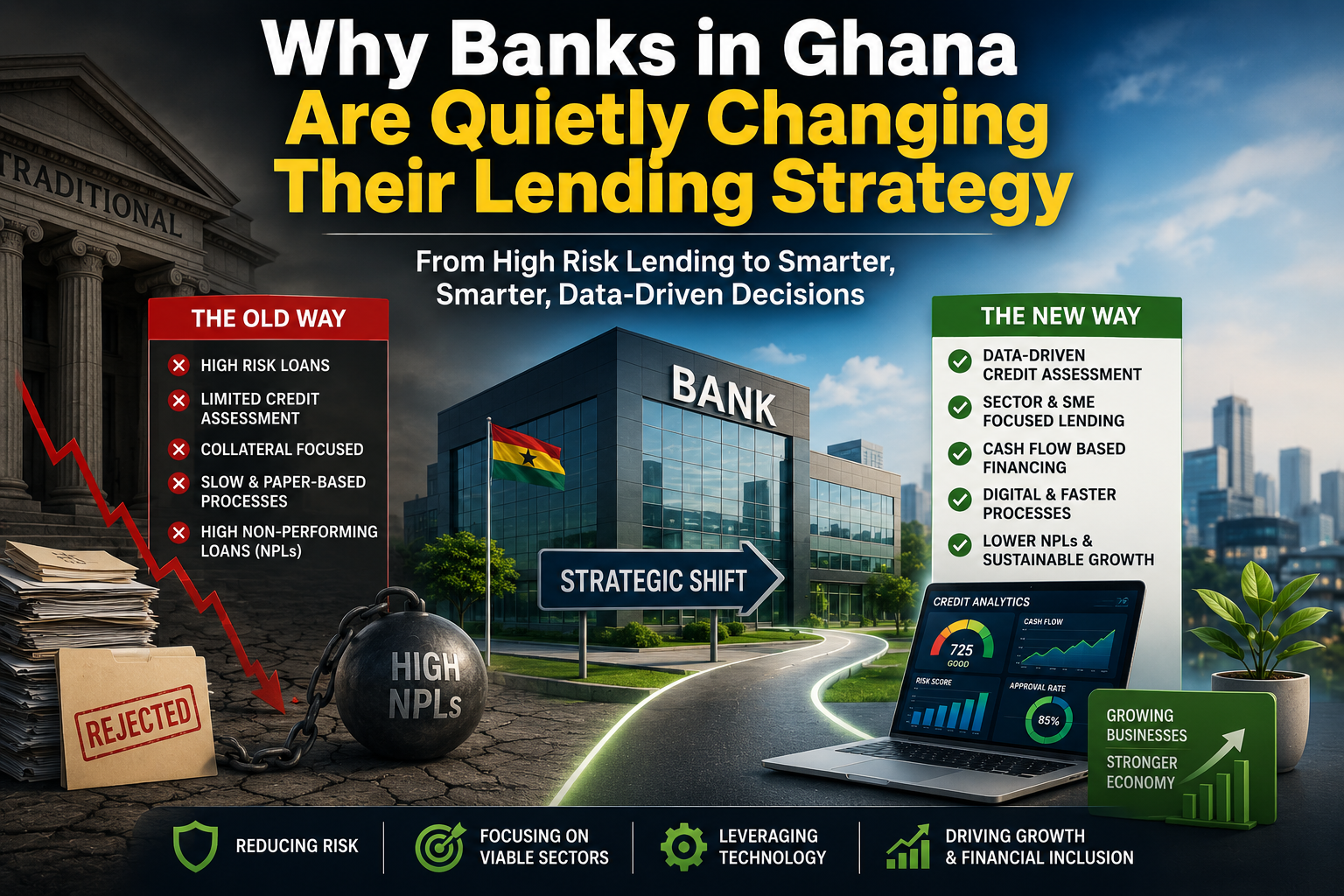

Why Banks in Ghana Are Quietly Changing Their Lending Strategy – T-bill yields collapsed from 35% to 4.91%, forcing Ghana’s banks to abandon risk-free returns and return to private sector lending. Our deep-dive analysis reveals the strategic pivot, digital threats and what it means for businesses.
Why Banks in Ghana Are Quietly Changing Their Lending Strategy: The End of T-Bill Reliance and the Return to Private Sector Credit
For the better part of a decade, Ghana’s commercial banks operated on a simple, profitable, and increasingly dangerous premise: why lend to a risky manufacturer in Tema when you can lend to the Government of Ghana at double-digit yields with zero credit risk?
The arithmetic was irresistible. At the height of the debt crisis in 2023, a bank could park liquidity in a 91-day Treasury bill and earn 35 per cent annualised — risk-free. The same bank could extend a working capital loan to a small business, spend weeks on due diligence, monitor repayments, and earn perhaps a few hundred basis points more, while carrying the very real risk of default. The choice was not a choice at all. By early 2025, banks held an estimated 30–35 per cent of their assets in government securities, with some institutions approaching 50 per cent. The banking sector had effectively become a financing arm of the fiscal authority, not a lender to the real economy.
📢 GET DETAILED ARTICLES + JOBS
Join THSB's WhatsApp Channel and never miss a post or opportunity.
That era is ending — quietly, incompletely, but unmistakably.

The collapse of Treasury bill yields from 35 per cent in 2023 to below 5 per cent in May 2026 has shattered the risk-free returns that once dominated bank balance sheets. The once-lucrative carry trade that encouraged banks to park liquidity in sovereign securities during the crisis years has largely disappeared. With that cushion gone, banks have begun to rebalance toward lending.
But the shift is neither linear nor unanimous. Private sector credit expanded by 18.7 per cent between February 2025 and February 2026 — a genuine recovery from the contraction of 2024. Yet total loan growth slowed to 15.6 per cent, down from 25.2 per cent a year earlier. The non-performing loan (NPL) ratio, while improved to 18.9 per cent from 23.6 per cent, remains more than triple the international benchmark of 5 per cent. And the transmission from policy rate cuts to what an Accra-based manufacturer actually pays for a working capital loan remains frustratingly slow.
This profile unpacks the quiet transformation of Ghana’s banking sector: why the old model broke, how banks are adapting (and failing to adapt), the digital battleground where telcos and fintechs are stealing market share, and what this means for businesses seeking credit in 2026 and beyond.
Company Overview
The Bank of Ghana regulates 23 universal banks, including subsidiaries of pan-African groups (Ecobank, Standard Chartered, Access Bank), Ghanaian-owned institutions (GCB Bank, Republic Bank, Consolidated Bank Ghana), and smaller niche players. As of December 2025, the financial sector’s total assets stood at GH¢647.25 billion, or approximately 45.1 per cent of GDP. Total bank deposits rose to GH¢325.3 billion by December 2025, up from GH¢276.2 billion a year earlier.
The capital adequacy ratio improved to 17.5 per cent, comfortably above the 13 per cent regulatory minimum. Banks have strengthened considerably following the DDEP-era capital pressures, with cumulative new loan disbursements rising from GH¢80.95 billion in October 2025 to GH¢104.17 billion by December.
Yet beneath these aggregate improvements lies a fractured lending landscape. The sector’s liquid-assets-to-total-assets ratio stood at 30.9 per cent, leaving banks well positioned to meet potential loan demand — if they choose to lend. The Governor, Dr Johnson Pandit Asiama, has repeatedly expressed frustration at the sector’s risk aversion, noting that Ghana channels only about 8 per cent of GDP in bank credit to the private sector, compared with around 30 per cent in Kenya.
Why the Old Model Broke: The Collapse of Risk-Free Returns
To understand why banks are changing their lending strategy, one must first understand what made the old strategy so comfortable — and why that comfort disappeared.
Between 2022 and 2024, Ghana’s banking sector operated in a perversely profitable environment. The government’s acute financing needs, combined with investor risk aversion following the DDEP, drove Treasury bill yields to historic highs of 35 per cent or more. A bank could do almost nothing — literally nothing — and earn a risk-free return that exceeded the return on equity of most productive enterprises.
The carry trade worked like this: banks accepted deposits at relatively low interest rates (often 5–10 per cent for savings and current accounts), parked those funds in Treasury bills yielding 25–35 per cent, and pocketed the spread. Credit risk was zero. Operational costs were minimal. Shareholders were happy.
This arrangement was catastrophic for the real economy. Private sector credit contracted. Businesses that could have grown were starved of capital. Banks lost the institutional competence to assess credit risk, having spent years avoiding it entirely.

The turning point came in late 2024 and accelerated through 2025. The Bank of Ghana cut the Monetary Policy Rate from 30 per cent in late 2023 to 14 per cent by March 2026. The 91-day Treasury bill rate fell from nearly 28 per cent in December 2024 to approximately 11 per cent in December 2025, then collapsed further to 4.91 per cent by May 2026.
The arithmetic no longer worked. A bank that parked GH¢100 million in T-bills in 2023 would have earned GH¢35 million annually. The same GH¢100 million in May 2026 earns less than GH¢5 million — barely enough to cover operating costs on that capital, let alone generate acceptable returns for shareholders. The cushion was gone. Banks had to lend or die.
The Rebalancing: From Government Paper to Private Credit
The shift in credit allocation is visible in the data, though it remains incomplete. Between February 2025 and February 2026, private sector credit expanded by GH¢16.334 billion, or 18.7 per cent, despite a moderation from the 26.9 per cent growth recorded the previous year. More significantly, the private sector’s share of total outstanding credit increased to 95.8 per cent, up from 93.7 per cent a year earlier. Public sector credit contracted sharply by 27.8 per cent to GH¢4.6 billion, reducing its share of total industry credit to 4.2 per cent from 6.8 per cent.
This contraction in public sector lending is itself a sign of strategic rebalancing. It reflects ongoing fiscal consolidation — the government is borrowing less from the banking system — but also a deliberate shift by banks away from government paper toward private opportunities.
The sectoral breakdown of credit reveals where the new lending is going. The services sector received the largest proportion, with annual credit flows of GH¢9.164 billion in February 2026, significantly higher than the GH¢5.305 billion recorded a year earlier. The mining and quarrying sector saw an even more dramatic increase: credit flows of GH¢2.965 billion, representing 110.2 per cent growth, compared with GH¢451.11 million (20.1 per cent) a year earlier.
Commerce and finance maintained a 23 per cent share of total loans, while manufacturing held steady at 11 per cent — a share that many analysts consider dangerously low for an economy attempting to industrialise. The manufacturing sector’s constrained access to credit remains a structural weakness.
The banking sector’s total loan book reached GH¢111 billion by December 2025, up from GH¢95 billion a year earlier, with cumulative new loan disbursements accelerating from GH¢80.95 billion in October 2025 to GH¢104.17 billion by December. Nominal private sector credit growth accelerated to over 19 per cent, while real credit growth — adjusted for inflation — rose to about 13 per cent, compared with just 2 per cent the previous year.
Yet caution is warranted. The rebound still trails the pace recorded at the beginning of 2025, when credit expansion stood at 27.1 per cent in January. This divergence reflects the lag between policy easing, lending rates, and risk appetite as banks remain cautious after years of elevated credit stress.
Lending Rates: The Stubborn Gap
If banks are lending more, why do businesses still complain about high borrowing costs? The answer lies in the persistent gap between the central bank’s policy rate and what commercial banks actually charge.
The Monetary Policy Rate fell to 14 per cent in March 2026. The Ghana Reference Rate — the benchmark calculated by the Ghana Association of Banks to guide base lending — fell to 10.03 per cent in May 2026. Yet average commercial bank lending rates, though down from a crisis-era peak of 30.5 per cent, remained elevated at 22.2 per cent in late 2025 and around 19–22 per cent in early 2026.
The spread between the Reference Rate and actual lending rates — typically 500 to 1,200 basis points — represents banks’ risk premiums, operational costs, and required returns on equity. This spread has narrowed but not collapsed.
Banks argue that the spread reflects genuine risk. Despite improvements, the NPL ratio stood at 18.9 per cent in December 2025, down from 23.6 per cent in May, but still more than triple the international benchmark of 5 per cent. Fitch Ratings has noted that banks will need to continue aggressive write-offs to bring NPL ratios below 15 per cent by the end of 2026. Governor Asiama has set an even more ambitious target: a 10 per cent NPL ratio by the end of 2026, with a “clear roadmap” for banks to achieve it.
The Governor has also expressed concern about weak private-sector lending relative to other African economies. Speaking at the March 2026 MPC briefing, he noted that peer countries like Kenya direct about 30 per cent of GDP in bank credit to the private sector, while Ghana sits at just 8 per cent. He has stated it is his personal goal to see lending rates fall below 10 per cent before he leaves office — an objective that remains distant.
The Non-Bank Competitors: Fintechs, Telcos and Mobile Money
The quietest but most consequential change in Ghana’s lending strategy is not about whom banks lend to, but what they are losing by not lending fast enough.
Mobile money platforms now process over 97 per cent of all digital transaction volumes and account for 72 per cent of total value, according to data from the central bank’s March 2025 Summary of Economic and Financial Data. Bank digital channels account for less than 1 per cent of volume. ATM usage fell sharply to 16 per cent in 2025, down from 34 per cent in 2024, while mobile money usage surged to 80 per cent.
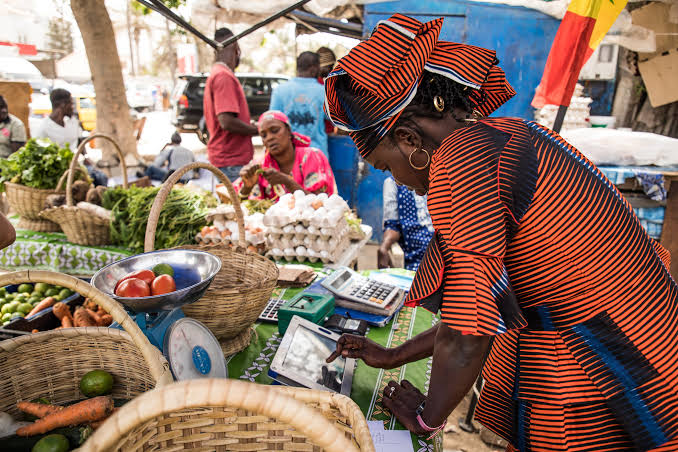
The implications for credit are profound. Mobile money platforms are not just transaction processors; they are becoming lenders. MTN’s MoMo, Vodafone Cash, and AirtelTigo Money have all expanded into micro-lending, using transaction data to assess creditworthiness in ways traditional banks cannot.
The Bank of Ghana has responded by bringing digital credit under regulation. In September 2025, it announced that digital credit now falls within the Non-Bank Financial Institutions Act, requiring a minimum capital of GH¢2 million, a transaction cap of GH¢10,000, and licensing fees starting at GH¢20,000. Some traditional banks have responded in kind. Fidelity Bank, in partnership with MobileMoney Limited and JUMO, launched BoseaLoan, a mobile-based short-term loan product “to enhance financial inclusion” by delivering real-time mobile loans to underserved communities.
Governor Asiama has challenged traditional banks to reposition themselves as key players in Ghana’s digital finance revolution, warning that telcos and fintechs are fast reshaping financial access and consumer behaviour. He urged banks to lead in open banking adoption, shared identity systems, and last-mile solutions. “The next phase of transformation requires a shift in focus — from access to value, from connectivity to capability,” he said.
The challenge for banks is existential. If they do not move into digital lending at scale, they risk becoming marginal players in a rapidly evolving landscape. But moving into digital lending requires technology investments, data analytics capabilities, and an appetite for small-ticket, high-volume lending — none of which are traditional banking strengths.
The Risk Calculus: NPLs, Regulatory Pressure and the 10 Per Cent Target
Banks are not refusing to lend out of laziness or greed. They are genuinely afraid of repeating the mistakes of the pre-crisis era, when aggressive lending led to catastrophic NPL ratios.
The sector entered 2025 still adjusting to the effects of the Domestic Debt Exchange Programme. Capital buffers were under pressure, non-performing loans were elevated, and confidence required rebuilding. Through recapitalisation efforts and close supervisory engagement, the banking system has strengthened considerably. But the scars remain.
Governor Asiama has made asset quality a priority for 2026, stating that banks now have “a clear roadmap to reduce NPLs toward 10 per cent by end-2026. The roadmap includes enhanced supervision of credit risk management practices, stricter enforcement of loan classification and provisioning requirements, improved credit information sharing, and frameworks to support sustainable lending.
The tension is obvious: banks are being pressured to lend more to the private sector while simultaneously being pressured to reduce NPLs. The only way to resolve this tension is to lend smarter, not just more — better underwriting, better monitoring, and better use of data.
There are signs this is happening. The NPL ratio declined from 22.6 per cent in February 2025 to 18.7 per cent in February 2026, reflecting improved asset quality and intensified recovery efforts and write-offs by banks. The financial soundness indicators in terms of profitability, liquidity, solvency, asset quality, and efficiency all improved over the period.
Yet the ratio remains well above the international benchmark. The BoG has put in place measures for the full implementation of regulatory guidelines aimed at reducing NPLs, including enhanced supervision, stricter enforcement, and improved credit information sharing.
The Strategic Pivot: What Banks Are Actually Doing Differently
Beyond the aggregate numbers, Ghana’s banks are quietly implementing four distinct strategic shifts.
First, relationship-based lending is returning. After years of transactional T-bill investing, banks are rebuilding credit assessment teams. Loan officers are being deployed to industrial zones, agricultural regions, and trading hubs. The Ghana Reference Rate’s decline to 10.03 per cent has given banks room to price loans competitively while maintaining acceptable spreads.
Second, sector specialisation is emerging. The dramatic increase in lending to mining and quarrying (110.2 per cent growth) and services (GH¢9.164 billion) reflects a strategic bet on Ghana’s most dynamic sectors. Banks are no longer treating all private sector borrowers as identical risks; they are segmenting by industry, building expertise, and pricing accordingly.
Third, digital lending is accelerating. The BoG’s digital lending guidelines, finalised in August 2025, have created a regulatory framework for mobile-based lending. Banks are launching their own digital loan products, partnering with fintechs, or acquiring digital lenders outright. Fidelity’s BoseaLoan is a bellwether; more such products are coming.
Fourth, deposit mobilisation is being rethought. With T-bill yields no longer generating outsized spreads, banks are competing more aggressively for low-cost deposits. The 17.8 per cent growth in total deposits to GH¢325.3 billion reflects this intensified competition. Banks are also exploring alternative funding sources, including diaspora bonds and corporate deposits, to reduce reliance on expensive term deposits.
Challenges and Risks
The quiet transformation is not without serious risks.
First, the NPL trap. If the economy slows — and IMF projections suggest 2026 growth may moderate — banks that have increased private sector lending could see default rates rise. Governor Asiama has set a 10 per cent NPL target by end-2026, but achieving this while expanding credit will require exceptional underwriting discipline.
Second, the competition blind spot. Banks still treat fintechs and telcos as partners rather than competitors. This is a mistake. Mobile money platforms are not just transaction processors; they are building credit histories, developing lending products, and capturing the customers most likely to need small-scale credit. By the time banks fully recognise the threat, the market may already be lost.
Third, the transmission problem persists. The gap between the Reference Rate and actual lending rates — averaging 1,200 basis points in 2025 — has narrowed but remains wide. Average lending rates of 19–22 per cent are still too high for most small and medium-sized enterprises to sustain profitable operations.
Fourth, regulatory uncertainty. The BoG has signalled that it may introduce new capital requirements or lending guidelines as part of Ghana’s transition to the IMF’s Policy Coordination Instrument. Banks that have built strategies around current regulations may need to pivot again.
Fifth, the government borrowing overhang. Despite fiscal consolidation, the government still needs to roll over approximately GH¢137 billion in Treasury bills annually. Even at lower yields, this creates a crowding-out effect: banks must allocate capital to government paper to maintain regulatory liquidity ratios, leaving less for private sector lending.
Economic and Industry Impact
The shift in bank lending strategy matters far beyond the banking sector. It has direct implications for Ghana’s economic trajectory.
Private sector credit growth — even at the moderated 18.7 per cent rate — represents a genuine recovery from the credit contraction of 2024. Real private sector credit grew by 14.9 per cent in February 2026, compared to 3.1 per cent in February 2025. This suggests that more capital is reaching productive enterprises, not just the government.
Job creation is directly correlated with SME credit access. The services sector, which received GH¢9.164 billion in credit, is Ghana’s largest employer. Increased lending to this sector should translate into sustained or expanded employment.
Financial inclusion is improving, though unevenly. Mobile money usage at 80 per cent and the rise of digital lending products are bringing formal credit to populations previously excluded from the banking system. However, the GH¢10,000 transaction cap on digital loans limits the size of loans available through these channels.
Industry development remains a concern. Manufacturing’s continued 11 per cent share of total loans is insufficient for an economy seeking to industrialise. Banks are still lending to commerce and services rather than to production — a pattern that perpetuates Ghana’s import-dependent growth model.
The banking sector’s own health has improved markedly. Total assets rose 23.3 per cent to GH¢647.25 billion in 2025. Profitability and solvency positions are strengthening across banking, insurance, securities, and pensions. The sector has moved “from stress to stability” after navigating macroeconomic shocks and debt restructuring risks.
Future Outlook
Where is Ghana’s banking sector heading? Three scenarios are plausible.
Scenario One: Gradual Lending Normalisation (65 per cent probability)
In this base case, private sector credit growth stabilises in the 15–20 per cent range through 2026 and 2027. Average lending rates fall toward 18 per cent by end-2026 as competition intensifies. NPLs decline to 12–14 per cent as write-offs continue and new lending is better underwritten. Banks successfully launch digital lending products, capturing 5–10 per cent of the digital transaction market currently dominated by telcos.
Scenario Two: Acceleration (20 per cent probability)
If the economy grows faster than expected — perhaps 6–7 per cent GDP growth — loan demand could surge. Banks with strong capital positions (CAR above 17.5 per cent) would be well positioned to capture this demand. Average lending rates could fall below 15 per cent by 2027. This scenario requires continued fiscal discipline, stable cedi, and no external shocks.
Scenario Three: Reversal (15 per cent probability)
If inflation returns toward 8–10 per cent, the BoG may be forced to raise rates. T-bill yields would rise, making government paper attractive again. Banks could retreat from private lending to the relative safety of sovereign securities. This would repeat the cycle the economy has just escaped — and would be a devastating setback for the real economy.
The most likely path is Scenario One: slow, uneven but genuine progress. The era of 35 per cent T-bills is over. Banks cannot go back. But the transition to a lending-driven business model will take years, not quarters, and will be marked by false starts, regional disparities, and ongoing tension between regulators and bankers.
Governor Asiama’s challenge to the banking industry is clear: “Let us bank the last mile”. Whether Ghana’s banks can rise to that challenge — or whether telcos and fintechs will beat them to it — will define the next decade of Ghanaian finance.
THSB Conclusion
Ghana’s banks are changing their lending strategy not out of choice but out of necessity. The collapse of T-bill yields has shattered the risk-free returns that dominated bank balance sheets for years. The old model — buy government paper, collect the spread, ignore the real economy — is no longer viable.
The new model is still being built. Private sector credit is growing, but from a low base. NPLs are improving, but remain dangerously high. Digital lending is emerging, but banks are playing catch-up to telcos and fintechs that have already captured the customer relationship. Lending rates have fallen, but not enough to unlock the SME credit that Ghana’s economy desperately needs.
The quiet transformation is real, but it is also fragile. A return to fiscal indiscipline, a resurgence of inflation, or another external shock could send banks scurrying back to the safety of government paper. The challenge for regulators is to keep the pressure on — pushing banks to lend more, lend smarter, and lend to the productive sectors that will drive Ghana’s long-term growth.
For businesses seeking credit, the message is mixed. More capital is available than at any point since the crisis, but the cost remains high and the approval process remains cautious. The quiet change is underway, but it is not yet a revolution. Perhaps that is the most honest assessment of Ghana’s banking sector in 2026: moving in the right direction, but not moving nearly fast enough.
Frequently Asked Questions (FAQ)
Q1: Why are Ghana’s banks changing their lending strategy now?
The collapse of Treasury bill yields from 35 per cent in 2023 to 4.91 per cent in May 2026 has eliminated the risk-free returns that banks relied on for years. Banks can no longer generate acceptable profits by parking liquidity in government securities; they must lend to the private sector to earn returns.
Q2: How much have private sector loans grown?
Private sector credit expanded by 18.7 per cent (GH¢16.334 billion) between February 2025 and February 2026. The private sector now accounts for 95.8 per cent of total outstanding credit, up from 93.7 per cent a year earlier.
Q3: What are the average lending rates in Ghana right now?
Average commercial bank lending rates have fallen from crisis-era peaks of about 30.5 per cent to approximately 19–22 per cent in early 2026. The Ghana Reference Rate — the benchmark for base lending — stands at 10.03 per cent as of May 2026, but banks add risk premiums, resulting in higher actual rates.
Q4: Why is there still a gap between the Reference Rate and actual lending rates?
The gap — typically 500 to 1,200 basis points — represents banks’ risk premiums, operational costs, and required returns on equity. Despite improvements, the non-performing loan ratio remains elevated at 18.7 per cent, more than triple the international benchmark of 5 per cent.
Q5: How are fintechs and mobile money affecting bank lending?
Mobile money platforms now process over 97 per cent of digital transaction volumes and are expanding into micro-lending, using transaction data to assess creditworthiness. Banks risk becoming marginal players if they do not accelerate their digital lending capabilities.
Q6: What is the Bank of Ghana doing to encourage lending?
The BoG has cut the Monetary Policy Rate to 14 per cent, pushing the Ghana Reference Rate down to 10.03 per cent. It has also introduced digital lending guidelines, strengthened credit information sharing, and set a target of reducing the NPL ratio to 10 per cent by end-2026.
Q7: Which sectors are receiving the most new credit?
The services sector received GH¢9.164 billion in annual credit flows (up 73 per cent year-on-year), followed by commerce and finance at 23 per cent of total loans. Mining and quarrying saw the fastest growth at 110.2 per cent. Manufacturing remains under-served at just 11 per cent of total loans.
Q8: Are non-performing loans still a problem?
Yes, though improving. The NPL ratio declined from 22.6 per cent in February 2025 to 18.7 per cent in February 2026. Governor Asiama has set a target of 10 per cent by end-2026, supported by a “clear roadmap” including enhanced supervision, stricter provisioning, and improved credit information sharing.
Q9: What is the capital adequacy of Ghana’s banks?
The capital adequacy ratio improved to 17.5 per cent, comfortably above the 13 per cent regulatory minimum. Total banking assets rose 23.3 per cent to GH¢647.25 billion in 2025, representing 45.1 per cent of GDP.
Q10: How does the government’s borrowing affect bank lending?
Despite fiscal consolidation, the government still needs to roll over approximately GH¢137 billion in Treasury bills annually. This creates a crowding-out effect, as banks must allocate capital to government paper to maintain regulatory liquidity ratios, leaving less for private sector lending.
Q11: What digital lending products are banks launching?
Fidelity Bank launched BoseaLoan, a mobile-based short-term loan product in partnership with MobileMoney Limited and JUMO. Other banks are expected to follow as the BoG’s digital lending guidelines create a clearer regulatory framework.
Q12: What is the outlook for lending rates in 2026 and 2027?
Most analysts expect average lending rates to fall gradually toward 18 per cent by end-2026 as competition intensifies and the BoG maintains its easing stance. However, a return to single-digit lending rates remains a medium-term goal dependent on sustained fiscal discipline and continued reduction in credit risk.
Source: The High Street Business
Disclaimer: Some content on The High Street Business may be aggregated, summarized, or edited from third-party sources for informational purposes. Images and media are used under fair use or royalty-free licenses. The High Street Business is a subsidiary of SamBoad Publishing under SamBoad Business Group Ltd, registered in Ghana since 2014.
For concerns or inquiries, please visit our Privacy Policy or Contact Page.

Esther Aku-Sika is a content writer and social media strategist who helps brands and startups grow through intentional storytelling and practical marketing strategies. With a keen eye for trends and audience behavior, she shares business insights, content strategies, and real-life lessons to help entrepreneurs build visibility and turn ideas into income. Through her writing, she simplifies complex concepts and equips readers with actionable steps to grow in today’s digital space.