








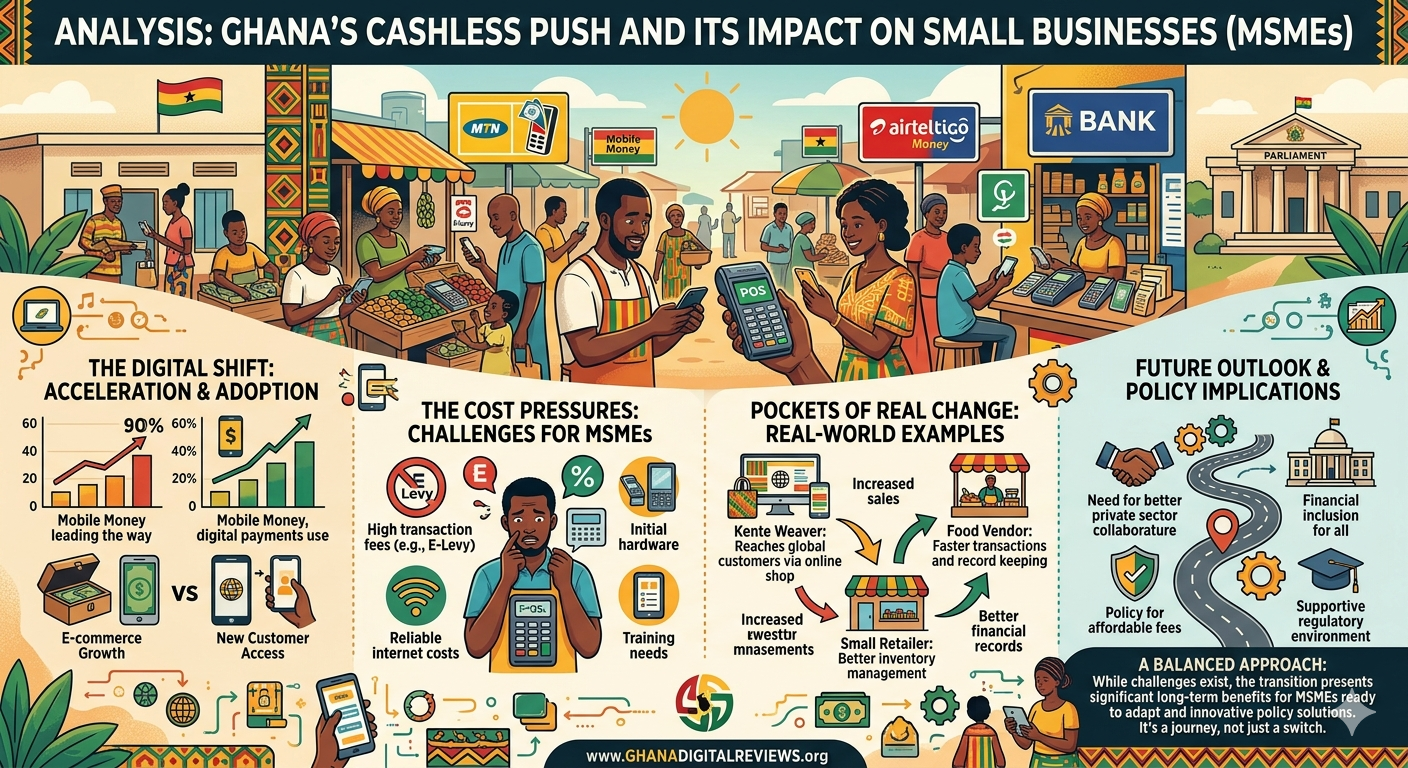

GH¢493bn in monthly mobile transactions, yet only 37% of Ghanaian businesses accept digital payments. Our deep‑dive analysis reveals the opportunities, costs and barriers for SMEs in Ghana’s cashless economy.
Ghana’s Cashless Economy Push Is Reshaping Small Businesses — The Digital Shift, Cost Pressures and the Pockets of Real Change for MSMEs
The numbers are breathtaking. In April 2026 alone, mobile money transactions in Ghana reached GH¢493.2 billion — a monthly volume that exceeds the country’s entire annual GDP from just a decade ago. Registered mobile money accounts have climbed to 83 million, far surpassing the adult population of roughly 20 million. Monthly mobile money transaction values have grown from GH¢155 billion annually in 2017 to GH¢493 billion monthly by April 2026, marking a thousand‑fold increase in less than a decade. Ghana now holds the distinction of being Africa’s most financially inclusive country, with a financial inclusion rate of 81 per cent, driven largely by mobile money agents and basic phone‑based transactions.
Yet this digital revolution has not reached every business equally. A sobering reality persists: while 95 per cent of individuals surveyed have used digital payments as consumers, only 37 per cent of businesses across Ghana currently accept or use digital payment platforms. Adoption remains heavily concentrated in Greater Accra and a few regional capitals. Knowledge gaps, fraud fears, and uncertainty over returns continue to limit broader adoption, especially among smaller enterprises and in the agricultural sector, which records the lowest adoption levels.
📢 GET DETAILED ARTICLES + JOBS
Join THSB's WhatsApp Channel and never miss a post or opportunity.
This gap between consumer and business adoption is one of the most pressing contradictions of Ghana’s cashless push. For the 1.5 million micro, small and medium enterprises that form the backbone of the Ghanaian economy — accounting for more than 90 per cent of all businesses and the majority of private sector employment — the shift to digital payments is not merely a technological upgrade. It is an existential transformation. It brings reduced theft risk, improved record‑keeping and potential access to credit. But it also brings transaction fees that compress already thin margins, cybersecurity threats that can wipe out weeks of earnings overnight, and the relentless pressure to adapt or be left behind.

This profile goes inside Ghana’s cashless economy push to examine how small businesses are being reshaped — the opportunities they are seizing, the costs they are bearing, and the structural barriers that keep most of them from fully participating. It tells the story of two digital Ghanas: one where tech‑savvy urban SMEs are thriving and another where knowledge gaps and high fees keep the majority on the margins of the formal digital economy.
The Cashless Thrust: How We Got Here
Ghana’s journey from a predominantly cash‑based economy to one of Africa’s most advanced digital payment markets has been deliberate and structured, anchored by key policy interventions.
Interoperability as the foundation: The launch of mobile money interoperability in May 2018, championed by then‑Vice President Dr Mahamudu Bawumia, enabled seamless payments between all mobile money networks and bank accounts. Before this launch, Ghana had a fragmented payment system where direct transfers across networks were not possible. The impact was transformative: interoperability transaction values increased to GH¢5.8 billion in April 2026, compared to GH¢4 billion a year earlier, while transaction volumes rose to 31.7 million. By enabling customers to send and receive money across different platforms, interoperability reduced payment friction for businesses and supported broader adoption of digital commerce.
National Payment Systems Strategy (2025–2029): The Bank of Ghana has formalised its vision for a cash‑lite economy through the National Payment Systems Strategy, which outlines a roadmap for deeper interoperability, open banking frameworks, data‑sharing protocols and digital payments innovation. The strategy places fintech and digital finance firmly within Ghana’s long‑term economic development agenda and aims to create faster settlement times, lower transaction costs and greater financial inclusion.
The E‑Levy repeal: One of the most controversial obstacles to cashless adoption was the Electronic Transfer Levy (E‑Levy) — a 1 per cent tax on electronic transactions introduced in 2022. Critics argued it discouraged digital payments by penalising electronic transactions while cash transactions remained untaxed. The levy was officially abolished on 2 April 2025, following Parliament’s approval of the repeal bill. Finance Minister Dr Cassiel Ato Baah Forson emphasised that repealing the levy would encourage digital transactions, potentially lower inflation and boost economic activity. MTN Ghana immediately announced the removal of E‑Levy charges on MoMo transactions, and President Mahama noted that Ghana was “undergoing a rapid digital transformation” and that the repeal “promises further growth and inclusion in digital financial services”. The impact was immediate: monthly mobile money transactions surged to GH¢518.4 billion in December 2025, with peer‑to‑peer transfers increasing their contribution to MTN MoMo’s revenue from 28.9 per cent to 33.7 per cent.
Beyond payments: The Bank of Ghana is now broadening its digital finance agenda beyond payments into digital credit, embedded finance, supply‑chain finance and cross‑border financial services, with a stated focus on micro, small and medium‑sized enterprises, women, young people and the informal sector. Governor Dr Johnson Pandit Asiama has stated that “the next phase of digital finance will not be defined by payments alone,” and that the opportunity lies in building value‑added services that address the credit and financial needs of underserved businesses. This shift from payments to full‑service digital finance is designed to help small businesses move beyond basic transactions toward credit‑building and financial management tools that can support growth.
The Scale of the Shift: Numbers That Matter
The scale of Ghana’s digital payment market is difficult to overstate. According to Bank of Ghana data, the total value of mobile money transactions climbed to GH¢493.2 billion in April 2026, with 967 million transactions recorded. Interoperability transaction values rose to GH¢5.8 billion in April from GH¢4.0 billion a year earlier.
The underlying infrastructure supporting this shift has expanded dramatically. Active mobile money accounts rose to 26.7 million by December 2025, up from 23.5 million a year earlier, reflecting deeper engagement rather than mere account sign‑ups. Registered agents reached 992,000 by April 2026, with active agents numbering 534,000.
Other digital payment channels are also growing rapidly. GhIPSS Instant Pay — the country’s real‑time interbank transfer system — processed GH¢79 billion in April 2026, representing a 50.7 per cent increase from a year earlier. The number of point‑of‑sale terminals increased 44.6 per cent year‑on‑year to 23,151 units in April, with more than 4,500 added in the final two months of the period, marking the fastest deployment on record. Prepaid card issuance rose 89.4 per cent from 379,000 in April 2025 to 718,000 in April 2026, driven by financial inclusion efforts targeting unbanked and underbanked populations.
While these aggregate numbers signal a rapidly digitising economy, they obscure a critical distinction: most of the volume is consumer‑to‑consumer transfers, not business‑to‑consumer payments. This gap between consumer adoption and merchant acceptance lies at the heart of the small business challenge.

The Two Digital Ghana: Adoption Gaps and Sectoral Disparities
The headline 37 per cent adoption rate for business digital payments conceals significant disparities across firm size, sector, formality and location.
Urban‑rural divide: Digital payments adoption is heavily concentrated in Greater Accra and a few regional capitals. For small businesses in secondary towns and rural growth centres, the infrastructure for digital payments is either absent or too costly. POS terminals reached only 23,151 units across the country by April 2026 — a figure that remains modest given Ghana’s population of approximately 35 million people and its expanding commercial base.
Sectoral disparities: The agricultural sector records the lowest level of digital payment adoption among all sectors. For farmers and agribusinesses operating on thin margins, the combination of low digital literacy, limited connectivity and high transaction fees makes cash a more practical option.
Firm size: Larger companies tend to diversify their usage, leveraging merchant accounts that are better aligned with business needs and help drive revenue growth. For micro‑enterprises operating at the edge of the formal economy, the barriers to adopting a dedicated business payment account — documentation, fees, compliance — can be prohibitive.
Gender dimensions: Female managers tend to outperform their male counterparts in boosting revenue and adopting merchant accounts when they have access to capital. However, women‑owned businesses often struggle with limited access to capital, which remains one of the key barriers to greater adoption. As Professor Peter Quartey of ISSER noted, “Female managers tend to be better at managing firms. But the issue is that most women lack the capital to own or expand businesses, and that limits their ability to invest in digital finance”.
Perhaps most tellingly, Francis Annan, an assistant professor of economics at the University of California, Berkeley and co‑lead of the ReFinD project, described the gap between consumer and business adoption as “striking”. While nearly 95 per cent of individuals surveyed have used digital payments as consumers, only about 37 per cent of businesses have done the same. “Firms face barriers like lack of understanding and concerns about security,” Annan said. “For more educated users, these barriers aren’t binding. But across the broader firm landscape, these constraints are real and they matter”.
What Cashless Means for Small Businesses: The Real Economics
For the small business owner in Makola Market or a roadside vendor in Kumasi, the shift to digital payments is not an abstract policy objective. It is a daily calculation of costs, risks and benefits.
The benefits (real and significant):
- Reduced theft risk: Carrying cash — especially during evening hours or on the way to the bank — exposes business owners to armed robbery. Mobile money transfers eliminate physical cash movement for many transactions.
- Improved record‑keeping: Digital payment data reveals buying patterns and peak periods, enabling smarter inventory management, targeted promotions and data‑driven pricing strategies. For businesses that lack formal accounting systems, the automatic transaction log is a form of financial management.
- Access to credit: Transaction history on digital platforms can serve as a substitute for formal credit records. Fintech lenders like Fido (which raised $5.5 million in debt funding in March 2026), Oze and others use digital payment data to assess creditworthiness, offering small loans to businesses that would never qualify for traditional bank credit.
- Customer convenience and reach: Customers who have moved entirely to digital payments will not stop at a business that refuses to accept mobile money. In urban areas, accepting digital payments has shifted from a competitive advantage to a baseline expectation.
The costs (often underestimated):
- Transaction fees: Per‑transaction charges — typically 0.5–1.5 per cent of transaction value — can significantly compress margins for businesses operating on thin profitability. Unlike cash transactions, which carry no direct fee for the merchant, digital payments impose a cost on every sale.
- Platform dependency: Businesses that rely on mobile money become dependent on the pricing, uptime and policies of MTN MoMo, Telecel Cash or AT Money. A network outage during peak hours can mean lost sales. A fee increase directly reduces net revenue.
- Personal versus business accounts: Most firms using digital platforms still rely on personal mobile money accounts rather than dedicated business merchant accounts. Personal accounts are costlier and less efficient for business transactions. But the cost and complexity of obtaining a business account — including registration requirements and Know‑Your‑Customer obligations — discourages many small enterprises from making the switch.
The social costs:
- The same digital infrastructure that enables seamless transfers also exposes business owners to SIM swap fraud, phishing attacks and insider collusion. In 2023 alone, the Cybercrime Unit of the Ghana Police Service recorded 7,250 cases of mobile money fraud. Cyber fraud losses rose from GH¢2.4 million in the first quarter of 2024 to GH¢14.94 million in just the first half of 2025.
- Agent liquidity shortages remain the primary cause of agent inactivity, leaving businesses in some areas without a nearby agent to facilitate cash‑in/cash‑out services. Digital payments are only as useful as the physical infrastructure that supports them.
Small Businesses Are Fighting Back: Innovations from the Ground Up
Despite the barriers, Ghanaian small businesses are not passive recipients of the cashless shift. They are adapting, innovating and, in some cases, leading.
Virtual point‑of‑sale solutions: Ghanaian fintech startup appsNmobile has secured $1 million in funding to scale its virtual POS payment solution. The platform provides each merchant with a unique USSD short code extension for transactions, specifically targeting businesses that cannot afford traditional POS devices. This is the democratisation of merchant payments: a mobile phone, not a dedicated terminal, becomes the point of sale. A portion of the funding will be used to fulfill the Bank of Ghana’s license capital requirement of GH¢2 million, illustrating the path from informal fintech to regulated financial service provider.
Low‑cost, low‑tech entry points: Absa Bank launched Mobi Tap in June 2025, a mobile payment application designed specifically for small businesses to accept digital payments without investing in expensive hardware. The launch addressed the high cost of traditional POS devices and apprehensions about digital payment security — two of the most frequently cited barriers to SME adoption.
Digital lending integration: Adehyeman Savings and Loans, under a two‑year rollout plan from 2026 to 2027, plans to provide GH¢30 million in loans to around 1,500 MSMEs through Oze’s digital lending platform. The model recognises that digital payments and digital credit are two sides of the same coin: businesses that accept digital payments create a data trail, and that data trail enables lenders to assess creditworthiness without traditional collateral.
Fintech as financial inclusion accelerator: Affinity, winner of the 2025 AFI Inclusive Fintech Showcase, offers zero‑fee digital accounts and loans to customers who have never held a bank card. Oze has built a business management app that doubles as a lending platform, serving over 10,000 SMEs with bookkeeping tools and credit access. Oze recently secured additional funding from Visa and DEG to expand its loan management system, helping financial institutions offer unsecured, collateral‑free digital loans to merchants and small businesses.
Agent‑led payment acceptance: For businesses that cannot afford POS terminals or smartphone apps, the agent network itself can serve as a payment acceptance channel. Customers pay the agent, who then transfers the equivalent value to the business — a workaround that has emerged spontaneously from the ground up.
Community‑led training and advocacy: The lack of financial literacy around digital payments is a major barrier, particularly for smaller enterprises and female‑owned businesses. The Ghana Chamber of Telecommunications CEO Kenneth Ashigbey has stressed the importance of leveraging data insights to design inclusive financial products, noting that “the gender gap is clear, and we now have the data to guide how we address it”. Industry‑led initiatives such as MoMoFest, which brings first‑hand experience with digital payments to community members nationwide, are reinforcing the role of digital payments in supporting small businesses.
The Regulatory Response: What the BoG Is Doing
The Bank of Ghana is actively shaping the conditions under which small businesses will operate in a cashless economy.
The GhanaPay counterweight: GhanaPay, the bank‑owned digital wallet launched by GhIPSS and backed by 23 banks, reached over one million active subscribers by June 2025. Its proposition is straightforward: zero charges on peer‑to‑peer transfers, direct linkage to bank accounts and a suite of banking‑grade features — savings pots, crowdfunding (susu), sponsored wallets, fuel top‑ups and bill payments — that no telco‑led wallet can match. For small businesses, GhanaPay offers a fee‑free alternative to MTN MoMo for receiving customer payments. However, its lower agent penetration outside urban areas limits its reach for cash‑dependent businesses.
Open banking on the horizon: The BoG has stated that it plans to introduce new regulatory frameworks for open banking, digital banking and digital credit by the end of 2026, as part of efforts to expand financial access and support SMEs. Open banking would allow third‑party fintechs, with customer consent, to access bank data and offer competing financial services. For small businesses, this could mean lower costs, more competitive loan offers and access to a wider range of digital financial products.
Digital credit regulation: In September 2025, the BoG rolled out comprehensive directives for digital credit service providers, designating digital credit as a non‑bank financial service and establishing licensing procedures with minimum capital requirements. For small businesses that rely on digital lenders like Fido and Oze for working capital, this regulation aims to ensure that borrowers are protected from predatory lending practices and that digital lenders maintain adequate capital buffers.
Cyber and information security: The Cyber Security Authority reports a significant increase in online fraud, with financial losses rising from GH¢2.4 million in the first quarter of 2024 to GH¢4.4 million in the same period of 2025. The BoG’s revised Cyber and Information Security Directive extends participation in sector‑wide monitoring and response systems to include fintechs, payment service providers and other non‑bank institutions — acknowledging that the digital payments ecosystem is only as secure as its weakest link. For small businesses, stronger cybersecurity regulation should translate into better fraud protection, but the immediate effect is increased compliance costs for digital payment service providers, which may be passed on to merchants.
Addressing the E‑Levy era damage: Beyond the repeal itself, policymakers are now confronting the behavioural legacies of the E‑Levy. A microfinance expert noted that “the E‑Levy and other digital payments charges are major disincentives for informal persons and businesses such as VSLAs to deposit money into their bank accounts”. Rebuilding trust and reversing the cash‑hoarding behaviour encouraged by the tax will take years, not months.
Challenges That Will Not Go Away
Even with the most supportive regulatory environment, several structural challenges will continue to shape small business digital payment adoption.
Trust remains fragile: Fear of fraud is consistently cited as a top barrier to adoption. The stories are real: a small‑scale entrepreneur in Bolgatanga had GH¢2,000 in earnings drained from her mobile money wallet in 37 minutes through a fraudulent SIM swap. Until trust is restored, a segment of small businesses will remain cash‑only, regardless of the policy incentives.
The knowledge gap: Knowledge gaps — not just about how digital payments work, but about their benefits, their costs and their security features — disproportionately affect smaller enterprises and businesses in rural areas. The ReFinD study notes that “for more educated users, these barriers aren’t binding. But across the broader firm landscape, these constraints are real and they matter”.
The last‑mile infrastructure challenge: Registered agents reached 992,000, but active agents remain far lower at 534,000. Agent liquidity shortages — agents running out of cash for withdrawals or having too much idle cash — remain the primary cause of agent inactivity. For small businesses in communities where agents are inactive, digital payments are not feasible. The GRA’s August 2026 mandate that all retail businesses must process transactions through dedicated POS devices linked to GRA systems could accelerate POS deployment but may also exclude businesses that cannot afford the hardware.
The cost burden: Per‑transaction fees may be small for individual customers, but for a business processing thousands of transactions monthly, they add up. The transparency challenge remains significant, as “consumers frequently report difficulties understanding how charges are applied across transactions”. For small business owners who already manage operations, staff and customer relations, adding “decode mobile money fee structure” to their to‑do list is a non‑starter.
The cash‑to‑digital translation problem: Despite mobile money’s dominance, Ghana remains fundamentally a cash economy — but the relationship is evolving. As of April 2026, mobile money wallet balances stood at GH¢36.7 billion, suggesting that Ghanaians are increasingly comfortable storing value digitally. Yet cash‑out transactions still account for a significant share of mobile money activity, meaning much of the digital value is ultimately converted back to physical currency. The true cashless economy — where digital money stays digital — remains a distant goal.
Future Outlook: Where Is Ghana’s Cashless Economy Heading?
Three scenarios will shape how Ghana’s cashless economy reshapes small businesses over the next three to five years.
Scenario One: Fragmented Acceleration (65 per cent probability)
Digital payment adoption continues to grow, but unevenly. Urban SMEs embrace digital payments at scale, driving POS terminal deployment toward 30,000–40,000 units by 2028. Fintechs capture a growing share of SME payment processing, with platforms like appsNmobile, Oze and Affinity serving hundreds of thousands of micro‑businesses. However, rural and agricultural businesses lag significantly. The 37 per cent business adoption rate rises to 45–50 per cent, but the remaining half of Ghana’s firms still rely primarily on cash. The financing gap for digital‑excluded SMEs remains substantial.
Scenario Two: Inclusive Transformation (25 per cent probability)
Open banking frameworks, GhanaPay expansion and targeted financial literacy programmes succeed in bringing smaller and rural businesses into the digital payments ecosystem. POS terminals reach 50,000+ units by 2028, and merchant payment volumes match or exceed consumer‑to‑consumer transfers. Digital credit becomes widely available to MSMEs, with transaction data substituting for collateral. The SME financing gap begins to close. This scenario requires continued fiscal discipline, stable macroeconomic conditions and significant private sector investment in fintech infrastructure.
Scenario Three: Trust Erosion and Reversal (10 per cent probability)
Widespread fraud incidents or high‑profile digital payment failures erode trust. A major SIM swap attack against businesses, or a significant mobile money platform outage during peak trading, could drive merchants back to cash. Investor confidence in fintech weakens. Cyber fraud losses exceed GH¢100 million annually, making headlines and shaping public perception. The E‑Levy repeal’s benefits are overshadowed by security failures. In this scenario, the 37 per cent adoption rate could stall or even decline, and Ghana’s cashless momentum would suffer a significant setback.
The most likely path is Scenario One: continued but uneven growth. The forces pushing toward cashless — customer demand, government policy and fintech innovation — are powerful. But the barriers — trust, knowledge, cost and infrastructure — are deep‑seated and will not be solved by one reform or one technology. The cashless economy will reshape Ghanaian small businesses, but not all at once, not without cost, and not without leaving some businesses behind.
THSB Conclusion
Ghana’s cashless economy push is not a future prediction. It is a present reality. GH¢493 billion in mobile money transactions every month. 83 million registered accounts. POS terminal growth of 44 per cent in one year. A financial inclusion rate of 81 per cent — the highest in Africa. The infrastructure of a digital economy is being built, and it is being built fast.
But the gap between consumer adoption and business acceptance — 95 per cent versus 37 per cent — is the fault line that defines the real state of Ghana’s cashless transformation. Small businesses have not rejected digital payments. They have been blocked by knowledge gaps, fraud fears, cost concerns, and a digital payments ecosystem designed primarily for consumer‑to‑consumer transfers, not merchant transactions. Most firms still rely on personal mobile money accounts for business purposes, which are both more expensive and less efficient than dedicated business merchant accounts.
The interventions that matter are those that address these specific barriers: affordable virtual POS solutions like appsNmobile and Mobi Tap; digital lending platforms like Oze and Adehyeman that use transaction data as a credit bridge; regulatory frameworks like open banking and digital credit rules that create a predictable environment for fintech investment; and, above all, a relentless focus on building trust through better cybersecurity, fraud prevention and consumer education.
The Bank of Ghana has stated that the next phase of digital finance will extend beyond basic payments to include digital credit, embedded finance and supply‑chain finance, with particular attention to women, micro‑enterprises and the informal sector. That is the right direction. But moving from intention to implementation — from a 37 per cent business adoption rate to 50, 60 or 70 per cent — requires more than policy.
It requires that every small business owner, from Makola Market to a roadside stall in Tamale, sees digital payments not as a cost to be borne, but as a tool to be used. Lower fees. Better fraud protection. Clearer information. Infrastructure that works everywhere, not just in Accra. These are not lofty goals. They are the baseline requirements for a cashless economy that genuinely includes the small businesses that make Ghana run.
The cashless economy is coming. The question is not whether it will reshape small businesses. It already is. The question is whether that reshaping will be inclusive, affordable and secure — or whether it will leave the majority of Ghana’s small enterprises struggling to adapt while the digital economy passes them by.
Frequently Asked Questions (FAQ)
Q1: What is the current state of Ghana’s cashless economy?
Ghana has become Africa’s most financially inclusive country, with mobile money transaction values reaching GH¢493.2 billion in April 2026 — more than the country’s annual GDP from a decade ago. Registered mobile money accounts have reached 83 million, and the financial inclusion rate is 81 per cent. However, only 37 per cent of businesses currently accept or use digital payments, highlighting a significant gap between consumer and business adoption.
Q2: How many businesses in Ghana actually use digital payments?
According to a nationwide study by the Ghana Statistical Service and ReFinD (2025), only 37 per cent of businesses across Ghana currently accept or use digital payment platforms. Adoption is heavily concentrated in Greater Accra and a few regional capitals, with the agricultural sector recording the lowest levels of adoption.
Q3: Why are only 37 per cent of businesses using digital payments despite high consumer adoption
The gap exists because of several barriers: knowledge gaps about digital payment benefits and security, fears of fraud and cybercrime, perceived uncertain returns on investment in digital infrastructure, the cost of transaction fees, the cost and complexity of obtaining dedicated business merchant accounts, and limited infrastructure in rural areas.
Q4: How has the E‑Levy repeal affected digital payments?
The E‑Levy (a 1 per cent tax on electronic transactions) was abolished on 2 April 2025. The repeal removed a major disincentive for digital transactions, contributing to the surge in mobile money activity — monthly transactions reached GH¢518.4 billion in December 2025, with peer‑to‑peer transfers increasing their share of revenue. However, rebuilding trust and reversing the cash‑hoarding behaviour encouraged by the tax will take time.
Q5: What digital payment options are available for small businesses beyond mobile money?
Small businesses can use mobile money merchant accounts (MTN MoMo, Telecel Cash, AT Money), virtual POS solutions like appsNmobile that work via USSD on basic phones, mobile payment apps like Absa Mobi Tap, traditional POS terminals accepting cards and mobile payments (23,151 units as of April 2026), and bank‑owned wallets like GhanaPay.
Q6: How do transaction fees affect small business profitability?
Per‑transaction charges (typically 0.5–1.5 per cent of transaction value) can significantly compress margins for businesses operating on thin profitability. Unlike cash transactions, which carry no direct fee for the merchant, digital payments impose a cost on every sale. The transparency of fee structures remains a concern, with many consumers and business owners reporting difficulty understanding how charges are applied.
Q7: What is the difference between using a personal mobile money account and a business merchant account?
Most small businesses still rely on personal mobile money accounts, which are costlier and less efficient for business transactions. Personal accounts are designed for consumer‑to‑consumer transfers, not for processing high volumes of customer payments. Business merchant accounts offer lower fees, better transaction tracking, and integration with accounting and inventory systems — but they require business registration documentation and compliance with Know‑Your‑Customer requirements that many small, informal businesses cannot meet.
Q8: What is GhanaPay and how does it help small businesses?
GhanaPay is a bank‑owned digital wallet launched by GhIPSS and backed by 23 banks. It offers zero charges on peer‑to‑peer transfers, direct linkage to bank accounts, and features like savings pots, crowdfunding (susu), sponsored wallets, fuel top‑ups and bill payments. It has surpassed one million active subscribers. For small businesses, GhanaPay offers a fee‑free alternative for receiving customer payments.
Q9: How can digital payments help small businesses access credit?
Transaction history on digital platforms serves as a substitute for formal credit records. Fintech lenders like Fido, Oze and Adehyeman use digital payment data to assess creditworthiness, offering loans to businesses that would never qualify for traditional bank credit due to lack of collateral or documented financial records. Adehyeman plans to provide GH¢30 million in loans to around 1,500 MSMEs through Oze’s digital lending platform by 2027.
Q10: What are the biggest cybersecurity risks for small businesses using digital payments?
SIM swapping — where fraudsters obtain duplicate SIM cards using forged identification documents and then drain mobile money accounts — is a common method. Phishing attacks, social engineering, fake websites mimicking legitimate platforms, and even insider collusion at mobile money operators are all documented risks. Cyber fraud losses in Ghana rose from GH¢2.4 million in the first quarter of 2024 to GH¢14.94 million in the first half of 2025.
Q11: How does the Bank of Ghana plan to support SME digital payment adoption?
The BoG is advancing several initiatives: the National Payment Systems Strategy (2025–2029) prioritising interoperability and open banking; new regulatory frameworks for digital credit, open banking and digital banking by end‑of‑2026; cyber and information security directives covering fintechs and payment service providers; and broader digital finance policies specifically targeting women, micro‑enterprises and the informal sector.
Q12: What is the future outlook for digital payment adoption by small businesses?
The most likely scenario is continued but uneven growth. Urban SMEs will adopt digital payments at scale, while rural and agricultural businesses will lag. Business adoption rates are projected to reach 45–50 per cent by 2028. Key drivers include expansion of virtual POS solutions, open banking frameworks, digital credit availability and reduced transaction fees. Key barriers include persistent fraud fears, knowledge gaps and the cost of last‑mile agent infrastructure.
Source: The High Street Business
Disclaimer: Some content on The High Street Business may be aggregated, summarized, or edited from third-party sources for informational purposes. Images and media are used under fair use or royalty-free licenses. The High Street Business is a subsidiary of SamBoad Publishing under SamBoad Business Group Ltd, registered in Ghana since 2014.
For concerns or inquiries, please visit our Privacy Policy or Contact Page.

Esther Aku-Sika is a content writer and social media strategist who helps brands and startups grow through intentional storytelling and practical marketing strategies. With a keen eye for trends and audience behavior, she shares business insights, content strategies, and real-life lessons to help entrepreneurs build visibility and turn ideas into income. Through her writing, she simplifies complex concepts and equips readers with actionable steps to grow in today’s digital space.