










Why Insurance Penetration in Ghana Remains Low — Ghana’s insurance penetration has stalled at 1% of GDP (0.63% under IFRS 17). Our deep‑dive analysis reveals four structural barriers: macroeconomic shocks, informal sector mismatch, product irrelevance, and the trust deficit — and three scenarios for breaking the ceiling.
Executive Introduction
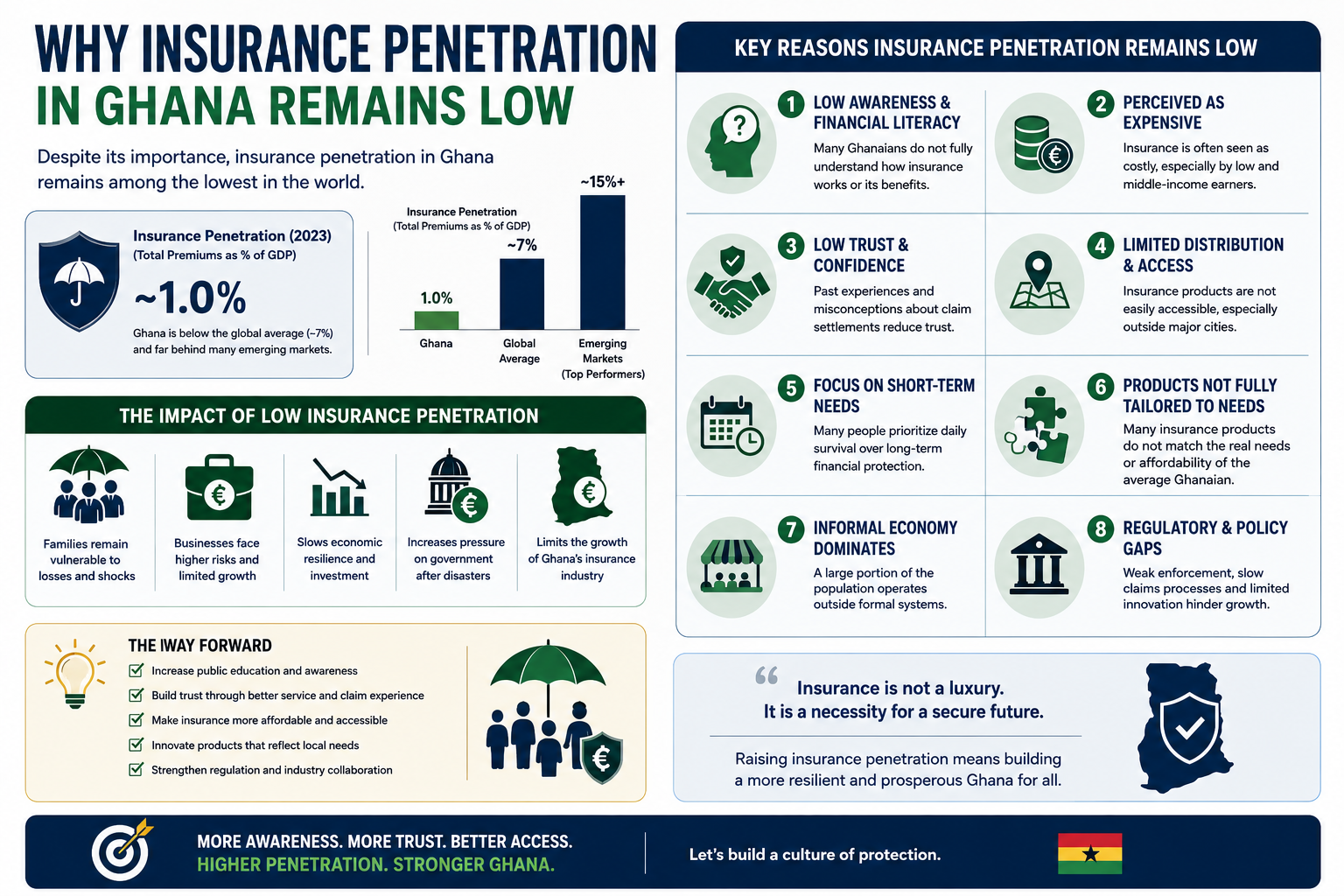
The numbers are stark. Ghana’s insurance penetration — gross premiums as a percentage of GDP — has remained stuck at approximately 1.0 per cent for years, unchanged from 2023 to 2024, according to the 2026 Deloitte Africa Insurance Outlook. Under the stricter IFRS 17 insurance service revenue basis, penetration falls even further, to just 0.63 per cent. Insurance density — per capita spend on premiums — stood at about GH¢202 in 2024, a figure that has barely budged despite a growing economy.
This is not a story of an industry that is failing. With over 50 licensed insurers and reinsurers, the sector generated total revenue of GH¢7.34 billion in 2024, up 31 per cent from the previous year, and recorded real revenue growth of 19.9 per cent in 2025. Profit After Tax (PAT) more than quadrupled between 2020 and 2024, rising from GH¢293 million to GH¢1.24 billion. Every day, Ghanaian insurers pay out approximately GH¢9.2 million in legitimate claims — GH¢5.2 million from general insurers and GH¢4 million from life insurers.
📢 GET DETAILED ARTICLES + JOBS
Join THSB's WhatsApp Channel and never miss a post or opportunity.
Yet the 1 per cent penetration ceiling has refused to budge. The question is not why the industry is small — it is why, despite its financial size and resilience, insurance remains irrelevant to the vast majority of Ghanaians.

This profile goes inside the four structural barriers that explain the paradox. It examines the macroeconomic shocks — the Domestic Debt Exchange Programme (DDEP), inflation peaking at 23.8 per cent in December 2024, and currency depreciation — that have eroded balance sheets and forced insurers into defensive postures. It analyses the informal sector mismatch: over 80 per cent of Ghana’s workforce operates outside formal employment, yet insurance products remain designed for salaried workers with predictable monthly incomes.
It explores the product irrelevance gap, where informal workers need entirely new products designed from scratch to match their income patterns and risk profiles, not simplified versions of formal-sector products. It confronts the trust deficit that sees about 70 per cent of Ghanaians lacking any insurance coverage, and it maps the distribution bottlenecks that keep insurance out of reach for rural and low-income populations.
The insurance industry in Ghana is bigger than most people realise — but its penetration is smaller than almost any other sector of the formal economy. Understanding why requires moving beyond the one-liner about “poor financial literacy” and confronting the systemic barriers that have kept 98 per cent of Ghana’s economic activity and household assets unprotected for decades. The Deloitte report describes the industry at “a critical juncture, facing near-term pressures but also positioned for long-term transformation, provided structural challenges are effectively addressed”. This is the roadmap to that transformation — and the account of how far Ghana still has to travel.
The Macroeconomic Body Blow — DDEP, Inflation and the Investment Income Collapse
No explanation of Ghana’s low insurance penetration can begin without the DDEP. Prior to the domestic debt restructuring, the insurance industry held approximately GH¢4.6 billion in government securities — representing about 40 per cent of the sector’s total assets. Insurers had built a comfortable, long-standing business model: collect premiums, invest the float in government bonds yielding double-digit returns, and earn a reliable, sovereign-backed investment income stream to compensate for weak underwriting. The DDEP shattered that assumption.
The restructuring forced insurers to exchange high-yielding bonds for lower-yielding instruments with extended maturities, incurring substantial losses. The non-life insurance sector reduced its holdings in government securities by 13 per cent — from 38 per cent of its investment portfolio in 2022 to 27 per cent in 2023. The life segment cut more modestly, from 49 per cent to 40 per cent over the same period. But the damage was already done: “Most insurers incurred substantial losses following the DDEP, Eurobond restructuring, political transitions, inflationary pressures, and sharp currency depreciation,” the Deloitte report states. The government established a US$750 million Financial Stability Fund to support affected institutions, but the sector’s investment income — its “life support” — had been severely impaired.
Compounding the shock, inflation surged to 23.8 per cent by December 2024, eroding real returns and squeezing household disposable income. Rising costs led the Ghana Insurers Association to propose a 10 per cent increase in motor insurance premiums; the NIC suspended the proposal, citing concerns about the burden on consumers. Currency depreciation further weakened balance sheets, as overseas reinsurance transfers — which jumped sharply in 2024 — exposed domestic insurers to exchange rate volatility.
The transition to IFRS 17 has added another layer of pressure. The new accounting standard, which recognises revenue as services are delivered rather than as cash flows, has exposed “significant gaps, including outdated systems, poor data quality, and a shortage of skilled actuarial professionals,” the Deloitte report notes. Implementation costs are estimated at about $110,000 per firm, a major concern for smaller insurers that may struggle to meet the requirements without additional support.
The cumulative effect is that many insurers have been forced into defensive postures — tightening underwriting, raising premiums, and reducing risk appetite — precisely when the industry should be expanding to reach the uninsured majority. As one MP observed, “Insurance thrives on the principle of large numbers. When many people contribute, the pool can easily pay the few who make claims. But when participation is low, even routine claims become a burden. Low penetration and high macroeconomic pressures have created a self-reinforcing cycle: insurers cannot afford to take risks, so they do not expand, so penetration remains low. Breaking that cycle is the first and most urgent challenge.
The Structural Fault Line — Insurance Designed for a Formal Economy That Does Not Exist
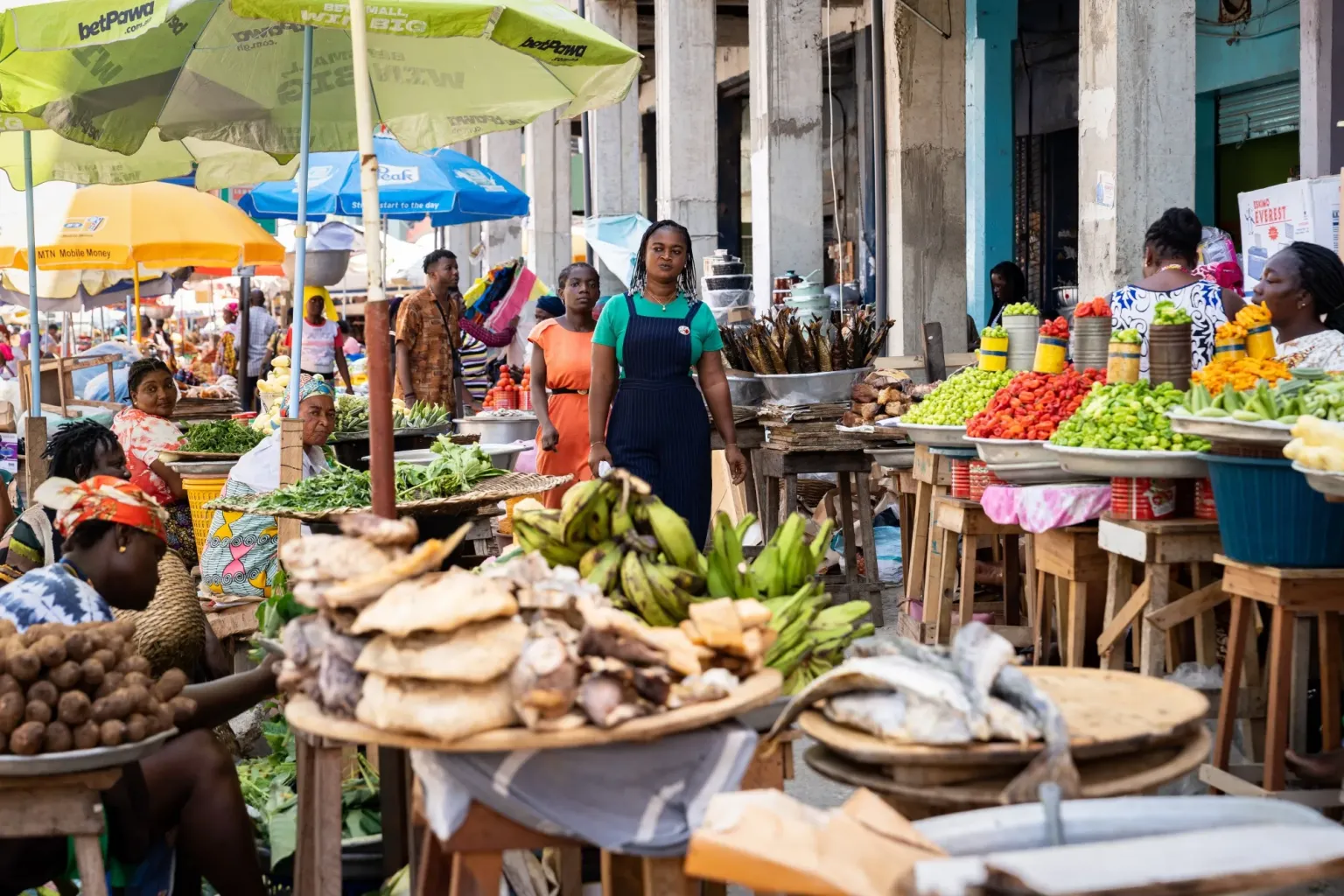
Approximately 80 per cent of Ghana’s workforce is in the informal sector — market traders, farmers, artisans, gig workers, and small-scale entrepreneurs. Yet the vast majority of insurance products sold in Ghana were designed for salaried formal-sector workers with predictable monthly incomes, employer-provided benefits, and bank accounts.
The Acting Commissioner of Insurance, Dr Abiba Zakariah, has been characteristically blunt: “We are moving towards innovation and inclusive insurance because we realise that the majority of Ghanaians have not been able to take insurance, not because they don’t want to, but because we have not yet met them where they are. This is not a failure of consumer demand — it is a failure of product design and distribution.

Informal workers face three structural mismatches with traditional insurance:
Payment frequency mismatch: Traditional annual or monthly premiums assume income regularity that informal workers do not have. A market woman earning GH¢1,500 in a good month and GH¢500 in a bad month cannot commit to a fixed monthly premium. Daily or weekly premium models, such as those offered by digital microinsurance platforms like aYo Ghana, are better aligned — but they remain the exception, not the norm.
Documentation barriers: Most insurance policies require formal identification, proof of income, and sometimes a bank account. The Ghana Card mandate, effective from 1 January 2026, has improved identity verification but added an administrative step that many informal workers find daunting. The NIC’s own Committee on Insurance Penetration identified “limited and cumbersome reporting structures on inclusive insurance” as a major barrier.
Relevance gap: Informal workers do not need simplified versions of formal-sector products — they need entirely new products designed from scratch. As one analysis noted, “These workers don’t need simplified versions of formal sector products — they need entirely new products designed from scratch to meet their unique needs, income patterns, and risk profiles. The risk profile of a market woman is not a scaled-down version of a corporate executive’s risk profile. She needs protection against theft of inventory, illness that prevents her from trading, and damage to her stall. She does not need endowment policies or unit-linked savings plans.
The NIC has recognised this gap and launched a new strategic direction aimed at extending insurance coverage to the informal sector, supported by initiatives such as the Inclusive Insurance Innovation Challenge with UNDP and the rollout of micro-insurance clinics targeting market traders and artisans. But scale remains elusive. Micro-insurance revenue reached GH¢420 million in 2024 — a significant sum, but still a fraction of the GH¢7.34 billion total industry revenue. The informal sector remains, as the Commissioner put it, a “massive untapped market for insurers.
The Product Absence — Gaps in Agriculture, SME, and Disaster Coverage
The informal sector is not the only underserved market segment. Critical sectors of the Ghanaian economy operate with virtually no insurance coverage at all.
Agriculture: Smallholder farmers face drought, flooding, pests, and post-harvest losses — yet agricultural insurance generates only a fraction of industry premium income. The UNDP has documented that weather-indexed insurance solutions for smallholder farmers exist (policies costing between GH¢40 and GH¢100 per month), but coverage remains limited. The NIC has announced plans for an agri-insurance concept with a premium subsidy to ease the burden on farmers, but implementation has been slow.
SMEs: Micro, small and medium-sized enterprises account for more than 90 per cent of registered businesses in Ghana, yet their insurance coverage is negligible. Business interruption, theft of inventory, liability to third parties, and loss of tools are risks that go almost entirely uncovered. The Credit Insurance Guarantee Scheme, currently under development by the 24-Hour Economy Authority, the Bank of Ghana, and the NIC, aims to address this gap by allowing SMEs to use insurance as a substitute for physical collateral. But the scheme has yet to launch.
Climate and disaster cover: Dr Zakariah has warned that Ghana is “entering an era of heightened climate vulnerability, with flooding, droughts and extreme weather events becoming more frequent. These events “could wipe out entire communities beyond the capacity of what families or government alone could rebuild. Yet penetration of property and catastrophe insurance remains negligible outside the formal commercial property market. The Commissioner has argued that “insurance allows us to pool our risks and our resources, nationally and globally” — but the products that would enable this pooling do not yet exist at scale.
Compulsory insurance enforcement gaps: The Insurance Act, 2021 (Act 1061) mandates several classes of compulsory insurance — motor third-party, professional indemnity, public liability, and marine cargo — but enforcement remains inconsistent. The Committee on Insurance Penetration identified “the avoidance of compulsory motor insurance by some motorists and vehicle owners” as a major issue. The Motor Insurance Database (MID) has significantly reduced the fake-sticker epidemic, but property insurance for commercial buildings is widely flouted, and task forces continue to find properties without valid fire insurance certificates. The lesson is clear: if the state does not enforce compulsory insurance, private citizens will not voluntarily purchase it.
The newly sworn-in President of the Ghana Insurers Association (GIA), Boatemaa Barfour-Awuah, has confronted this gap directly: “Insurance remains underutilized in Ghana relative to its importance to families, businesses, and the state. The numbers make this plain”. She has announced a Quarterly Industry Scorecard to track penetration, density, compulsory insurance compliance, claims turnaround time, and premium payment integrity — “not just statistics; they represent a protection gap in resilience, confidence, and long-term domestic capital formation.
The Trust Deficit — The 25% Fraud Tax and the Cycle of Mistrust
The most frequently cited barrier to insurance uptake in Ghana is trust — specifically, the widely held belief that insurers collect premiums but do not pay claims.
The perception is not without basis. According to the NIC, approximately 25 per cent of all insurance claims in Ghana show elements of fraud — staged accidents, falsified police reports, inflated repair bills, and duplicate claims. These fraudulent claims absorb investigative resources, slow down legitimate claim processing, and drive up premiums for honest policyholders. The “fraud tax” adds an estimated GH¢50–80 per policy for third-party motor cover — money that could otherwise be returned to customers or reinvested in expanding access.
But the perception of non-payment is also a failure of communication. Insurers pay out GH¢9.2 million daily in legitimate claims, but these payouts rarely make headlines. A single delayed or disputed claim, by contrast, spreads rapidly through social networks and reinforces the narrative that insurance is a scam. The Abuakwa South MP, Dr Kingsley Agyemang, has argued that “nothing restores trust faster than paying claims on time and keeping clients informed”.
The industry’s response has been twofold. First, the NIC has implemented strict guidelines requiring insurers to settle claims within one month of receiving all required documents, with sanctions for delays. Second, the industry has launched the Insurance Consumer Support Group (ICSG) to rebuild confidence, with daily payouts of GH¢4.4 million in non-life claims and GH¢4.6 million in life benefits.
The trust problem is exacerbated by mis-selling and opaque policy language. The KPMG 2025 Banking Survey found that complex contract language limits many Ghanaians from fully understanding their coverage. Customers purchase policies with inaccurate expectations about what is covered — especially the difference between third-party and comprehensive motor cover, or the exclusions in health policies — and then feel cheated when their claim is denied.
The GIA President has identified “trust deficits, limited public awareness, and enforcement challenges around compulsory insurance” as key factors contributing to low uptake. Insurers have been urged to rebuild trust by ensuring “prompt and fair settlement of claims, adhering to ethical standards, improving consumer engagement. But trust earned over years is lost in weeks. The industry remains trapped in a cycle: low penetration leads to higher premiums and slower claims processing, which further erodes trust, which further reduces uptake. Breaking that cycle requires not just regulatory enforcement but a fundamental shift in how insurers engage with customers — from the point of sale through to the point of claim.
The Distribution Bottleneck — Why Insurance Is Hard to Buy If You Are Not in Accra
Even when a Ghanaian wants to buy insurance, the distribution channels often fail them.
The traditional model — commissioned agents and physical branches — is expensive, fragmented, and concentrated in urban centres. As of 2016, the industry had approximately 4,537 registered agents, 72 brokers, and one reinsurer. By 2024, the distribution landscape had grown, with insurance brokers contributing 43 per cent of gross written premium in the non-life sector and bancassurance contributing 13 per cent. But these numbers are dwarfed by the scale of the market: 80 per cent of the workforce is in the informal sector, and most of that 80 per cent live outside Greater Accra.
Bancassurance — the distribution of insurance through bank branches — has grown in importance, with formalised partnerships between banks and insurers enabled by the BoG’s bancassurance directives. The market is projected to grow steadily through 2031, driven by increased demand for life and non-life products, especially among individuals and SMEs. But bancassurance serves the banked population — about 60‑70 per cent of adults. The unbanked, who are also the uninsured, are not reached.
Agents and brokers remain the dominant channel, but the agent model has inherent limitations. Agents are compensated through commission, which incentivises them to sell high-premium products to customers who can afford them. Micro-insurance, with its low premiums and small commissions, is less attractive to agents. The result is a persistent mismatch between what low-income customers need and what the distribution network is incentivised to sell.
Digital distribution is the most promising channel for reaching scale. aYo Ghana has demonstrated that low-income Ghanaians will buy insurance when it is embedded into products they already use — airtime purchases, mobile money transfers. The company has insured over 8.5 million lives and paid more than GH¢35 million in claims. DOSH Health Insurance, launched in partnership with MTN MoMo, offers entry-level health premiums from GH¢365 per year. ETAP, operating with an NIC insurtech licence, offers telematics-based auto insurance.
But digital distribution has not yet reached escape velocity. The NIC’s sandbox programme has admitted five insurtechs, but most are still in pilot phase. Agent liquidity shortages remain the primary cause of agent inactivity, leaving businesses in some areas without a nearby agent to facilitate cash-in/cash-out services. The digital divide — access to smartphones, digital literacy, and mobile money registration — excludes significant pockets of the population, particularly in rural areas.
The distribution bottleneck is not a technology problem — it is a coverage problem. The technology exists. The question is whether the industry can deploy it at a cost structure that makes serving low-income, rural customers economically viable while maintaining the trust and service quality that will keep them coming back.
The Path Forward — Three Scenarios for Ghana’s Insurance Penetration
The 1 per cent penetration ceiling will not break by accident. It will require deliberate, coordinated action from regulators, insurers, and technology platforms.
Scenario One: Gradual Digital Expansion (65 per cent probability)
In this base case, embedded microinsurance continues to expand, reaching 12‑15 million lives by 2028. Penetration rises slowly to 1.5‑2 per cent of GDP. The NIC’s sandbox programme produces a steady stream of new entrants. Bancassurance partnerships extend coverage to banked SME customers. The industry remains profitable, but the informal sector remains largely uncovered. This scenario requires no major external shocks and continued regulatory support. The GIA’s Quarterly Industry Scorecard would show modest, incremental improvement — but not the breakthrough that the 80 per cent informal workforce needs.
Scenario Two: Accelerated Inclusion Breakthrough (25 per cent probability)
The credit insurance guarantee scheme is successfully implemented, unlocking bank financing for hundreds of thousands of SMEs. Telematics becomes standard for motor policies, reducing fraud and enabling usage-based pricing. Embedded health insurance becomes a standard feature of smartphone financing and mobile money accounts. The NIC’s open insurance framework enables seamless integration between insurers and third-party digital platforms. Penetration rises to 2.5‑3 per cent by 2028. Ghana becomes a regional leader in inclusive insurance, and the 80 per cent informal workforce begins to be reached at scale. This optimistic scenario depends on political will, effective execution of complex regulatory reforms, and a stable macroeconomic environment.
Scenario Three: Stagnation and Trust Erosion (10 per cent probability)
A major fraud incident or high-profile claims dispute erodes public trust in digital insurance platforms. The NIC, facing enforcement capacity constraints, struggles to keep pace with new forms of fraud — ghost broking, fake digital policies, AI‑generated claim documents. The 1 per cent penetration ceiling holds. Microinsurance remains a niche product for the urban formal sector. The informal majority remains uncovered. This scenario would be a significant setback for the entire industry and would likely lead to consolidation among smaller insurers.
The most likely path is Scenario One: slow, incremental expansion. The GH¢7.34 billion revenue base will continue to grow. The GH¢9.2 million daily claims payout will rise. The 1 per cent penetration rate may tick up to 1.5 per cent or 2 per cent. But the structural gap between the industry’s financial size and its social reach — the paradox of a GH¢17.9 billion industry covering only 1 per cent of GDP — will persist unless the informal sector is finally reached.
The Deloitte report concludes that the industry is at “a turning point,” but turning requires more than resilience. It requires a fundamental reorientation of products, distribution, and trust-building. The 10‑year Insurance Master Plan announced in the 2026 Budget, to be developed in collaboration with industry stakeholders, offers a framework. The NIC’s push toward Risk-Based Supervision (RBS) offers a regulatory foundation. The GIA’s Quarterly Industry Scorecard offers accountability.
But the missing ingredient is not capital, technology, or regulation. It is the will to design products for the 80 per cent — not as an afterthought, but as the primary market. The Commissioner has said it plainly: “the majority of Ghanaians have not been able to take insurance, not because they don’t want to, but because we have not yet met them where they are”. Meeting them where they are — in the market, on the farm, in the gig economy — requires a level of innovation, investment, and humility that the industry has not yet demonstrated. The 0.63 per cent penetration rate under IFRS 17 is not a statistic. It is a measure of the distance Ghana’s insurance industry has yet to travel.
THSB Conclusion
Ghana’s insurance penetration remains low not for one reason, but for four interlocking ones. The macroeconomic shocks — DDEP, inflation, currency depreciation — have eroded the industry’s traditional investment income, forcing insurers into defensive postures when they should be expanding. The 80 per cent informal workforce faces products designed for salaried workers, payment structures that do not match irregular incomes, and distribution channels that do not reach them. The trust deficit — rooted in real claim delays, perceived non-payment, and opaque policy language — has made insurance feel like a gamble rather than a guarantee. And the distribution bottleneck — fragmented agents, underdeveloped bancassurance, and digital platforms still in pilot — has made insurance hard to buy for those who need it most.
The industry is not failing. It is profitable. It is well capitalised. It pays GH¢9.2 million in claims daily. But it is not growing in the dimension that matters: the proportion of Ghanaians and Ghanaian economic activity that is protected by private insurance. The 1 per cent penetration ceiling is not a statistic. It is a measure of failure.
The path forward is clear. Regulators must continue to enforce compulsory insurance, invest in digital infrastructure, and create the enabling environment for inclusive products. Insurers must shift from designing products for formal-sector salaried workers to designing for the 80 per cent. Distribution must move from commissioned agents to digital embedded models that reach customers where they already are. Trust must be rebuilt, not through regulatory threats, but through prompt, transparent, empathetic claims handling at every point of contact.
The 10‑year Master Plan, the Quarterly Industry Scorecard, and the NIC’s strategic push toward inclusive insurance are the right directions. But directions are not destinations. The distance between 0.63 per cent penetration and 3 per cent — the West African average — is not measured in regulatory documents. It is measured in the number of market women who can afford a micro‑insurance policy, the number of smallholder farmers protected against drought, and the number of families who receive a claim payment within a week, not a month.
The insurance industry in Ghana is bigger than most people realise. But its potential is bigger still — and that potential will only be realised when the industry finally decides to meet the 80 per cent where they are, not where the industry wishes they would be. The tools exist. The capital exists. The regulatory framework is improving. The missing ingredient is the will to use them — and the patience to rebuild trust, one claim, one policy, one customer at a time.
The 1 per cent is not a destiny. It is a challenge. The industry that rises to that challenge will not only be profitable. It will be transformative. And that is a future worth insuring against.
Quick Facts Box
Category || Details
- Insurance Penetration (GDP basis) ~1.0% (unchanged from 2023 to 2024)
- Insurance Penetration (IFRS 17 basis) 0.63%
- Insurance Density (2024) GH¢202 per capita
- West African Average Penetration ~3%
- Global Average Penetration ~7%
- Ghanaians with No Insurance Coverage ~70%
- Informal Sector Share of Workforce >80%
- Total Industry Revenue (2024) GH¢7.34 billion (+31% YoY)
- Profit After Tax (2024) GH¢1.24 billion (up from GH¢293m in 2020, +324%)
- Daily Claims Paid GH¢9.2 million (GH¢5.2m non-life, GH¢4m life)
- Licensed Insurers & Reinsurers 50+
- Pre‑DDEP Government Securities Held by Insurers GH¢4.6 billion
- Financial Stability Fund US$750 million
- Inflation Peak (Dec 2024) 23.8%
- IFRS 17 Implementation Cost per Firm ~$110,000
- Fraudulent Share of Total Claims ~25% (NIC estimate)
- Microinsurance Revenue (2024) GH¢420 million
- aYo Ghana Lives Insured 8.5 million (claims paid: GH¢35m+)
- Life Insurance Retention Ratio 95.3%
- Non-Life Insurance Retention Ratio 73%
- Motor Insurance Proposed Increase (2024) 10% (suspended by NIC)
- Compulsory Insurance Types Motor third‑party, professional indemnity, public liability, marine cargo
- Primary Regulator National Insurance Commission (NIC)
- Key Industry Body Ghana Insurers Association (GIA)
Frequently Asked Questions (FAQ)
Q1: What is Ghana’s current insurance penetration rate?
Ghana’s insurance penetration — gross premiums as a percentage of GDP — is approximately 1.0 per cent, unchanged since at least 2023. Under the stricter IFRS 17 insurance service revenue basis, penetration falls to just 0.63 per cent. The West African average is about 3 per cent, and the global average is 7 per cent.
Q2: Why has insurance penetration remained so low despite industry growth?
Low penetration persists because of four structural barriers: macroeconomic shocks (DDEP, inflation, currency depreciation) have eroded balance sheets; insurance products are designed for formal-sector workers, yet over 80 per cent of the workforce is informal; trust deficits rooted in claim delays and mis-selling discourage uptake; and distribution channels fail to reach rural and low-income populations.
Q3: How does the informal sector affect insurance penetration?
Approximately 80 per cent of Ghana’s workforce is in the informal sector — market traders, farmers, artisans, gig workers — yet insurance products were designed for salaried formal-sector workers with predictable monthly incomes, employer benefits, and bank accounts. The NIC Commissioner has stated that “the majority of Ghanaians have not been able to take insurance, not because they don’t want to, but because we have not yet met them where they are.”
Q4: How did the DDEP affect the insurance industry?
Prior to the domestic debt restructuring, insurers held approximately GH¢4.6 billion in government securities — about 40 per cent of the sector’s total assets. The DDEP forced insurers to exchange high‑yielding bonds for lower‑yielding instruments, incurring substantial losses. The non‑life sector reduced government securities holdings from 38% to 27%, and the life sector from 49% to 40%. The government established a US$750 million Financial Stability Fund to support affected institutions.
Q5: Is it true that insurance companies in Ghana do not pay claims?
No. Ghanaian insurers pay approximately GH¢9.2 million in legitimate claims daily — GH¢5.2 million from general insurers and GH¢4 million from life insurers. However, approximately 25 per cent of claims show elements of fraud, and claim delays and disputes — often arising from mis-selling, incomplete documentation, or policy exclusions — reinforce public mistrust. Legitimate claims are paid, but the perception of non‑payment persists.
Q6: What percentage of Ghanaians have no insurance coverage?
Approximately 70 per cent of Ghanaians lack any insurance coverage. The 0.63 per cent penetration rate under IFRS 17 indicates that the industry serves only a tiny fraction of the population with any meaningful coverage.
Q7: What is the NIC doing to improve insurance penetration?
The NIC is pursuing a three‑pillar strategy: sanitising the insurance market (enforcing compulsory insurance, combating fraud), growing the market through technology (insurtech sandbox, digital platforms, mobile money integration), and positioning Ghana’s industry for long‑term competitiveness (Risk‑Based Supervision, inclusive insurance frameworks). A Committee on Insurance Penetration presented its report in August 2025, recommending measures to address avoidance of compulsory motor insurance, unreported leakages, and limited reporting structures on inclusive insurance.
Q8: What is microinsurance and how does it help penetration?
Microinsurance provides low‑premium, simplified coverage designed for low‑income individuals and informal workers. It is typically distributed via mobile phones and mobile money, with premiums as low as GH¢1 per day. Microinsurance revenue reached GH¢420 million in 2024, and aYo Ghana has insured over 8.5 million lives. However, microinsurance remains a fraction of total industry revenue and has not yet reached scale.
Q9: What is the Ghana Insurers Association doing to address low penetration?
The newly sworn‑in GIA President, Boatemaa Barfour‑Awuah, has announced a Quarterly Industry Scorecard to track penetration, density, compulsory insurance compliance, claims turnaround time, and premium payment integrity. She has stated that “insurance remains underutilized in Ghana relative to its importance to families, businesses, and the state” and that the industry must confront “an uncomfortable truth.”
Q10: What is IFRS 17 and why does it matter for insurance penetration?
IFRS 17 is a new international accounting standard for insurance contracts that recognises revenue as services are delivered rather than as cash flows. Implementation has exposed gaps in outdated systems, poor data quality, and a shortage of skilled actuarial professionals. It has also lowered Ghana’s reported penetration rate from 1.0% to 0.63%, providing a more accurate — and more sobering — picture of the industry’s reach.
Q11: What products are missing from Ghana’s insurance market?
Key missing products include affordable, accessible insurance for agriculture (drought, flood, pests), SMEs (business interruption, inventory theft, liability), micro‑enterprises (market stall insurance, equipment cover), and climate/disaster risks (flood and catastrophe coverage for households and small businesses). The NIC has announced plans for an agri‑insurance concept with a premium subsidy, but implementation has been slow.
Q12: What is the outlook for insurance penetration in Ghana?
The most likely scenario is gradual digital expansion, with penetration rising slowly to 1.5‑2 per cent of GDP by 2028. Digital microinsurance and telematics will be the primary drivers. The informal sector remains the great untapped market, and whether it is reached will depend on product innovation, claims performance, and regulatory support. The NIC, GIA, and Ministry of Finance have all signalled commitment to inclusive insurance, but execution will determine the outcome.
Source: The High Street Business
Disclaimer: Some content on The High Street Business may be aggregated, summarized, or edited from third-party sources for informational purposes. Images and media are used under fair use or royalty-free licenses. The High Street Business is a subsidiary of SamBoad Publishing under SamBoad Business Group Ltd, registered in Ghana since 2014.
For concerns or inquiries, please visit our Privacy Policy or Contact Page.

Esther Aku-Sika is a content writer and social media strategist who helps brands and startups grow through intentional storytelling and practical marketing strategies. With a keen eye for trends and audience behavior, she shares business insights, content strategies, and real-life lessons to help entrepreneurs build visibility and turn ideas into income. Through her writing, she simplifies complex concepts and equips readers with actionable steps to grow in today’s digital space.