








Why Policy Credibility Matters: Policy credibility is essential for economic stability and investor confidence. Learn why credible government and central bank policies matter for Ghana’s growth and financial markets.
Why Policy Credibility Matters
In economics, confidence is built on trust. Businesses invest, consumers spend, and investors commit capital when they believe policymakers will do what they say they will do. This trust is known as policy credibility.
For Ghana, policy credibility has become increasingly important as the country works to restore economic stability, reduce inflation, and strengthen public finances. When government institutions and the central bank are seen as reliable and consistent, markets respond positively. When credibility is weak, uncertainty rises and economic progress can stall.
📢 GET DETAILED ARTICLES + JOBS
Join THSB's WhatsApp Channel and never miss a post or opportunity.
What Is Policy Credibility?
Policy credibility refers to the degree to which people trust that policymakers will follow through on their commitments.
This includes confidence in:
- Government fiscal policies
- Tax and spending decisions
- Debt management plans
- Monetary policy from the Bank of Ghana
- Structural reform programmes
When policies are credible, households and businesses can plan with greater certainty. Investors are more willing to hold local assets and lenders are more comfortable providing financing.
Why Trust Matters in Economics
Economic decisions are based largely on expectations about the future. A business deciding whether to build a new factory needs confidence that inflation will remain under control, taxes will be predictable, and the currency will be relatively stable. Investors buying government bonds want assurance that debt will be managed responsibly.
If policymakers consistently deliver on their promises, confidence strengthens. If they fail to do so, markets may react negatively.
Impact on Inflation Expectations
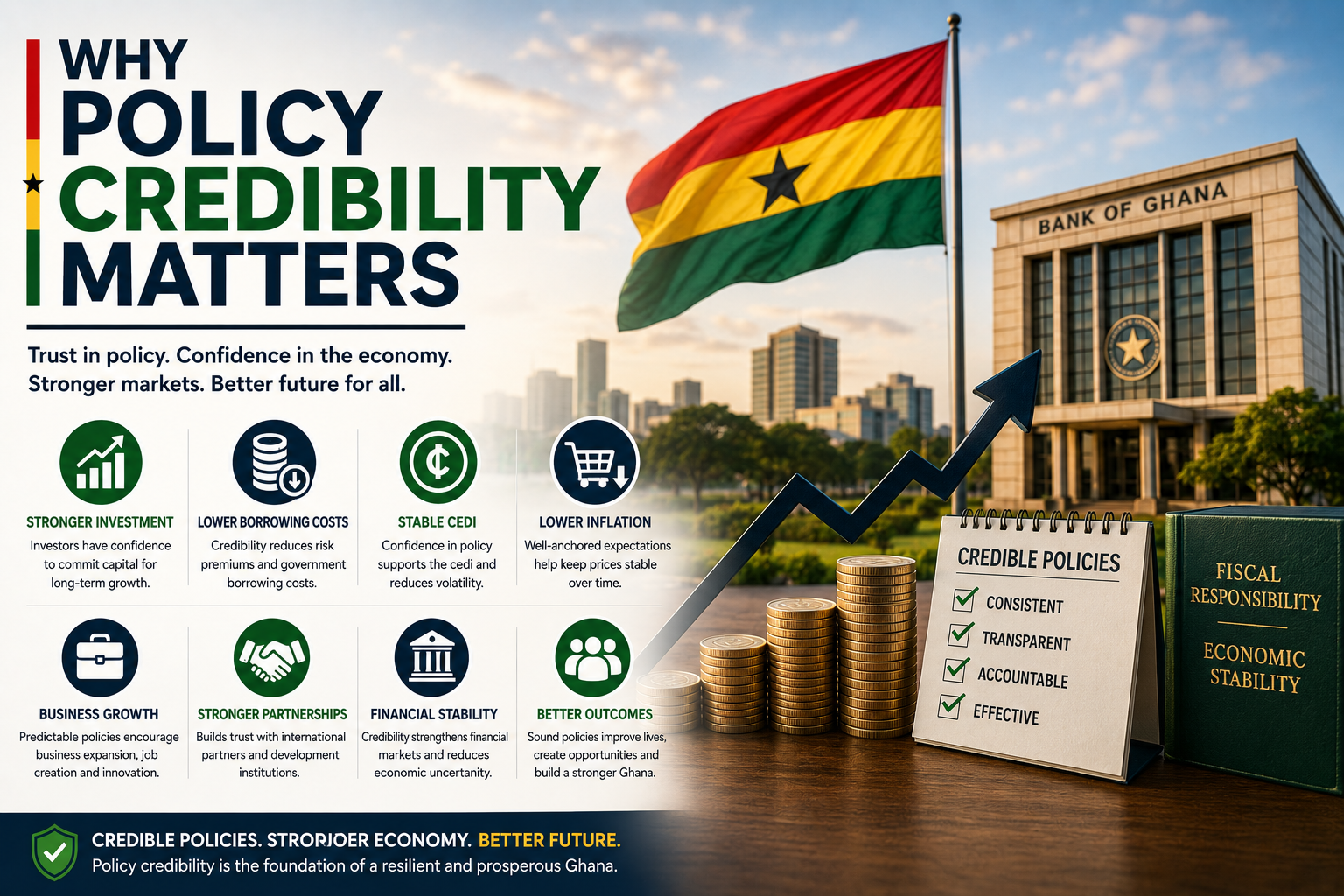
Credible policies help anchor inflation expectations. When the public trusts the Bank of Ghana to maintain price stability, businesses are less likely to raise prices aggressively and workers are less likely to demand large wage increases based on fears of future inflation.
This makes it easier to bring inflation down and keep it under control over time.
Support for the Ghana Cedi
The Ghanaian cedi often reflects investor confidence in economic management. When markets believe fiscal and monetary policies are sound, demand for cedi-denominated assets tends to rise. This can support the currency and reduce exchange rate volatility.
A stable cedi lowers import costs and helps ease inflationary pressures across the economy.
Lower Borrowing Costs
Policy credibility can reduce the cost of borrowing. Governments with strong credibility are generally able to issue bonds at lower interest rates because investors perceive less risk. Businesses and households may also benefit as overall financing conditions improve.
For Ghana, stronger credibility can help reduce debt-servicing costs and create more room for spending on infrastructure, healthcare, and education.
Encouraging Investment
Investors value predictability. When policy decisions are transparent and consistent, businesses are more likely to expand operations, hire workers, and commit long-term capital. Foreign investors are also more willing to enter the market.
Credible policies therefore play a direct role in attracting investment and supporting job creation.
Strengthening IMF and Reform Programmes
Ghana’s reform efforts, including those supported by the International Monetary Fund, depend heavily on policy credibility.
Meeting fiscal targets, implementing structural reforms, and communicating clearly with the public demonstrate commitment to long-term stability. Successful execution increases confidence among development partners and private investors.
What Undermines Policy Credibility?
Several factors can weaken trust in economic management:
- Frequent policy reversals
- Missed fiscal targets
- Inconsistent communication
- Excessive government borrowing
- Political interference in institutions
- Lack of transparency
Once credibility is damaged, restoring confidence can take considerable time and effort.
Ghana’s Recent Experience
In recent years, Ghana has faced significant economic challenges, including high inflation, exchange rate pressures, and debt restructuring.
Efforts to restore stability have focused on tighter monetary policy, fiscal discipline, and structural reforms. As inflation moderates and macroeconomic indicators improve, credibility is gradually being rebuilt.
The extent to which policymakers remain consistent will influence how durable the recovery becomes.
Why Policy Credibility Matters for Everyday Ghanaians
Policy credibility may sound technical, but its effects are felt widely. When policies are trusted:
- Inflation tends to remain lower
- The cedi becomes more stable
- Interest rates can decline
- Businesses invest and hire more workers
- Economic growth becomes more sustainable
In short, credible policymaking supports a more predictable environment for households and businesses.
THSB Bottom Line
Policy credibility is one of the most valuable assets an economy can have. It shapes expectations, influences investment decisions, and strengthens financial stability.
For Ghana, maintaining credible fiscal and monetary policies is essential to preserving investor confidence, supporting the cedi, reducing inflation, and creating the conditions for long-term growth. When policymakers consistently deliver on their commitments, the entire economy stands to benefit.
Source: The High Street Business
Disclaimer: Some content on The High Street Business may be aggregated, summarized, or edited from third-party sources for informational purposes. Images and media are used under fair use or royalty-free licenses. The High Street Business is a subsidiary of SamBoad Publishing under SamBoad Business Group Ltd, registered in Ghana since 2014.
For concerns or inquiries, please visit our Privacy Policy or Contact Page.

Esther Aku-Sika is a content writer and social media strategist who helps brands and startups grow through intentional storytelling and practical marketing strategies. With a keen eye for trends and audience behavior, she shares business insights, content strategies, and real-life lessons to help entrepreneurs build visibility and turn ideas into income. Through her writing, she simplifies complex concepts and equips readers with actionable steps to grow in today’s digital space.