






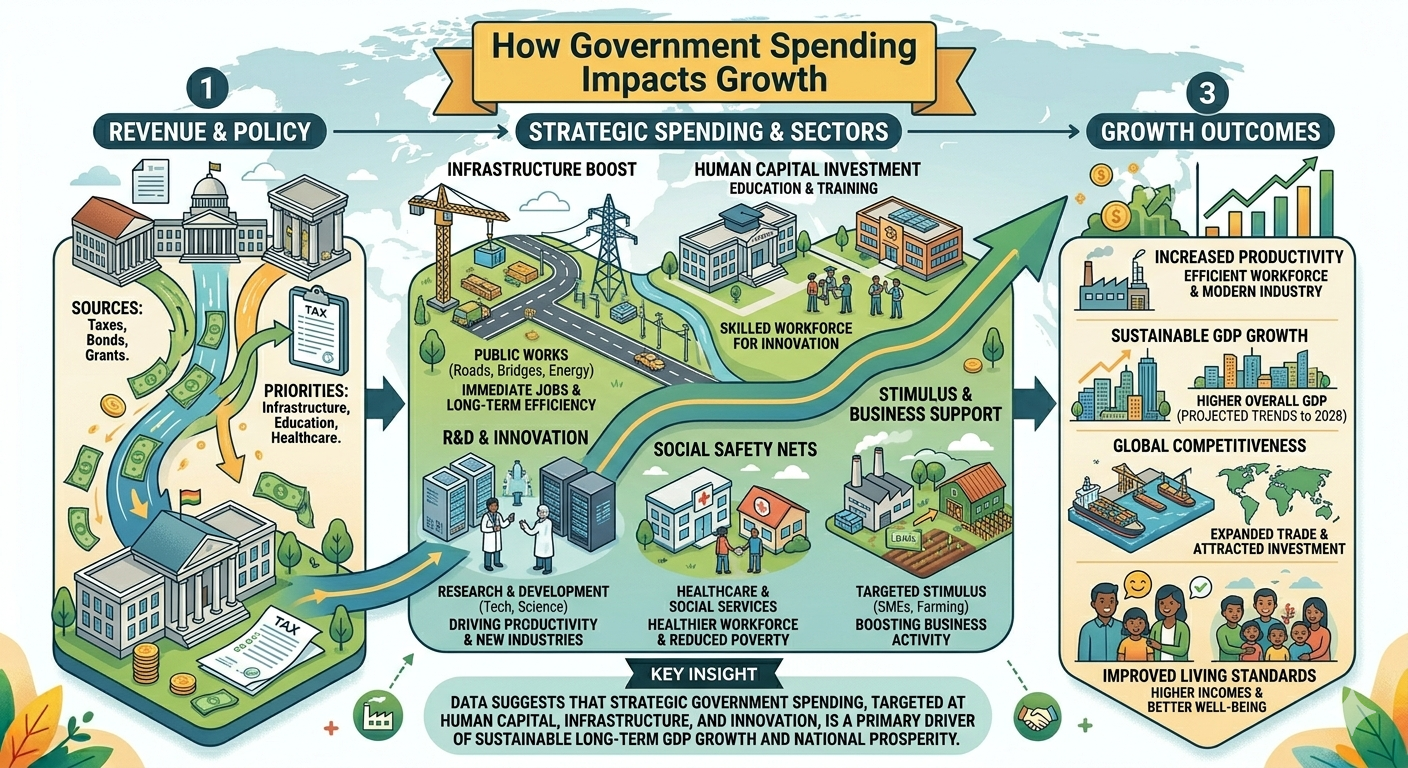
How Government Spending Impacts Growth – Government spending plays a major role in economic growth by supporting infrastructure, jobs, healthcare, education, and business activity. Here’s how it affects Ghana’s economy.
How Government Spending Impacts Growth
Government spending is one of the most powerful tools used to influence an economy. From building roads and hospitals to funding schools and public services, state expenditure affects businesses, employment, and the overall pace of economic growth.
In Ghana, government spending shapes both short-term economic activity and long-term national development. When managed effectively, it can stimulate growth, improve living standards, and encourage investment. But when spending becomes excessive or poorly managed, it can also create economic pressure.
📢 GET DETAILED ARTICLES + JOBS
Join THSB's WhatsApp Channel and never miss a post or opportunity.
What Is Government Spending?
Government spending refers to money used by the state to provide services, build infrastructure, and support economic activity.
This includes spending on:
- Roads and transportation
- Healthcare and hospitals
- Education and schools
- Security and public administration
- Agriculture and industrial support
- Energy and utilities
Such investments are often aimed at improving productivity and creating opportunities for businesses and citizens.
Government Spending and Economic Growth
When governments spend money, it circulates through the economy. Contractors hire workers, suppliers provide materials, and employees spend their wages on goods and services.
This process can:
- Increase business activity
- Create jobs
- Boost consumer spending
- Encourage private investment
As a result, economic growth may improve, especially during periods of weak economic activity.
Infrastructure Development and Productivity
Infrastructure is one of the clearest examples of how public spending supports growth. Projects such as highways, ports, electricity systems, and water supply networks help businesses operate more efficiently.
Better infrastructure can:
- Reduce transportation costs
- Improve trade and logistics
- Attract foreign investment
- Support industrial growth
In Ghana, infrastructure spending often plays a major role in long-term development planning.
Education and Human Capital
Government spending on education contributes to economic growth by developing a skilled workforce. When countries invest in:
- Schools
- Teacher training
- Technical education
- Universities
they improve the productivity and employability of their population. A stronger workforce can support innovation, entrepreneurship, and higher national income over time.
Healthcare and Economic Stability
Public healthcare spending also affects growth. Healthy populations are generally more productive and able to participate fully in economic activity.
Investment in healthcare can:
- Reduce productivity losses from illness
- Improve workforce efficiency
- Increase life expectancy
- Strengthen social stability
This is why many economists view healthcare spending as both a social and economic investment.
Support for Businesses and Agriculture
Governments often spend money to support key industries such as agriculture, manufacturing, and small businesses. This may include:
- Subsidies
- Loans and grants
- Agricultural programmes
- Industrial development initiatives
In Ghana, agriculture remains a major employer, so public investment in farming and food production can have widespread economic effects.
The Risks of Excessive Spending
Although government spending can stimulate growth, excessive spending may create problems if it is not properly managed.
Potential risks include:
- Rising public debt
- Higher inflation
- Budget deficits
- Increased borrowing costs
If governments spend more than they generate in revenue for long periods, economic stability can weaken. This is why balancing spending with fiscal discipline is important.
Government Spending During Economic Challenges
During economic downturns, governments often increase spending to support recovery. This may involve:
- Funding social programmes
- Supporting businesses
- Creating public sector jobs
- Investing in infrastructure projects
The aim is to stimulate demand and reduce economic hardship. However, policymakers must also ensure that spending remains sustainable in the long term.
Why Investors Watch Government Spending
Investors closely monitor government budgets and spending patterns because they influence:
- Economic confidence
- Inflation expectations
- Interest rates
- Currency stability
Well-managed public spending can improve investor trust, while excessive or inefficient spending may create uncertainty.
Conclusion
Government spending plays a central role in shaping economic growth. By investing in infrastructure, healthcare, education, and business support, governments can stimulate economic activity and improve living standards.
In Ghana, public spending remains a key driver of development and national progress. But the effectiveness of that spending depends not only on how much is spent, but also on how wisely and sustainably it is managed.
Disclaimer: Some content on The High Street Business may be aggregated, summarized, or edited from third-party sources for informational purposes. Images and media are used under fair use or royalty-free licenses. The High Street Business is a subsidiary of SamBoad Publishing under SamBoad Business Group Ltd, registered in Ghana since 2014.
For concerns or inquiries, please visit our Privacy Policy or Contact Page.

Esther Aku-Sika is a content writer and social media strategist who helps brands and startups grow through intentional storytelling and practical marketing strategies. With a keen eye for trends and audience behavior, she shares business insights, content strategies, and real-life lessons to help entrepreneurs build visibility and turn ideas into income. Through her writing, she simplifies complex concepts and equips readers with actionable steps to grow in today’s digital space.