









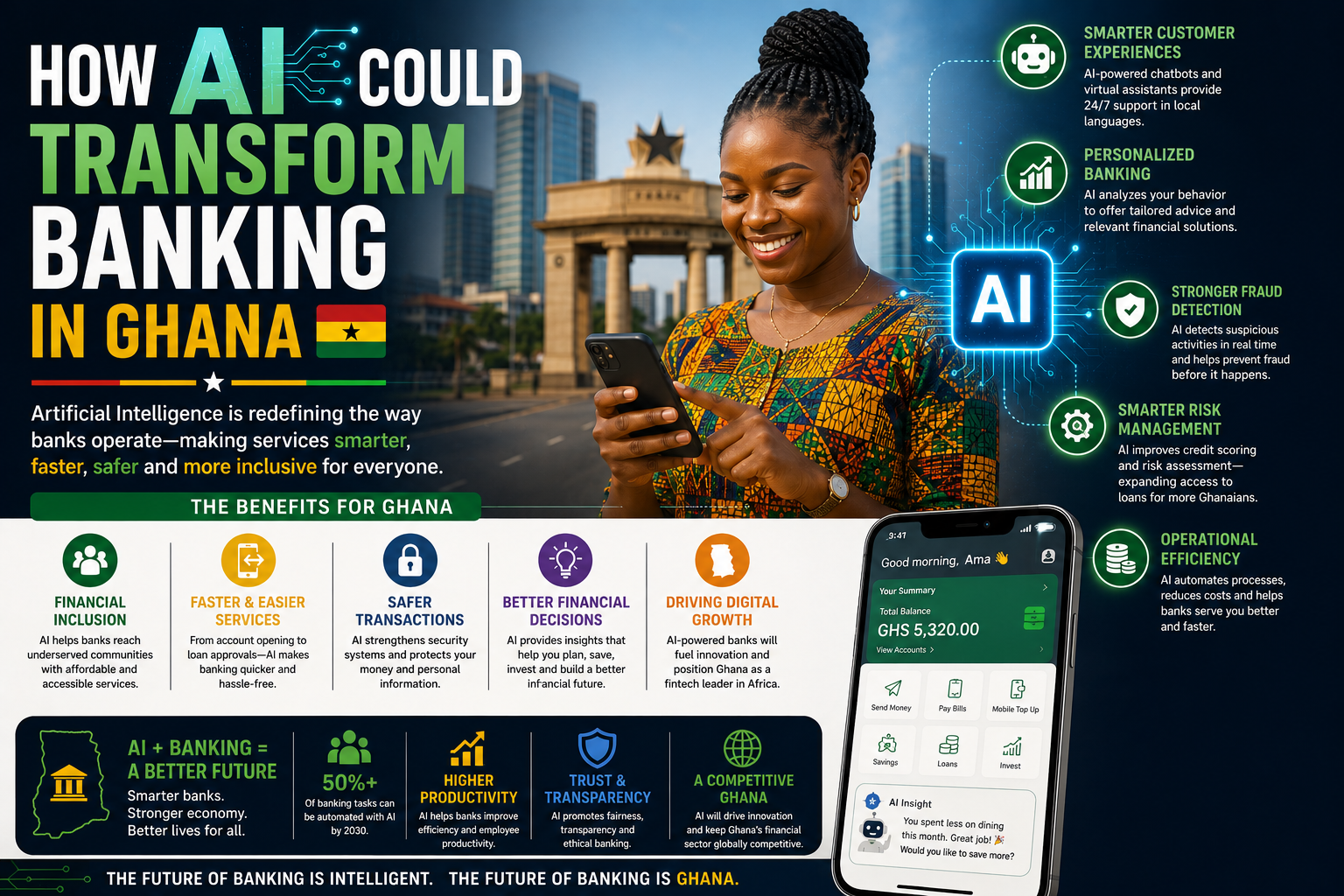
How AI Could Transform Banking in Ghana — 68% of Ghana’s bank CEOs are adopting AI, contributing to GH¢28.65bn net interest income. Our deep‑dive analysis reveals AI‑powered behavioural fraud detection, alternative credit scoring reaching the 80% informal sector, the Bank of Ghana’s CISD 2026 framework, the National AI Strategy, and three scenarios for Ghana’s AI banking future.
Executive Introduction
Ghana’s banking sector is on the cusp of its most profound transformation since the launch of mobile money. Artificial intelligence is no longer a Silicon Valley abstraction debated in Accra’s boardrooms. It is being deployed today — in the algorithms that detect mobile money fraud before it reaches your wallet, in the credit scoring models that are finally reaching the 80 per cent of the workforce in the informal sector, and in the chatbots that answer customer queries at 2am when no human agent is available. The question for Ghana’s banks is no longer whether to adopt AI, but how fast they can deploy it — and whether they can do so without leaving customers behind.
The numbers are already visible. According to the PwC Ghana Banking Survey 2025, 68 per cent of bank CEOs reported some level of AI adoption, with measurable impact on revenue and profitability. Early gains from AI and generative AI deployment were credited with contributing to the sector’s strong 2025 results, including net interest income of GH¢28.65 billion and profit before tax of GH¢21.87 billion. The Bank of Ghana has established specialised units, including the FinTech and Innovation Department and the Data Analytics and Artificial Intelligence Department, to accelerate digital transformation within the institution and the broader financial ecosystem. The central bank has also introduced new governance standards for AI and machine learning systems used in fraud detection and credit scoring, aimed at ensuring transparency and security in automated decision‑making.
📢 GET DETAILED ARTICLES + JOBS
Join THSB's WhatsApp Channel and never miss a post or opportunity.
Beyond the banking sector, the government has set a national direction. Ghana officially launched its National Artificial Intelligence Strategy on 24 April 2026, a decade‑long blueprint (2023–2033) built around eight pillars covering AI education, youth employment, digital infrastructure, data governance, and sectoral AI adoption across seven priority sectors including financial services. Cabinet has approved a $250 million investment to establish an AI computer centre, positioning Ghana as a leading hub for responsible AI innovation in Africa. Mobile penetration currently exceeds 110 per cent, with over 38 million mobile subscriptions nationwide — a foundation that the Communications Minister has cited as central to scaling AI‑driven services.
This profile examines how AI could transform banking in Ghana across five critical dimensions: fraud detection and financial security, credit scoring and financial inclusion, operational efficiency and cost reduction, customer service and experience, and the regulatory framework that will determine whether AI serves Ghanaians or simply serves the banks that deploy it. The technology is advancing rapidly. The capital is being committed. The question is whether the benefits will be distributed as widely as the signals — or whether AI will entrench the very exclusion it promises to overcome.
Fraud Detection — From Rule‑Based to Behavioural Security
The most urgent application of AI in Ghana’s banking ecosystem is not about efficiency or customer experience. It is about security. Mobile money fraud has been a persistent threat to the entire digital finance ecosystem, with cyber fraud losses rising from GH¢2.4 million in the first quarter of 2024 to GH¢14.94 million in the first half of 2025 alone. Fraudsters have become increasingly sophisticated, using SIM swaps, phishing attacks and fake customer service numbers to drain accounts. The traditional approach to fraud detection — rule‑based systems that flag transactions matching certain pre‑defined patterns — has proved insufficient against these evolving tactics.
MTN MoMo has been at the forefront of the shift from rule‑based to behavioural analysis. Shaibu Haruna, CEO of MobileMoney Fintech Limited, explained that the organisation is placing greater emphasis on technology to detect unusual transaction activity and uncover patterns commonly associated with fraudulent agents. Thanks to the power of artificial intelligence, we are strengthening our monitoring mechanisms, shifting from just rule‑based applications to more behavioural analysis, which makes it a lot easier for us to narrow down the elements and deal with them,” he said. The adoption of artificial intelligence has greatly enhanced the company’s monitoring capabilities, signalling a move away from traditional rule‑based approaches toward more behaviour‑focused analysis.
This approach works by establishing a baseline of normal transaction behaviour for each user — their typical transaction size, frequency, time of day, geographic location — and then flagging deviations from that baseline. A sudden large transfer to a new recipient, a login from an unfamiliar device, or a rapid sequence of transactions that matches known fraud patterns all trigger real‑time alerts. The system can then block the suspicious transaction before funds are lost, rather than investigating after the fact.
MTN MoMo has made huge investments in digital security, fraud prevention systems, and financial literacy campaigns to protect users. “The investment in platform security is not in question. We have the best‑in‑class fraud management tools, anti‑money laundering systems, and AI‑generated prevention technologies in place to safeguard our operations,” Shaibu Haruna said. The company has also launched extensive public education initiatives such as the ‘Shine Your Eye’ campaign and community‑based awareness drives in areas identified as fraud hotspots. “You can have all the technology in place, but if there is a gap in digital financial literacy, everything begins to unravel,” he explained.
Beyond mobile money, the broader banking sector is adopting AI‑powered fraud detection systems with similar logic. Real‑time anomaly detection strengthens compliance with the Bank of Ghana’s cyber and anti‑money laundering directives. Machine learning models can sift through thousands of variables — transaction frequency, income flow, and even behavioural patterns — to identify suspicious activity with far greater accuracy than static rules. PwC Ghana identified fraud detection and compliance as areas where banks were already seeing traction, with generative AI offering further potential to automate loan monitoring and personalise customer repayment plans.
The Bank of Ghana has formalised this shift. The revised Cyber and Information Security Directive (CISD 2026), launched in March 2026, introduces new governance standards for artificial intelligence and machine learning systems used in fraud detection and credit scoring, aimed at ensuring transparency and security in automated decision‑making. The directive extends regulatory coverage beyond banks to include fintechs, microfinance institutions and other financial sector players, shifting toward a system‑wide approach to managing cyber risk. Governor Dr Johnson Pandit Asiama has described cyber threats as “national security concerns”, citing risks such as ransomware attacks and systemic data breaches that can disrupt operations and erode public confidence. “A financial ecosystem is only as strong as its weakest link,” the Governor said.
Credit Scoring and Financial Inclusion — Reaching the 80 Per Cent
The most transformative potential of AI in Ghanaian banking lies not in fraud prevention but in credit scoring. Traditional credit histories capture less than 30 per cent of financially active Ghanaians, leaving the vast majority of the population — particularly the 80 per cent of the workforce in the informal sector — unable to access formal credit. Banks have historically relied on collateral‑based lending because they lacked reliable data to assess creditworthiness. AI is changing that calculus.
Alternative data — mobile money usage, utility bill payments, and behavioural patterns — is rich with insight. There are over 83 million registered mobile money accounts and 26 million active users in Ghana. The patterns in how people spend, save, and transfer funds are proving to be strong indicators of financial responsibility. As more fintechs tap into these insights, Ghana is seeing a more inclusive credit landscape emerge.
Credit scoring powered by AI is quickly shifting from “nice‑to‑have” to “must‑have.” Machine learning can sift through thousands of variables — transaction frequency, income flow, and even behavioural patterns — to help lenders make smarter decisions. Deep learning models are taking this even further. They are effective at spotting fraud, predicting default risks, and even reading unstructured data like customer reviews or digital footprints. The results are precise credit scores and fewer people left out of the financial system.
UMB CEO Dr Philip Oti‑Mensah has outlined credit scoring, fraud detection, and customer service transformation as the priority areas where banks should be measuring real results. “Real change looks like identifying specific use cases, launching defined AI projects with timelines, investing in data infrastructure and talent, and measuring the outcomes,” he said.
Real‑time credit scoring is a game changer. With tools like APIs and instant data syncing, lenders can now evaluate applications in minutes using the most current financial behaviour available. This dynamic approach allows credit scores to update as a person’s situation changes, providing a more accurate view of risk and opportunity. It is faster, fairer, and more responsive to real life.
The market potential is substantial. Ghana’s credit scoring market currently has a penetration of 35 per cent with an annual growth rate of 25 per cent. Analysts expect the credit scoring market to triple by 2030, especially as digital adoption increases and more institutions adopt AI‑driven approaches. Digital tools are also making the business of credit scoring cheaper; as systems scale, operational costs could drop by 40 per cent.
PwC Ghana identified credit risk modelling as an area where banks are already seeing traction. Generative AI offers further potential to automate loan monitoring and personalise customer repayment plans. For the informal sector worker who has never had a bank account but has years of mobile money transaction history, AI‑powered credit scoring could finally open the door to formal credit — with profound implications for financial inclusion.
The Bank of Ghana has moved to create a regulatory environment that enables this shift. The revised CISD 2026 introduces new governance standards for artificial intelligence and machine learning systems used in credit scoring, aimed at ensuring transparency and security in automated decision‑making. The proportionality framework scales compliance requirements based on the size and risk profile of institutions, ensuring that a small rural bank is not held to the same standard as a large multinational. This creates a more predictable environment for institutions looking to scale their AI deployments, while protecting consumers from opaque or biased algorithms.
Operational Efficiency — The Back‑Office Transformation
While fraud detection and credit scoring receive the most attention, the most immediate return on AI investment for many banks will come from operational efficiency improvements. Automation of compliance, reporting, and client onboarding is reducing operational costs while freeing up resources for higher‑value activities. Sentinel Asset Management’s MD, Kisseih Antonio, has noted that AI‑driven tools support real‑time monitoring and predictive modelling, helping institutions better manage volatility in emerging and frontier markets.
A 2025 KPMG West Africa Banking Industry Customer Experience Survey, drawing on insights from over 35,000 retail customers and 5,000 small and medium enterprises across Ghana and Nigeria, found that strategically deployed AI could move the sector from reactive problem‑solving to proactive service delivery. The survey highlighted AI as a unique opportunity to address both customer expectations and institutional challenges simultaneously.
Specifically, AI could enable proactive detection and resolution of failed transactions before customers lodge complaints. It could allow chatbots to handle complex issues without repeated escalations. It could improve credit assessment processes by analysing risk more quickly and accurately, substantially reducing loan processing times and improving service efficiency. The transition from traditional machine learning to generative AI and now to agentic AI — systems capable of making decisions and taking actions with minimal human input — is expected to redefine banking operations.
KPMG’s survey notes persistent structural challenges affecting both SME and corporate banking customers. These challenges have become increasingly visible as customers compare banking services with the speed, convenience and personalisation offered by technology‑driven industries. Banks face their own operational constraints: digital reliability issues, delayed credit processing, slow response times and technical instability. Even where digital platforms are available, service failures often force customers to pursue resolutions across multiple channels, leading to frustration and inefficiency.
For banks, the benefits of AI‑driven operations extend to improved resilience. AI‑driven systems are better able to scale during periods of high demand, recover more quickly from disruptions and operate efficiently in an increasingly competitive financial landscape. Banks that position AI as a strategic capability rather than an experimental tool are likely to be better equipped to address long‑standing service deficiencies.
The sector’s movement in that direction, if still uneven, is unmistakable. According to the PwC Ghana Banking Survey 2025, 68 per cent of bank CEOs reported some level of AI adoption, with measurable impact on revenue and profitability. Early gains from AI and generative AI deployment were credited with contributing to the sector’s strong 2025 results, including net interest income of GH¢28.65 billion and profit before tax of GH¢21.87 billion. The policy environment is also becoming more supportive as the National Artificial Intelligence Strategy has received Cabinet approval and is scheduled for official launch on April 24, 2026, with the government describing it as a defining moment in the country’s digital transformation journey. The Bank of Ghana has issued a regulatory framework outlining expectations for data governance, model risk, and cybersecurity, creating a more predictable environment for institutions looking to scale their deployments.
Customer Service — The AI‑Powered 24/7 Experience
For the average banking customer in Ghana, the most visible AI transformation will be in customer service. The 9‑to‑5 service window is dead. Customers expect answers at midnight, on Sundays, during public holidays. They expect instant confirmations, payment links within seconds, and delivery updates in real time.
Most banks cannot afford to hire night staff for this. They cannot afford to pay customer service agents to answer “what are your opening hours?” one hundred times a day. But they can afford a basic AI chatbot subscription — and for thousands of Ghanaian businesses, from bank customer service desks to hotel booking systems, that price is changing everything. By early 2026, ChatGPT commanded over 90 per cent of the mobile AI chatbot market in Ghana, with Microsoft Copilot at 7.4 per cent and Google Gemini at 1.6 per cent.
Stanbic Bank Ghana has been a leader in this space. The bank’s Chat Banking platform, Ohemaa Eva, is an artificial intelligence‑powered platform which provides real‑time responses to key banking enquiries and allows customers to perform common banking transactions instantly. The platform is designed to authenticate customer identity using the Ghana Card verification system. Stanbic’s Head of Digital Transformation, Estelle Jacqueline Asare, has revealed that AI‑driven systems are being deployed across the bank, including integration with USSD platforms, to enhance customer interactions and speed up service delivery.
Absa Ghana has brought an extensive digital product portfolio to the market, including being among the first to fully launch WhatsApp Banking service with its chatbot Abby. The bank has committed to AI‑powered convenience for customers, embedding artificial intelligence across its digital channels. Absa Group has successfully modernised its banking infrastructure across multiple African markets with the deployment of advanced, AI‑compatible SAP technologies, prioritising mobile and digital channels and embedding artificial intelligence to boost customer engagement.
The question is no longer whether AI chatbots will transform customer service in Ghana. They already have. The question is who is adopting them, who is being left behind, and what happens to the customer service agent whose job is being automated. For customers, the benefits are tangible: faster service delivery, fewer operational errors, more relevant products and more dependable digital platforms.
The Policy Backbone — Ghana’s National AI Strategy and the BoG’s Regulatory Framework
The banking industry’s AI transformation does not exist in a vacuum. It is being shaped — and in some cases accelerated — by a policy environment that has made AI adoption a national priority.
Ghana officially launched its National Artificial Intelligence Strategy on 24 April 2026, with President John Dramani Mahama presiding over the launch. The decade‑long blueprint (2023‑2033) was developed with support from Smart Africa, German development agency GIZ FAIR Forward, and The Future Society. It is built around eight pillars covering AI education, youth employment, digital infrastructure, data governance, ecosystem development, sectoral AI adoption, applied research, and public sector deployment, with seven priority sectors identified including healthcare, agriculture, financial services, and energy.
Cabinet has approved a $250 million investment to establish an AI computer centre, a move expected to boost the country’s tech innovation and position Ghana as a leading hub for responsible AI innovation in Africa. The Minister for Communication, Digital Technology and Innovations, Samuel Nartey George, has identified four priority implementation areas: strengthening data governance systems, investing in AI research and computing infrastructure, expanding AI education and digital skills, and embedding ethical safeguards in deployment. A dedicated Responsible AI Office will oversee implementation, ensuring the strategy aligns with ethical standards and national development goals.
The Bank of Ghana has positioned itself at the forefront of digital financial innovation. Governor Dr Johnson Pandit Asiama announced that the central bank has established specialised units, including the FinTech and Innovation Department and the Data Analytics and Artificial Intelligence Department, to accelerate digital transformation within the institution and the broader financial ecosystem. “Artificial intelligence, data analytics, cloud computing, and digital finance are redefining business models and market structures globally, and Ghana cannot afford to be a passive observer,” he stated.
The revised Cyber and Information Security Directive (CISD 2026), launched in March 2026, introduces key measures including governance frameworks for artificial intelligence, enhanced security protocols for cloud computing, and a proportionality approach that aligns regulatory requirements with the size and risk profile of institutions. The directive extends regulatory coverage beyond banks to include fintechs, microfinance institutions and other financial sector players, shifting toward a system‑wide approach to managing cyber risk.
For the banking industry, these policy developments provide both direction and pressure. Banks are expected to align their AI investments with national ambitions, and they are being watched closely by a regulator that has made clear its intention to hold institutions accountable for how they deploy automated systems. The Bank of Ghana’s open banking framework, planned by end‑2026, could further accelerate AI adoption by allowing third‑party fintechs, with customer consent, to access bank data and offer competing services.
Case Studies — Early Adopters and Their Strategies
MTN MoMo — Behavioural Fraud Detection at Scale
Shaibu Haruna, CEO of MobileMoney Fintech Limited, confirmed that the adoption of artificial intelligence has greatly enhanced the company’s monitoring capabilities, signalling a move away from traditional rule‑based approaches toward more behaviour‑focused analysis. The company is ramping up measures to tackle fraud by deploying advanced artificial intelligence‑driven monitoring systems, placing greater emphasis on technology to detect unusual transaction activity and uncover patterns commonly associated with fraudulent agents.
GCB Bank — Digital Transformation and Fintech Collaboration
GCB Bank has invested heavily in modernising its technology infrastructure and expanding its digital offerings. The bank has invested in cloud applications and AI‑driven platforms to optimise efficiency and growth, collaborating with vendors such as PureSoftware, Cisco Systems and Joomla. It has also chosen Intellect Digital Core, powered by a revolutionary eMACH.ai (Events driven, Microservices‑based, API‑enabled, Cloud Native, Headless with underlying AI models) architecture, to drive its digital transformation.
At its Fin & Tonic networking event, GCB brought together leading fintech CEOs, startup founders, and digital innovators for discussions on emerging trends such as AI‑driven banking, regulatory sandboxes, embedded finance, and digital partnerships. “Fintechs bring agility and vision. We bring scale and trust. Together, we can shape what banking looks like tomorrow,” said Linus Kumi, Executive Head of Corporate Banking. GCB has also hosted ‘Fin & Tonic’ to drive fintech‑bank collaboration, exploring opportunities for collaboration across instant credit scoring, API‑powered payment systems, and embedded financial services, and emphasising the bank’s readiness to provide fintechs with access to its extensive infrastructure and systems to co‑develop impactful solutions.
Stanbic Bank — Regulatory Safeguards and AI‑Powered Chat
Stanbic Bank Ghana’s Head of Digital Transformation, Estelle Jacqueline Asare, has called for urgent regulatory safeguards to guide AI and open banking in Ghana’s financial services landscape. “In Ghana, we must first establish a solid open banking foundation. This means defining the legal and security frameworks for sharing customer financial data, identifying the right API standards, and ensuring that all participating institutions meet minimum cybersecurity requirements,” she said. “Our financial environment is different. Mobile financial services are deeply embedded in our daily lives. Any open banking framework must consider this local context to ensure inclusiveness. We cannot simply replicate models from Europe or elsewhere without adapting them to Ghana’s realities.” At the same time, Stanbic has deployed its AI‑powered Chat Banking platform, Ohemaa Eva, which provides real‑time responses to key banking enquiries and performs common banking transactions instantly.
UMB — Making AI a Boardroom Priority
UMB CEO Dr Philip Oti‑Mensah has called on the banking industry to deepen its deployment of artificial intelligence beyond isolated back‑office functions, arguing that the sector has the use cases, the regulatory backing, and the talent pipeline to make the technology a genuine driver of transformation. He outlined credit scoring, fraud detection, and customer service transformation as the priority areas where banks should be measuring real results, stating that the variable separating leaders from laggards is institutional will. “Leadership today is not about knowing what to do. It is about doing what we already know, consistently, courageously and completely.”
The Challenges — Data, Talent and Trust
For all the promise of AI, Ghana’s banking industry faces structural constraints that no algorithm can solve.
The first is data fragmentation. The Bank of Ghana’s new SIM registration regime, briefed to Parliament in March 2026, includes support for both Android and iOS devices, self‑registration options for embedded SIM and physical SIM cards, and remote SIM delinking capabilities. But the system requires real‑time biometric verification against the National Identification Authority database, and for AI to function effectively, data from multiple sources — banks, mobile money operators, utility companies — must be integrated. The central bank’s open banking framework, planned by end‑2026, is designed to address this fragmentation, but implementation remains uncertain.
The second is the talent gap. Building and maintaining AI systems requires data scientists, machine learning engineers, and cloud infrastructure specialists — roles that are in short supply globally and even scarcer in Ghana. The government’s response is the “One Million Coders” programme, a flagship initiative designed to equip Ghana’s youth with critical digital skills. But without a sustained pipeline of trained AI professionals, banks’ ability to deploy and maintain AI systems will be constrained by talent availability, not capital availability.
The third is the trust deficit. The Bank of Ghana has warned that innovation must be supported by strong governance systems, cybersecurity safeguards, and consumer protection measures. “As we embrace technological transformation, we must ensure innovation remains responsible, inclusive, and secure,” Governor Asiama said. The challenge is that consumer trust in automated systems is fragile. A single algorithmic error — a loan wrongly denied, a transaction wrongly flagged as fraudulent — can erode confidence in AI systems across the entire sector. Building trust requires not only accurate algorithms but also transparent grievance mechanisms and clear accountability for automated decisions.
The fourth is infrastructure readiness. A Citinewsroom analysis noted that “demand is already emerging from financial institutions, telecom operators and public‑sector platforms integrating AI into core operations. At the same time, regulatory signals are shifting. The question is whether Ghana will build the infrastructure to host that adoption, or rely on external systems that capture most of the value.” The government’s $250 million AI computing centre is a step in the right direction, but its operational timeline remains uncertain.
The Future Outlook — Three Scenarios for AI in Ghana’s Banking Sector
The trajectory of AI adoption in Ghana’s banking sector will be shaped by three variables: the pace of regulatory implementation, the availability of AI talent, and the willingness of customers to trust automated systems.
Scenario One: Gradual Integration (65 per cent probability).
In this base case, AI adoption continues steadily but unevenly. The largest banks deploy AI for fraud detection and customer service, achieving meaningful improvements in efficiency and security. Credit scoring powered by alternative data expands but remains concentrated among fintechs and digital lenders. The Bank of Ghana’s open banking framework is implemented gradually, enabling some data sharing but not a fundamental restructuring of credit markets. The National AI Strategy produces a modest expansion of the talent pool, but skill shortages remain a binding constraint. Ghana’s Global AI Index ranking rises to the top five in Africa, but the country does not achieve its ambition of becoming the continent’s AI banking hub by 2033.
Scenario Two: Accelerated Breakthrough (25 per cent probability).
Open banking is implemented effectively, enabling seamless data sharing across banks, telcos, and fintechs. The One Million Coders programme produces a genuine pipeline of AI talent. The $250 million AI computing centre is operational, attracting foreign investment in AI research and development. Banks compete on AI‑driven personalisation, driving down costs and improving service quality across the industry. Credit scoring models that incorporate mobile money data become the industry standard, dramatically expanding access to credit for informal workers. Ghana’s AI ranking rises to the top three in Africa, and the banking sector becomes a genuine engine of digital inclusion.
Scenario Three: Stagnation and Entrenchment (10 per cent probability).
Open banking is delayed indefinitely. The talent pipeline fails to materialise, with trained AI professionals leaving for better‑paid opportunities abroad. The AI computing centre faces technical and financial challenges, and its operational timeline slips. AI deployment is concentrated in the largest banks, with smaller institutions falling further behind. Data fragmentation persists, and AI models are trained on incomplete data, producing biased or inaccurate outcomes. Consumer trust in automated systems erodes following high‑profile algorithmic failures. Ghana’s banking sector falls behind regional peers, and the promise of AI‑driven inclusion remains unfulfilled.
The most likely path is Scenario One: gradual integration, not a breakthrough. The technology is advancing rapidly, but the structural constraints — data fragmentation, talent shortages, infrastructure readiness — will limit the speed of transformation. However, even gradual integration represents a significant improvement over the status quo. A banking sector where 68 per cent of institutions have adopted AI, where fraud detection is behavioural rather than rule‑based, where credit scoring reaches the previously unbanked, and where customer service is available 24/7 is a sector that has fundamentally transformed.
Conclusion
Artificial intelligence is not a distant future for Ghana’s banking sector. It is being deployed today — in the algorithms that block fraudulent mobile money messages before they reach your phone, in the credit scoring models that are finally reaching the 80 per cent of the workforce in the informal sector, and in the chatbots that answer customer queries at 2am. The BoG has established dedicated AI and fintech departments. The National AI Strategy has set a clear direction, backed by a $250 million computing centre. The CISD 2026 has established governance standards for AI in financial services. The numbers are not ambiguous: 68 per cent of bank CEOs are already adopting AI, profit before tax has reached GH¢21.87 billion, and the policy environment has never been more supportive.
Yet the promise of AI cannot be separated from the structure of the sector that deploys it. The largest banks will lead; smaller institutions may struggle to keep pace. The talent pipeline is still uncertain; Ghana ranks 72nd globally in the Global AI Index, behind Egypt, Mauritius, South Africa, and Tunisia. Data fragmentation remains a constraint; the open banking framework that would enable data sharing is not yet fully operational. And trust remains fragile — a single algorithmic failure could set back public confidence by years.
The question is not whether AI will change Ghana’s banking sector. It already has. The question is whether that change will be inclusive — whether the efficiency gains from AI will translate into lower loan costs for SMEs, whether the credit scoring models will serve informal workers rather than entrenching existing biases, and whether the algorithms that increasingly govern access to financial services will serve the public interest or merely the private profit of a few large institutions.
The technology is ready. The capital is being committed. The policy framework is in place. The missing ingredient is the will to ensure that the AI revolution in Ghana’s banking sector lifts all Ghanaians, not just the ones who already have bank accounts and credit histories. That is the unfinished business of the most important technological transformation the industry has ever seen. And it will not be solved by an algorithm. It will be solved by the choices that regulators, bankers, and policymakers make — right now — about who gets to benefit from the intelligence embedded in the system.
Quick Facts Box
Category || Details
- Bank CEO AI Adoption Rate (PwC 2025) 68 per cent
- Banking Sector Net Interest Income (2025) GH¢28.65 billion
- Banking Sector Profit Before Tax (2025) GH¢21.87 billion
- National AI Strategy Launch Date 24 April 2026
- National AI Strategy Period 2023‑2033
- AI Computing Centre Investment $250 million
- Ghana AI Index Rank (2025) 72nd globally, 6th in Africa
- Mobile Penetration Exceeds 110% (38m+ subscriptions)
- Financial Institutions Under BoG Supervision 23 universal banks plus specialised institutions
- NPL Ratio (Feb 2026) 18.7% (target: 10% by end‑2026)
- Credit Scoring Market Penetration 35%
- Credit Scoring Market Annual Growth 25%
- Projected Credit Scoring Market Growth Triple by 2030
- Cyber Fraud Losses (H1 2025) GH¢14.94 million
- BoG AI Governance Framework CISD 2026
- BoG Specialised AI Unit Data Analytics and Artificial Intelligence Department
- Regulatory Bodies Bank of Ghana (BoG), National Communications Authority (NCA)
Frequently Asked Questions (FAQ)
Q1: How many Ghanaian banks are adopting artificial intelligence?
According to the PwC Ghana Banking Survey 2025, 68 per cent of bank CEOs reported some level of AI adoption, with measurable impact on revenue and profitability. Early gains from AI and generative AI deployment were credited with contributing to the sector’s strong 2025 results.
Q2: What is the National AI Strategy and when was it launched?
Ghana’s National Artificial Intelligence Strategy is a decade‑long blueprint (2023‑2033) launched on 24 April 2026, with President John Dramani Mahama presiding over the launch. It is built around eight pillars covering AI education, youth employment, digital infrastructure, data governance, ecosystem development, sectoral AI adoption, applied research, and public sector deployment, with seven priority sectors including healthcare, agriculture, financial services, and energy.
Q3: How is the Bank of Ghana regulating AI in banking?
The Bank of Ghana introduced a revised Cyber and Information Security Directive (CISD 2026) in March 2026, which includes new governance standards for artificial intelligence and machine learning systems used in fraud detection and credit scoring, aimed at ensuring transparency and security in automated decision‑making. The directive extends regulatory coverage beyond banks to include fintechs, microfinance institutions and other financial sector players.
Q4: How does AI detect mobile money fraud in Ghana?
AI systems use behavioural analysis rather than static rules. They establish a baseline of normal transaction behaviour for each user — typical transaction size, frequency, time of day, geographic location — and then flag deviations from that baseline. A sudden large transfer to a new recipient, a login from an unfamiliar device, or a rapid sequence of transactions that matches known fraud patterns trigger real‑time alerts. MTN MoMo has invested heavily in AI‑generated prevention technologies, shifting from rule‑based applications to more behavioural analysis.
Q5: How can AI help reach the 80 per cent of Ghanaians in the informal sector?
AI‑powered credit scoring uses alternative data — mobile money usage, utility bill payments, and behavioural patterns — to assess creditworthiness for individuals who lack traditional credit histories. Traditional credit histories capture less than 30 per cent of financially active Ghanaians. Machine learning can sift through transaction frequency, income flow, and behavioural patterns to help lenders make smarter decisions, bringing formal credit to previously excluded populations.
Q6: What is the Bank of Ghana’s role in AI adoption?
Governor Dr Johnson Pandit Asiama announced that the Bank of Ghana has established specialised units, including the FinTech and Innovation Department and the Data Analytics and Artificial Intelligence Department, to accelerate digital transformation. The BoG is leveraging cloud computing, data analytics and artificial intelligence internally and has issued a regulatory framework outlining expectations for data governance, model risk, and cybersecurity.
Q7: How much is the government investing in AI infrastructure?
Cabinet has approved a $250 million investment to establish an AI computer centre, expected to boost the country’s tech innovation and position Ghana as a leading hub for responsible AI innovation in Africa. The centre will support AI research, development, and deployment across key sectors including financial services.
Q8: Which banks are leading in AI adoption in Ghana?
Bank Ghana has deployed Ohemaa Eva, an AI‑powered chat banking platform integrated with the Ghana Card verification system. Absa Ghana has launched WhatsApp Banking with its chatbot Abby. GCB Bank has invested in cloud applications and AI‑driven platforms, collaborating with vendors such as PureSoftware, Cisco Systems and Joomla. UMB’s CEO has called for banks to make AI a boardroom priority, identifying credit scoring, fraud detection, and customer service transformation as priority areas.
Q9: How does AI improve customer service in Ghana’s banks?
AI‑powered chatbots provide 24/7 customer support, answering queries and performing transactions at any time of day. Stanbic’s Ohemaa Eva provides real‑time responses to key banking enquiries and allows customers to perform common banking transactions instantly. Absa’s chatbot Abby operates on WhatsApp. AI can also proactively detect and resolve failed transactions before customers lodge complaints and enable chatbots to handle complex issues without repeated escalations.
Q10: What is the outlook for AI adoption in Ghana’s banking sector?
The most likely scenario is gradual integration, with AI adoption continuing steadily but unevenly. The largest banks will deploy AI for fraud detection and customer service, achieving meaningful improvements in efficiency and security. Credit scoring powered by alternative data will expand but remain concentrated among fintechs and digital lenders. Ghana’s Global AI Index ranking is expected to rise to the top five in Africa, but the country may not achieve its ambition of becoming the continent’s AI banking hub by 2033. A genuine breakthrough would require effective open banking implementation, a genuine talent pipeline, and sustained consumer trust in automated systems.
Q11: What is the KPMG survey finding on AI in Ghana’s banking sector?
The 2025 KPMG West Africa Banking Industry Customer Experience Survey, drawing on insights from over 35,000 retail customers and 5,000 small and medium enterprises, found that strategically deployed AI could move the sector from reactive problem‑solving to proactive service delivery. Priority areas include customer responsiveness, credit processing efficiency and technical stability.
Q12: What is the e‑Cedi and how does it relate to AI in banking?
The e‑Cedi is Ghana’s proposed Central Bank Digital Currency. The pilot phase has been completed successfully. Governor Asiama has indicated that the initiative could improve cross‑border payments and strengthen payment system efficiency. The Bank of Ghana is leveraging cloud computing, data analytics and artificial intelligence to support the e‑Cedi and broader payment ecosystem modernisation.
Disclaimer: Some content on The High Street Business may be aggregated, summarized, or edited from third-party sources for informational purposes. Images and media are used under fair use or royalty-free licenses. The High Street Business is a subsidiary of SamBoad Publishing under SamBoad Business Group Ltd, registered in Ghana since 2014.
For concerns or inquiries, please visit our Privacy Policy or Contact Page.

Esther Aku-Sika is a content writer and social media strategist who helps brands and startups grow through intentional storytelling and practical marketing strategies. With a keen eye for trends and audience behavior, she shares business insights, content strategies, and real-life lessons to help entrepreneurs build visibility and turn ideas into income. Through her writing, she simplifies complex concepts and equips readers with actionable steps to grow in today’s digital space.