









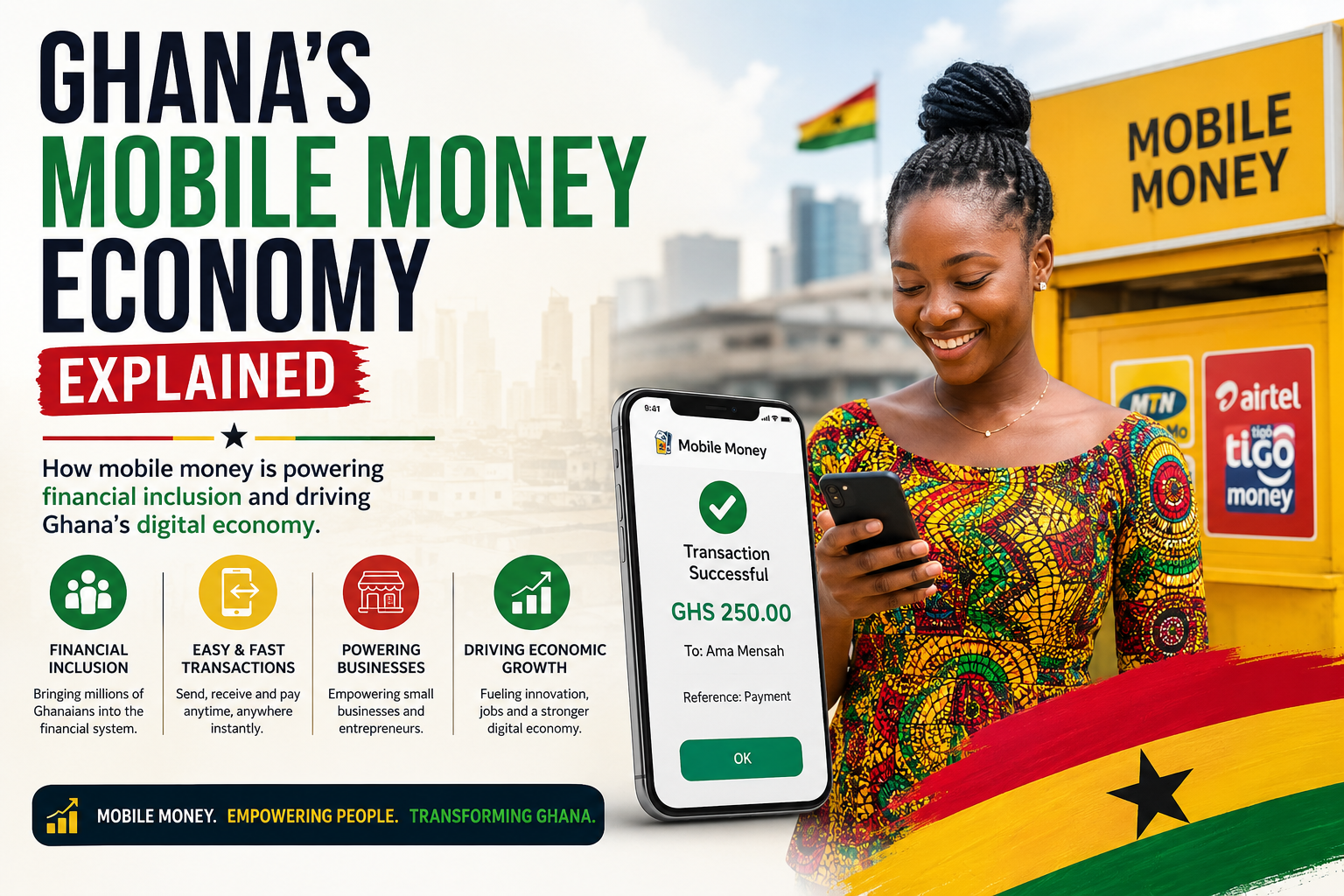

Ghana’s Mobile Money Economy Explained – Ghana’s mobile money transaction value hit GH¢4.54tn in 2025 with 26m active users. Our deep‑dive analysis reveals market structure, how MTN MoMo makes GH¢6bn in revenue, agent economics, regulatory shifts and three scenarios for the future of digital finance.
Executive Introduction
Mobile money is no longer a niche service for the unbanked in Ghana. It is the circulatory system of the entire economy. Total mobile money transaction value surged from GH¢2.7 trillion in 2024 to GH¢4.54 trillion in 2025, a 53.8 per cent increase, while monthly transaction volumes peaked at 967 million in April 2026. By April 2026, registered accounts reached 83.0 million, and 26.0 million active users — those using mobile money at least once every 90 days — were transacting across the country. The scale is staggering: mobile money processes more value than cheques (GH¢36.6 billion in April 2026, less than eight per cent of mobile money’s volume), automated clearing house and even GhIPSS Instant Pay (GH¢79.0 billion), consolidating its position as Ghana’s dominant payment channel.
The financial architecture beneath these headline numbers is complex, concentrated and fiercely contested. At the top sits MTN MoMo, whose subsidiary MobileMoney Limited (MML) reported revenue of GH¢6.0 billion in 2025, a 35.7 per cent increase, driven by 19.3 million active users and accelerated by the abolition of the E‑Levy in April 2025. MTN MoMo now accounts for about 25 per cent of MTN Ghana’s total service revenue of GH¢24.4 billion. Advanced services — merchant payments, digital lending, savings and insurance — grew 55.9 per cent to GH¢2.0 billion in 2025, reflecting a strategic pivot from basic transfers to a full‑fledged digital financial ecosystem.
📢 GET DETAILED ARTICLES + JOBS
Join THSB's WhatsApp Channel and never miss a post or opportunity.
At the bottom of the profit chain are the agents. Registered agents reached 992,000, with active agents rising to 534,000. The agent‑squeeze remains acute: agents are paid fixed, often low commissions for cash‑out and cash‑in services, yet bear the burden of liquidity management, fraud and the cost of armed robbery. Agent liquidity shortages are the primary cause of agent inactivity; the number of active agents has fallen from peaks above 600,000 to 453,000 as of October 2025.

This profile explains the entire mobile money value chain: how the system works, who the major players are, how revenue is generated, how regulators are responding, what risks threaten the ecosystem, and what the future holds as Ghana builds toward a cash‑lite economy. Mobile money is no longer an alternative to formal finance — it is the formal finance for millions of Ghanaians.
The Market at a Glance — GH¢4.54 Trillion and 83 Million Accounts
The sheer scale of Ghana’s mobile money ecosystem is difficult to overstate.
- Total Annual Transaction Value (2025): GH¢4.1 trillion (53.8% increase from GH¢2.7 trillion in 2024).
- Full‑Year 2025 Value (BoG Data): GH¢4.54 trillion (up from GH¢3.02 trillion in 2024).
- Monthly Transaction Value (April 2026): GH¢493.2 billion, representing a 35.1 per cent year‑on‑year increase.
- December 2025 Peak: GH¢518.4 billion, driven by festive spending.
- Registered Accounts (April 2026): 83.0 million.
- Active Accounts (90‑day window): 26.0 million.
- Active Monthly Users: Approximately 24.5 million users participate in digital transactions monthly.
- Monthly Transaction Volume (April 2026): 967 million (up from 778 million in April 2025).
The agent network, the physical backbone of the system, expanded to 992,000 registered agents and 534,000 active agents by April 2026. The decline in active agents relative to registered agents (from earlier peaks above 600,000 to 453,000 in October 2025) suggests profitability concerns and liquidity shortages remain significant constraints.
Wallet Balances on Float reached GH¢36.7 billion in April 2026 (up from GH¢28.2 billion a year earlier), indicating a profound shift in consumer behaviour: mobile wallets are increasingly treated as short‑term savings instruments, not merely payment conduits. The float — funds held in trust accounts in commercial banks — rose to GH¢39.6 billion at end‑2025.
Interoperability — the ability to transfer money across different mobile money networks — has gained momentum but remains a small fraction of total value. Interoperability transaction value rose from GH¢4.0 billion to GH¢5.8 billion in April 2026, with volumes climbing from 23.1 million to 31.7 million. However, interoperability accounts for only about 1 per cent of total transaction value, indicating most activity remains within walled‑garden networks.
How It All Works — The Three Pillars
The mobile money system in Ghana is built on three interconnected pillars: the technology platform (mobile wallets, USSD, apps), the agent network (physical cash‑in/cash‑out points) and the float system (trust accounts backing electronic value).
Wallets are stored‑value accounts accessible via SIM toolkit (USSD) on any mobile phone, regardless of smartphone ownership. The system is fully integrated with the Bank of Ghana’s payments architecture via GhIPSS.
Agents are the human interface. They convert cash into e‑value and e‑value into cash. A customer gives cash to an agent, the agent credits the customer’s mobile wallet (cash‑in). Conversely, a customer can withdraw cash by debiting their wallet, and the agent pays out physical cash (cash‑out). This two‑way conversion is what gives mobile money its “cash‑in, cash‑out” utility, bridging digital and physical currency. The Agent Commission Structure (MTN, 2024–2025) is as follows:
- Cash‑out: GH¢0.20 for amounts under GH¢50; 0.4 per cent for transactions between GH¢50 and GH¢2,000; flat GH¢8 for amounts above GH¢2,000.
- Cash‑in: Agents earn a small percentage (typically 0.25–0.5 per cent).
- Bill payments and airtime: Additional commissions.
Float is the total value of funds held in mobile money wallets. Under the Payment Systems and Services Act, 2019 (Act 987), mobile money operators are required to hold trust accounts with licensed banks, ensuring every cedi of electronic value is backed by actual cash deposits. Shaibu Haruna, CEO of MobileMoney Limited, explained: “Every single customer’s account is associated with a bank bin, which is the escrow that holds the funds”. The float is currently held across 22 partner banks.
The Bank of Ghana is currently undertaking a comprehensive review of the modalities governing the management of mobile money float accounts held by authorised universal banks, seeking industry input to strengthen the framework.
The Money Flows — Revenue Models and Profit Pools
Mobile money generates profit through five primary channels. Understanding these is essential to understanding who really profits.
1. Transaction Fees (Cash‑Out Dominant, but Declining) — Historically, cash‑out fees contributed the largest share of revenue, but the mix is shifting. In 2025, MTN MoMo’s advanced services (digital payments, merchant transactions, mobile lending) grew 55.9 per cent to GH¢2.0 billion, while basic services grew 27.2 per cent.
2. Float Income (The Silent Profit Engine) — Mobile money operators earn interest on the float held in trust accounts. With customer wallet balances reaching GH¢39.6 billion, the interest income is substantial — and mostly invisible to users. The BoG’s ongoing float management review could reshape where this income flows.
3. Lending and Credit Products — Mobile lending is emerging as a high‑margin revenue stream. AT Money focuses on micro‑lending, offering small loans with quick approvals. MTN MoMo’s advanced services segment, which includes lending, grew 55.9 per cent to GH¢2 billion in 2025, signalling strong demand for digital credit.
4. Merchant and Business Services — As more businesses accept mobile money payments, platform owners earn merchant discount rates on every transaction. The shift away from cash withdrawals toward merchant payments is accelerating: withdrawals’ share of revenue dropped from 51.2 per cent to 45.6 per cent in 2025, while merchant and advanced services gained ground.
5. International Remittances — Cross‑border money transfers into mobile wallets are a growing revenue line, with revised inward remittance guidelines issued in August 2025 setting stricter settlement and compliance obligations but also formalising the role of mobile money operators in the international payments chain.
The Players — MTN MoMo, Telecel Cash and AT Money
The market structure is highly concentrated. By Q2 2025, MTN held 73.67 per cent of total mobile subscriptions, Telecel 18.57 per cent and AT Ghana 7.93 per cent. MTN’s data market share stood at 81.29 per cent by February 2026.
MTN Ghana (MoMo) is the undisputed market leader. In 2025, its MoMo revenue reached GH¢6.0 billion, a 35.7 per cent year‑on‑year increase. Active MoMo users grew 12.3 per cent to 19.3 million. MTN MoMo’s revenue now contributes about 25 per cent of MTN Ghana’s total service revenue of GH¢24.4 billion. MTN Ghana’s profit after tax for the full 2025 fiscal year surged 55.9 per cent to GH¢7.8 billion. In April 2026, MTN completed the spin‑off of its Ghana MoMo business into a standalone fintech entity, operated by MobileMoney Fintech LTD (MMFL), with ownership structure of 70 per cent MTN Dutch Holdings B.V. and 30 per cent MTN Ghana Fintech Trust to meet local ownership requirements.
Telecel Cash (formerly Vodafone Cash) has maintained a relatively stable second position with about 15 per cent market share in 2025, supported by network investments and subscriber growth. Telecel has enabled Google Play payments in Ghana and is actively expanding its micro‑lending offerings.
AT Money (formerly AirtelTigo Money) is the struggling third player. AT Ghana’s market share has sharply declined, prompting the government to negotiate a sale of a 60 per cent stake to Canadian firm Rektron Group and local partner Afritel to inject fresh capital.
The Agent Squeeze — Profit at the Margins
If MTN MoMo is the undisputed profit champion, agents are the foot soldiers — and the economics of being an agent are increasingly grim. Registered agents reached 992,000 by April 2026, but active agents stood at just 534,000 — an active rate of 54 per cent, down from 65 per cent in June 2024. Average daily earnings for a high‑volume agent range from GH¢50–200; for a low‑volume agent, GH¢20–50; average monthly earnings range from GH¢1,500 to GH¢6,000+. Agents face liquidity management costs, fraud, armed robbery and fixed commissions from telcos, with little bargaining power. Agent liquidity shortages remain the primary cause of agent inactivity, leaving businesses in some areas without a nearby agent to facilitate cash‑in/cash‑out services.
Profitability Deep Dive — The E‑Levy Repeal Effect
The abolition of the Electronic Transfer Levy (E‑Levy) on 2 April 2025 has had a measurable impact on the industry. MTN MoMo revenue from basic services (cash‑in/cash‑out, P2P transfers, standard merchant payments) grew by 27.2 per cent year‑on‑year, largely driven by increased transfer volumes following the removal of the tax disincentive. Monthly mobile money transactions surged to GH¢518.4 billion in December 2025, with peer‑to‑peer transfers increasing their contribution to MTN MoMo’s revenue from 28.9 per cent to 33.7 per cent, as customers returned to the platform after the levy was scrapped.
Innovations and the Regulatory Frontier
The next wave of mobile money growth will not come from basic transfers. The Bank of Ghana is actively positioning digital finance as a development tool. Governor Dr Johnson Pandit Asiama has stated: “The next phase of digital finance will not be defined by payments alone. Across our markets, the basic payment infrastructure is increasingly in place. The opportunity now lies in building the next layer of value”. Key regulatory initiatives include:
- Open Banking Frameworks by end‑2026, enabling third‑party fintechs to access customer data (with consent) and offer competing services.
- Digital Credit Regulations formalising the lending market.
- Cyber and Information Security Directive (CISD 2026) extending regulatory coverage to fintechs and payment service providers.
- GhanaPay: The bank‑owned digital wallet launched in January 2026 offering zero peer‑to‑peer transfer fees, direct bank account linkage, and features no telco wallet can match, with over one million active subscribers.
Challenges and Risks
The mobile money sector faces significant headwinds. Agent Profitability and Sustainability is a crisis: active agents have dropped from peaks above 600,000 to 453,000 due to liquidity shortages and thin margins. Cyber Fraud and Security is a mounting threat: the Cybercrime Unit recorded 7,250 cases of mobile money fraud in 2023 alone; cyber fraud losses rose from GH¢2.4 million in Q1 2024 to GH¢14.94 million in H1 2025. Interoperability Gaps persist: cross‑network transfers account for only about 1 per cent of transaction value, limiting competition. Regulatory Uncertainty from the BoG’s float management review and potential open banking frameworks creates compliance costs. Competition from Beyond — banks, GhanaPay, and pan‑African fintechs — could reshape market shares.
Future Outlook — Three Scenarios for Ghana’s Mobile Money Economy
Scenario One: Gradual Expansion (65 per cent probability)
Mobile money revenue continues to grow at 15‑20 per cent annually, driven by basic transfers and modest advanced services uptake. Agent profitability remains a structural problem. Interoperability remains low (under 5% of value). Ghana’s financial inclusion rate reaches 85‑88 per cent.
Scenario Two: Accelerated Breakthrough (25 per cent probability)
Open banking and GhanaPay succeed in creating genuine competition; merchant payments and lending services grow at 30‑40 per cent annually; agent profitability improves through diversified revenue; financial inclusion reaches 90+ per cent.
Scenario Three: Stagnation and Fraud Erosion (10 per cent probability)
A major fraud incident erodes trust; regulators impose stricter controls; agent activity collapses; penetration stalls as users revert to cash.
Conclusion — The Unfinished Business of Inclusion
Ghana’s mobile money economy is a paradox of extraordinary scale and persistent exclusion. GH¢4.54 trillion in annual transactions, 83 million registered accounts, 26 million active users — these are numbers that would have been unimaginable a decade ago. Yet the gap between registered and active accounts (83 million vs 26 million) reminds us that not every account is being used. The active agent base of 534,000, down from earlier peaks, suggests that the physical backbone of the system is under strain. And interoperability remains stuck at about 1 per cent of transaction value.
The mobile money economy in Ghana is thriving. But for the profits to be more evenly shared — between telcos, agents, and the millions of Ghanaians who rely on the system daily — the next phase must focus on competition, interoperability, agent sustainability, and building the value‑added services that will turn a payments platform into a financial ecosystem. The infrastructure is in place. The users are ready. The unfinished business is making the system work for everyone, not just for the platform that controls the rules.
Quick Facts Box
table_20260531Ghana’s Mobile Money Economy Explained — GH¢4.54 Trillion, 26 Million Active Users, and the Battle for Digital Financial Dominance
Frequently Asked Questions (FAQ)
Q1: How big is Ghana’s mobile money economy?
Total mobile money transaction value in 2025 reached GH¢4.54 trillion, up from GH¢3.02 trillion in 2024. In April 2026 alone, transaction value hit GH¢493.2 billion across 967 million transactions.
Q2: Who are the main mobile money providers in Ghana?
Three operators dominate: MTN MoMo (by far the largest, with over 70 per cent of the mobile money market), Telecel Cash (formerly Vodafone Cash), and AT Money (formerly AirtelTigo Money). MTN MoMo’s active users reached 19.3 million in 2025.
Q3: How do mobile money agents make money?
Agents earn commissions on cash‑in, cash‑out, bill payments and airtime sales. Cash‑out commission structure: GH¢0.20 for amounts under GH¢50; 0.4 per cent for transactions between GH¢50 and GH¢2,000; flat GH¢8 for amounts above GH¢2,000. Many agents also supplement MoMo income with retail services.
Q4: How many mobile money agents are there in Ghana?
Registered agents reached 992,000 by April 2026, while active agents (those transacting at least once in the preceding month) stood at 534,000. The number of active agents has declined from earlier peaks, suggesting profitability challenges.
Q5: What is mobile money float?
Float is the total value of funds held in mobile money wallets at any given time. As of April 2026, float balances stood at GH¢36.7 billion. These funds are held in trust accounts in commercial banks, ensuring every cedi of electronic value is backed by actual cash deposits.
Q6: How much revenue does MTN MoMo generate?
MTN MoMo’s revenue in 2025 was GH¢6.0 billion, a 35.7 per cent year‑on‑year increase. It contributed about 25 per cent of MTN Ghana’s total service revenue of GH¢24.4 billion. Advanced services (digital payments, merchant transactions, lending) grew 55.9 per cent to GH¢2.0 billion.
Q7: What is the E‑Levy and why was it abolished?
The E‑Levy was a 1 per cent tax on electronic transfers introduced in 2022. It was officially abolished on 2 April 2025 after widespread criticism that it discouraged digital transactions and disproportionately burdened low‑income users. Its removal has boosted peer‑to‑peer transfers and overall mobile money activity.
Q8: What is interoperability in mobile money?
Interoperability allows users to transfer money across different mobile money networks (e.g., from MTN MoMo to Telecel Cash). Launched in 2018, interoperability still accounts for only about 1 per cent of total transaction value, as most activity remains within network‑specific walled gardens.
Q9: How does the Bank of Ghana regulate mobile money?
The BoG regulates mobile money primarily through the Payment Systems and Services Act, 2019 (Act 987). Key requirements include licensing for dedicated electronic money issuers (DEMIs), minimum capital of GH¢20 million, 30 per cent local equity participation, and trust account rules for float management. The BoG is currently reviewing float management rules and planning open banking frameworks.
Q10: Why does mobile money matter for financial inclusion?
Ghana’s financial inclusion rate has reached 81 per cent, driven largely by mobile money agents and basic phone‑based transactions. Mobile money has brought formal financial services to millions of previously unbanked Ghanaians, particularly in rural areas where bank branches remain scarce.
Q11: How does mobile money fraud happen?
Common fraud methods include SIM swapping (where fraudsters obtain duplicate SIM cards using forged identification documents and drain mobile money accounts), phishing attacks, fake customer service numbers, and insider collusion at mobile money operator locations. Cyber fraud losses rose from GH¢2.4 million in Q1 2024 to GH¢14.94 million in the first half of 2025.
Q12: What is the future outlook for mobile money in Ghana?
The most likely scenario is continued but slower growth, with total transaction value expected to grow at 15‑20 per cent annually through 2028. Key growth drivers include open banking frameworks, expansion of merchant payments, digital lending, and cross‑border remittances. The industry is projected to grow from $227 billion in 2025 to $770 billion by 2032, a compound annual growth rate of 19.16 per cent.
Disclaimer: Some content on The High Street Business may be aggregated, summarized, or edited from third-party sources for informational purposes. Images and media are used under fair use or royalty-free licenses. The High Street Business is a subsidiary of SamBoad Publishing under SamBoad Business Group Ltd, registered in Ghana since 2014.
For concerns or inquiries, please visit our Privacy Policy or Contact Page.

Esther Aku-Sika is a content writer and social media strategist who helps brands and startups grow through intentional storytelling and practical marketing strategies. With a keen eye for trends and audience behavior, she shares business insights, content strategies, and real-life lessons to help entrepreneurs build visibility and turn ideas into income. Through her writing, she simplifies complex concepts and equips readers with actionable steps to grow in today’s digital space.