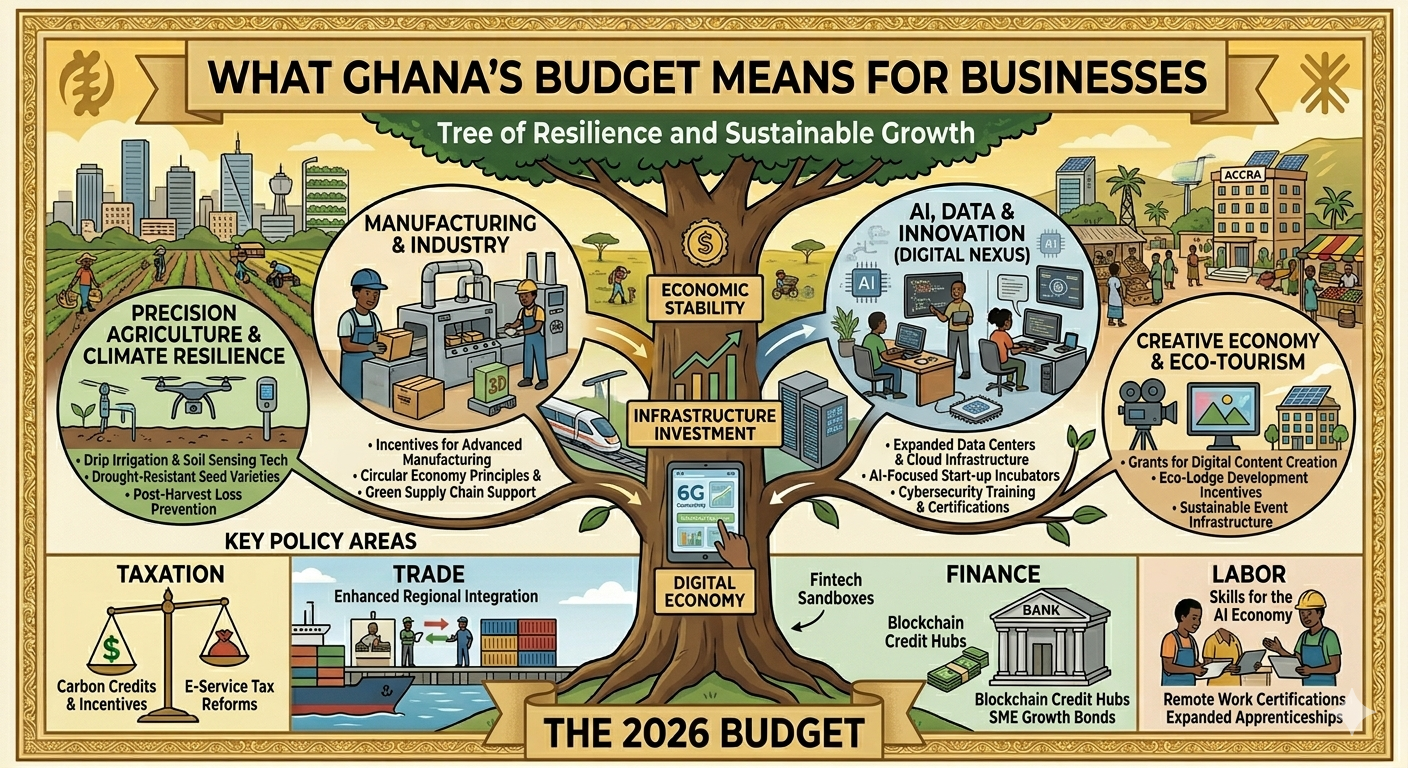






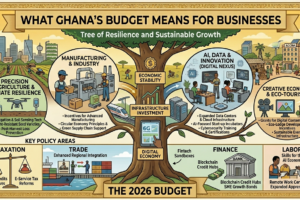

For the Ghanaian entrepreneur navigating a rapidly shifting policy environment, understanding the government’s economic direction is not optional. It is a survival and growth imperative. After a period of intense fiscal stress, the country is now embarking on what the finance minister describes as a transition “from stability you build resilience, and from resilience you build an economy that will benefit the masses” .
This High Street Business article provides a clear, analytical overview of Ghana’s current economic policies, designed for business owners who need to understand the new rules of the game.
The Macroeconomic Context: Stability First
Before diving into specific policies, it is essential to understand the starting point. Ghana has recently completed a three-year, $3 billion bailout programme with the International Monetary Fund (IMF). The government has achieved significant macroeconomic stability, with the fiscal deficit narrowing, public debt falling to around 45% of GDP, and the currency stabilizing .
📢 GET DETAILED ARTICLES + JOBS
Join THSB's WhatsApp Channel and never miss a post or opportunity.
For business owners, this stability translates into a more predictable operating environment. As the US government’s trade analysis notes, “these macro shifts reduce country risk and improve the feasibility of long-term commitments, project finance, and capital-intensive ventures” .
However, President Mahama has been clear: “stabilisation is not equal to transformation” . The government’s ambition is to move beyond stability to structural reforms, aiming to increase the manufacturing sector’s contribution to GDP from its stagnant 10% to at least 15% by 2030 .
The New Investment Framework: The GIPA Act
The most significant reform for investors is the replacement of the Ghana Investment Promotion Centre (GIPC) Act with the Ghana Investment Promotion Authority (GIPA) Act, 2026 (Act 1173) .
This represents the most comprehensive reform of Ghana’s investment regime in over a decade. For business owners, several changes are critical.
Removal of Minimum Capital Requirements
Previously, foreign investors faced blanket minimum capital requirements: US$200,000 for joint ventures and US$500,000 for wholly foreign-owned enterprises . The new Act abolishes these requirements . This opens Ghana’s investment landscape to a wider range of investors, “especially capable small and medium-sized enterprises (SMEs), technology startups and knowledge-based businesses,” where strategic expertise and intellectual property outweigh blanket capital requirements .
For trading enterprises (wholly foreign-owned or joint ventures), the minimum capital requirement has been reduced from US$1 million to US$500,000 . The previous rigid mandate to employ at least 20 skilled Ghanaians has been replaced with a more flexible workforce ratio requiring at least 75% of skilled employees to be Ghanaians .
A Stronger Institution
The transition from a “Centre” to an “Authority” is not just a name change. Act 1173 expands the institution’s mandate significantly. GIPA now has statutory responsibility to promote outward investment by Ghanaian enterprises, facilitate technology transfer, and operate a one-stop shop for investors .
The Act also establishes a statutory Investor Grievance Mechanism designed to address investor concerns before they develop into formal disputes . GIPA also serves as Ghana’s national focal institution for implementing the AfCFTA Protocol on Investment .
Citizenship by Investment
The Act introduces a provision for citizenship by investment. While the legislation does not itself establish such a programme, it mandates the creation of an appropriate legal framework in consultation with the Ministry of the Interior and in accordance with the 1992 Constitution .
The 24-Hour Economy: Ghana’s Flagship Transformation
Perhaps the most ambitious and talked-about policy is the 24-Hour Economy. President Mahama has described it as “the boldest economic transformation initiative in Ghana’s recent history” .
The initiative seeks to transform Ghana into a self-sufficient, export-led economy by promoting continuous productivity and job creation across key sectors . The 24-Hour Economy Authority Bill has been passed into law, and GHS 110 million has been committed in the 2026 Budget for its implementation .
A Performance-Based System
Crucially, access to the programme’s incentives is strictly performance-based. As the Presidential Adviser on the policy, Augustus Goosie Tanoh, explained, eligibility is tied to verifiable indicators such as employment records, electricity consumption, and participation in recognised trade associations .
“If you do those things, then you get the incentive. If you don’t do them, you don’t get the incentive. It’s not awarded for you to keep and put in your pocket,” he stated .
Tangible Incentives for Businesses
The government has proposed a range of incentives to encourage participation:
-
Tax Rebates and Export Bonuses: A mix of tax rebates, tax credits, and export bonuses designed to lower the cost of doing business and attract fresh investment .
-
Duty-Free Machinery Imports: Factories registered under the programme will be allowed to import capital equipment for expansion or retooling without paying duties and taxes . This is a direct response to private sector concerns about the high cost of importing machinery .
-
Expedited Port Services: Registered companies will be able to clear their goods within 24 hours at the port .
-
Off-Peak Electricity Tariffs: Tax rebates on electricity consumed during off-peak hours .
-
Enhanced Security: Measures to enhance security for night-shift workers .
Early Progress
The Secretariat has confirmed that 268 filling stations and 33 manufacturing companies are now running on an extended, multi-shift operational model . Joint Development Agreements worth $5.5 billion have been signed with private sector partners, and the programme targets 1.7 million decent jobs by the end of 2028 .
Tax Reforms: A More Business-Friendly Environment
The government has implemented a series of significant tax reforms. According to Mary Kwarteng Darko, an Associate Director at PwC Ghana, the overall sentiment is that “the country is taking a more balanced approach to taxation, shifting from a period of heavy tax imposition to one where the system is being rationalised, simplified, and made more business-friendly” .
Levies Abolished
Three major levies have been abolished:
-
Emissions Levy
-
COVID-19 Health Recovery Levy
These measures directly affect pricing structures and ultimately reduce the cost borne by consumers . The effective VAT rate has been reduced from approximately 21.9% to about 20% following the abolition of the COVID-19 levy and the harmonisation of VAT-related taxes .
Income Tax Reforms
Parliament has passed the Income Tax (Amendment) Bill, 2026. Key provisions include:
-
Minimum Wage Exemption: The National Daily Minimum Wage is now exempt from income tax, supporting low-income workers by increasing their disposable income .
-
Simplified Compliance for Small Businesses: The turnover threshold for the presumptive tax regime has been raised from GH¢200,000 to GH¢750,000, aligning it with the VAT registration threshold . This means more small businesses can remain under a simplified tax system, reducing compliance costs and encouraging tax registration .
Increased VAT Registration Threshold
The government has significantly raised the VAT registration threshold, which reduces compliance burdens for smaller suppliers and simplifies value chains .
The Mixed Picture
While there have been welcome reliefs, not all changes point in the same direction. The Special Import Levy and the Growth and Sustainability Levy, which were expected to expire, have both been extended to 2028 . The result, according to PwC, is “mixed business sentiments” .
The “New Economy” and the Future
Looking ahead, the government is preparing a new flagship programme known as the “New Economy.” This initiative, which is being fine-tuned for rollout in the 2027 Budget, will utilise about $1.6 billion (approximately 1% of GDP) to develop key pillars of the economy .
The goal, according to the Finance Minister, is to enable the private sector to leverage these investments for job creation . This signals a shift from government-led employment to an environment that “attract[s] the private sector to create jobs” <span class=””>.
Ghana will operate under a new Policy Coordination Instrument (PCI) arrangement with the IMF, which focuses on reforms and technical support rather than financial assistance . The economic strategy under the PCI will be built around three key stages—stability, resilience, and development, with the next phase prioritising “development initiatives capable of creating jobs and improving the living conditions of Ghanaians” .
THSB Conclusion
For business owners, Ghana’s current policy environment presents a landscape of both opportunity and adjustment. The foundation is stronger than it has been in years, with macroeconomic stability creating a more predictable environment for investment. Significant reforms, such as the GIPA Act, are lowering barriers to entry, while the 24-Hour Economy initiative offers substantial incentives for businesses willing to expand operations.
However, the policy environment is also demanding. Access to the new incentives is performance-based, requiring businesses to be structured, compliant, and ready to demonstrate their contribution to job creation and production. The transition from stability to structural reform is underway, and for the entrepreneur who understands the new rules, the rewards are there to be captured.
QUICK FACTS BOX
| Element | Detail |
|---|---|
| IMF Programme Status | Completed (Extended Credit Facility) |
| Public Debt-to-GDP | ~45% |
| GIPA Act | Replaced GIPC Act (2026) |
| Foreign Minimum Capital | Removed (Joint Ventures & Wholly Foreign) |
| VAT Effective Rate | Reduced to ~20% |
| VAT Registration Threshold | Raised (reduces compliance burden) |
| Levies Abolished | E-Levy, COVID-19 Levy, Emissions Levy |
| 24-Hour Economy Authority | Established (2025 Act) |
| 24-Hour Incentive | Duty-free machinery imports, tax rebates |
| 24-Hour Target | 1.7 million jobs by 2028 |
| Presumptive Tax Threshold | Increased to GH¢750,000 |
| Minimum Wage Tax | Exempt from income tax |
| $5.5bn | Private sector agreements under 24-Hour Economy |
FREQUENTLY ASKED QUESTIONS
1. What are the most important economic policy changes for businesses in Ghana?
The most significant changes are the GIPA Act (removing minimum capital requirements for foreign investors), the 24-Hour Economy initiative with its performance-based incentives, and major tax reforms (abolishing E-levy, reducing VAT, and increasing registration thresholds) .
2. What is the GIPA Act and how does it affect foreign investors?
The GIPA Act replaces the GIPC Act. It removes blanket minimum capital requirements for joint ventures and wholly foreign-owned enterprises, establishes a one-stop shop and investor grievance mechanism, and positions Ghana as the focal point for the AfCFTA Protocol on Investment .
3. What is the 24-Hour Economy initiative?
It is a flagship programme designed to transform Ghana into a self-sufficient, export-led economy by promoting round-the-clock productivity and job creation in agriculture, manufacturing, logistics, and services .
4. What incentives are available under the 24-Hour Economy?
Incentives include duty-free importation of machinery, tax rebates and export bonuses, expedited port clearance, off-peak electricity tax rebates, and enhanced security for night shifts .
5. What tax reforms have been implemented recently?
The government has abolished the Emissions Levy, COVID-19 Levy, and E-Levy. The effective VAT rate has been reduced to 20%. The minimum wage is now tax-exempt, and the presumptive tax threshold has been increased to GH¢750,000 .
6. What is the “New Economy” programme?
The New Economy is a planned $1.6 billion initiative to be rolled out in the 2027 Budget, designed to develop key economic pillars and enable the private sector to create jobs .
7. How has the IMF programme affected Ghana’s economy?
Ghana has successfully completed a $3 billion IMF bailout programme, achieving macroeconomic stability with reduced deficits, lower public debt, and currency stabilisation. This has improved investor confidence and created a more predictable environment for businesses <span class=””>.
8. What does the removal of minimum capital requirements mean for foreign investors?
It means the minimum investment thresholds for joint ventures (US$200,000) and wholly foreign-owned enterprises (US$500,000) no longer apply, allowing smaller and knowledge-based enterprises to enter the market more easily .
9. What is the one-stop shop for investors?
Under the GIPA Act, the Authority is mandated to operate a one-stop shop to promote, facilitate, and regulate investments, reducing bureaucratic bottlenecks and providing a more efficient experience for investors .
10. How does the government plan to tackle the cost of energy?
President Mahama has described energy costs as the single most dominant constraint. Reforms include expanding renewable energy, introducing differentiated off-peak industrial tariffs, promoting embedded generation, and restructuring energy sector debt .
11. What is the presumptive tax regime and how has it changed?
The presumptive tax regime is a simplified tax system for small businesses in the informal sector based on turnover rather than detailed profit calculations. The threshold has been increased from GH¢200,000 to GH¢750,000, allowing more small businesses to benefit from simpler compliance .
12. What is the government’s target for manufacturing?
The government aims to increase the manufacturing sector’s contribution to GDP from its current 10% to at least 15% by 2030 .
13. What is citizenship-by-investment?
The GIPA Act introduces a provision for citizenship-by-investment, mandating the establishment of a legal framework in consultation with the Ministry of the Interior and in accordance with the Constitution .
14. How is the 24-Hour Economy being funded?
The programme is largely funded by private capital. The Secretariat has announced Joint Development Agreements worth $5.5 billion with private sector partners . The government’s role is focused on coordination, project preparation, and viability gap financing .
15. What is the minimum wage tax exemption?
The Income Tax (Amendment) Bill, 2026, exempts the National Daily Minimum Wage from income tax, providing meaningful tax relief to low-income earners and increasing their disposable income
Source: The High Street Business
Disclaimer: Some content on The High Street Business may be aggregated, summarized, or edited from third-party sources for informational purposes. Images and media are used under fair use or royalty-free licenses. The High Street Business is a subsidiary of SamBoad Publishing under SamBoad Business Group Ltd, registered in Ghana since 2014.
For concerns or inquiries, please visit our Privacy Policy or Contact Page.

Samuel Kwame Boadu is a Ghanaian entrepreneur, writer, and digital consultant passionate about creating impactful stories and business solutions. He is the Founder & CEO of SamBoad Business Group Ltd, a dynamic company with subsidiaries in digital marketing, logistics, publishing, and risk management.