





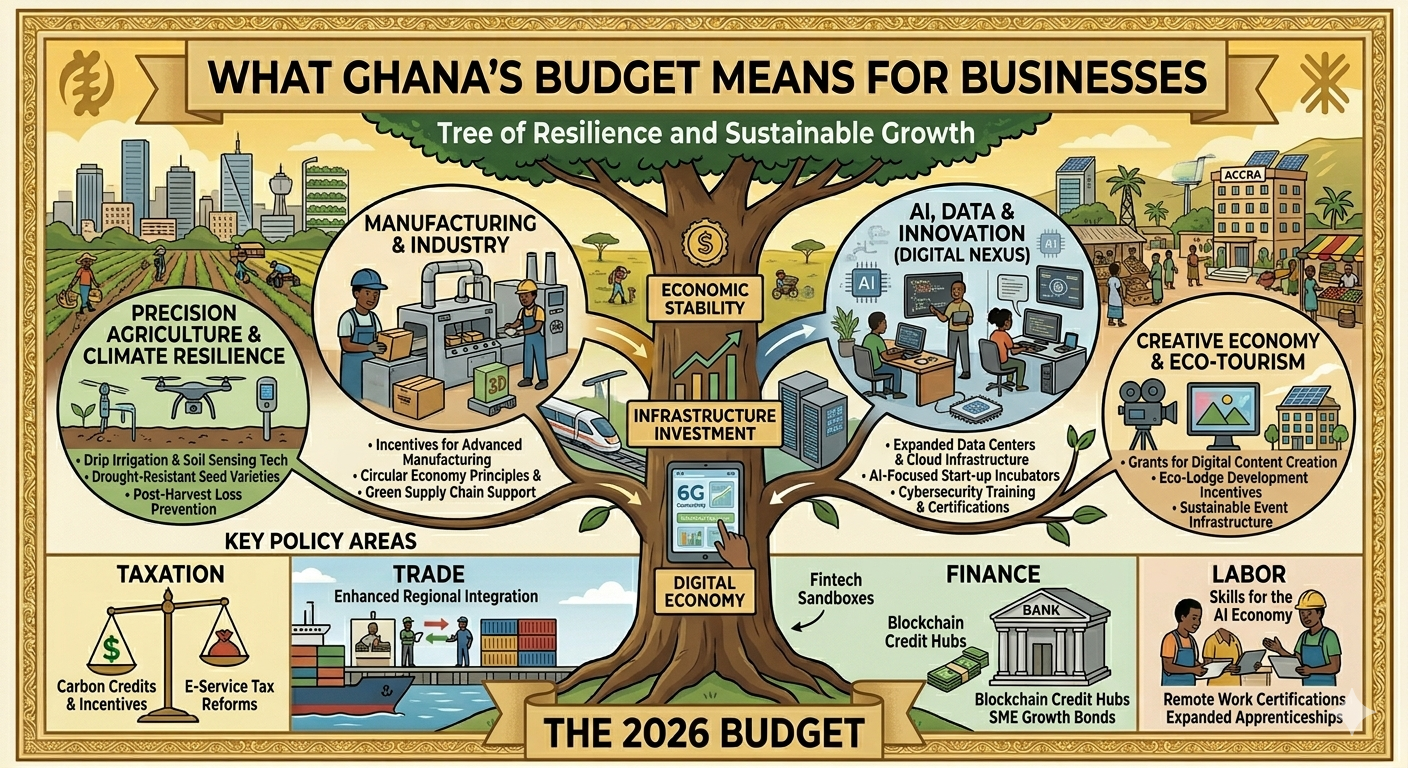
For the Ghanaian entrepreneur and investor, the 2026 Budget represents a decisive pivot. After years of fiscal stress, high inflation, and an often-burdensome tax regime, the government has signaled a clear shift toward stability, relief, and a more business-friendly operating environment .
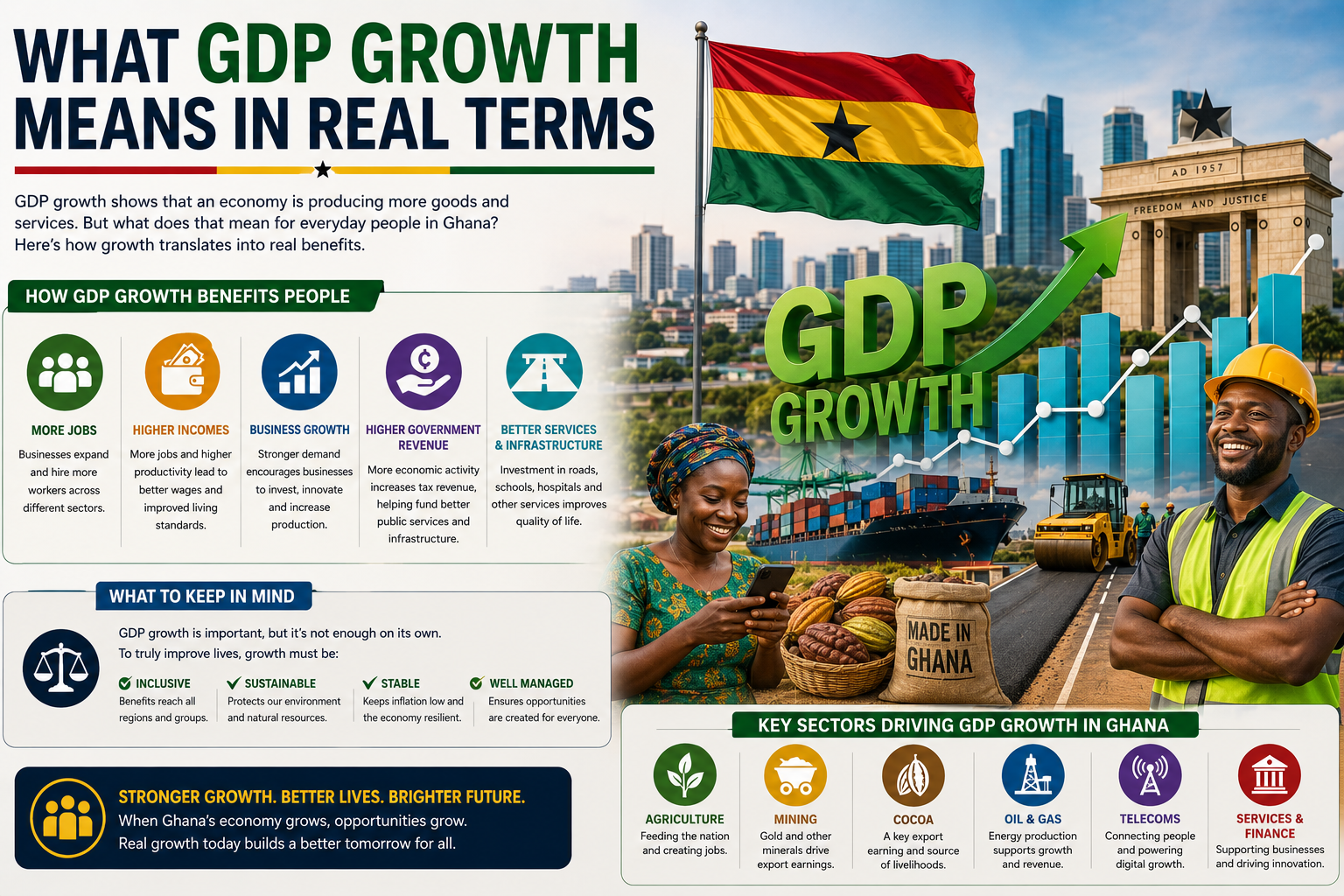
The numbers tell the story: inflation is down to single digits, the cedi has strengthened, and public debt has fallen to about 45 percent of GDP . The budget, themed “Resetting for Growth, Jobs, and Economic Transformation,” is designed to consolidate these gains while creating tangible relief for businesses . For the first time in years, the private sector is being positioned as the primary engine of job creation rather than an afterthought to government spending .
The Tax Reforms: Relief Where It Matters
At the heart of the 2026 Budget is a comprehensive tax reform package projected to inject approximately GH¢6 billion back into the pockets of businesses and households . For many enterprises, the cumulative effect of these changes could be transformative.
📢 GET DETAILED ARTICLES + JOBS
Join THSB's WhatsApp Channel and never miss a post or opportunity.
The Numbers That Matter
The government has abolished the COVID-19 Health Recovery Levy, a 1 percent charge on goods and services that had become a permanent fixture of the tax system. This alone is projected to return GH¢3.7 billion to individuals and businesses in 2026 . The effective VAT rate has been reduced from 21.9 percent to 20 percent, leaving more income in the hands of consumers and businesses .
Perhaps most significantly for small and medium enterprises, the VAT registration threshold has been raised from GH¢200,000 to GH¢750,000 . For the thousands of micro and small businesses that were previously required to register, this removes a significant compliance burden and allows owners to focus their resources on expansion rather than tax administration.
The reforms also allow businesses to claim full input tax deductions on the National Health Insurance Levy (NHIL) and Ghana Education Trust Fund (GETFund) levies—a policy expected to cut operating costs by approximately five percent . This eliminates the cascading effect that had made Ghana’s VAT system a hidden burden on production.
What the Experts Say
The Ghana Revenue Authority has described the VAT reforms as “the backbone of a broader government strategy to use tax policy as a catalyst for business expansion, revenue mobilisation, and nationwide economic transformation” . The President of the Ghana National Chamber of Commerce and Industry, while welcoming the measures, has urged the government to broaden cost-cutting measures for productive sectors and reduce corporate taxes further . The Chamber noted that the effectiveness of these measures will depend greatly on implementation and the extent to which they ease the cost of doing business in Ghana.
The 24-Hour Economy: A New Frontier
The government’s flagship policy is the 24-Hour Economy, now enshrined in law following the passage of the 24-Hour Economy Authority Bill . The initiative seeks to transform Ghana into a self-sufficient, export-led economy by promoting continuous productivity and job creation across key sectors .
What Businesses Stand to Gain
The government has committed GHS 110 million in the 2026 Budget to implement the initiative . The incentives are designed to be tangible and attractive:
-
Duty- and tax-free importation of equipment for expansion or retooling of factories
-
Tax rebates on electricity consumed during off-peak hours
-
Enhanced security for night-shift workers
-
Strategic partnerships with the Development Bank of Ghana and the Ghana Investment Infrastructure Fund
The initiative is expected to generate approximately 1.7 million jobs and reduce reliance on imports . For businesses willing to adopt multi-shift operations, the programme offers a pathway to scale while benefiting from substantial cost reductions.
The Sectoral Implications
Manufacturing and Agribusiness
The Feed the Industry Programme is designed to link agriculture to manufacturing, with the goal of ensuring factories operate at 70–80 percent capacity instead of the current 30–40 percent . This represents a significant opportunity for agribusinesses and manufacturers to access reliable supply chains and expand production.
The government has allocated GH¢200 million for the Buffer Stock Company to purchase rice, chicken, maize, and other foodstuffs from Ghanaian producers , providing a guaranteed market for local farmers.
Infrastructure and Construction
The budget preserves space for strategic public investment, with priority spending in infrastructure, agriculture, health, and education . GH¢4.2 billion has been allocated for the Free Senior High School programme, and GH¢2 billion will build 200 new junior high schools, 200 primary schools, and 200 kindergarten schools .
The Minister of Roads and Highways has been presenting the 2026 performance targets of his Ministry, indicating a continued focus on infrastructure development . For construction firms, this represents a steady pipeline of public contracts.
The Automobile Sector: A Cautionary Tale
Not all businesses have benefited from the 2026 Budget. The Automobile Assemblers Association of Ghana has raised serious concerns about the removal of key tax incentives that supported the local vehicle assembly industry .
The 2026 Budget eliminated the 20 percent VAT exemption on applicable duties for locally assembled vehicles, a move the Association warns could undermine the viability of Ghana’s growing vehicle assembly sector . The AAAG President, Jeffrey Oppong Peprah, warned that “the business case for local assembly is no longer viable” and that the industry could face:
-
Loss of more than 400 skilled engineering jobs
-
Closure of seven assembly plants
-
Reputational damage to Ghana as an investment destination
The Association estimates that members have collectively invested nearly €80 million in equipment, assembly facilities, and workforce development . The government is facing calls to urgently restore the VAT exemption or introduce a temporary duty increase on imported vehicles as a stop-gap measure.
Fiscal Discipline and the Macroeconomic Context
The government has anchored the budget in a commitment to fiscal discipline. A primary surplus of 1.5 percent of GDP is now a statutory requirement, and debt-to-GDP is capped at 45 percent by 2034/35 . These reforms, combined with procurement reforms mandating electronic platforms for transparency, are designed to reduce country risk and improve the feasibility of long-term business commitments .
The macroeconomic achievements are significant:
-
Inflation returned to single digits by October 2025
-
The cedi appreciated by approximately 34 percent
-
Public debt fell from 68.9 percent to 45 percent of GDP
For businesses, these macro shifts translate into a more predictable operating environment and lower financing costs.
Challenges and Concerns
Implementation
The Chamber of Commerce has stressed that the effectiveness of the budget measures will depend greatly on implementation . As the 24-Hour Economy initiative moves from planning to action, businesses are watching closely to see whether the promised incentives materialize.
The Industry-Specific Impact
The experience of the automobile assembly industry highlights the complexity of tax reform. While the budget provides broad relief, some sectors have been adversely affected by the removal of specific incentives . The government will need to monitor these unintended consequences and consider targeted interventions.
Corporate Taxes Remain High
Despite the tax reforms, corporate income tax remains at 25 percent, and the Ghana National Chamber of Commerce has called for reductions . For businesses operating in a competitive regional environment, this remains a consideration.
THSB Conclusion
The 2026 Budget represents one of the most significant shifts in Ghana’s economic policy in recent years. It is unapologetically pro-business, pro-jobs, and pro-reform . The VAT reforms alone are expected to return nearly GH¢6 billion to businesses and households, providing much-needed liquidity and stimulus.
Yet the budget’s success will ultimately be measured by implementation. For the entrepreneur, the opportunity is clear: lower compliance burdens, strategic incentives for growth, and a more predictable operating environment. But as the Chamber of Commerce has noted, these measures must translate into tangible outcomes for Ghanaian enterprises .
The 24-Hour Economy offers a new frontier for businesses willing to expand operations. The Feed the Industry Programme opens doors for agribusinesses and manufacturers. And the fiscal discipline provides a foundation for long-term confidence.
The budget has laid the foundation. The challenge now is to turn these gains into lasting productivity improvements and decent jobs . For the business owner who understands the new rules of the game, the rewards are there to be captured.
QUICK FACTS BOX
| Element | Detail |
|---|---|
| Budget Theme | Resetting for Growth, Jobs, and Economic Transformation” |
| Tax Relief Package | ~GH¢6 billion returned to businesses and households |
| COVID-19 Levy | Abolished (returns GH¢3.7 billion) |
| Effective VAT Rate | Reduced from 21.9% to 20% |
| VAT Registration Threshold | Increased from GH¢200,000 to GH¢750,000 |
| Input Tax Deductibility | Restored for NHIL and GETFund levies |
| 24-Hour Economy Allocation | GH¢110 million |
| 24-Hour Economy Jobs Target | ~1.7 million jobs |
| Feed the Industry Programme | Targets factory capacity of 70-80% |
| Primary Surplus Target | 1.5% of GDP |
| Debt-to-GDP Cap | 45% |
| Public Debt Reduction | From 68.9% to 45% of GDP |
| Inflation Target | 8% by end of 2026 |
| GDP Growth Target | 4.8% in 2026 |
| GH¢4.2bn | Allocation for Free SHS programme |
| GH¢2bn | Allocation for new school infrastructure |
| GH¢200m | Allocation for Buffer Stock Company purchases |
| GH¢110m | Allocation for 24-Hour Economy implementation |
| GH¢401m | Allocation to Women’s Development Bank |
FREQUENTLY ASKED QUESTIONS
1. What are the main tax reforms in Ghana’s 2026 Budget?
The main reforms include: abolishing the COVID-19 Health Recovery Levy, reducing the effective VAT rate from 21.9% to 20%, raising the VAT registration threshold from GH¢200,000 to GH¢750,000, and allowing full input tax deductions for NHIL and GETFund levies . Together, these measures are projected to return nearly GH¢6 billion to businesses and households in 2026 .
2. How does the VAT threshold increase affect small businesses?
The threshold increase from GH¢200,000 to GH¢750,000 removes the tax compliance burden from thousands of micro and small businesses, allowing them to focus on expansion and employment rather than tax administration . Businesses below the threshold are no longer required to register for VAT.
3. What is the 24-Hour Economy and how can my business benefit?
The 24-Hour Economy is a flagship initiative designed to promote round-the-clock economic activity in agriculture, manufacturing, logistics, and services. Benefits include duty- and tax-free importation of equipment for expansion, tax rebates on off-peak electricity consumption, enhanced security for night workers, and strategic partnerships with the Development Bank of Ghana . The initiative has a GH¢110 million allocation and targets 1.7 million jobs .
4. How much tax relief is the government providing?
The government expects the combined VAT reforms to return nearly GH¢6 billion to businesses and households in 2026. The abolition of the COVID-19 levy alone injects GH¢3.7 billion back into the economy .
5. What is the Feed the Industry Programme?
The Feed the Industry Programme is designed to link agriculture to manufacturing, aiming to ensure factories operate at 70–80 percent capacity instead of the current 30–40 percent . It includes the Oil Palm Development Policy and agro-processing plants for cashew, rice, poultry, and shea.
6. How does the 2026 Budget affect the automobile assembly industry?
The budget removed the 20% VAT exemption on applicable duties for locally assembled vehicles, a change that the Automobile Assemblers Association warns could lead to the loss of over 400 skilled jobs, the closure of seven assembly plants, and nearly €80 million in threatened investments . The Association is urging the government to restore the exemption.
7. What are the fiscal discipline measures in the budget?
The government has established a primary surplus target of 1.5% of GDP and capped debt-to-GDP at 45% by 2034/35. Procurement reforms mandate electronic platforms for transparency . Public debt has already fallen from 68.9% to 45% of GDP .
8. What is the economic outlook for 2026?
The government targets GDP growth of 4.8% and inflation at 8.0% in 2026 . Inflation returned to single digits in October 2025, the cedi appreciated significantly, and public debt has been reduced . These gains are expected to create a more predictable environment for businesses .
9. What is the Women’s Development Bank allocation?
The budget allocated GH¢401 million to the Women’s Development Bank, supporting female entrepreneurship .
10. How can I access 24-Hour Economy incentives?
The 24-Hour Economy is being implemented through the 24-Hour Economy Authority. Businesses can expect incentives including duty- and tax-free equipment imports, tax rebates for off-peak electricity consumption, and strategic partnerships with the Development Bank of Ghana and Ghana Infrastructure Investment Fund . Details on application procedures are expected as the Authority becomes operational.
11. What is the government’s investment in education in the 2026 Budget?
The budget allocates GH¢4.2 billion for Free SHS, GH¢2 billion to build 200 new junior high schools, 200 primary schools, and 200 kindergarten schools, and GH¢400 million for teacher bungalows in rural areas .
12. What are the employment targets in the 2026 Budget?
The government targets over 800,000 jobs in 2026 through infrastructure projects, TVET expansion, and the 24-Hour Economy initiative . Allocations include GH¢170 million for apprenticeships and GH¢110 million for round-the-clock operations
Source: The High Street Business
Disclaimer: Some content on The High Street Business may be aggregated, summarized, or edited from third-party sources for informational purposes. Images and media are used under fair use or royalty-free licenses. The High Street Business is a subsidiary of SamBoad Publishing under SamBoad Business Group Ltd, registered in Ghana since 2014.
For concerns or inquiries, please visit our Privacy Policy or Contact Page.

Samuel Kwame Boadu is a Ghanaian entrepreneur, writer, and digital consultant passionate about creating impactful stories and business solutions. He is the Founder & CEO of SamBoad Business Group Ltd, a dynamic company with subsidiaries in digital marketing, logistics, publishing, and risk management.