










MTN Ghana Mobile Money Dominance: 19.3 Million Users, GH¢6 Billion Revenue and Africa’s Digital Finance Blueprint – Why MTN Ghana controls 70%+ of mobile money market. In-depth analysis of MoMo’s business model, flywheel effect, digital banking ambitions and risks. Essential reading for investors.
Executive Introduction
In February 2009, when MTN Ghana launched a service allowing subscribers to send money via text message, few predicted it would become the most consequential financial innovation in the country since the introduction of the cedi. Seventeen years later, MTN Mobile Money—better known as MoMo—has transcended its telecom origins to become a financial infrastructure upon which millions of Ghanaians depend.
The numbers are staggering. As of December 2025, MTN MoMo served 19.3 million active users, a 12.3 per cent increase year-on-year. Mobile money revenue rose 35.7 per cent to GH¢6.0 billion, accounting for nearly a quarter of MTN Ghana’s total service revenue. Total transaction value surged 53.8 per cent to GH¢4.1 trillion, while the value of funds held in MoMo wallets grew 60.9 per cent to GH¢38.4 billion.
📢 GET DETAILED ARTICLES + JOBS
Join THSB's WhatsApp Channel and never miss a post or opportunity.
But market dominance in Ghana’s mobile money space is not merely a question of size. It is a question of structure. MTN has built what analysts call a “flywheel”—a self-reinforcing cycle where users purchase data with MoMo, use that data to access MoMo services, and deepen their relationship with the network with every transaction. Competitors Telecel and AT Ghana hold just 14.5 per cent and 4.2 per cent of data subscriptions respectively, and neither has a financial services product with remotely comparable scale.

This profile examines how MTN Ghana built and sustains its mobile money dominance: the business model, the regulatory manoeuvres, the competitive moat, and the risks that lie ahead. For investors, policymakers, and business leaders seeking to understand Ghana’s digital economy, MTN MoMo is not a case study. It is the case study.
Quick Facts Box
Metric Detail
- Founded 2009 (Mobile Money launch)
- Parent Company (Telecom) Scancom PLC (MTN Ghana)
- Fintech Entity MobileMoney Fintech LTD (MMFL)
- Ownership (MMFL) MTN Dutch Holdings B.V. (70%), MTN Ghana Fintech Trust (30%)
- CEO (Scancom PLC/MTN Ghana) Stephen Blewett
- CEO (MMFL/MoMo) Shaibu Haruna
- Active MoMo Users (Dec 2025) 19.3 million
- Annual MoMo Revenue (2025) GH¢6.0 billion
- Total Transaction Value (2025) GH¢4.1 trillion
- Agent Network (registered) Over 923,000
- Active Daily Agents Approximately 423,000
- Market Position Dominant, 70%+ mobile money market share
- Website: mtn.com.gh
- Key Operations P2P transfers, bill payments, merchant payments, lending, savings, insurance
Company Overview
Background and Founding
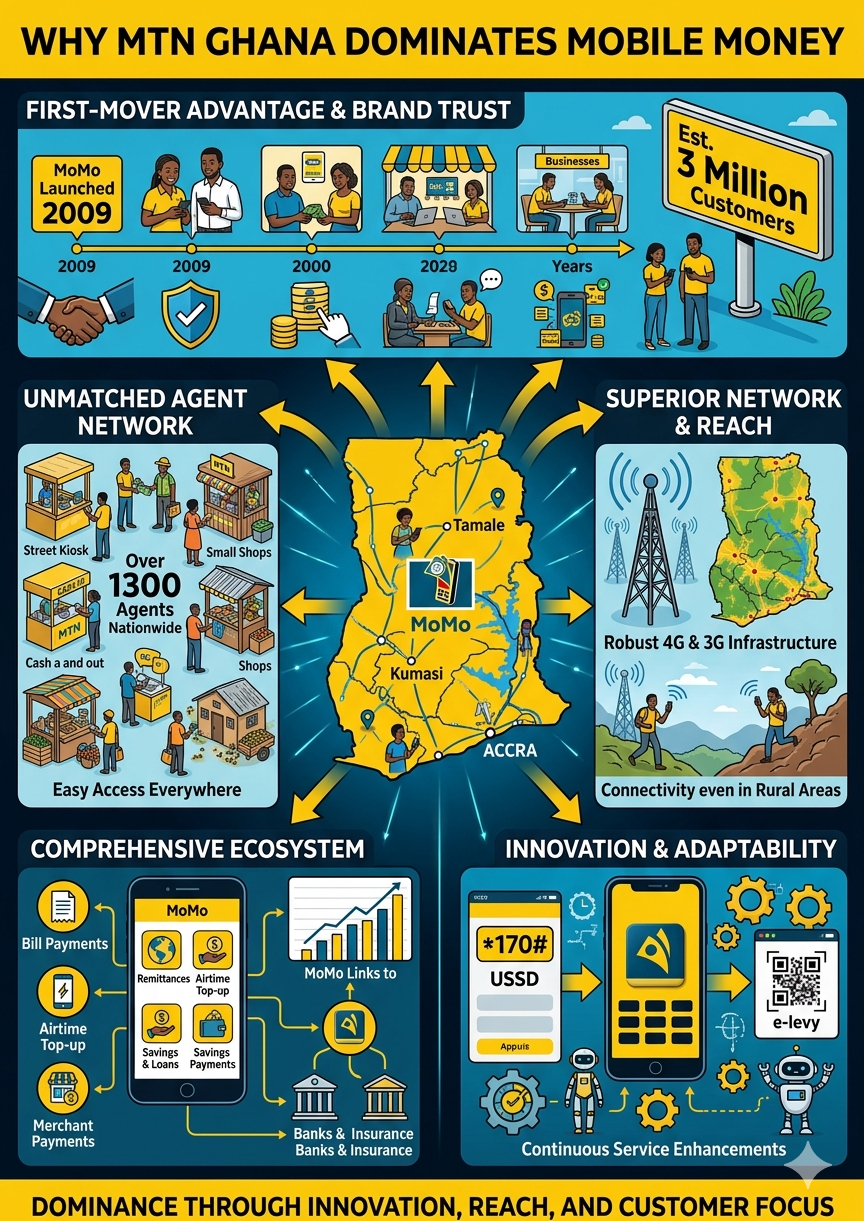
MTN Mobile Money was launched in Ghana in 2009, making the country one of the early adopters of mobile-based financial services in Africa. At the time, formal banking penetration stood below 40 per cent, leaving tens of millions of Ghanaians without access to savings, credit, or secure transaction mechanisms. The service was initially conceived as a simple person-to-person transfer tool, allowing MTN subscribers to send and receive money using their mobile phones.
What began as a telecom add-on has since evolved into a fully-fledged digital financial platform. For years, MoMo operated as a division within MTN Ghana’s telecom business, housed under a subsidiary called MobileMoney LTD. But regulatory pressure—specifically Ghana’s Payment Systems and Services Act, 2019 (Act 987)—forced a fundamental restructuring. Act 987 requires mobile money operators to be independent, well-capitalised entities with at least 30 per cent Ghanaian ownership.
Ownership Structure
On March 31, 2026, MTN Ghana completed the structural separation of its mobile money business. The transaction merged MobileMoney LTD into a newly incorporated entity, MobileMoney Fintech LTD (MMFL), which now houses all of MTN Ghana’s mobile money operations. Scancom PLC continues to operate the core telecommunications business.
Under the new structure, MMFL is owned by two shareholders: MTN Dutch Holdings B.V., a subsidiary of MTN Group, which holds a 70 per cent stake; and the MTN Ghana Fintech Trust, which holds 30 per cent. The trust was established to benefit non-MTN Group shareholders of Scancom PLC, ensuring that a portion of the economic value generated by mobile money remains within Ghanaian ownership structures. This arrangement fulfils Act 987’s localisation requirements without altering MTN Ghana’s overall shareholding structure.
The separation has profound implications. MMFL now operates as a standalone growth engine, with its own governance, reporting lines, and strategic direction. Shares in both entities remain stapled and trade as a single unit under the MTNGH ticker on the Ghana Stock Exchange, but the fintech arm can now attract dedicated investment, pursue partnerships, and—crucially—achieve a separate valuation from the telecoms business.
Core Operations and Services
MTN MoMo today offers a comprehensive suite of financial services:
- Basic Services: Cash-in/cash-out, peer-to-peer transfers, merchant payments, bill payments, airtime top-ups. In 2025, basic services revenue grew 27.2 per cent year-on-year, driven largely by increased transfer volumes following the abolition of the electronic levy.
- Advance Services: Digital payments, QR code merchant acquiring, lending solutions (micro-credit), insurance products (InsurTech), savings and investment products, BankTech services. Advanced services revenue reached GH¢2.0 billion in 2025, growing 55.9 per cent year-on-year—substantially faster than basic services.
Geographic Presence
While MTN Ghana operates exclusively within Ghana’s borders, its parent company MTN Group spans 19 markets across Africa and the Middle East. Ghana is one of MTN’s most mature and strategic mobile money markets. Together with Nigeria, the two operations account for more than 40 per cent of MTN Group’s total revenue.
Business Model
How MTN Ghana Makes Money from Mobile Money
MTN MoMo’s revenue model rests on a three-layered structure: transaction fees, float income, and advanced service fees.
Transaction fees: Every cash-in, cash-out, P2P transfer, and bill payment generates a fee, typically a small percentage of the transaction value. This is the most visible revenue stream. The abolition of the 1.5 per cent electronic transfer levy (e-levy) in 2023 significantly boosted transaction volumes, as a major friction point was removed.
Float income: MoMo holds customer funds in trust accounts. While the primary purpose is safeguarding customer deposits, the aggregated float—which reached GH¢38.4 billion by end-2025—generates interest income and provides liquidity for lending operations. This float-based model is central to mobile money economics.
Advanced service fees: Lending (interest on micro-loans), insurance (premiums), and merchant acquiring (discount rates) represent higher-margin, faster-growing revenue streams. Advanced services grew 55.9 per cent in 2025, nearly double the rate of basic services.
In 2025, MoMo contributed roughly 25 per cent of MTN Ghana’s total service revenue of GH¢24.4 billion, up from 24.9 per cent the previous year. While this share dipped marginally, the absolute growth—from GH¢4.4 billion in 2024 to GH¢6.0 billion in 2025—is undeniable.
Customer Segments
MTN MoMo serves three primary customer segments:
- Retail consumers (P2P transfers, bill payments, airtime, savings)
- Small and medium enterprises (merchant payments, working capital loans, business accounts)
- Corporate and institutional clients (bulk disbursements, payroll, government payments)
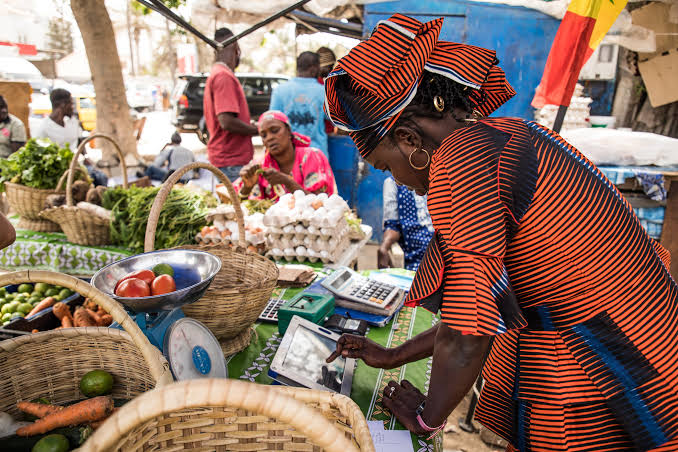
The platform is also deeply embedded in Ghana’s informal economy. Street vendors, taxi drivers, market traders, and farmers rely on MoMo for daily financial activity—many of whom were previously excluded from formal banking.
Strategic Focus Areas
The newly separated MMFL has articulated a clear strategic pivot: from access to usage. For years, the focus was on expanding registration numbers. The next phase prioritises active engagement—ensuring customers use MoMo for more than just cash-in and cash-out. This means onboarding more merchants, reducing reliance on cash-out, and creating end-to-end digital payment ecosystems where users can transact digitally from purchase to settlement.
Market Position and Competition
Industry Ranking
MTN MoMo commands an estimated 70 per cent or more of Ghana’s mobile money market share. Telecel Cash and AT Money together account for a much smaller portion of transactions and active wallets.
But the data market tells an even starker story. MTN Ghana held 81.29 per cent of Ghana’s mobile data subscriptions as of February 2026. Telecel held 14.50 per cent. AT Ghana held just 4.21 per cent.
This is not a coincidence. The two markets—data and mobile money—are deeply intertwined. MTN users buy data bundles with MoMo and use that data to access MoMo services. A subscriber considering a switch to Telecel or AT Ghana would lose access to their MoMo wallet, their transaction history, their savings, and their payment relationships. The switching cost is no longer just a question of signal quality or pricing. It is financial.
Key Competitors
- Telecel Cash: The second-largest mobile money operator, with a moderate user base concentrated in urban centres. Telecel has struggled to build a mobile money product with comparable scale to MoMo. Its data market share of 14.5 per cent provides a limited foundation for financial services growth.
- AT Money (formerly AirtelTigo): A distant third, with a small market footprint and limited agent network. The Ghanaian government has been exploring a merger between Telecel and AT Ghana to create a stronger rival to MTN, but even combined, the two would face an enormous gap in both data and mobile money market share.
- Bank-backed wallets (e.g., G-Money, various bank apps): These have found niche adoption but lack the agent network scale and telecom integration that make MoMo ubiquitous.
MTN’s position is further reinforced by the National Communications Authority’s classification of MTN as a Significant Market Power (SMP) in 2020—a designation intended to impose pricing constraints and mandatory network sharing. Five years later, MTN’s market share has not dipped below 81 per cent. Regulation has not levelled the playing field
DIGITAL STRATEGY & INNOVATION
The “MoMo Flywheel”
The most analytically significant feature of MTN MoMo is not any single product but the structural dynamic that locks in users. The flywheel works like this:
1. Users purchase MTN data bundles using MoMo.
2. They use that data to check their MoMo balance, send money, pay bills.
3. Each transaction generates data usage and transaction fee revenue.
4. The more people use MoMo, the more useful it becomes—shops accept it, friends use it, employers disburse via it.
5. Leaving MTN means leaving the MoMo ecosystem behind.
This is not network lock-in in the traditional sense—it is ecosystem lock-in. And it is why competitors cannot close the gap through better signal quality or lower prices alone.
Infrastructure Investment
MTN Ghana has backed its digital ambitions with capital. In 2025, the company deployed GHS6.4 billion in total capex, including GHS4.6 billion in ex-lease capex, focused on network expansion, capacity enhancement, IT modernisation, and digital platform support.
Looking ahead, MTN Group has committed **US1 billion invested over the previous five years. For 2026 alone, CEO Stephen Blewett committed more than US$300 million in capex focused on network expansion and digital infrastructure.
Artificial Intelligence and Fraud Mitigation
Fraud remains a significant risk for mobile money operators. MTN Ghana has acknowledged that fraud attempts naturally concentrate on its platform simply because it processes the majority of transactions. The company is deploying AI-driven tools to detect fraud patterns, while also investing in customer education campaigns such as the “Shine Your Eye” initiative to improve digital literacy and reduce social engineering scams.
MTN Group President Ralph Mupita has confirmed that AI will be used to “improve the ability to deal with scams and fraud that we see particularly in the mobile money market”.
CHALLENGES & RISKS
Regulatory Pressure
Regulation is both a challenge and, paradoxically, a moat. Act 987 forced MTN to structurally separate its mobile money business—a costly and complex process that took five years to complete. However, compliance has also localised the business, created a dedicated fintech entity, and cleared the path for the digital banking licence MTN now seeks.
More recently, the Bank of Ghana suspended a proposed 0.75 per cent fee on wallet-to-bank transfers that MTN’s MMFL had scheduled to take effect on 1 June 2026. The suspension came amid public and political pushback, highlighting the regulatory scrutiny that comes with dominant market position. CUTS International applauded the Bank of Ghana for “acting swiftly to protect consumers”.
The episode underscores a fundamental tension: MTN’s scale gives it pricing power, but that same scale invites regulatory intervention. The Bank of Ghana has made clear that dominant players will not be permitted to impose fees without consultation.
Competition
While the competitive gap is wide, it is not static. The Ghanaian government has formally announced the merger of state-owned AT Ghana with Telecel to create a stronger rival to MTN. The proposed merger would combine Telecel’s existing subscriber base with AT Ghana’s 3.2 million customers.
However, even a merged entity would face the same structural challenge: building a mobile money product from scratch while competing against a platform with 19.3 million active users and a self-reinforcing data-MoMo flywheel. As one analyst put it, the challenge “is no longer catching up on towers or spectrum. It is replicating a financial ecosystem that took years to build and now reinforces itself with every transaction”.
Macroeconomic Factors
Ghana’s macroeconomic environment has improved significantly, with inflation easing to 3.2 per cent in March 2026 from 5.4 per cent in December 2025. But currency volatility remains a risk for MTN Group’s consolidated reporting, as revenues in Ghana cedis must be translated into South African rand.
Fraud and Trust
Fraud is the Achilles’ heel of any dominant digital financial platform. MTN processes the majority of mobile money transactions in Ghana, and fraudsters naturally target the largest pool of potential victims. Public complaints about fraud are disproportionately associated with MTN MoMo, even when normalised for transaction volume.
The company has responded with AI detection systems and customer education, but trust erosion remains a real risk. A single high-profile fraud incident could shake user confidence and accelerate migration to alternative platforms.
Consumer Behaviour Shifts
MTN’s pivot from access to usage acknowledges a critical challenge: many registered MoMo users remain passive, using the service primarily for cash-in and cash-out rather than for savings, lending, or merchant payments. Deepening engagement requires not just technology but behaviour change—a notoriously difficult nut to crack.
ECONOMIC & INDUSTRY IMPACT
Tax Contribution
MTN Ghana is the country’s largest corporate taxpayer. In 2025, the company paid GHS10.5 billion in direct and indirect taxes, a 22.6 per cent increase from 2024’s GHS8.6 billion. In Q1 2026 alone, tax payments reached GHS2.8 billion.
Job Creation
The MoMo ecosystem has become a major source of employment. As of late 2025, MTN MoMo had registered over 923,000 agents, with approximately 423,000 active daily. For many young people in rural and peri-urban areas, operating as a MoMo agent represents an entry point into the formal economy.
Beyond agents, MTN Ghana remains one of the largest private sector employers in the country, both directly and indirectly. The separation of MMFL has created new roles in fintech-specific functions—lending, analytics, API management, BankTech—further deepening the company’s employment footprint.
Financial Inclusion
MTN MoMo has arguably done more for financial inclusion in Ghana than any single bank or government programme. The platform has brought millions of previously unbanked Ghanaians—particularly in rural areas—into the formal financial system. Services like credit, insurance, and savings were previously out of reach for many; today, they are available on a mobile phone.
The company has partnered with research institutions such as ReFinD at the University of Ghana to study and improve financial inclusion outcomes, particularly for underserved communities.
Industry Development
MTN’s dominance has shaped the entire fintech ecosystem in Ghana. Interoperability, mandated by the Bank of Ghana, has allowed users of different mobile money platforms to transact with one another. But interoperability works both ways: it reduces the friction of switching, potentially eroding MTN’s lock-in effect over time.
FUTURE OUTLOOK
Digital Banking Licence
The single most important development on the horizon is MTN’s pursuit of a digital banking licence. MTN Group President Ralph Mupita confirmed during a visit to Accra in February 2026 that the company is in active discussions with the Bank of Ghana.
A full digital banking licence would allow MTN to offer a significantly expanded product suite: full bank accounts, higher-value lending, investment products, and potentially even credit cards. Mupita has described digital banking as “the natural next step in deepening financial inclusion”.
The question is not whether MTN will obtain a licence, but on what terms. The Bank of Ghana will likely impose conditions—capital requirements, governance standards, and potentially limitations on cross-selling—to prevent the mobile money behemoth from capturing the entire digital banking market.
IPO on Ghana Stock Exchange
MMFL CEO Shaibu Haruna has committed to listing the mobile money business on the Ghana Stock Exchange within three to five years. “We have committed to our shareholders that within three to five years, MoMo will be listed on the local stock market so Ghanaians can buy shares in the company,” he said.
An IPO would achieve multiple objectives: it would provide a liquidity event for early investors, give Ghanaians direct ownership in the country’s most successful fintech, and—critically—further localise ownership in compliance with Act 987.
Mastercard Partnership and Valuation
MTN struck a partnership with Mastercard in 2023 that could see the payments giant take a stake in the fintech unit, potentially valuing the business at over US$5 billion. The Ghana separation is widely viewed as a test case for similar restructurings in Nigeria and Uganda, all aimed at paving the way for the Mastercard deal.
US$1.1 Billion Investment Plan
The US$1.1 billion capital commitment between 2026 and 2028 will focus on 5G rollout, network expansion, and digital infrastructure. For mobile money, this means faster, more reliable access—particularly in underserved rural areas where financial inclusion gains are most needed.
Long-Term Positioning
MTN Ghana has been elevated to the status of a third major subsidiary within the MTN Group, alongside Nigeria and South Africa—a recognition that carries significant implications for investment flows and capital allocation.
Ghana’s mobile money market is projected to grow at a CAGR of 18 per cent from 2026 to 2034, reaching US$821.98 billion by 2034. The operator best positioned to absorb that growth already holds more than four-fifths of the data market and more than two-thirds of the mobile money market.
THSB CONCLUSION
MTN Ghana’s mobile money dominance is not an accident of timing or a consequence of regulatory capture. It is the product of a structural advantage that competitors cannot easily replicate: a self-reinforcing ecosystem where data usage and financial services feed into each other, locking in 19.3 million active users.
The separation of MMFL into a standalone fintech entity marks a new chapter. Compliance with Act 987 has cleared the regulatory runway. The pursuit of a digital banking licence could transform MoMo from a payment platform into a full-service financial institution. The planned IPO would democratise ownership and further localise economic value.
But dominance brings scrutiny. The Bank of Ghana’s swift suspension of the proposed wallet-to-bank transfer fee is a reminder that regulators will act when they perceive overreach. Fraud remains an ongoing operational risk. And the government’s push to merge Telecel and AT Ghana suggests that policymakers are not content to let MTN run unopposed.
Nevertheless, the structural realities favour the incumbent. Building a mobile money ecosystem from scratch is no longer a matter of capital—it is a matter of time, trust, and network effects. MTN has a seventeen-year head start. Competitors are not just catching up on technology; they are catching up on human behaviour.
For investors, MTN Ghana remains the most valuable stock on the Ghana Stock Exchange, accounting for roughly 31.6 per cent of total equity market capitalisation. For policymakers, the challenge is balancing the undeniable benefits of financial inclusion—which MTN has delivered at scale—against the risks of a single entity controlling the nation’s digital financial infrastructure.
For the ordinary Ghanaian, MoMo is simply how money moves. And that, more than any market share statistic, is the true measure of MTN’s dominance.
FAQ SECTION
Q1: What is MTN Ghana’s mobile money market share?
MTN Ghana commands an estimated 70 per cent or more of the mobile money market, making it the dominant player by a wide margin. Telecel Cash and AT Money together account for a much smaller portion of transactions and active wallets.
Q2: How many active users does MTN MoMo have?
As of December 2025, MTN MoMo had 19.3 million active users, a 12.3 per cent increase year-on-year. By Q1 2026, active users had reached 18 million (on a pro-forma consolidated basis).
Q3: How much revenue does MTN Ghana generate from mobile money?
In 2025, mobile money revenue rose 35.7 per cent year-on-year to GH¢6.0 billion, driven by a 12.3 per cent increase in active users. Advanced services (lending, insurance, merchant payments) grew 55.9 per cent to GH¢2.0 billion.
Q4: Who owns MTN Ghana’s mobile money business?
Following the structural separation completed on March 31, 2026, MobileMoney Fintech LTD (MMFL) is owned by MTN Dutch Holdings B.V. (70%) and the MTN Ghana Fintech Trust (30%). The trust was established to benefit non-MTN Group shareholders of Scancom PLC, ensuring Ghanaian participation in the fintech business.
Q5: What is the “MoMo flywheel”?
The MoMo flywheel is the self-reinforcing cycle where users purchase MTN data bundles using MoMo, then use that data to access MoMo services—sending money, paying bills, checking balances. Each transaction deepens the user’s relationship with MTN, making switching to a competitor financially costly because it would mean abandoning the MoMo ecosystem.
Q6: Is MTN Ghana applying for a digital banking licence?
Yes. MTN Group President Ralph Mupita confirmed in February 2026 that the company is in active discussions with the Bank of Ghana over securing a digital banking licence, describing it as “the natural next step in deepening financial inclusion”.
Q7: Will MTN MoMo be listed on the Ghana Stock Exchange?
Yes. MMFL CEO Shaibu Haruna has committed to listing the mobile money business within three to five years, stating that “MoMo will be listed on the local stock market so Ghanaians can buy shares in the company”.
Q8: What is the ownership structure of MTN Ghana (Scancom PLC)?
Scancom PLC (MTN Ghana) is publicly traded on the Ghana Stock Exchange. The structural separation of MoMo did not alter Scancom’s shareholding structure. However, MMFL—the new fintech entity—has a separate ownership structure with 30 per cent held by the MTN Ghana Fintech Trust on behalf of minority shareholders.
Q9: How many MoMo agents does MTN Ghana have?
As of late 2025, MTN MoMo had registered over 923,000 agents, with approximately 423,000 active daily. This agent network forms the physical backbone of the mobile money ecosystem, particularly in rural and peri-urban areas.
Q10: What is Act 987 and why does it matter for MTN MoMo?
The Payment Systems and Services Act, 2019 (Act 987) requires electronic money issuers to operate as independent, well-capitalised entities with at least 30 per cent Ghanaian ownership. MTN completed the structural separation of its MoMo business on March 31, 2026, to comply with this law.
Q11: How does MTN MoMo make money?
MTN MoMo generates revenue from three primary sources: transaction fees (cash-in/out, P2P transfers, bill payments), float income (interest on customer deposits held in trust accounts), and advanced service fees (interest on loans, insurance premiums, merchant discount rates). Advanced services grew 55.9 per cent in 2025, nearly double the rate of basic services.
Q12: What are the biggest risks to MTN Ghana’s mobile money dominance?
The key risks include: regulatory intervention (e.g., fee suspensions or pricing constraints), fraud and trust erosion, competition from a merged Telecel-AT Ghana entity, macroeconomic volatility affecting transaction volumes, and consumer behaviour challenges in transitioning users from cash-out to advanced digital services.
Source: The High Street Business
Disclaimer: Some content on The High Street Business may be aggregated, summarized, or edited from third-party sources for informational purposes. Images and media are used under fair use or royalty-free licenses. The High Street Business is a subsidiary of SamBoad Publishing under SamBoad Business Group Ltd, registered in Ghana since 2014.
For concerns or inquiries, please visit our Privacy Policy or Contact Page.

Esther Aku-Sika is a content writer and social media strategist who helps brands and startups grow through intentional storytelling and practical marketing strategies. With a keen eye for trends and audience behavior, she shares business insights, content strategies, and real-life lessons to help entrepreneurs build visibility and turn ideas into income. Through her writing, she simplifies complex concepts and equips readers with actionable steps to grow in today’s digital space.