









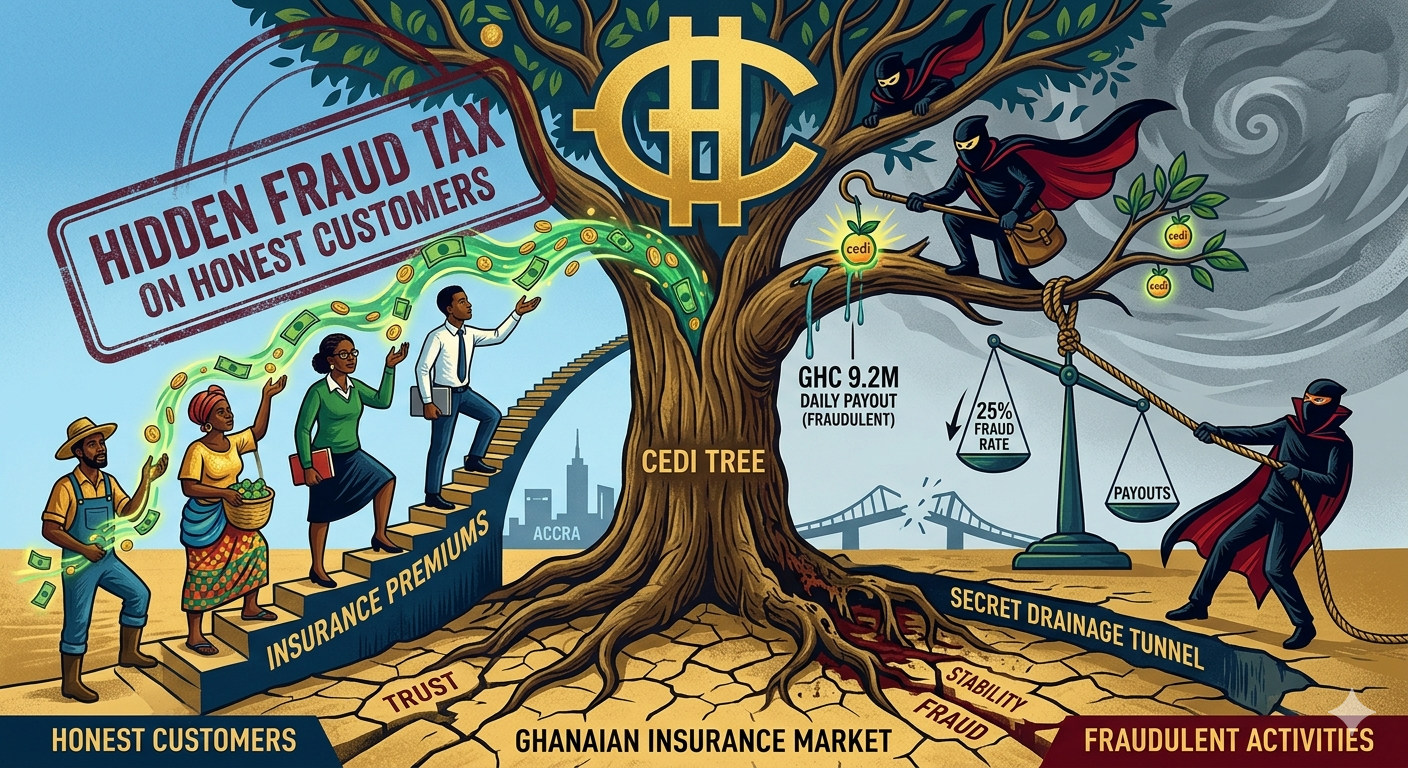

25% of Ghana’s insurance claims show elements of fraud, costing honest policyholders millions. Our deep-dive analysis reveals how staged accidents, fake stickers, and inflated claims drive up premiums — and what the NIC is doing to stop it.
How Insurance Fraud Affects Premiums in Ghana — The GH¢9.2m Daily Payout, the 25% Fraudulent Claim Rate, and the Hidden Tax on Honest Customers
Every day, Ghanaian insurers pay out approximately GH¢9.2 million in legitimate claims — GH¢5.2 million from general insurers and GH¢4 million from life insurers. Yet embedded within this daily payout is a silent, costly parasite. According to the National Insurance Commission (NIC), 25 per cent of all insurance claims in Ghana show elements of fraud — a figure that has remained stubbornly consistent for years. The fraud manifests in many forms: staged accidents and intentional collisions created solely to obtain compensation; falsified police accident reports submitted to support illegitimate claims; inflated repair estimates that turn a minor dent into a major payout; multiple claims filed for the same incident across different insurers; and the submission of false driver or ownership details after an accident. Beyond these direct claim frauds, the market is also plagued by counterfeiters selling fake insurance stickers and certificates to unsuspecting motorists, and by rogue agents who collect premiums but never remit them to the insurer.
The financial toll is staggering. Deloitte Ghana estimates that occupational fraud alone drains approximately 5 per cent of company income annually from Ghanaian insurers. In the National Health Insurance Scheme (NHIS), conservative estimates suggest annual losses of around US$500 million due to irregularities, inflated billing, and false claims. The cumulative effect is a quiet, regressive “fraud tax” that falls most heavily on honest policyholders. Every fraudulent claim artificially inflates the claims ratio — the proportion of premium income consumed by claim payouts. To maintain solvency, insurers are forced to raise premiums across the board. The GH¢482 third-party premium for a saloon car became GH¢530 in 2025, a 10 per cent increase driven in part by the need to offset losses from fraudulent claims and inflated repair costs. The honest motorist who has never filed a claim pays the same inflated rate as the serial fraudster.
📢 GET DETAILED ARTICLES + JOBS
Join THSB's WhatsApp Channel and never miss a post or opportunity.
This profile examines the mechanics of insurance fraud in Ghana: who commits it, how they operate, what it costs, and how those costs are ultimately passed on to every premium-paying customer. It also explores the countermeasures — from the Motor Insurance Database to telematics and AI — that offer a path to a fairer, more transparent market. For the industry, fraud is a survival threat. For honest policyholders, it is the most expensive cost of insurance they never see on their receipt.

The Scale of the Problem: How Fraud Translates Directly into Higher Premiums
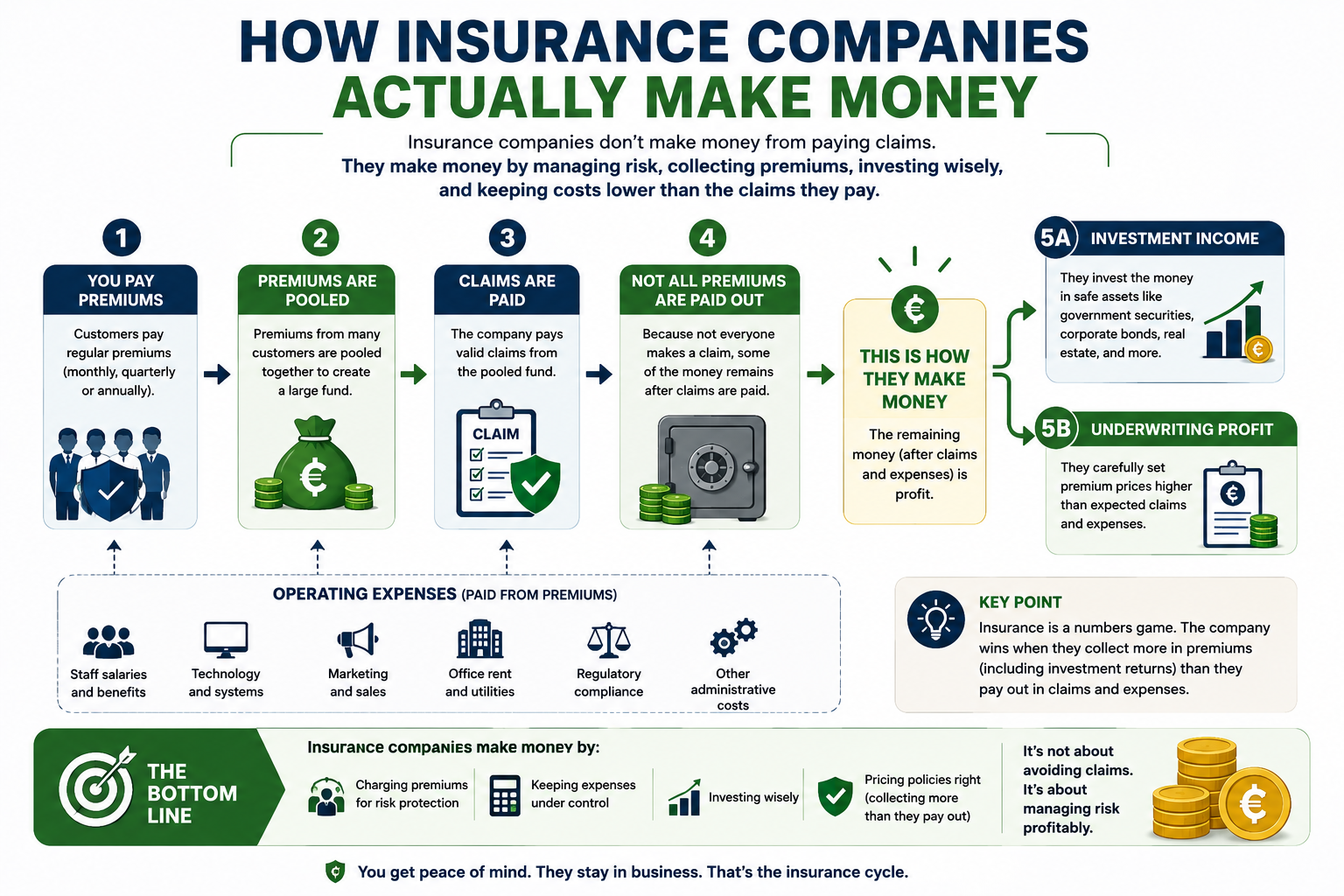
Insurance is, at its core, a mechanism for pooling risk. Premiums from many policyholders fund claim payments for the few who suffer losses. The premium each customer pays is calculated to cover the expected cost of claims for their risk pool, plus the insurer’s operating expenses and a reasonable profit margin. Fraud distorts this equation in ways that are both mathematically predictable and economically regressive.
The Claims Ratio Distortion: When fraudulent claims are submitted — say, a GH¢50,000 claim for a staged accident — that amount is added to the insurer’s total claim expenditure. The claims ratio (total claims divided by total premiums) rises. To restore profitability, insurers must either increase premiums, reduce legitimate claim payments (by delaying or disputing them), or both. Industry data suggests that fraudulent claims contribute 5–10 per cent of total claim costs in the Ghanaian market, a burden that falls squarely on honest policyholders.
The Underwriting Adjustment: Insurers base their premium calculations on historical claim data. When fraud inflates that data, actuaries are forced to incorporate inflated risk assumptions into their pricing models. The result is a permanent upward shift in premium rates, even for customers who have never filed a claim. The NIC’s 10 per cent increase in third-party motor premiums, effective February 2025, was formally attributed to inflation and rising claims costs, but fraud — particularly inflated repair estimates and staged accidents — is a significant driver of those rising costs.
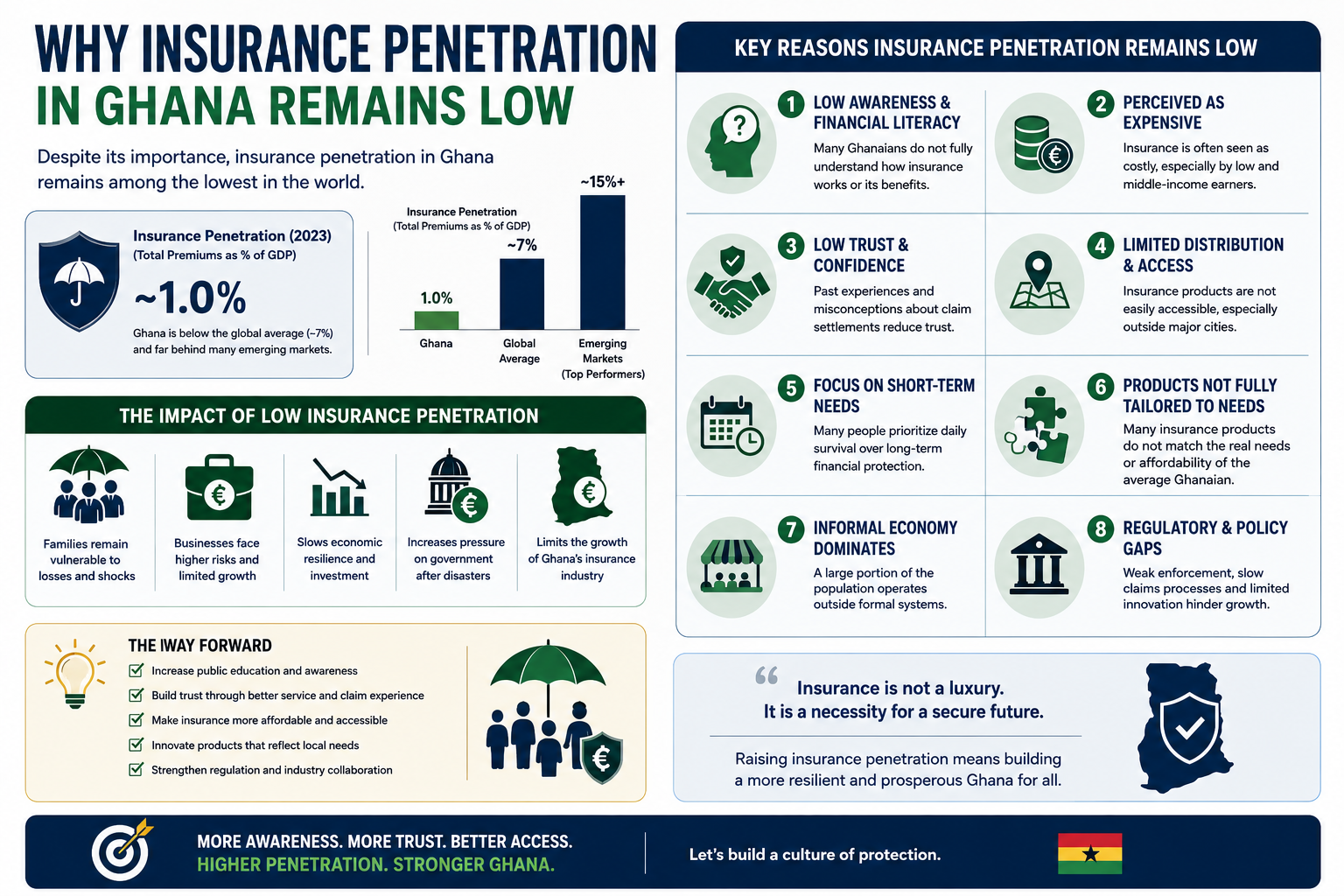
The Socialisation of Losses: Fraud is a hidden subsidy: honest policyholders pay higher premiums to cover the losses caused by dishonest claimants. This regressive transfer of wealth is especially burdensome in Ghana, where insurance penetration is already low (1 per cent of GDP). The honest driver on a tight budget pays the same inflated premium as the fraudster who drives without insurance entirely or who files false claims annually.
The Calculation: For an honest driver purchasing third-party coverage at GH¢530 per year, analysis suggests that fraud-related premium inflation adds approximately GH¢50 to GH¢80 to the annual premium — 10 to 15 per cent of the total cost. This is the “fraud tax”: a levy that no regulator ever announced and no government ever imposed, yet every honest policyholder pays it.
The Industry Data: A peer-reviewed study on the causes, effects, and deterrence of insurance fraud in Ghana concluded that fraud has a “significant negative effect on the annual return on assets (financial performance) of insurers in Ghana”. This profitability drag is ultimately passed back to customers in the form of higher premiums, slower claim payments, and reduced service quality.
The Many Faces of Fraud: How Fraudsters Operate in Ghana’s Insurance Market
Case Study: The GLICO GH¢400,000 Funeral Policy Fraud (2023). In one of the most audacious fraud cases in recent years, Joseph Amaning, a building contractor, Baffour Nkyi, a businessman, and Gideon Agyei Gyamfi, another trader, jointly forged a GLICO insurance claim for GH¢400,000. They fabricated a postmortem report, a police accident report, a death certificate, and a burial permit for a deceased person named Jacob Tetteh. The documents claimed that Tetteh had died in a motor accident. In reality, Tetteh had died of a short illness at Kibi Government Hospital on 25 September 2022 and was buried at Asikasu Number 2 near Tafo. No accident had ever occurred. The fraud was detected during document checks, and the three were arrested and charged with conspiracy to commit crime, forgery of documents, and defrauding by false pretense. The case illustrates how fraudsters are willing to forge official documents — police reports, death certificates, burial permits — to extract money from insurers.
Fraud in Ghana’s insurance market takes multiple forms, each with its own economic impact.
Staged and Intentional Accidents (Motor Insurance): Groups of fraudsters deliberately cause collisions to file claims for vehicle damage and bodily injury. This form of fraud is organised, sophisticated, and difficult to detect without telematics or real-time accident verification. Inflated repair estimates submitted by colluding garages amplify the payout, and damaged vehicles are used in multiple staged accidents.
Falsified Police Accident Reports: Fraudsters fabricate police reports to support illegitimate claims, including inventing entire accidents that never happened, exaggerating the severity of actual accidents, and claiming injuries that did not occur.

Multiple Claims for a Single Incident: The same accident is reported to multiple insurers, each paying out as if it were the primary policy. This is especially common in commercial fleets.
Fake Insurance Stickers and Certificates: This is perhaps the most widespread form of fraud affecting ordinary Ghanaians. Charlatans issue fake insurance stickers to unsuspecting drivers, who only discover the fraud when they are stopped by police or, worse, when they are involved in an accident and find that their “insurance” covers nothing. The NIC and MTTD have conducted joint operations to clamp down on fake sticker dealers. An insurance agent at the Takoradi DVLA office was charged for issuing fake stickers.
Health Insurance Fraud (NHIS and Private): The NHIS is a major target for fraud. In August 2025, the NHIA ordered Akim Oda Government Hospital to refund GH¢312,413 following an audit that identified inflated billing, phantom patients, and overprescription of medicines. In the private health insurance sector, insurers report similar patterns: billing for services not rendered, upcoding (billing for a more expensive service than was provided), and patient-sharing arrangements.
Application Fraud: Policyholders misrepresent facts on insurance applications. In motor insurance, a driver may claim they are the primary user when in fact the vehicle is used for commercial transport, or they may understate annual mileage to qualify for lower premiums. In health insurance, policyholders may fail to disclose pre-existing conditions, knowing that the insurer’s underwriting process cannot verify the omission.
Ghost Broking: This refers to the sale of fake insurance policies by unlicensed individuals posing as legitimate brokers. The policyholder pays a premium, receives a convincing-looking certificate, but has no actual coverage. The fraud is often discovered only at the point of claim.
The Claim Settlement Reality: GH¢9.2m Daily, But Fraud Slows Genuine Payments
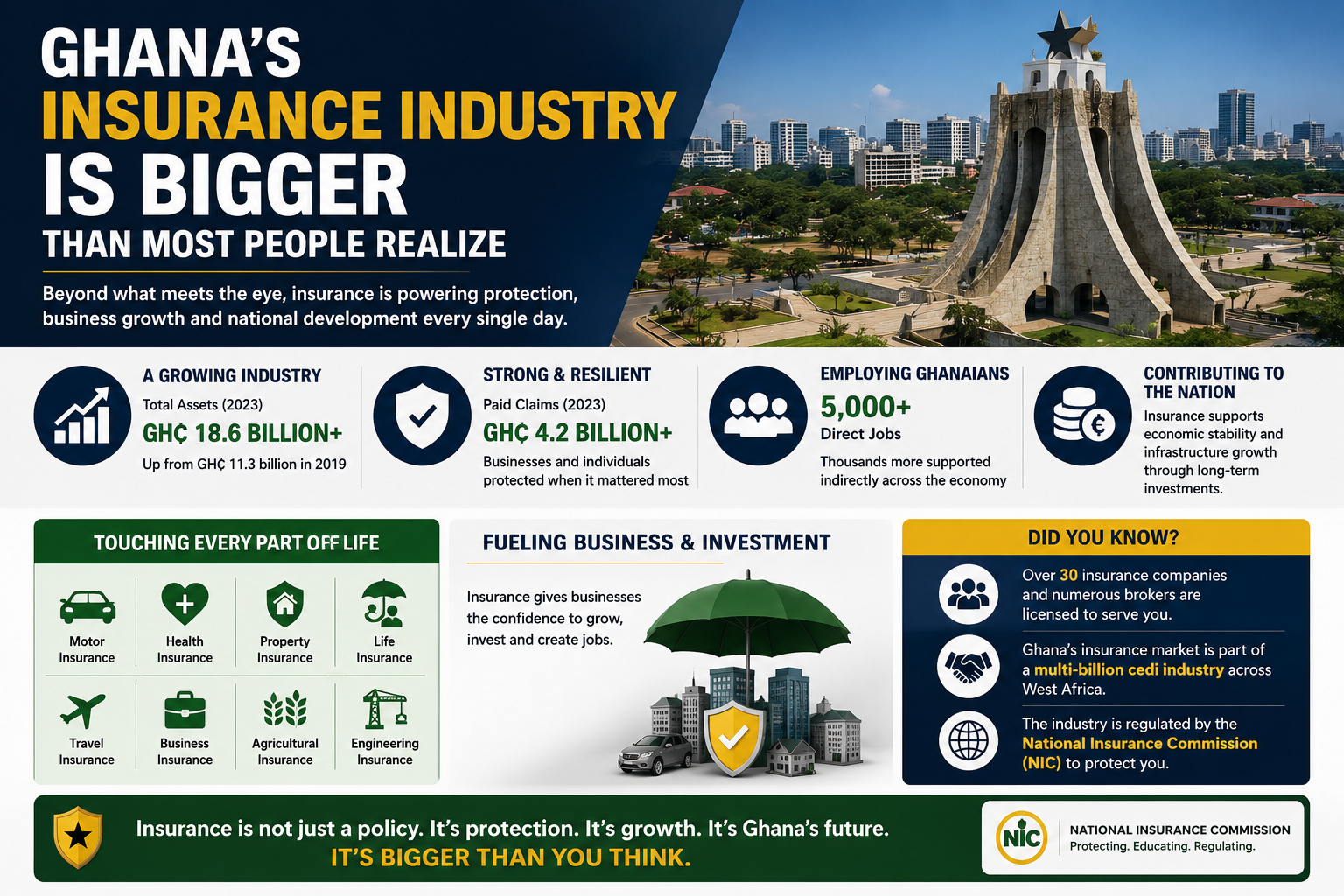
The Insurance industry in Ghana pays out approximately GH¢9.2 million in claims daily — GH¢5.2 million in general insurance (including motor, property, and health) and GH¢4 million in life insurance. This is a substantial and ongoing transfer of value from insurers to policyholders. Yet the public perception is that claims are rarely paid. The NIC Commissioner, Dr. Justice Ofori, has acknowledged that 25 per cent of claims show fraud elements, which directly contributes to processing delays.
Why Fraud Slows Everything Down: Each suspicious claim must be investigated. Investigators must verify police reports, inspect damaged vehicles, interview witnesses, and cross-reference with other insurers to detect duplicate claims. These investigations absorb resources that could otherwise be used to process legitimate claims faster. The NIC is actively seeking to engage the Chief Justice on the possibility of establishing special courts dedicated to the prosecution of insurance fraud cases — a move that would both deter fraud and expedite the resolution of genuine claims.
The Premium Impact: What the 10% Increase Actually Means
The NIC announced a 10 per cent increase in motor insurance premiums, effective 1 February 2025, following consultations with stakeholders. The initial proposal had been 15 per cent, but this was revised downward after industry feedback. The NIC stated that the adjustment was designed to help insurance companies meet rising claims costs while continuing to provide value to customers.
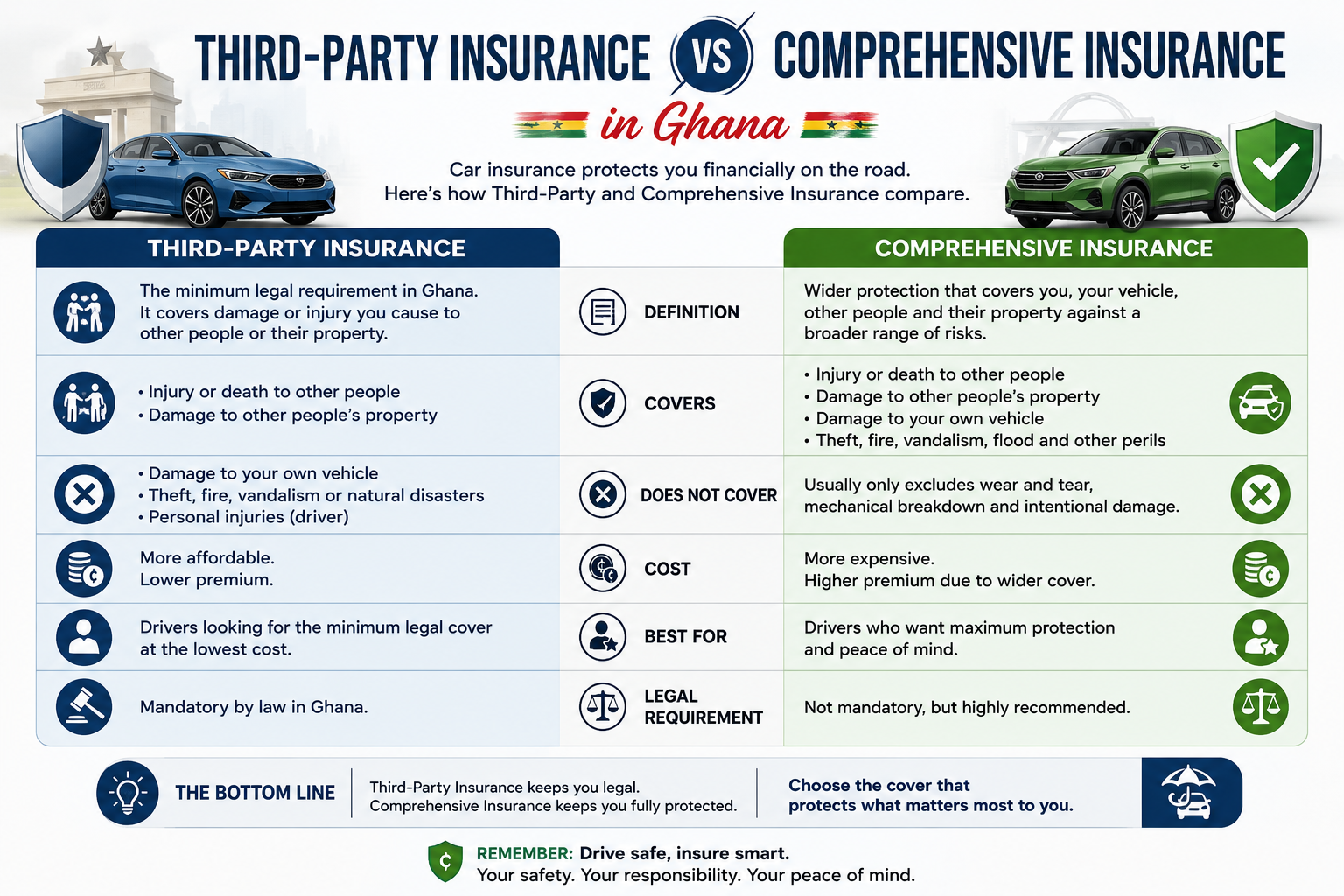
The increase was applied only to third-party premiums. Comprehensive policyholders saw a much smaller adjustment — approximately 1.45 per cent of their total premium — because only the third-party element of their coverage increased. For a private car owner, the annual third-party premium rose from GH¢482 to GH¢530. For taxis, rates went from GH¢684 to GH¢744; for small commercial vehicles (trotro, 30 passengers), from GH¢820–1,092 to GH¢894–1,194. This increase, though modest in absolute terms, triggered significant public backlash. Transport unions in the Ashanti Region protested, arguing that the increase would raise transport fares and burden households already struggling with high living costs.
The NIC defended the increase, noting that 2024 inflation had reached nearly 20 per cent, increasing the cost of car parts and repairs at markets like Abossey Okai, Kokompe, and Suame Magazine. However, fraudulent claims — particularly staged accidents and inflated repair estimates — have also contributed to rising claims costs, making the 2025 increase at least in part a fraud tax.
The Technology Countermeasures: MID, Telematics, and AI
The Motor Insurance Database (MID): Launched on 1 January 2020, the MID was introduced to eliminate the problem of vehicles operating with fake motor insurance stickers. The database centralises all valid motor policies and allows instant verification via USSD (92057#), SMS confirmation, and QR code scanning on electronic stickers. For law enforcement, the NIC has deployed Gota phones to the MTTD police unit, allowing officers to verify insurance validity instantly at checkpoints. The MID has significantly reduced the fake sticker epidemic, though the NIC acknowledges that more work remains.
Telematics: The Future of Fair Pricing. Telematics — the use of GPS and sensors to monitor driving behaviour — is emerging as a powerful fraud prevention tool. As a study on telematics ratemaking in Ghana notes, telematics enables insurers to access real-time data on a policyholder’s driving habits, including speed, braking patterns, acceleration, and cornering. Telematics improves risk management, prevents automotive insurance fraud, reduces road traffic crashes, and lowers the financial burden on insurers. Insurers in the Sekondi-Takoradi metropolis view telematics as a way of ensuring proper risk profiling of customers, thereby reducing fraudulent claims and increased claim costs.
AI and Blockchain: AI-powered fraud detection tools can flag suspicious claims before payouts are made. Blockchain can secure transparent claims histories, preventing duplicate claims and ensuring immutability of claim records. As Ebenezer Forson, a Chartered Insurer and Branch Manager of Priority Insurance, has argued, the rewards are significant: payouts within 48 hours, fraud reduction through AI and blockchain, improved customer experience, and ultimately, lower premiums driven by efficiency.
The Legal and Regulatory Framework
Insurance Act, 2021 (Act 1061): The Act establishes the NIC as the regulator of the insurance market and provides the legal framework for combating fraud. Operating without a license constitutes a crime and is punishable by a maximum fine of GH¢600,000 or a maximum term of five years imprisonment. The Act also empowers the NIC to impose administrative penalties for non-compliance.
Penalties: Engaging in insurance fraud is a criminal offense. The NIC has the power to impose administrative penalties of up to 10,000 penalty units for unlicensed insurance operations. In practice, however, enforcement has been inconsistent, and the NIC has acknowledged the need for stronger deterrents, including the proposed establishment of special fraud courts.
The Proposed Special Courts: In 2025, the NIC announced that it is seeking to engage the Chief Justice on the possibility of establishing special courts dedicated to the prosecution of insurance fraud cases. The move is aimed at deterring fraudulent behaviour and strengthening regulatory enforcement. If implemented, special courts could dramatically accelerate the prosecution of fraudsters, increasing the perceived risk of detection and punishment.
Premium Undercutting and Ethical Integrity: The NIC Commissioner, Dr. Abiba Zakariah, has reiterated the Commission’s strong stance on curbing premium undercutting — a practice where insurers charge premiums below the true cost of risk to win business. This practice, while distinct from fraud, is often linked to it, as underfunded claims reserves lead to delayed payments, disputes, and increased incentives for fraud. The Committee on Premium Undercutting and Unethical Practices submitted its report to the NIC in August 2025, recommending stricter enforcement and greater accountability.
The Human Cost of Fraud
Fraud in insurance is often framed in terms of financial losses to companies. But the real victims are ordinary Ghanaians.
For the honest driver who pays GH¢530 for third-party cover, fraud means paying more than necessary. For the accident victim who waits months for a claim settlement, fraud means the claims department is too busy investigating staged accidents to process legitimate claims promptly. For the family that is denied a health claim because their insurer’s finances have been weakened by fraud, the consequences can be devastating.
The NIC Commissioner noted that it is “hardly controversial to say that most people view their insurance providers with ambivalence”. This ambivalence is rooted in the lived experience of many Ghanaians: they pay premiums, but when they need to claim, they encounter delays, disputes, and sometimes outright denial. The fact that 25 per cent of claims are fraudulent does not excuse the mistreatment of the other 75 per cent. But it explains, at least in part, why insurers are slow to trust.
For the industry, fraud is a drag on profitability and a barrier to growth. For policymakers, it is a governance failure that undermines the financial inclusion goals of the state. For the honest policyholder, it is an invisible tax — the most expensive cost of insurance that never appears on a receipt.
Future Outlook: Three Scenarios for Fraud and Premiums
Scenario One: Incremental Improvement (65 per cent probability).
The MID continues to reduce fake stickers. Telematics adoption grows slowly, led by commercial fleets and ride-share operators. AI and blockchain pilots demonstrate fraud reduction benefits, but full-scale deployment is five to seven years away. The 25 per cent fraudulent claim rate edges down to 18–20 per cent. Premiums continue to rise with inflation, but the fraud component stabilises. The NIC’s special courts proposal remains under discussion but is not implemented.
Scenario Two: Technology‑Driven Breakthrough (25 per cent probability).
The NIC implements a fully digitised, end-to-end claims platform integrated with MTTD and DVLA data. Telematics becomes standard for all new motor policies. AI-driven fraud detection reduces fraudulent claims to single digits within five years. Premiums fall in real terms as fraud-related costs are eliminated. Ghana becomes a regional leader in insurance technology.
Scenario Three: Fraud Escalation and Premium Spike (10 per cent probability).
Organised fraud networks expand into new areas — health insurance, property insurance, and agricultural insurance. The NIC, lacking enforcement capacity, struggles to keep pace. The 25 per cent fraudulent claim rate rises to 35 per cent. Premiums increase sharply. Public trust collapses further, and insurance penetration stagnates below 2 per cent of GDP.
The most likely path is Scenario One: slow, incremental progress. The forces pushing toward digitisation — the MID, Ghana Card integration, telematics pilots — are powerful. But the forces resisting change — organised fraud networks, weak enforcement, public distrust — are equally entrenched. The honest policyholder will continue to pay the fraud tax for the foreseeable future.
THSB Conclusion
Insurance fraud in Ghana is not a victimless crime. The victim is the honest driver whose premium rises 10 per cent to cover the cost of staged accidents and inflated repair estimates. The victim is the health insurance policyholder who pays higher premiums because hospitals have learned to inflate bills. The victim is the family whose legitimate claim is delayed because investigators are busy chasing fraudsters.
Every day, Ghanaian insurers pay out GH¢9.2 million in claims — GH¢5.2 million in general insurance and GH¢4 million in life insurance. Embedded within that daily payout is a silent parasite: 25 per cent of all claims show elements of fraud. The fraud takes many forms — staged accidents, falsified police reports, counterfeit stickers, inflated hospital bills, and forged death certificates. The cost is measured in billions of cedis annually, and that cost is ultimately borne by the honest policyholder in the form of higher premiums, slower service, and reduced trust.
The countermeasures exist. The MID has slashed the fake sticker epidemic. Telematics offers the promise of pay-how-you-drive pricing that rewards safe driving and detects staged accidents. AI and blockchain can automate claim validation and prevent duplicate payments. The NIC’s proposal for special fraud courts, if implemented, would deter fraud by increasing the risk of prosecution.
But technology alone is not enough. What is required is a shift in public culture — an understanding that insurance fraud is not a clever way to “get back” at a company, but a tax on every honest policyholder. The 10 per cent premium increase that took effect in February 2025 was not an act of regulatory greed. It was, at least in part, a fraud tax. Every driver who has ever been tempted to inflate a repair estimate or stage a minor collision should understand that they are, in effect, raising premiums for their neighbours, their colleagues, and their family members.
The government has a role. The NIC has a role. Insurers have a role. But the most important actor in reducing insurance fraud is the honest policyholder — the driver who insists on a genuine policy, the patient who refuses to collude with a hospital’s billing fraud, the citizen who reports suspicious activity to the authorities. Fraud is a crime of opportunity. It flourishes where enforcement is weak, but it also flourishes where social norms tolerate it. Changing those norms will take time. But every percentage point reduction in fraud is a direct reduction in premiums for honest policyholders. That is the bargain that Ghana’s insurance market offers: a fairer, more affordable system, in exchange for a public that refuses to tolerate fraud.
The fraud tax is real. The question is whether Ghana will continue to pay it — or whether it will finally choose to stop. The cost of the fraud is measured in billions of cedis annually, and it is passed directly to the honest premium payer. Lowering it depends on detection technology, but most of all on deterrence and public education. The honest policyholder is the ultimate victim of every fraudulent claim — and also the only one who can ultimately stop it.
Frequently Asked Questions (FAQ)
Q1: What percentage of insurance claims in Ghana are fraudulent?
The National Insurance Commission (NIC) estimates that approximately 25 per cent of all insurance claims in Ghana show elements of fraud. This includes staged accidents, falsified police reports, inflated repair bills, duplicate claims for the same incident, and fake death certificates.
Q2: How does insurance fraud affect my premium directly?
Fraud drives up the industry’s claims ratio — the proportion of premium income consumed by claim payouts. To maintain solvency, insurers raise premiums across the board to cover the losses caused by fraudulent claims. For a third‑party motor policy costing GH¢530, fraud analysis suggests approximately GH¢50–80 of that premium — 10 to 15 per cent — is effectively a “fraud tax.
Q3: What types of insurance fraud are most common in Ghana?
Staged or intentional accidents created to obtain compensation; falsified police accident reports; multiple claims filed for the same incident across different insurers; fake insurance stickers and certificates issued by charlatans; inflated billing and phantom patients in health insurance; and ghost broking (sale of fake policies by unlicensed individuals).
Q4: What was the 10% motor insurance premium increase about?
In February 2025, the NIC increased third‑party motor premiums by 10 per cent — for example, private cars from GH¢482 to GH¢530 annually. The NIC stated that the adjustment was needed to help insurers meet rising claims costs driven by inflation (nearly 20% in 2024) and increased repair costs at markets like Abossey Okai. Fraudulent claims — particularly inflated repair estimates — contributed significantly to those rising costs.
Q5: How much does Ghana’s insurance industry pay out in claims daily?
Insurers in Ghana collectively pay an average of GH¢9.2 million in claims every day — GH¢5.2 million from general insurers (motor, property, health) and GH¢4 million from life insurers. This figure underscores both the scale of genuine payouts and the financial burden imposed by fraudulent claims.
Q6: What is the Motor Insurance Database (MID) and how does it fight fraud?
Launched on 1 January 2020, the MID is a centralised digital repository of all valid motor policies in Ghana. It allows instant verification of a vehicle’s insurance status via USSD short code 92057#, SMS confirmation, or QR code scanning. The MID has significantly reduced the prevalence of fake insurance stickers.
Q7: Can technology like telematics and AI reduce insurance fraud in Ghana?
Yes. Telematics (GPS and sensors that monitor driving behaviour) can provide objective data on speed, braking, acceleration, and cornering — making it difficult for fraudsters to stage accidents and claim damages. AI-powered fraud detection can flag suspicious patterns before payouts are made. Blockchain can secure transparent claims histories, preventing duplicate claims.
Q8: What are the penalties for insurance fraud under Ghanaian law?
Operating without an insurance licence constitutes a crime and is punishable by a maximum fine of GH¢600,000 or a maximum term of five years imprisonment under the Insurance Act, 2021 (Act 1061). The NIC can also impose administrative penalties for non-compliance. The NIC has proposed the establishment of special courts dedicated to the prosecution of insurance fraud cases to strengthen deterrence.
Q9: How can I check if my motor insurance policy is genuine?
Dial 92057# on any mobile phone, enter the vehicle registration number, and receive the insurer name and policy expiry date instantly. You can also scan the QR code on your insurance sticker using a QR code reader app. If the MID does not recognise your policy, your insurance is likely fake.
Q10: Is health insurance fraud a problem in Ghana?
Yes. In August 2025, the NHIA ordered Akim Oda Government Hospital to refund GH¢312,413 following an audit that identified inflated billing, phantom patients, and overprescription of medicines. Conservative estimates suggest the NHIS loses approximately US$500 million annually to fraud and abuse.
Q11: What is “ghost broking” and how do I avoid it?
Ghost broking is the sale of fake insurance policies by unlicensed individuals posing as legitimate brokers. Victims pay premiums, receive convincing-looking certificates, but have no actual coverage. To avoid ghost broking, always purchase insurance from a licensed insurer or a registered broker whose credentials have been verified through the NIC website.
Q12: Will insurance premiums in Ghana continue to rise?
Most analysts expect premiums to continue rising in line with inflation and healthcare costs. However, if telematics and AI-driven fraud detection are successfully deployed, the fraud component of premiums could be reduced over time, potentially stabilising or even lowering real premiums for honest policyholders. The NIC’s proposed special courts could also deter fraud, reducing the fraud tax burden on honest customers.
Source: The High Street Business
Disclaimer: Some content on The High Street Business may be aggregated, summarized, or edited from third-party sources for informational purposes. Images and media are used under fair use or royalty-free licenses. The High Street Business is a subsidiary of SamBoad Publishing under SamBoad Business Group Ltd, registered in Ghana since 2014.
For concerns or inquiries, please visit our Privacy Policy or Contact Page.

Esther Aku-Sika is a content writer and social media strategist who helps brands and startups grow through intentional storytelling and practical marketing strategies. With a keen eye for trends and audience behavior, she shares business insights, content strategies, and real-life lessons to help entrepreneurs build visibility and turn ideas into income. Through her writing, she simplifies complex concepts and equips readers with actionable steps to grow in today’s digital space.