









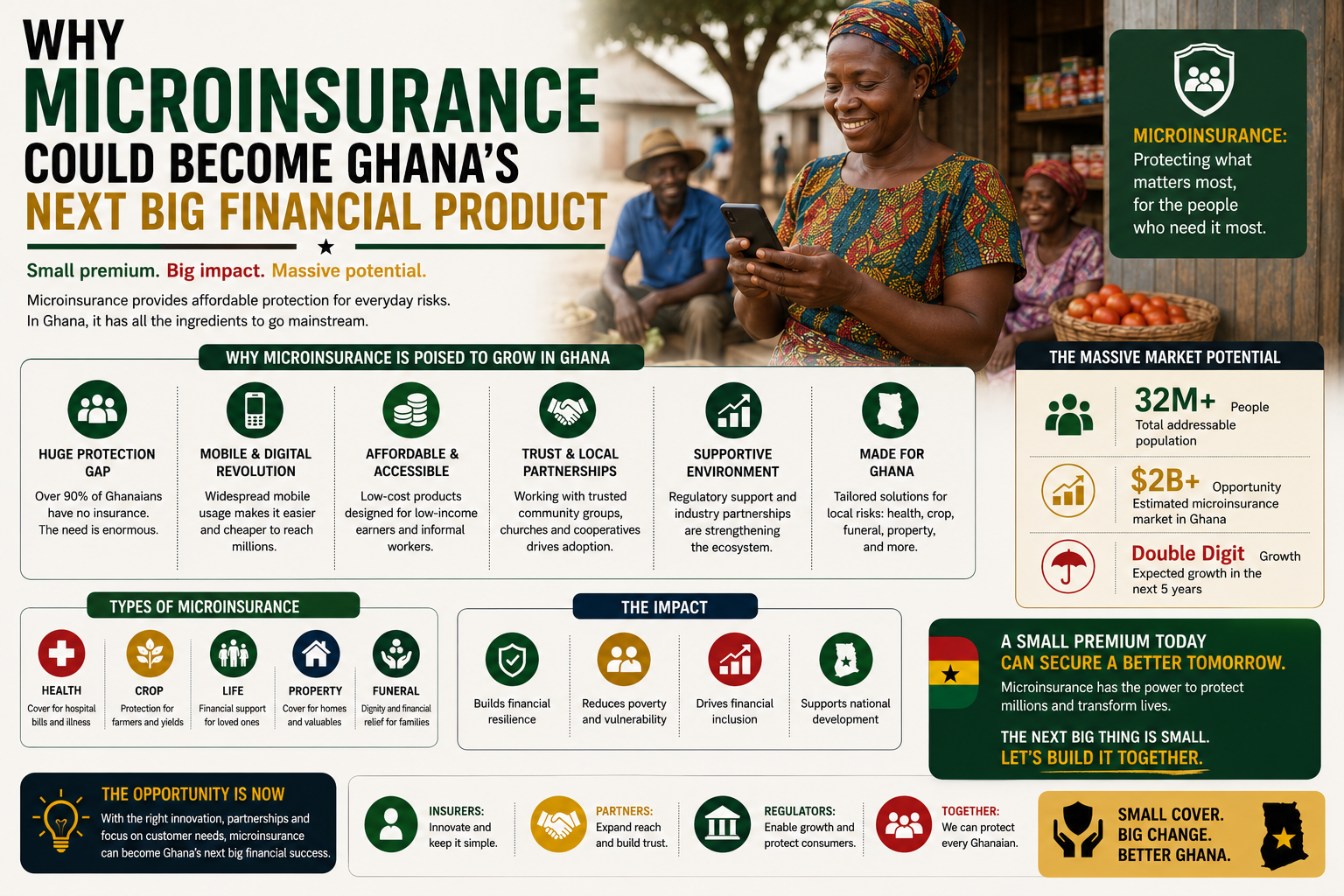

With 8.5 million lives insured and GH¢35 million in claims paid, microinsurance is finally reaching Ghana’s informal sector. Our deep‑dive analysis reveals the aYo–DOSH–ETAP revolution, regulatory sandbox innovations, and the path to scaling beyond 1 per cent penetration.
Why Microinsurance Could Become Ghana’s Next Big Financial Product — 8.5m Lives, GH¢1 Premiums and the Unfinished Business of Reaching 80% of the Workforce
For decades, the mathematics of Ghanaian insurance has been simple, stable and deeply unsatisfactory. Penetration has remained stuck at about 1 per cent of GDP — and under the stricter IFRS 17 standard the figure falls even further to just 0.63 per cent. More than 98 per cent of Ghana’s economic activity, household assets and personal income are not protected by any private insurance. The reasons have been thoroughly rehearsed: premiums designed for salaried workers in a country where 80 per cent of the workforce is in the informal sector; distribution channels that never reached the remote communities where most Ghanaians live; a deep trust deficit fuelled by stories of delayed and denied claims; and cultural substitutes — family, churches, susu groups — that have historically made formal insurance feel unnecessary.
Yet a quiet but unmistakable shift is now underway. A new generation of digital microinsurance platforms, most of them anchored in mobile money, has begun to demonstrate that low‑income Ghanaians will buy insurance when it is affordable, accessible and simple. aYo Ghana, the market leader, has insured over 8.5 million lives and paid more than GH¢35 million in claims, distributing policies via USSD codes that work on any mobile phone, regardless of smartphone ownership. DOSH Health Insurance, launched in December 2025 in partnership with MTN MoMo, offers entry‑level health coverage from GH¢365 per year and promises to settle clean claims within 24 hours. ETAP, in partnership with Hollard Ghana, secured the country’s first‑ever insurtech operational licence in late 2024, allowing it to process claims, collect premiums and offer auto insurance directly to consumers.
📢 GET DETAILED ARTICLES + JOBS
Join THSB's WhatsApp Channel and never miss a post or opportunity.
These are not speculative pilots. They are live products, serving hundreds of thousands of paying customers. The question is no longer whether microinsurance can work in Ghana, but whether it can scale from a promising niche to a mainstream financial product — and what that would mean for the 80 per cent of the workforce that has never owned a policy.

This profile examines the forces that could make microinsurance Ghana’s next big financial product: the digital infrastructure that has lowered distribution costs to almost zero; the partnership models that have embedded insurance into mobile money and banking platforms; the regulatory innovations — including the NIC sandbox — that are enabling new entrants; the structural shift in risk perception created by economic shocks; and the massive, largely untapped market of informal workers, gig workers and small business owners who need protection but cannot afford traditional premiums. Microinsurance will not replace traditional insurance. But for the majority of Ghanaians who have never been able to afford a policy, it is the only realistic entry point into formal risk protection — and it may finally be reaching escape velocity.
The Market Context: The 1 % Problem and the Digital Answer
To understand why microinsurance could become Ghana’s next big financial product, one must first understand the scale of the failure it is trying to address. Insurance penetration in Ghana — measured as gross premiums as a share of GDP — has remained at approximately 1 per cent for years. Deloitte’s Africa Insurance Outlook projects that this rate will hover around 1 per cent in 2026, reflecting a market that is still relatively untapped. Under IFRS 17, the more conservative accounting treatment of insurance contracts, effective penetration falls even further, to just 0.63 per cent.
The reasons for this chronic under‑penetration are structural. The economy is dominated by an informal sector that accounts for roughly 80 per cent of total employment, but most insurance products were designed for salaried formal‑sector workers with predictable monthly income. Premiums are often paid annually or in large instalments, a payment structure that is incompatible with the daily or weekly cash flows of market traders, farmers and gig workers. Distribution has historically relied on expensive physical branches and commissioned agents, making it uneconomical to serve low‑income customers in remote areas. And the trust deficit — rooted in stories of delayed claims, denied payouts and opaque policy language — has discouraged voluntary uptake.
However, the digital infrastructure required to solve these problems now exists. Ghana has over 76 million registered mobile money accounts, with more than 19 million active monthly users. Mobile money contributes more than five per cent of GDP. The interoperability framework allows seamless transfers between mobile money wallets and bank accounts. The Ghana Card provides a verifiable identity for policy purchase. And the Bank of Ghana’s push toward open banking and digital credit is creating an ecosystem in which insurance can be embedded seamlessly into other financial transactions.
The NIC has recognised this opportunity. The Commission’s strategy rests on three pillars: sanitising the insurance market, growing the market through technology, and positioning Ghana’s industry for long‑term competitiveness. Technology is not an optional add‑on; it is the primary lever for reaching the 80 per cent of the workforce that has never bought a policy. The Acting Commissioner has stated that through digital technology, insurance could be sold “to people where insurance companies themselves could not go”.
The table shows that while Ghana’s premium‑based penetration lags global benchmarks, the inclusion of microinsurance raises the proportion of people with some form of risk protection, even if the coverage is limited. The gap between the 1 per cent premium figure and the 8.5 million lives covered by aYo alone illustrates the fundamental challenge: microinsurance generates low premium volume per customer, but it has the potential to reach millions of Ghanaians who have never been touched by traditional insurance.
The DDEP hangover and the push for new models: The insurance sector’s traditional business model — relying on investment income from large government securities holdings — was severely disrupted by the Domestic Debt Exchange Programme (DDEP). Prior to the restructuring, the industry held close to GH¢4.6 billion in government securities. The DDEP eroded capital reserves across the sector, forcing insurers to reconsider their strategies. The government established a US$750 million Financial Stability Fund to support affected institutions. The disruption has had an unintended positive effect: insurers can no longer rely on a comfortable, sovereign‑backed investment income stream. They are being forced to underwrite profitably and to grow their premium base in new ways — including through microinsurance. As the NIC’s strategy acknowledges, “the traditional model — relying on investment income to compensate for weak underwriting — is no longer sustainable”. Microinsurance is not merely an inclusive innovation; it is becoming a commercial necessity.
The industry’s digital transformation is being accelerated by the combined pressures of the DDEP, high inflation (which reached about 23.8 per cent by end‑2024), currency depreciation and the structural demands of IFRS 17. These forces, while painful, have forced insurers to reconsider their strategies and to invest in new distribution channels and product innovations — including microinsurance.
The Distribution Revolution: How Mobile Money Lowered the Cost of Distribution
The single most important enabler of microinsurance growth has been the sharp reduction in distribution costs made possible by mobile money. Traditional insurance distribution required physical branches and commissioned agents. The cost of selling a low‑premium policy through those channels exceeded the premium itself. Mobile money changed that calculus completely.
Embedded insurance: The most successful microinsurance products are those embedded directly into products and services that customers already use. aYo’s Recharge with Care, for example, attaches life and hospital coverage to airtime purchases. Customers dial *296#, select the product and pay premiums via mobile money deductions. The distribution cost is effectively zero because the customer is already on the platform. The same logic applies to Send with Care — insurance attached to mobile money transfers — and to DOSH’s integration into the MTN MoMo app, which allows users to purchase health insurance “as easily as sending money or paying bills”.

The mobile money scale advantage: MTN MoMo alone has over 12 million active users. By integrating insurance into the MoMo app, DOSH gained immediate access to a pool of potential customers larger than the entire formal sector workforce. No traditional distribution channel could match that reach at a comparable cost. The cost structure of mobile‑enabled microinsurance is fundamentally different from traditional insurance. Customer acquisition costs are low because the customer acquisition happens as part of a transaction the customer was already making. Premium collection is automated through mobile money deductions, reducing administrative overhead. Claims can be initiated via USSD or mobile app, eliminating paper handling and reducing processing costs.
DOSH–MoMo as a model: DOSH’s entry‑level health premium of GH¢365 per year for a benefit cover of GH¢9,000 is at the outer edge of what many low‑income Ghanaians can afford, but it is substantially lower than traditional private health premiums. The flexibility of paying in instalments via mobile money makes it accessible to customers with irregular income. The promise of processing clean claims within 24 hours directly addresses the trust deficit that has historically limited insurance uptake. If DOSH can deliver on that promise at scale, it will set a new standard for the entire industry.
New digital entrants: The NIC’s sandbox programme has granted temporary innovation licences to five insurtechs, including Figtech (an insurance aggregator), Moovon Insure (pay‑as‑you‑go premiums) and ETAP (telematics‑based motor insurance), creating a pipeline of digitally native products that can be scaled if they prove successful. The sandbox, supported by FSD Africa’s Bimalab programme, has accelerated 100 insurtechs continent‑wide, enabling 75 new projects, increasing coverage by 5 million and facilitating US$35 million in capital raising.
The agent network dimension: While digital distribution receives most of the attention, the agent network remains essential for last‑mile access. Agents provide education, help customers navigate the enrolment process and facilitate cash‑in/cash‑out for customers who are not yet comfortable holding value in their mobile money wallets. However, agent liquidity shortages and low commissions remain constraints. The NIC’s sandbox has included agent‑focused innovations, such as Moovon Insure’s flexible premium payment platform, which could improve agent‑customer engagement.
The underlying distribution story is clear: mobile money has made it possible to sell low‑premium, high‑volume microinsurance at a cost that is economically viable. The challenge now is to convert that distribution reach into sustainable premium volume and trusted claims performance.
The Key Players and Their Models
The microinsurance landscape in Ghana is not a monopoly. It is a competitive arena with several distinct business models, each targeting a different segment of the market and leveraging different distribution channels.
1. aYo Ghana — Embedded Microinsurance at Scale
aYo Ghana, underwritten by Metropolitan Life, is the undisputed market leader. Incorporated on 14 December 2016, the company has grown “from a zero base to reach more than GH¢5 million in premiums each month”. It has insured over 8.5 million lives and paid more than GH¢35 million in claims. Products include Recharge with Care, Family Cover, Annual Cover, MedCover and Pay & Drive motor insurance. Distribution is omnichannel: USSD code *296# works on any phone; customers can also use the MTN MoMo app, a multilingual call centre, WhatsApp or a network of nationwide agents. Claims can be initiated via the same USSD code, and many are settled within five working days.
aYo’s scale is its primary competitive advantage. No other player has achieved comparable customer reach. However, the company faces the challenge of converting customers from free or low‑cost embedded products to higher‑value paid products. As industry experts have noted, early digital insurance models relied heavily on free products to encourage customer behaviour; converting those customers to paid products has proven challenging.
2. DOSH Health Insurance — The MoMo‑Powered Challenger
Launched in December 2025, DOSH is the most significant new entrant in the health microinsurance space. Its partnership with MTN MoMo, with over 12 million active users, gave it immediate scale. Entry‑level premiums start at GH¢365 per year for a benefit cover of GH¢9,000, targeting individuals, SMEs and the informal sector. The company promises to process and pay clean claims within 24 hours, a commitment that, if sustained, would dramatically outperform the industry average and directly attack the trust deficit.
DOSH’s coverage includes areas often excluded from insurance packages, such as psychiatric care, erectile dysfunction and in‑vitro fertilisation, alongside nationwide access to accredited facilities including Ghana Health Service centres. The company also offers a 24‑hour call centre and flexible payment options via MoMo. The Deputy Director of the Ministry of Health described the model as “a significant step in democratising access to quality healthcare”.
3. ETAP–Hollard — The First Operational Insurtech Licence
ETAP, a leading African insurtech, secured the first operational insurtech licence from the NIC in late 2024, allowing it to process claims, collect premiums and offer auto insurance directly to consumers and businesses in collaboration with Hollard Insurance Ghana. The licence is significant because it moves ETAP beyond a technology‑enabled distributor to a fully licensed insurance operator. Its auto products cover cars, trucks, motorcycles and tricycles, using telematics to enable flexible, pay‑as‑you‑drive pricing. While still relatively small in terms of customer numbers, ETAP’s regulatory status positions it as a potential leader in the motor microinsurance segment.
4. Figtech — AI‑Powered Aggregator
Figtech is a digital insurance intermediary admitted into the NIC’s Sandbox Programme. Its MyFigTech platform uses AI to allow users to compare policies from multiple providers, review premiums and coverage options side‑by‑side, and receive personalised recommendations. It then enables purchase and policy management directly through the platform. Figtech does not underwrite insurance; it aggregates and distributes. Its value proposition is transparency and choice in a market where consumers have historically had no easy way to compare products.
5. Activa International Insurance — Reaching Women Entrepreneurs
Activa represents the more traditional insurer that has adapted its strategy to reach underserved segments. Its Activ’Lady Programme, developed in partnership with the International Finance Corporation, targets women running small businesses — market vendors, caterers, hairdressers — who for years had no protection for their assets or income. The programme combines insurance with financial literacy training, recognising that “you can have the best product in the world, but if people don’t understand why they need it or how it works, they won’t buy it”.
6. BIMA Ghana — Pan‑African Microinsurance Veteran
BIMA is a microinsurance company operating in Ghana, Kenya and Tanzania, leveraging mobile technology to offer affordable health, life and personal accident insurance. It has partnered with mobile network operators and mobile money providers to cover over 30 million customers across its markets. BIMA pioneered the telemedicine and mobile‑first insurance model in Ghana and has received the country’s first telemedicine licence. While its Ghana‑specific numbers are not publicly broken out, its continental scale demonstrates the viability of the mobile microinsurance model.
Bancassurance and hybrid models: Beyond pure‑play digital platforms, bancassurance — the distribution of insurance through bank branches — is also growing. Absa Bank Ghana had served over 157,000 clients through its bancassurance offerings by mid‑2025. GCB Bank’s partnership with StarLife Assurance is considered one of the largest bancassurance platforms in Ghana. While not microinsurance in the strict sense, bancassurance extends insurance access to lower‑income banked customers who may not be reached by pure digital channels.
The competitive landscape is fragmented, but that fragmentation is healthy. No single player dominates every segment. aYo leads in life and hospital cash microinsurance. DOSH is the most aggressive entrant in health. ETAP is the early leader in digital motor insurance. Figtech is pioneering comparison. This diversity of business models is exactly what the Ghanaian market needs — different approaches serving different customer segments, all of which are currently under‑insured.
Affordability and Claims: The Two‑Part Test for Success
Two factors will determine whether microinsurance moves from a promising niche to a mainstream product: affordability and claims performance. Neither is a given.
Affordability — Premium levels and payment flexibility
The premium levels of leading microinsurance products show a clear affordability hierarchy.
Provider Product Premium Benefit / Coverage Notes
- aYo Ghana Hospital Cash GH¢1‑6 / month Cash per night of hospitalisation; life cover for accidental death Distributed via USSD
- aYo Ghana Recharge with Care Embedded in airtime Life + hospital cover No additional premium
- DOSH Health Entry‑level Health Plan GH¢365 / year GH¢9,000 benefit cover 24‑hour clean claims target
- Impact Life Abrabopa GH¢2.40 / month Life + health for informal sector
- Enterprise Life Health riders Varies Added to life policies Integrated with existing policyholders
The table shows that the most affordable products are those embedded into airtime or mobile money transactions, where the customer may not even perceive a separate premium payment. Daily premiums of GH¢1–2 are within reach of most informal workers, though the coverage is correspondingly limited.
However, affordability is not just about the size of the premium; it is also about the payment frequency and the customer’s income volatility. The ability to pay daily or weekly via mobile money deductions is as important as the total premium amount. As the GSMA–MiN report noted, “relevance remained one of the biggest drivers of adoption” — and relevance means fitting the customer’s actual cash flow.
Claims performance — The trust bottleneck
The single most important factor in microinsurance uptake is not price but trust. The NIC Commissioner has observed that “most people view their insurance providers with ambivalence” — a diplomatic description of the widespread perception that insurers do not pay claims. Microinsurance platforms that can demonstrate fast, reliable claims settlement will have a decisive competitive advantage.
aYo Ghana settles many claims within five working days. DOSH’s commitment to 24‑hour settlement for clean claims is even more ambitious. GHIC (GAB Health) achieved a 97 per cent claim settlement ratio in 2025 — a benchmark that other microinsurance providers will be measured against.
The difficulty is that claims processing is where digital insurance platforms are most vulnerable to failure. Fraud detection, document verification and provider coordination all add friction that can delay payouts. For a customer who has paid daily premiums of GH¢1 for a year, a two‑week delay in a GH¢500 claim is an unacceptable failure. The economics of microinsurance depend on automated claims processing; manual investigation of small claims is not economically viable.
The NIC’s proposal to establish special courts dedicated to the prosecution of insurance fraud would, if implemented, increase deterrence and could reduce the investigation burden on insurers, potentially speeding up legitimate claim settlements【citation needed】. But for now, the onus is on microinsurance platforms to design claims processes that are both fast and fraud‑resistant — a difficult balance.
The Uncovered Masses: SMEs, Gig Workers and the 80 % Workforce
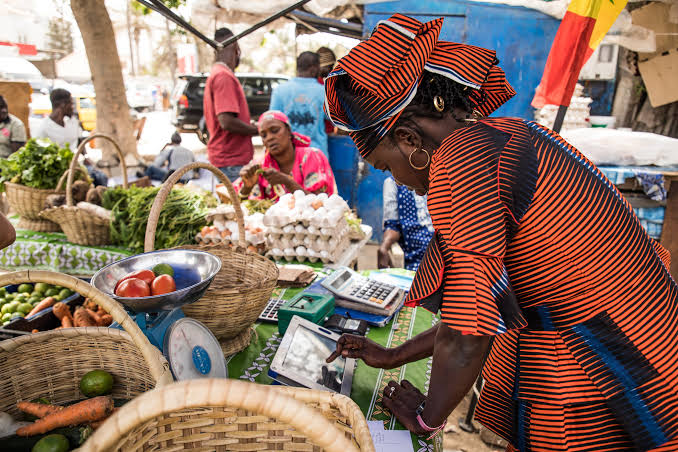
Perhaps the most significant gap in Ghana’s insurance market is the small business and gig economy segment. As the Chief Product and Services Officer of MobileMoney Limited has noted, “about 95 per cent of what we have as insurance products are individual and largely life insurance. There is a whole segment of SMEs and gig workers that are not adequately covered”. This gap is not accidental. Traditional insurance products were designed for individual salaried workers, not for business owners who need coverage for their inventory, equipment, or business interruption. The result is that Ghana’s most dynamic economic actors — the market women, the spare‑parts dealers, the ride‑share drivers — operate without any formal risk protection.
Credit insurance guarantee scheme: The 24‑Hour Economy Authority, in collaboration with the Bank of Ghana and the NIC, is developing a credit insurance guarantee scheme aimed at improving access to finance for SMEs. The scheme would reduce reliance on physical collateral, a barrier that currently limits about 95 per cent of businesses from securing loans. If implemented effectively, the scheme could enable SMEs to obtain bank credit using insurance as a substitute for tangible assets, unlocking financing that has historically been inaccessible.
Bancassurance for SMEs: Access Bank, in partnership with Coronation Insurance, launched a Business Protection Insurance offering in February 2026, providing cover against fire, flood, burglary and personal accidents for SMEs. The product is distributed through the bank’s branch network — a channel that already has relationships with many small business owners. GCB–StarLife’s bancassurance platform has also been recognised for its performance in serving SME and individual customers.
The gig economy gap: Gig workers — ride‑share drivers, delivery riders, freelance tradespeople — represent a particularly underserved segment. They have irregular income, no employer to provide group coverage and often operate outside formal business registration. aYo’s Pay & Drive motor insurance and ETAP’s telematics‑based auto products are early attempts to serve this market, but coverage remains limited. The challenge is to design products that align with gig‑worker cash flows, provide flexible cover (hourly or daily), and can be purchased and claimed entirely through a mobile phone.
The risk of product mismatch: The microinsurance industry faces the risk of scaling products that are easy to distribute but not genuinely relevant to customers. As the GSMA–MiN report emphasised, “anything that customers do not find relevant, they will not patronise”. The early focus on life and hospital cash cover was driven by ease of distribution rather than customer demand. The next phase of microinsurance growth must be driven by products that address the actual risks that informal workers and SMEs face: business interruption, theft of inventory, illness that prevents work, and liability to third parties. The industry is aware of this gap; the question is whether product innovation can keep pace with distribution innovation.
The Future Outlook: Three Scenarios for Microinsurance
The trajectory of microinsurance in Ghana over the next three to five years will be shaped by regulatory decisions, technological developments and — perhaps most importantly — the performance of the claims systems that underpin customer trust.
Scenario One: Gradual Digital Expansion (65 per cent probability)
In this base case, embedded microinsurance continues to expand, driven by MTN MoMo and other telco partnerships. aYo Ghana reaches 12–15 million lives by 2028. DOSH, Figtech and ETAP establish viable niche markets in health, comparison and auto insurance. The NIC’s sandbox programme produces a steady stream of new entrants, and bancassurance partnerships extend coverage to banked SME customers. Penetration rises slowly to 1.5–2 per cent of GDP. The informal sector remains largely uncovered, but the foundation of digital trust is built. This scenario requires no major external shocks and continued regulatory support.
Scenario Two: Accelerated Inclusion Breakthrough (25 per cent probability)
The credit insurance guarantee scheme for SMEs is successfully implemented, unlocking bank financing for hundreds of thousands of small businesses. Telematics becomes standard for motor policies, reducing fraud and enabling pay‑how‑you‑drive pricing. Embedded health insurance becomes a standard feature of smartphone financing and mobile money accounts. The NIC’s open insurance framework enables seamless integration between insurers and third‑party digital platforms. Penetration rises to 2.5–3 per cent by 2028. Ghana becomes a regional leader in inclusive insurance, and the 80 per cent informal workforce begins to be reached at scale.
Scenario Three: Stagnation and Trust Erosion (10 per cent probability)
A major fraud incident or high‑profile claims dispute erodes public trust in digital microinsurance platforms. The NIC, facing enforcement capacity constraints, struggles to keep pace with new forms of fraud — ghost broking, fake digital policies, AI‑generated claim documents. The 1 per cent penetration ceiling holds. Microinsurance remains a niche product for the urban formal sector, and the informal majority remains uncovered. This scenario would be a significant setback for the entire industry and would likely lead to consolidation among microinsurance providers.
The most likely path is Scenario One: slow, incremental expansion, with microinsurance becoming a normal part of the financial landscape for a growing minority of Ghanaians. But the gap between the 8.5 million lives aYo has reached and the 80 per cent of the workforce that remains uninsured is vast. Closing that gap is not just a commercial opportunity for insurers. It is an economic imperative for a country where households remain dangerously exposed to shocks that formal risk transfer could easily mitigate. The 1 per cent penetration rate is not a statistic. It is a measure of the distance Ghana’s insurance industry has yet to travel.
THSB Conclusion
Microinsurance in Ghana has moved beyond the pilot phase. It is no longer a theoretical solution to the problem of low insurance penetration; it is a live market, with millions of paying customers, millions of cedis in claims paid, and a growing number of business models competing for share. The infrastructure is in place: mobile money accounts, interoperability, agent networks, digital identity. The regulatory environment is supportive: the NIC’s sandbox, the Insurance Act’s enabling provisions for inclusive insurance, the new deposit protection for mobile money wallets.
But scale remains the unfinished business. 8.5 million lives insured by aYo is an extraordinary achievement, but it represents a fraction of the 25–30 million working‑age Ghanaians who have no private insurance at all. The majority of those uncovered are in the informal sector — market traders, farmers, artisans, gig workers — whose irregular incomes and limited digital literacy make them difficult to reach with traditional products, but for whom the need for risk protection is most urgent.
The next phase of microinsurance growth will not be driven by better technology alone. It will be driven by products that customers genuinely need, not only those that are easy to distribute. It will be driven by claims performance that builds trust, not only by low premiums that attract initial enrolment. And it will be driven by partnerships that embed insurance into the daily financial lives of informal workers — not as a separate product to be purchased, but as an automatic accompaniment to the transactions they are already making.
The microinsurance revolution in Ghana is real. But it is still only touching the edges of a vast, uninsured market. The question is not whether microinsurance can work in Ghana. It has already been proven to work. The question is whether the industry, the regulators and the technology platforms can move fast enough, design products well enough and pay claims reliably enough to bring the other 90 per cent of Ghanaians into the system before the next major shock arrives. The stakes could not be higher. And the opportunity could not be larger.
Frequently Asked Questions (FAQ)
Q1: What is microinsurance and how is it different from traditional insurance?
Microinsurance provides low‑premium, simplified coverage designed for low‑income individuals and informal workers who cannot afford traditional insurance premiums. It typically uses mobile phones and mobile money for distribution, enrolment and claims, keeping administrative costs low enough to make small premiums viable.
Q2: How many people does microinsurance reach in Ghana?
aYo Ghana alone has insured over 8.5 million lives. Including other providers such as BIMA, Activa and DOSH, the number of Ghanaians with some form of microinsurance coverage exceeds 9 million, though many have limited benefit levels. However, when measured as a share of GDP, Ghana’s insurance penetration remains around 1 per cent, reflecting the low premium per customer typical of microinsurance.
Q3: How can I buy microinsurance on my mobile phone in Ghana?
Dial *296# from an MTN line for aYo products. For DOSH Health Insurance, use the MTN MoMo app. For telematics‑based auto insurance, ETAP is available through its mobile platform. Most microinsurance products are distributed via USSD, which works on any mobile phone, not only smartphones.
Q4: How much does microinsurance cost in Ghana?
aYo products start from GH¢1–6 per month for hospital cash and life cover. DOSH entry‑level health coverage costs GH¢365 per year (GH¢30.42 per month). Impact Life’s Abrabopa product costs GH¢2.40 per month. Some products are embedded into airtime purchases and incur no separate premium.
Q5: Does microinsurance pay claims quickly?
aYo settles many claims within five working days. DOSH promises to process and pay clean claims within 24 hours. However, claims that require additional documentation or investigation may take longer. The speed of claims settlement is the single most important factor in building customer trust.
Q6: What does aYo’s Recharge with Care cover?
Recharge with Care is an embedded product that provides life cover and hospital cash benefits when you recharge airtime. Hospital cash pays a set amount for each night you spend in a hospital. The product is automatically activated for qualifying MTN customers who have opted in.
Q7: What is the NIC sandbox and how does it help microinsurance?
The NIC sandbox is a regulatory framework that grants two‑year temporary licences to insurtech companies to develop and test technology‑driven insurance products on a limited scale. If successful, they can apply for full licences. The sandbox has accelerated 100 insurtechs continent‑wide, facilitated US$35 million in capital raising and increased coverage by 5 million across Africa.
Q8: Why is microinsurance important for Ghana’s informal sector?
Approximately 80 per cent of Ghana’s workforce is in the informal sector. These workers have no employer‑provided insurance, no formal pension and often no access to bank credit. Microinsurance provides a safety net for health shocks, accidents and death of a breadwinner — risks that can otherwise push informal households into destitution.
Q9: What products are missing from Ghana’s microinsurance market?
SME and gig‑worker products are severely under‑supplied. Most microinsurance products are individual life or health policies. There are few affordable products for business interruption, theft of inventory, liability to third parties or loss of tools/equipment. The industry recognises this gap; the question is whether product innovation can keep pace with distribution.
Q10: What is the credit insurance guarantee scheme?
The 24‑Hour Economy Authority, Bank of Ghana and NIC are developing a credit insurance guarantee scheme that would insure loans advanced to SMEs. If implemented, the scheme would allow businesses to obtain bank financing without providing physical collateral, a barrier that currently excludes about 95 per cent of businesses from bank credit.
Q11: How does mobile money make microinsurance affordable?
Mobile money reduces distribution costs to near zero by embedding insurance into transactions customers already make (airtime purchases, money transfers). Premium collection is automated via mobile money deductions. Claims can be initiated via USSD, eliminating paper handling. The result is a cost structure that makes low‑premium, high‑volume insurance economically viable.
Q12: What is the outlook for microinsurance in Ghana?
The most likely scenario is gradual digital expansion. Embedded microinsurance will continue to grow, driven by MTN MoMo and other telco partnerships. Penetration will rise slowly to 1.5–2 per cent of GDP by 2028. The informal sector remains the great untapped market, and whether it is reached will depend on claims performance, product relevance and continued regulatory support. The microinsurance revolution is real — but it is still only touching the edges of a vast, uninsured market.
Source: The High Street Business
Disclaimer: Some content on The High Street Business may be aggregated, summarized, or edited from third-party sources for informational purposes. Images and media are used under fair use or royalty-free licenses. The High Street Business is a subsidiary of SamBoad Publishing under SamBoad Business Group Ltd, registered in Ghana since 2014.
For concerns or inquiries, please visit our Privacy Policy or Contact Page.

Esther Aku-Sika is a content writer and social media strategist who helps brands and startups grow through intentional storytelling and practical marketing strategies. With a keen eye for trends and audience behavior, she shares business insights, content strategies, and real-life lessons to help entrepreneurs build visibility and turn ideas into income. Through her writing, she simplifies complex concepts and equips readers with actionable steps to grow in today’s digital space.