









How Ghana’s Banking System Works – Discover how Ghana’s banking system works, from commercial banks to the central bank, and how money flows through the economy to support businesses and individuals.
How Ghanas Banking System Works
Ghana’s banking system is the backbone of its economy, quietly powering everything from small business transactions to large-scale investments. Whether it’s a trader depositing daily sales or a corporation securing financing for expansion, the banking sector plays a central role in keeping economic activity moving.
But how exactly does it all work?
📢 GET DETAILED ARTICLES + JOBS
Join THSB's WhatsApp Channel and never miss a post or opportunity.
The Structure of Ghana’s Banking System
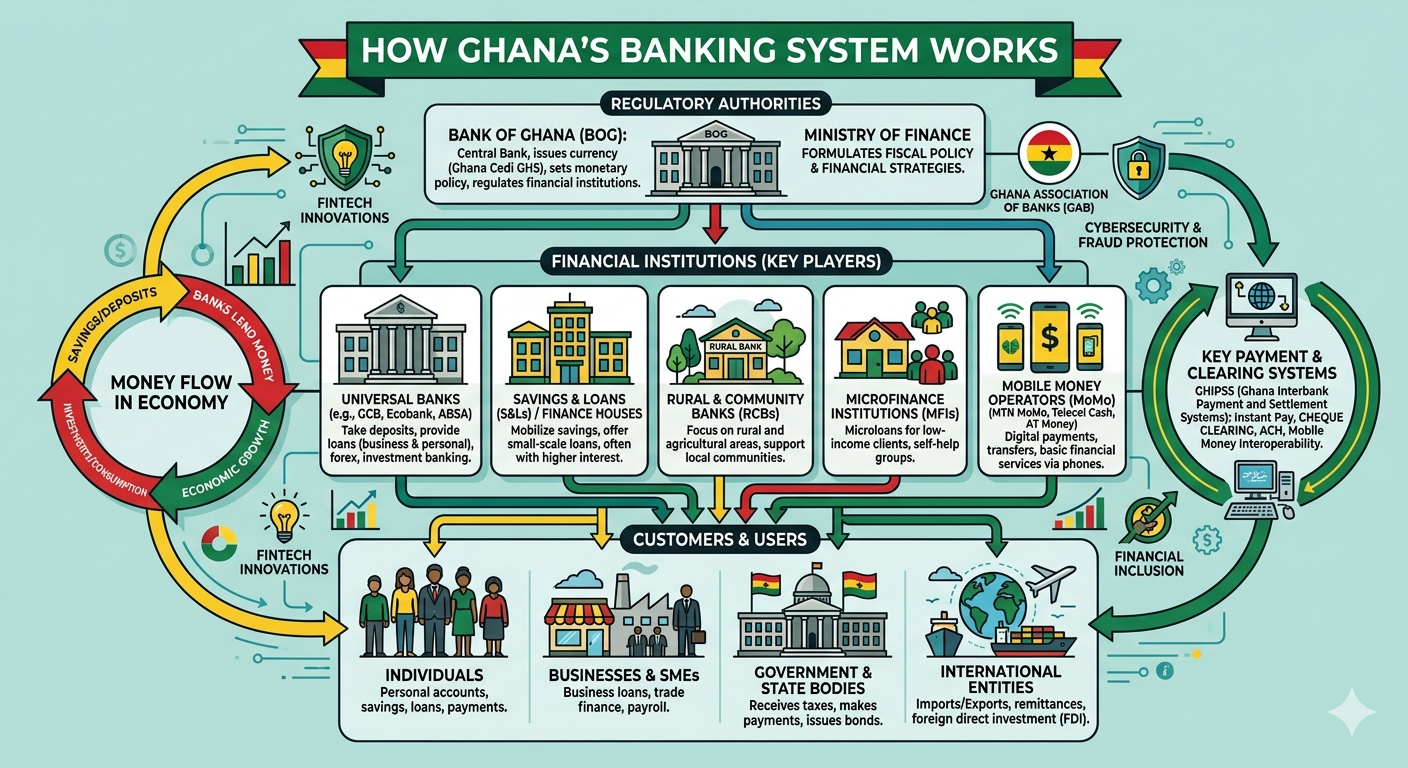
At the top of Ghana’s financial system sits the central bank, the Bank of Ghana. It acts as the regulator, supervisor, and policymaker for the entire banking industry.

Below it are:
- Commercial banks
- Savings and loans companies
- Rural and community banks
- Microfinance institutions
Each of these plays a different role, but together they form an interconnected system that supports both individuals and businesses.
The Role of the Central Bank
The Bank of Ghana is responsible for maintaining stability in the financial system.
Its key functions include:
- Issuing currency (the Ghana cedi)
- Setting interest rates to control inflation
- Regulating and supervising banks
- Managing foreign exchange reserves
When inflation rises, for example, the central bank may increase its policy rate to make borrowing more expensive. This helps reduce spending and stabilise prices.
In essence, the Bank of Ghana acts as the “guardian” of the financial system.
READ ALSO: What Business Confidence Means For Growth
Commercial Banks: The Engine of Everyday Banking
Commercial banks are what most people interact with daily. Institutions like GCB Bank, Ecobank Ghana, and Absa Bank Ghana provide services such as:
- Savings and current accounts
- Loans and credit facilities
- Payment services (transfers, cards, mobile banking)
These banks take deposits from customers and use part of that money to lend to individuals and businesses. This process is what keeps money circulating in the economy.
How Banks Make Money
Banks are businesses, and like any business, they aim to make a profit. Their primary source of income is the difference between:

- Interest paid on deposits, and
- Interest charged on loans
For example, if a bank pays 5% interest on savings but charges 20% on loans, the difference contributes to its earnings.
They also generate income from:
- Transaction fees
- Account maintenance charges
- Foreign exchange services
The Importance of Lending
Lending is at the heart of the banking system. When banks provide loans to:
- Entrepreneurs → businesses expand
- Farmers → production increases
- Individuals → consumption rises
This drives economic growth.
In Ghana, access to credit remains a major issue, especially for small and medium-sized enterprises (SMEs). High interest rates and strict collateral requirements often limit borrowing, which in turn affects business expansion.
Rural Banks and Financial Inclusion
Not every Ghanaian has access to big commercial banks. That’s where rural and community banks come in.
These institutions:
- Operate in smaller towns and villages
- Support farmers, traders, and local businesses
- Promote financial inclusion
They play a crucial role in bringing banking services closer to underserved populations, helping more people save, borrow, and invest.
Digital Banking and Mobile Money
In recent years, Ghana’s banking system has evolved rapidly with technology. Mobile money platforms like MTN Mobile Money have transformed how people access financial services.
Today, many Ghanaians can:
- Send and receive money instantly
- Pay bills and school fees
- Save and even access microloans
Banks have also embraced digital transformation, offering mobile apps and online banking services to stay competitive.
This shift is reshaping the financial landscape, making banking faster, more accessible, and more convenient.
Regulation and Stability
Ghana’s banking sector has gone through significant reforms in recent years. Following a financial sector cleanup between 2017 and 2019, the Bank of Ghana:
- Increased minimum capital requirements
- Revoked licenses of insolvent institutions
- Strengthened regulatory oversight
These measures were aimed at restoring trust and ensuring that only strong, well-capitalised banks operate in the system.
Today, the sector is more stable, though challenges remain.
Challenges Facing the Banking System
Despite progress, Ghana’s banking system faces several hurdles:
High Interest Rates
Borrowing remains expensive, limiting access to credit for businesses.
Non-Performing Loans
Some borrowers fail to repay loans, affecting bank profitability.
Economic Volatility
Inflation and currency fluctuations can impact banking operations and customer confidence.
The Bigger Picture From THSB
Ghana’s banking system is more than just deposits and withdrawals, it is a key driver of economic activity.
When the system works well:
- Businesses grow
- Jobs are created
- Investments increase
But when it struggles, the effects ripple across the entire economy.
The Bottom Line
Understanding how Ghana’s banking system works helps explain how money moves within the economy. From the regulatory role of the Bank of Ghana to the everyday services of commercial and rural banks, each part plays a vital role in supporting growth.
As Ghana continues to modernise its financial sector, especially through digital innovation, the strength and efficiency of its banking system will remain central to its economic future.
Disclaimer: Some content on The High Street Business may be aggregated, summarized, or edited from third-party sources for informational purposes. Images and media are used under fair use or royalty-free licenses. The High Street Business is a subsidiary of SamBoad Publishing under SamBoad Business Group Ltd, registered in Ghana since 2014.
For concerns or inquiries, please visit our Privacy Policy or Contact Page.

Esther Aku-Sika is a content writer and social media strategist who helps brands and startups grow through intentional storytelling and practical marketing strategies. With a keen eye for trends and audience behavior, she shares business insights, content strategies, and real-life lessons to help entrepreneurs build visibility and turn ideas into income. Through her writing, she simplifies complex concepts and equips readers with actionable steps to grow in today’s digital space.