








Ghana’s insurance penetration has been stuck at 1% for years – well below the West African average. Our deep‑dive analysis reveals six structural barriers: trust deficits, affordability gaps, cultural substitutes and the informal sector challenge.
Why Most Ghanaians Still Don’t Buy Insurance – The Trust Deficit, Affordability Gap and the Slow Digital Fix
Walk into any workplace break room, lorry park or roadside chop bar in Ghana and mention insurance. The reaction is almost predictable. A dismissive wave of the hand. A story about a friend whose claim took months to be settled. An assertion that “those companies only take your money”.
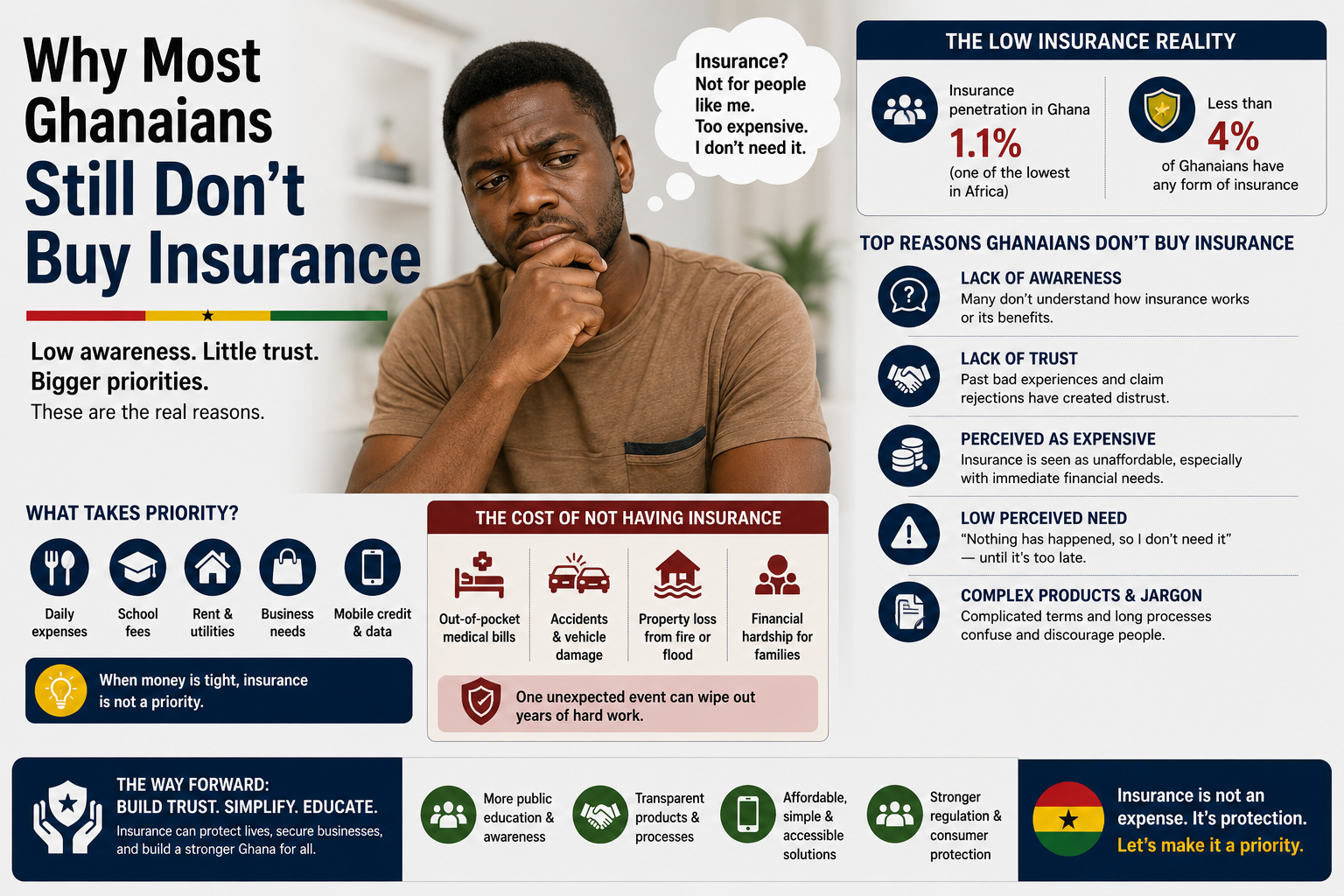
This collective scepticism is not merely anecdotal. It has a name and a number: insurance penetration. Measured as gross insurance premiums as a percentage of GDP, Ghana’s penetration rate has remained stubbornly stuck at 1 per cent for years – unchanged from 2023 to 2024, and well below the West African average of about 3 per cent and the global average of 7 per cent. Under the stricter International Financial Reporting Standard IFRS 17, the figure falls even further, to just 0.63 per cent.
📢 GET DETAILED ARTICLES + JOBS
Join THSB's WhatsApp Channel and never miss a post or opportunity.
Put bluntly: more than 98 per cent of Ghana’s economic activity, household assets and personal income are not protected by any form of private insurance. When a market woman loses her goods in a fire, a driver totals his taxi, a breadwinner falls gravely ill or a family loses its home in a flood, the financial burden falls almost entirely on personal savings, family networks, churches or the overstretched public purse. Insurance – the globally accepted tool for pooling and transferring risk – is, for the vast majority of Ghanaians, an afterthought.

This profile examines why. It goes beyond the easy explanation of “claims non-payment” to interrogate the deeper structural, cultural and economic barriers that keep Ghana’s insurance penetration at 1 per cent. It explores the stubborn trust deficit, the unaffordability of premiums relative to irregular incomes, the challenge of reaching a workforce that is 80 per cent informal, and the slow but promising emergence of digital microinsurance and regulatory reforms that could finally shift the needle.
The stakes are not small. Low insurance penetration means households are one accident away from destitution. It means businesses operate without a safety net, passing hidden risks to the broader economy. And it means that billions of cedis in potential investment capital – premiums that could be pooled and channelled into infrastructure and development – remain unrealised. Understanding why most Ghanaians still don’t buy insurance is the first step toward building a more resilient, more protected and more prosperous nation.
The Numbers That Define the Gap
Ghana’s insurance industry is not failing by every measure. The sector has demonstrated genuine resilience and growth in several dimensions.
In 2024, total industry assets climbed 18.6 per cent to GH¢17.9 billion, representing about 1.5 per cent of GDP. Equity bases expanded 31 per cent to GH¢6.62 billion, pushing average capital adequacy ratios well above the 150 per cent regulatory minimum – reaching 325 per cent for life insurers and 390 per cent for non-life insurers. Retention ratios also improved: life insurance held steady at 96.36 per cent and non-life rose to 73 per cent, indicating better local capacity to handle claims without heavy reliance on overseas reinsurers. The industry recorded real revenue growth of 19.9 per cent in 2025, according to the Financial Stability Review, with premium retention particularly strong in life insurance at 95.3 per cent.
Insurance density – per capita spending on premiums – rose modestly from GH¢195 in 2023 to GH¢202.40 in 2024, signalling either larger policy sizes or slightly improved disposable incomes. Activa Insurance claims that over 8.5 million lives have been insured through digital microinsurance platforms, and GAB Health Insurance Company (GHIC) achieved a 97 per cent claim settlement ratio in the first half of 2025, up from 94 per cent the previous year.
However, these positive indicators mask a deeper structural failure. The insurance sector’s share of Ghana’s total financial system assets has hovered around 3.4 per cent, stable over five years but dwarfed by banking at 76.4 per cent and pensions at 16.4 per cent. Penetration remains stubbornly flat. And the gap with regional peers remains wide: South Africa exceeds 13 per cent, Kenya and Morocco average 3–4 per cent, and even within West Africa, Ghana lags Ivory Coast at 1.3 per cent and Senegal at 1.2 per cent, only marginally ahead of Nigeria near 0.5 per cent.
Annual premium outflows to foreign reinsurers climbed to GH¢814 million in 2024 from GH¢656 million the year before, exposing the sector to exchange rate volatility and accelerating foreign currency outflows. With the cedi depreciating nearly 19 per cent against the dollar in 2024, this dependency is a vulnerability.
But the most telling statistic is this: Ghana’s informal sector accounts for approximately 80 per cent of the country’s workforce, yet remains almost entirely uncovered by private insurance. This is not a market that has rejected insurance. It is a market that insurance has never meaningfully reached.
The Real Reasons Most Ghanaians Don’t Buy Insurance
The conventional wisdom holds that Ghanaians don’t buy insurance because insurers don’t pay claims. This is only partly true – and perhaps not even the most important part.
1. The Trust Deficit – Real and Perceived
Claims complaints make up more than 40 per cent of all customer grievances received by the National Insurance Commission, according to a 2023 NIC report. This has created a powerful narrative: insurance companies are quick to collect premiums but slow to pay out when trouble strikes. Stories of disputed claims, lost paperwork and endless back-and-forth spread quickly, reinforcing a cycle of distrust.

Yet the data tells a more nuanced story. The majority of legitimate claims are paid – sometimes faster than customers expect. GHIC achieved a 97 per cent claim settlement ratio in 2025. The NIC itself has stated that GH¢9.2 million in claims is paid daily: GH¢5.2 million for general insurance claims and GH¢4 million for life. The newly appointed Commissioner of Insurance, Dr Abiba Zakariah, has reaffirmed the Commission’s commitment to tackling premium undercutting and unethical practices. New sanctions for delayed claims – including penalties for insurers failing to pay claims within one month of receiving all necessary documents – have been introduced.
Why does the perception persist? Because insurers have a communication problem. When a claim is paid, nobody hears about it. When a claim is delayed or denied, the story spreads like wildfire. The bigger issue, as Accra Street Journal research has found, is that insurance in Ghana has failed to build trust, relevance and simplicity for the everyday Ghanaian. Trust is not restored by regulatory enforcement alone. It requires consistent, transparent and empathetic engagement at the point of sale and, crucially, at the point of claim.
2. Affordability and the Irregular Income Problem
Even when Ghanaians trust insurance, many simply cannot afford it – or cannot afford the version of it that is offered. Traditional insurance products were designed for salaried workers with predictable monthly incomes. But over 80 per cent of the workforce is in the informal sector – market traders, farmers, artisans, drivers and gig workers whose incomes vary wildly from week to week.
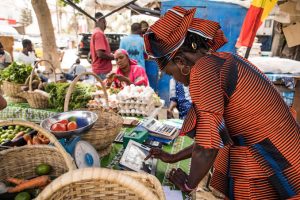
A driver earning GH¢1,500 in a good month may earn GH¢600 in a bad month. A market woman’s income fluctuates with seasons, weather and holidays. Committing to a monthly premium of GH¢300 for a health or life policy is simply impossible for someone who cannot guarantee that the money will be available. The structured premium payment model is not merely expensive – it is structurally incompatible with the financial reality of most Ghanaians. Structured premium payments often feel like a burden; many people live day‑to‑day and cannot commit to monthly deductions.
3. Cultural and Religious Substitutes for Formal Insurance
Ghana has deeply embedded informal risk‑sharing mechanisms that have operated for generations. The extended family network is the most powerful: when a member falls ill, loses a job or faces a funeral expense, the family pools resources. The susu system – a rotating savings and credit arrangement – provides another informal safety net. Churches, mosques and religious organisations function as mutual aid societies, with members contributing to welfare funds that assist those in distress.
These systems are not trivial. They are deeply trusted, culturally familiar and immediately accessible. Why pay premiums for an intangible promise when you can trust your people? Experimental research among Pentecostal church members in Accra found that enrolment in a commercial funeral insurance policy actually increased charitable giving to the church – suggesting that formal insurance and religious donations are perceived by some as substitutes, not complements. The distinction is not an abstract one. When a family must choose between a premium payment and a church offering, the offering often wins.
The challenge for insurers is not to replace these systems but to complement them – to offer protection for the kinds of catastrophic losses that even the most generous extended family cannot absorb. A family can cover a modest hospital bill. It cannot cover a cancer treatment costing tens of thousands of cedis. A church welfare fund can help with funeral expenses. It cannot rebuild a factory destroyed by fire. Insurance is not competing with tradition. It is competing with the misconception that tradition is enough.
4. Low Financial and Insurance Literacy
Most Ghanaians do not understand what they are buying – and insurers have done little to help them. Policies are written in legal jargon. Agents oversell without explaining exclusions. Customers assume that insurance means “they’ll pay me no matter what”, only to discover when a claim is denied that their policy had exclusions they never knew existed. A 2025 NIC‑commissioned report found that low insurance literacy remains a critical barrier, particularly for smaller enterprises and businesses in rural areas.
Compounding this, distribution channels remain inadequate. An effective, well‑trained distribution network is essential for building the trust that drives insurance uptake. However, microinsurance – designed specifically for low‑income populations – has historically been the least attractive product for brokers and agents because they work on commission; selling high‑premium products earns them much more. The result is a persistent mismatch between what low‑income Ghanaians can afford and need, and what the industry is incentivised to sell.
5. Enforcement Gaps in Compulsory Insurance
Ghana’s Insurance Act, 2021 (Act 1061) introduced or affirmed three categories of compulsory insurance: public liability, professional indemnity and marine cargo, in addition to the long‑standing motor and fire‑fighting insurance. Yet enforcement remains inconsistent.
Motor insurance is mandatory – and fake “policies” were once commonplace – but the introduction of the Motor Insurance Database (MID) has made enforcement more rigorous. Policies are now verified instantly, and fake documentation is harder to pass off.
Compulsory property insurance for commercial buildings, required under Sections 183 and 184 of the Insurance Act, is widely flouted. NIC task force exercises in Accra and Sekondi-Takoradi repeatedly find commercial properties without valid fire insurance certificates. One major fire in Accra could bankrupt dozens of businesses overnight because their landlords have not insured the buildings.
The gap between law and enforcement sends a powerful signal: if the government does not take compulsory insurance seriously, why should ordinary citizens?
6. The NHIS Confusion
The National Health Insurance Scheme (NHIS) has been Ghana’s most successful mass insurance programme, covering outpatient visits, maternity and some emergency care. But it has also created a problem of perception. Many Ghanaians believe that because they have NHIS, they do not need any other form of insurance – not realising that NHIS does not cover serious illnesses such as cancer, dialysis or expensive surgeries. The “insurance box” is ticked, but the gap remains wide. A quiet trend among middle‑class families is the purchase of top‑up private health coverage from providers such as Hollard Health, Glico Healthcare or Enterprise Life riders. For most Ghanaians, however, this remains out of reach financially and psychologically.
The Cost of the Gap: What 1 Per Cent Penetration Means for the Economy
Low insurance penetration is not merely a problem for the industry. It is a drag on the entire economy.
Household Vulnerability: With no formal risk transfer, households absorb shocks directly. A single accident, fire or illness can wipe out years of savings. The resulting poverty traps are persistent and severe. The social safety net – family, church, charity – is resilient but finite. When a major disaster strikes, it is not just one household that is pushed into distress, but the entire network that supports it.
Business Instability: Without business interruption insurance, property cover or liability protection, SMEs operate without a safety net. A fire in a market can wipe out dozens of small businesses simultaneously, destroying livelihoods and generating cascading defaults on loans, supplier payments and employee salaries.
Investment and Infrastructure: Insurers are major institutional investors in developed economies, channelling premium income into long‑term infrastructure bonds, corporate debt and real estate. In Ghana, the insurance sector’s total assets of GH¢17.9 billion represent just 1.5 per cent of GDP – a fraction of what could be mobilised. The NIC estimates that stronger insurance uptake could unlock billions in investment capital for national development.
Fiscal Burden: When uninsured households and businesses suffer losses, the burden often falls on the state. Disaster relief, emergency healthcare and social support programmes are all funded by taxpayers. A more insured population would reduce this contingent liability on the public purse.
Reinsurance Leakage: The outflow of GH¢814 million to foreign reinsurers in 2024 represents capital that could have been retained and reinvested locally if domestic reinsurance capacity were stronger. Higher penetration would deepen the local risk pool, making it viable to retain more risk onshore.
Catastrophic Vulnerability: As the Commissioner has noted, Ghana is entering an era of heightened climate vulnerability, with flooding, droughts and extreme weather becoming more frequent. These events can wipe out entire communities beyond the capacity of what families or government alone could rebuild. Insurance allows risk pooling nationally and globally. Without it, the exposure is dangerously high.
The Economics of the Insurers Themselves: Profitability Without Scale
If insurance penetration is so low, how are Ghana’s insurers performing? The answer is mixed.
Profitability has been strong in recent years, buoyed by investment income and improved underwriting, particularly in non‑life segments such as property and auto coverage. The industry’s average capital adequacy ratios are exceptionally high – 325 per cent for life insurers and 390 per cent for non‑life – reflecting both regulatory prudence and a cautious approach to underwriting. Retention ratios are strong, especially in life insurance at 96.36 per cent.
Yet these positive indicators mask a sector that remains small and concentrated. The industry’s share of total financial system assets at 3.4 per cent has not grown meaningfully in five years. The vast majority of premiums come from a narrow base of corporate clients, public sector employees and middle‑class households in Accra and a few regional capitals. The informal sector – 80 per cent of the workforce – remains largely untouched.
The sector is also vulnerable to external pressures. Overseas reinsurance transfers jumped sharply in 2024 to GH¢814 million, exposing domestic insurers to exchange rate volatility and reducing the share of premium income retained locally. Under IFRS 17, which recalibrates how insurance revenues are reported, penetration drops even lower – to 0.63 per cent – revealing how much of the industry’s reported premium income is consumed by reinsurance and other ceded arrangements.
The industry is profitable, but it is profitable on a small base. The challenge is not survival. It is growth. And growth cannot come from the already‑insured. It must come from the 98 per cent who are not.
The Path Forward: Digital Innovation, Microinsurance and Regulatory Reform
The story is not all bleak. A genuine shift is underway, driven by three intersecting forces: digital innovation, targeted microinsurance and determined regulatory reform.
Digital Microinsurance: Reaching the Masses on Their Phones
Mobile money has been Ghana’s most successful digital financial service, accounting for over 97 per cent of digital transaction volume. Insurtech – the use of digital tools and mobile phones to design, purchase and claim insurance – is beginning to ride that same wave.
aYo Ghana, the market leader in digital microinsurance, has insured over 8.5 million lives across the country and paid more than GH¢35 million in claims. Its model is simple: policies are purchased via mobile money using USSD codes (*296#) with premiums as low as GH¢1 per day. Products include “Recharge with Care”, Family Cover, MedCover and Pay & Drive motor insurance – low‑commitment, flexible coverage designed for mass‑market customers. The company has won multiple awards for mobile insurance innovation and customer experience, and its omnichannel model ensures that customers, regardless of location or digital literacy, can interact with aYo in the way that suits them best.
Activa International Insurance is leveraging digital innovation and targeted products to expand coverage among SMEs and underserved segments, deploying online policy acquisition, claims tracking and mobile‑based solutions to reduce entry barriers. ESOKO Ghana has introduced a form of microinsurance called “Esoko Banbɔ” as part of its bundled services to rural communities.
In agriculture, index‑based insurance models are using satellite data and AI to measure rainfall or drought, automatically triggering payouts for farmers without lengthy claims processes. CropGuard+ has developed the Farm Resilience Index (FRI) – an AI‑powered tool that verifies farmers’ climate‑smart practices and turns them into digital proof of creditworthiness, enabling both loan and insurance access.
Regulatory Push for Inclusion
The Insurance Act, 2021 (Act 1061) explicitly embeds the concept of inclusive insurance and microinsurance, enabling new license categories for innovative distribution channels. The NIC is now moving from enabling legislation to active implementation. A Committee on Insurance Penetration presented its report in August 2025, identifying three major issues: avoidance of compulsory motor insurance, significant unreported leakages, and limited reporting structures on inclusive insurance.
The NIC has announced a new strategic direction aimed specifically at extending insurance coverage to the informal sector, which constitutes the majority of Ghana’s workforce. The Commission is leveraging technology to overcome traditional distribution channel challenges, such as the high cost of setting up physical offices in every region. A planned agri‑insurance concept will include a premium subsidy to ease the financial burden on farmers.
The Commissioner of Insurance, Dr Abiba Zakariah, has been explicit: “We are moving towards innovation and inclusive insurance because we realise that the majority of Ghanaians have not been able to take insurance, not because they don’t want to, but because we have not yet met them where they are”.
Market Conduct and Trust Rebuilding
The NIC is also tackling the internal problems that have eroded trust. A Committee on Premium Undercutting and Unethical Practices, chaired by a former President of the Ghana Insurers Association, has submitted a report recommending strict enforcement of claims payment requirements, prevention of unfair pricing, promotion of fair competition and penalties for unethical practices at all levels – including shareholders, boards of directors and CEOs.
Strict enforcement of a one‑month claims payment timeline, with sanctions for violations, has been announced. The NIC has also stated that it plans to implement a Risk‑Based Supervision framework and launch a Customer Satisfaction Index to improve transparency and accountability.
Untapped Opportunities: Bancassurance and Embedded Insurance
Bancassurance – the distribution of insurance through bank branches – remains underdeveloped. Rural banks, which have the deepest reach into agricultural communities, have not been meaningfully integrated into insurance distribution due to regulatory and capacity constraints. Similarly, embedded insurance – bundling coverage with mobile money transactions, airtime purchases or other digital services – is still in its early stages. The NIC’s open insurance framework, currently being developed, could accelerate this, allowing insurtech platforms to integrate with agritech applications and other digital ecosystems seamlessly. Creating a federated ecosystem is essential for making agricultural insurance accessible.
Future Outlook: Three Scenarios for Ghana’s Insurance Market
Three scenarios will shape whether Ghana’s insurance penetration moves beyond 1 per cent.
Scenario One: Gradual Digital-Led Expansion (70 per cent probability)
Digital microinsurance continues to expand, driven by mobile money integration and insurtech innovation. aYo Ghana and similar platforms bring coverage to 10–15 million Ghanaians by 2028, primarily with low‑premium, high‑volume products. Penetration rises slowly to 1.5–2 per cent of GDP. The informal sector remains largely uncovered, but the foundation of digital trust is built. Regulatory reforms on claims payment and market conduct begin to shift public perception, though legacy mistrust fades slowly. This scenario requires sustained investment in digital infrastructure and no major external shocks.
Scenario Two: Accelerated Inclusion Breakthrough (20 per cent probability)
The NIC’s informal sector strategy, combined with aggressive digital distribution and premium subsidies for agriculture, creates a step change. Bancassurance is fully enabled. Embedded insurance becomes standard on mobile money platforms. The open insurance framework attracts significant fintech investment. Penetration reaches 2.5–3 per cent of GDP by 2028, closing the gap with West African peers. The industry’s share of financial system assets rises to 5–6 per cent. This optimistic scenario depends on strong political will, continued macroeconomic stability and effective execution of complex regulatory reforms.
Scenario Three: Stagnation and Entrenchment (10 per cent probability)
Economic shocks – a return of high inflation, cedi depreciation or a major fiscal crisis – erode household incomes and corporate confidence. Digital microinsurance growth stalls as disposable incomes shrink. Regulatory reforms are delayed or poorly implemented. Trust issues remain unresolved, and the informal sector remains largely uncovered. Penetration remains stuck at or below 1 per cent. In this scenario, Ghana continues to lag its peers, and the sector remains small, concentrated and vulnerable to reinsurance dependence and external shocks.
The most likely path is Scenario One: slow but steady expansion, led by digital innovation, with penetration climbing incrementally rather than surging. Ghana will not catch up to Kenya or Morocco in this decade. But it can, with sustained effort, close the gap with Ivory Coast and Senegal and begin to build a genuinely inclusive insurance market that serves the 80 per cent of the workforce currently left uncovered.
THSB Conclusion
Why do most Ghanaians still not buy insurance? The answer is not a single problem but a matrix of them: a trust deficit built on real grievances and poor communication; an affordability gap that traditional products were never designed to bridge; a large informal workforce whose irregular incomes and cultural risk‑sharing mechanisms are poorly understood by the industry; low financial literacy that leaves customers confused about what they are buying; weak enforcement that signals that compulsory insurance is optional; and an industry that, despite strong profitability and capitalisation, has not yet figured out how to distribute effectively to the mass market.
The insurance industry is not failing. It is profitable. It is well capitalised. It pays out millions in claims every day. But it is not growing – not in the sense that matters, which is reaching the 98 per cent of Ghanaians who currently have no private cover.
The path forward is becoming clearer. Digital microinsurance, led by aYo and other insurtech players, is demonstrating that Ghanaians will buy insurance when it is affordable, simple and accessible on their phones. The NIC’s strategic pivot toward inclusive insurance, premium subsidies for agriculture and technology‑enabled distribution is the right direction. The growing enforcement of market conduct rules, including sanctions for delayed claims and premium undercutting, is a necessary corrective.
But the gap between policy and practice remains wide. Trust is not restored by regulatory threats alone. It is earned, slowly and painfully, through consistent, transparent and empathetic engagement – at the point of sale, at the point of claim and at every point in between. The informal sector is not a problem to be solved. It is a market to be served. And serving it requires products designed for irregular incomes, distributed through channels people trust and explained in language they understand.
The 1 per cent penetration rate is not a statistic. It is a measure of the distance Ghana’s insurance industry has yet to travel. The foundation has been laid. The technology is available. The regulatory direction is clear. The missing ingredient is not capital or capacity. It is trust – and the determination to earn it, one policy, one claim, one customer at a time.
Frequently Asked Questions (FAQ)
Q1: What is Ghana’s current insurance penetration rate?
Ghana’s insurance penetration – gross premiums as a percentage of GDP – has remained stuck at 1 per cent for several years, unchanged from 2023 to 2024. Under the stricter IFRS 17 reporting standard, the figure is even lower at 0.63 per cent. The West African average is about 3 per cent, and the global average is 7 per cent.
Q2: How does Ghana compare to other African countries?
Ghana lags significantly behind South Africa (over 13 per cent) and Kenya and Morocco (3–4 per cent). Within West Africa, it trails Ivory Coast (1.3 per cent) and Senegal (1.2 per cent), and is only slightly ahead of Nigeria (0.5 per cent).
Q3: Why don’t more Ghanaians buy insurance?
Six factors interact: a persistent trust deficit built on real claims delays and poor communication; unaffordable premiums relative to irregular incomes; cultural reliance on family, churches and susu groups as informal safety nets; low insurance literacy leaving customers confused about what policies actually cover; weak enforcement of compulsory insurance requirements; and the National Health Insurance Scheme creating a false sense of comprehensive coverage.
Q4: Is it true that insurance companies in Ghana don’t pay claims?
No. The majority of legitimate claims are paid. GHIC achieved a 97 per cent claim settlement ratio in 2025, and the NIC states that GH¢9.2 million in claims is paid daily. However, claims complaints make up more than 40 per cent of all customer grievances, and the perception of non‑payment is powerful because negative stories spread faster than positive ones.
Q5: What is the National Insurance Commission doing to improve the sector?
The NIC is implementing a three‑pronged strategy: public sensitisation to build trust, stricter market conduct enforcement (including sanctions for delayed claims and premium undercutting), and a push toward inclusive insurance targeting the informal sector and agriculture. A Risk‑Based Supervision framework and Customer Satisfaction Index are being developed. A premium subsidy for agricultural insurance is planned.
Q6: What is microinsurance and how is it helping?
Micro insurance offers low‑premium, simple policies designed for low‑income consumers. aYo Ghana, the market leader, has insured over 8.5 million lives through mobile money, with premiums as low as GH¢1 per day. Activa Insurance, ESOKO Ghana and others are also expanding digital microinsurance.
Q7: How does mobile money help insurance penetration?
Mobile money integration allows policies to be purchased via USSD codes, with premiums deducted directly from mobile wallets. This removes the paperwork, lowers the entry barrier (sometimes to GH¢1) and meets customers where they already transact. aYo’s platform uses *296# for registration and claims initiation, and many claims are settled within five working days.
Q8: What insurance is compulsory in Ghana?
The Insurance Act, 2021 (Act 1061) makes motor insurance, fire‑fighting insurance for commercial properties, public liability insurance, professional indemnity insurance and marine cargo insurance compulsory. Enforcement has improved for motor insurance with the Motor Insurance Database (MID), but property insurance compliance remains poor, with task forces regularly finding commercial buildings without valid certificates.
Q9: Is NHIS enough, or do Ghanaians need private health insurance?
NHIS covers outpatient visits, maternity and some emergency care, but it does not cover serious illnesses such as cancer, dialysis or expensive surgeries. A growing number of middle‑class families are purchasing private top‑up coverage from providers such as Hollard Health, Glico Healthcare or Enterprise Life riders. For most Ghanaians, however, private health cover remains out of reach financially.
Q10: How affordable is insurance for the average Ghanaian?
Traditional annual premiums for comprehensive motor insurance, for instance, cost about 5–7 per cent of a vehicle’s value, while third‑party cover ranges from GH¢300 to GH¢500 per year. For a driver earning irregular income, this can be a significant burden. Daily or pay‑as‑you‑go microinsurance products (like aYo’s Recharge with Care and Pay & Drive) are designed specifically to address the irregular‑income problem.
Q11: What is the insurance sector’s share of Ghana’s financial system?
The insurance sector accounts for about 3.4 per cent of total financial system assets, dwarfed by banking at 76.4 per cent and pensions at 16.4 per cent. Total industry assets reached GH¢17.9 billion in 2024, representing 1.5 per cent of GDP.
Q12: What is the future outlook for insurance in Ghana?
The most likely scenario is gradual, digital‑led expansion, with penetration rising slowly to 1.5–2 per cent of GDP by 2028. Digital microinsurance will be the primary driver. The informal sector remains the great untapped market, and whether it is reached will depend on trust‑building, affordability and distribution innovation. The NIC’s strategic push toward inclusive insurance is the right direction, but execution will determine the outcome.
Source: The High Street Business
Disclaimer: Some content on The High Street Business may be aggregated, summarized, or edited from third-party sources for informational purposes. Images and media are used under fair use or royalty-free licenses. The High Street Business is a subsidiary of SamBoad Publishing under SamBoad Business Group Ltd, registered in Ghana since 2014.
For concerns or inquiries, please visit our Privacy Policy or Contact Page.

Esther Aku-Sika is a content writer and social media strategist who helps brands and startups grow through intentional storytelling and practical marketing strategies. With a keen eye for trends and audience behavior, she shares business insights, content strategies, and real-life lessons to help entrepreneurs build visibility and turn ideas into income. Through her writing, she simplifies complex concepts and equips readers with actionable steps to grow in today’s digital space.