






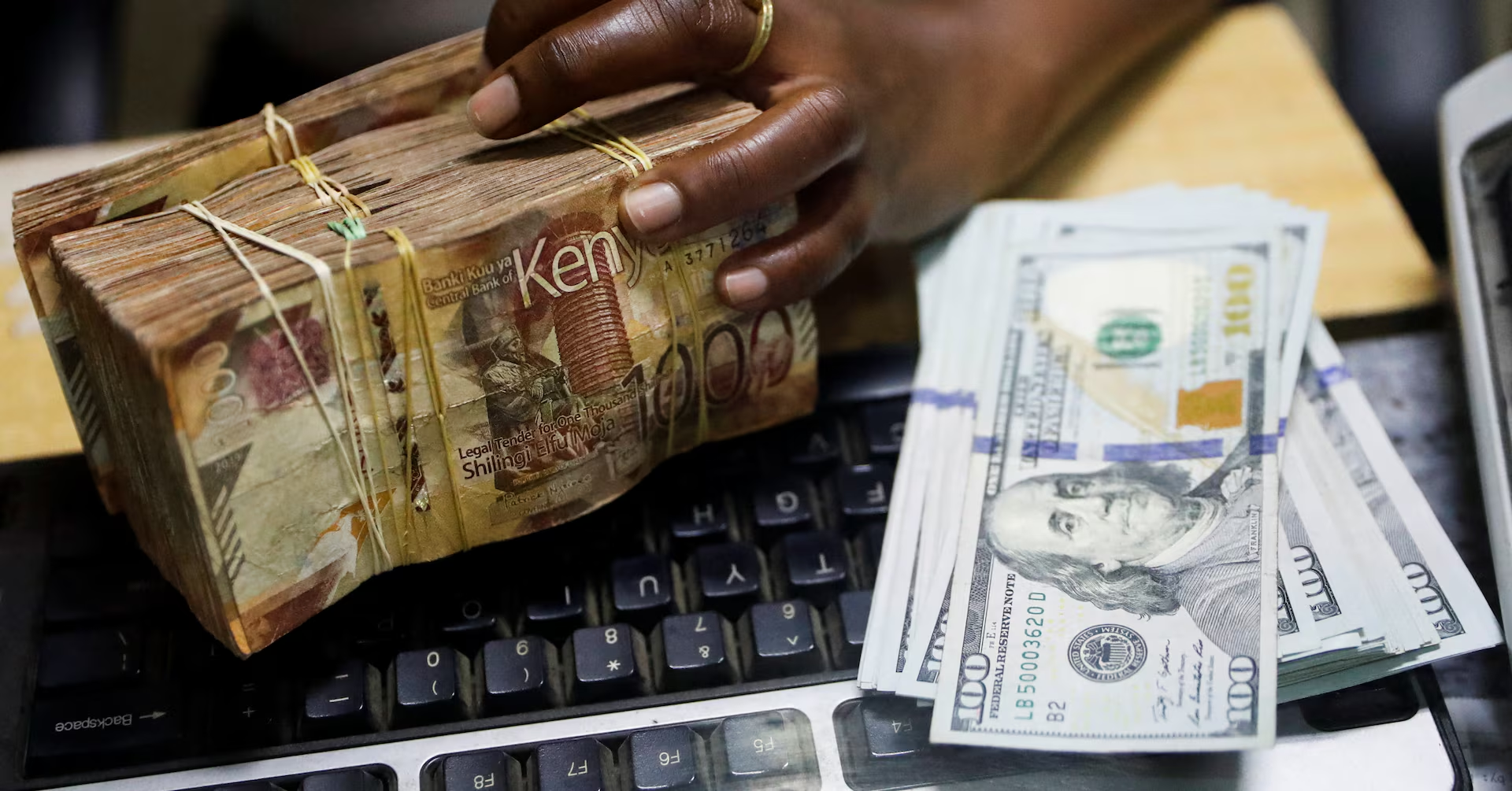
The Ghanaian cedi has long been one of Africa’s most closely watched currencies, and for good reason. In an import-dependent economy where the local currency’s value against the dollar can make or break businesses, currency movements ripple through every sector—from the price of petrol at the pump to the cost of imported rice on market shelves, and from the competitiveness of cocoa exports to the real value of remittances from abroad.
Between 2022 and 2025, Ghana experienced a dramatic currency rollercoaster. The cedi depreciated sharply through 2022-2023, then staged a remarkable recovery in early 2025, briefly strengthening from about GH¢14 to GH¢10 against the US dollar, before reversing course once more. This volatility has forced businesses, households, and policymakers to confront a fundamental question: What do currency movements actually mean for Ghana’s markets?
This THSB analysis unpacks the complex, often counterintuitive relationship between cedi movements and Ghana’s economic landscape, examining how businesses cope, why policymakers face conflicting pressures, and what structural reforms could finally break the cycle of volatility.
📢 GET DETAILED ARTICLES + JOBS
Join THSB's WhatsApp Channel and never miss a post or opportunity.
Part 1: The Mechanics of Currency Impact
The Import-Dependent Economy
Ghana’s vulnerability to currency movements begins with a simple structural reality: the country imports far more than it produces domestically. From petroleum products to machinery, from vehicles to food staples, Ghana relies on foreign exchange to meet everyday needs.
Research published in 2025 reveals the depth of this dependence. A study of 120 monthly observations from 2014 to 2023 found that world oil prices and domestic inflation significantly depreciate the cedi, while the exchange rate has an “almost perfect pass-through” to domestic petrol prices, with an estimated elasticity of 0.89 . In simpler terms, when the cedi weakens, fuel prices rise almost one-for-one.
The study further found that petroleum sector shocks can explain 42 percent of exchange rate long-term variance within a 24-month timeframe . This creates a vicious cycle: a weaker cedi raises fuel import costs, which feeds into inflation, which further pressures the currency—a self-reinforcing loop that Ghana has struggled to break.
The Commodity Price Connection
Ghana’s export basket—heavily concentrated in gold, cocoa, and crude oil—adds another layer of complexity. Research examining the asymmetric dependence between commodity prices and exchange rates from 2003 to 2023 uncovered surprising dynamics .
Contrary to conventional wisdom, not all commodity price movements affect the cedi in the same way. The study found that cocoa and crude oil prices demonstrate a “predominantly negative influence” on the exchange rate, indicating an appreciation of the cedi. However, diesel and petrol prices positively impact the exchange rate, implying a depreciation .
This finding reflects Ghana’s dual position: as an exporter of cocoa and crude oil but an importer of refined petroleum products. While higher global cocoa prices strengthen the cedi, higher imported fuel costs weaken it—illustrating how commodity dependence creates competing pressures.
The Overvaluation Risk
The cedi’s sharp appreciation in early 2025 created a different set of concerns. Analysis using the Real Effective Exchange Rate (REER) model showed that the currency became significantly overvalued relative to its long-term equilibrium .
Between 2015 and 2019, Ghana’s REER hovered near equilibrium, supporting export competitiveness. The sharp depreciation in 2023-2024 led to undervaluation, but this was inconsistent with economic fundamentals—a crisis-driven deviation . The sharp appreciation in 2025, however, pushed the REER to 85-88 against an equilibrium of 74, a “very wide misalignment” that now threatens competitiveness .
Dr. Anane Agyei, who conducted the analysis, warns that an overvalued currency “can erode export competitiveness, making Ghanaian goods more expensive abroad and increasing reliance on imports as imported goods become cheaper which will undermine the domestic economy” . The consequences ripple through the economy: widening current account deficits, pressure on foreign reserves, and inflationary surges.
Part 2: How Businesses Experience Currency Volatility
Importers and the Two-Tier FX System
For importers, currency movements are a daily reality. When the cedi weakens, costs rise; when it strengthens, relief is supposed to follow. But the experience is rarely that straightforward.
The Ghana Union of Traders Association (GUTA) has been vocal about the challenges. Vice President Clement Boateng acknowledged the cedi’s recent gains but warned that “this temporary relief could easily be eroded if systemic challenges remain unresolved” .
Long import cycles complicate the picture. Boateng explained that goods take weeks or months to arrive from China, the UAE, and other key markets, meaning “traders cannot immediately adjust prices to reflect exchange rate movements” . By the time goods land, the currency may have shifted again, leaving traders caught between margins and market expectations.
More concerning is the growing disconnect between official exchange rates and the rates importers actually pay. Analysis from the IMANI Centre for Policy and Education documented a “two-tier FX system” where banks ration dollars at the official rate (around GH¢10.30), forcing importers to turn to the black market where rates often exceed GH¢11.50 .
The interbank market is no longer truly reflective of demand and supply,” Bright Simons of IMANI observed. It is tightly watched by the BoG, and banks conduct only light trades at the official rate, trades that do not represent real volumes or real pressure” . This distortion means that even when the cedi appears strong in official data, businesses feel little relief.
Spare parts dealers at Abossey Okai in Accra reported that despite the cedi’s recovery, they saw “little reduction in import duties,” with Customs using an exchange rate that appears “out of step with the official rate” .
Exporters: The Price of Appreciation
For exporters, a strong cedi is not necessarily good news. Nana Amoto Mensah, Executive Director of C-nergy Global Holdings, warned that “because the Cedi is appreciating against the dollar, our exports become more expensive for external markets,” which “pushes us toward imports since we need fewer cedis to bring in goods” .
This dynamic, he cautioned, “effectively kills local industry and stifles job creation” . While the cedi’s appreciation has brought short-term benefits—inflation dropping to single digits and interest rates declining from over 30% to about 24%—these gains “must not obscure the long-term risks” .
The structural weakness of Ghana’s export sector compounds the problem. Dr. Nii Moi Thompson, Chairman of the National Development Planning Commission, noted that Ghana’s manufactured exports account for only about 5% of total merchandise exports, compared with an average of about 60% for lower middle-income countries .
“Ghana has been following this prescription since the early 1980s,” Thompson said of the belief that a weaker currency boosts exports. “If a weak currency alone could make a country competitive, we should by now be leading global exports” .
The conditions required for depreciation to work—low inflation, productive capacity, and competitive industrial structure—do not exist in Ghana’s economy, Thompson argued .
The Consumer Impact
At the household level, currency movements affect everything from food prices to school fees. GUTA observed that while some essential goods such as rice and cooking oil have seen marginal price reductions following the cedi’s appreciation, “many traders remain reluctant to adjust prices downward even when the currency strengthens” .
Bank of Ghana Governor Dr. Johnson Asiama has called out a deeper problem: the culture of dollarisation. Too many businesses continue to price in dollars, in real estate, education, and luxury retail, despite transacting entirely within Ghana,” he stated . This practice “not only violates legal tender laws but also undermines confidence in the Cedi” .
Compounding the issue, Dr. Asiama noted that “while export receipts have risen, a significant portion is either held offshore or not channelled back into productive activity at home,” meaning the foreign exchange Ghana earns does not always translate into domestic economic benefit .
SMEs and Hedging: The Strategic Capability Gap
Perhaps the most revealing research on how businesses cope with currency volatility comes from a study of 589 SMEs in Accra and Tema . The findings are stark: exchange-rate fluctuations exert a “negative and statistically significant drag” on SMEs’ import-export performance .
However, the study also found that hedging instruments—including forwards, options, swaps, and netting—can make a decisive difference. At high hedging intensity, adverse impacts of volatility “are neutralised or reversed, enabling well-hedged firms to convert currency swings into competitive advantage” .
The authors describe hedging not simply as a financial safeguard but as a “strategic capability,” consistent with the Resource-Based View that explains why some SMEs thrive under turbulence while others falter .
The implication is clear: Ghanaian businesses that treat currency risk management as a core competence—rather than an afterthought—are better positioned to weather the volatility that has become a structural feature of the Ghanaian economy.
Part 3: Policy Responses and Dilemmas
Gold-for-Oil: Managing Short-Term Pressure
In 2023, Ghana introduced a novel payment arrangement for petroleum imports, using gold instead of scarce US dollars . The policy was designed to reduce immediate demand for foreign exchange, supporting relative stability in the cedi and moderating fuel price pressures.
The strategy delivered short-term benefits. Inflation eased significantly from peak levels in 2023 to around 3%-4% in early 2026, and pump prices declined by over 20% year-on-year in February 2026 .
However, as energy economist Theophilus Acheampong cautions, “relief is not reform” . Ghana’s structural vulnerabilities remain: limited refining capacity, weak storage infrastructure, and an underdeveloped downstream petroleum sector. Domestic refining meets only a small share of demand, with roughly 72% of refined petroleum products supplied through imports .
This means that “as long as these constraints remain, oil shocks will continue to transmit quickly into the exchange rate, inflation and the broader economy” .
The Policy Dilemma
Bank of Ghana Governor Dr. Johnson Asiama has openly acknowledged the competing pressures facing policymakers. A strong currency improves terms of trade and helps lower inflation,” he said. But prolonged appreciation can hurt export competitiveness, make Ghanaian goods less attractive abroad, and slow the industrial recovery” .
The Bank must “walk a delicate line, managing forex strength without overtightening liquidity, which could suppress private sector credit and stifle the very growth we seek to encourage,” Dr. Asiama stated . This balance “requires constant recalibration based on evolving data and market behaviour” .
Structural Reform vs. Stabilisation
The deeper challenge, as Dr. Nii Moi Thompson argues, is that Ghana has confused stabilisation with development. The IMF is not designed to fix structural weaknesses,” he said. “Their benchmarks are often about short-term adjustments, not long-term transformation” .
Thompson warned that Ghana’s development challenge goes beyond fiscal targets and exchange rate management and must focus on building strong institutions, improving productivity, and restructuring the economy . “You can give any president a decade in office, but if the institutions responsible for delivering development are weak, very little will change,” he cautioned .
The Reserve Accumulation Imperative
Dr. Anane Agyei’s REER analysis offers specific policy prescriptions. First, the Bank of Ghana “must intervene judiciously to prevent excessive appreciation, using sterilised interventions to maintain monetary policy credibility” .
Second, building robust foreign reserve buffers “now that the ‘rains are not pouring'” will help cushion the economy against potential external shocks and currency volatility .
Third, diversification policies should be intensified “by promoting non-traditional exports and value-added sectors—such as agro-processing and manufacturing—to reduce dependence on primary commodities and strengthen competitiveness” .
Part 4: The Path Forward
Breaking the Cycle
Ghana’s experience with currency volatility offers lessons for other emerging economies. The path to stability is not found in exchange rate targeting alone but in addressing the structural weaknesses that make the economy vulnerable.
The key areas for reform include:
-
Export Diversification: Reducing dependence on gold, cocoa, and oil by developing non-traditional exports and value-added manufacturing. As the IMANI analysis notes, “Ghana’s exports remain dominated (over 80%) by unprocessed commodities. Without structural transformation, Ghana will continue to export raw goods and import everything else” .
-
Energy Independence: Expanding domestic refining capacity, improving storage infrastructure, and developing the downstream petroleum sector to reduce import dependence. The country’s vulnerability to oil price shocks, which can explain 42% of exchange rate variance, cannot be addressed without these changes .
-
Productivity Enhancement: Total factor productivity in Ghana has been “declining consistently” and has “intensified in the last two years,” according to the REER analysis . Reversing this decline requires investment in infrastructure, technology, and skills development.
-
Institutional Strengthening: As Dr. Thompson argues, Ghana’s economic recovery will remain fragile unless leaders shift focus from short-term policy fixes to long-term structural reforms that strengthen governance, productivity, and service delivery .
-
Transparency and Accountability: IMANI’s Bright Simons stresses that “Ghana’s industrial transformation agenda cannot succeed in secrecy” and calls for publishing program performance data and creating feedback loops to adapt and improve .
A Strategic Capability for Businesses
For businesses, the research is unequivocal: hedging is not merely a financial safeguard but a strategic capability . Firms that treat currency risk management as a core competence—institutionalising risk management systems and adopting derivative instruments—can neutralise or even reverse the adverse impacts of volatility .
As the GUTA Vice President noted, long import cycles mean traders cannot immediately adjust prices to reflect exchange rate movements . This underscores the importance of forward planning, currency forecasting, and strategic hedging in managing the inevitable volatility.
THSB Conclusion
Currency movements are not an external shock to be weathered in Ghana; they are a structural feature of the economic landscape. The cedi’s volatility reflects deeper vulnerabilities: an import-dependent economy, a concentrated export basket, limited domestic production capacity, and weak institutional infrastructure.
The appreciation of 2025 brought relief but also risk. While it helped lower inflation and interest rates, it also threatened export competitiveness, widened current account deficits, and created a two-tier FX system that left importers struggling to access dollars at official rates .
The lesson from Ghana’s experience is that currency stability cannot be achieved through exchange rate targeting alone. It requires structural transformation—diversifying exports, reducing energy import dependence, improving productivity, and strengthening institutions. As Dr. Thompson put it: “Stabilisation is not development. After stabilisation, you must grow, expand productive capacity and structurally transform the economy. That is where the real work is” .
For businesses, the imperative is clear: currency risk management must become a strategic capability, not an afterthought. Those that embrace this will not merely survive volatility; they will convert it into competitive advantage.
Quick Facts Box
| Category | Details |
|---|---|
| Cedi Performance (2026) | Depreciated 10.28%; West Africa’s worst-performing currency |
| Exchange Rate Pass-through to Fuel Prices | 0.89 elasticity (almost one-for-one) |
| Petroleum Shocks’ Share of Exchange Rate Variance | 42% over 24-month horizon |
| REER Overvaluation (2025) | Actual REER 85-88 vs. Equilibrium 74 |
| Manufacturing Share of Exports | ~5% (vs. ~60% for lower middle-income countries) |
| Refined Petroleum Imports | ~72% of domestic consumption |
| Top Export Commodities | Gold, Cocoa, Crude Oil |
| Key Currency Drivers | Stock market index, fiscal operations, Taylor rule, US economy spillovers |
| Businesses Most Exposed | Importers, exporters, SMEs |
| Key Reform Priorities | Export diversification, energy independence, productivity enhancement |
Source: The High Street Business
Disclaimer: Some content on The High Street Business may be aggregated, summarized, or edited from third-party sources for informational purposes. Images and media are used under fair use or royalty-free licenses. The High Street Business is a subsidiary of SamBoad Publishing under SamBoad Business Group Ltd, registered in Ghana since 2014.
For concerns or inquiries, please visit our Privacy Policy or Contact Page.

Samuel Kwame Boadu is a Ghanaian entrepreneur, writer, and digital consultant passionate about creating impactful stories and business solutions. He is the Founder & CEO of SamBoad Business Group Ltd, a dynamic company with subsidiaries in digital marketing, logistics, publishing, and risk management.