





Ghana’s economy is often discussed in terms of visible indicators—inflation rates, exchange movements, interest levels, and fiscal balances. These headline numbers dominate public debate and business conversations. Yet beneath these visible metrics lie deeper, less obvious risks that quietly shape outcomes for businesses, investors, and consumers.
At The High Street Business, we believe that some of the most significant threats to enterprise in Ghana are not always the ones making daily headlines. They are structural, behavioural, and systemic risks that build gradually and only become visible when conditions tighten.
Understanding these hidden risks is essential for businesses that want to survive volatility and remain relevant in a changing economic environment.
📢 GET DETAILED ARTICLES + JOBS
Join THSB's WhatsApp Channel and never miss a post or opportunity.
Risk One: Structural Dependence on a Narrow Economic Base
One of the most persistent hidden risks in Ghana’s economy is its structural dependence on a limited range of sectors and commodities. Gold, cocoa, oil, and a narrow set of services continue to drive foreign exchange earnings and fiscal revenues.
While diversification has been discussed for decades, the economy remains vulnerable to external shocks affecting these sectors. When global commodity prices fall or production is disrupted, the ripple effects reach businesses far beyond mining or agriculture.
For businesses, this creates indirect exposure. Reduced foreign exchange inflows affect currency stability, import costs, consumer spending, and government revenue—factors that shape the entire business environment.
Risk Two: Informality and Weak Business Integration
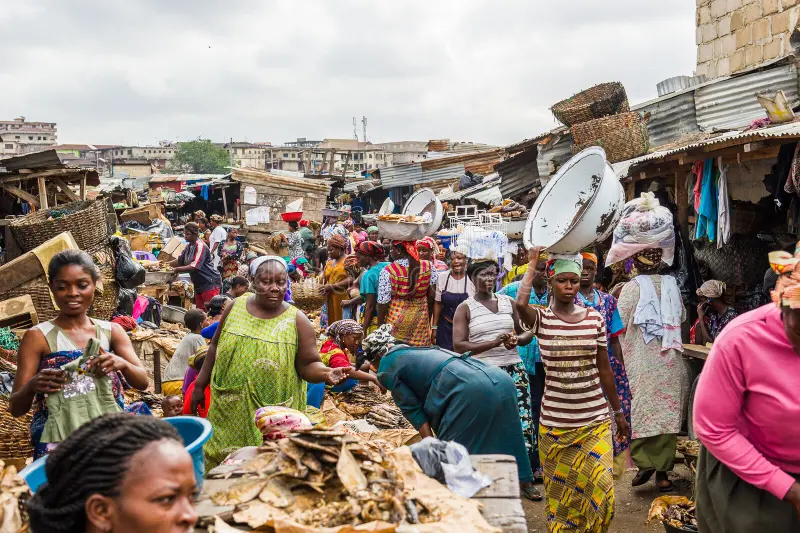
A significant portion of Ghana’s economy operates informally. While informality provides livelihoods, it also creates hidden risks for formal businesses.
An economy with a large informal sector limits tax revenue, distorts competition, and weakens regulatory enforcement. Formal businesses often face higher compliance costs while competing with informal operators who operate outside regulatory frameworks.
This imbalance discourages investment, reduces scale efficiencies, and limits the development of strong value chains. Over time, it slows productivity growth and weakens the overall business ecosystem.
Risk Three: Policy Uncertainty Beyond Announcements
Policy risk in Ghana is not always about what is announced—it is about how policies are implemented and sustained. Businesses often adjust to new taxes, levies, or regulations, but uncertainty arises when enforcement is inconsistent or policy direction shifts abruptly.
Hidden within policy changes is the risk of unpredictability. When businesses cannot reliably anticipate regulatory outcomes, long-term planning becomes difficult. This discourages investment, innovation, and job creation.
Economic history shows that uncertainty, more than policy difficulty, undermines business confidence.
Risk Four: Debt Pressures and Fiscal Constraints
Public debt is often discussed at the macroeconomic level, but its hidden risks are felt directly by businesses. High debt levels constrain government spending, delay payments to contractors, and increase pressure to raise taxes.
For businesses dependent on government contracts or public-sector-driven demand, fiscal stress can translate into cash flow challenges. Even private businesses are affected as higher taxes and reduced public investment limit economic momentum.
Debt pressures also reduce the government’s ability to respond effectively to future shocks, increasing vulnerability across the economy.
Risk Five: Financial Sector Risk Transmission
While Ghana’s financial sector has undergone reforms, hidden risks remain in how financial stress is transmitted to businesses. High interest rates, cautious lending practices, and risk aversion can persist long after economic conditions begin to stabilise.
SMEs are particularly exposed. Limited access to affordable credit restricts expansion, innovation, and working capital management. When banks prioritise safety over growth, productive businesses struggle to scale.
This credit constraint becomes a silent drag on economic recovery.
Risk Six: Skills Mismatch and Productivity Gaps
Another often-overlooked risk is the mismatch between labour force skills and business needs. Ghana has a youthful population, but skills gaps limit productivity growth.
Businesses spend time and resources retraining employees, increasing operating costs. Over time, low productivity affects competitiveness, pricing power, and profitability.
This hidden risk does not trigger immediate crises, but it weakens long-term growth potential across sectors.
Risk Seven: Overreliance on Consumption-Led Growth
Consumption plays a significant role in Ghana’s economy. While strong consumer demand supports businesses in the short term, overreliance on consumption without corresponding productivity and export growth creates imbalance.
When consumer spending is driven by borrowing or temporary income gains, downturns are sharper and recovery slower. Businesses that base growth solely on consumption trends are more vulnerable during economic adjustments.
Balanced growth requires investment, exports, and productivity—not consumption alone.
Risk Eight: Weak Supply Chain Resilience
Many businesses underestimate supply chain risks until disruptions occur. Ghana’s economy relies heavily on imports for raw materials, equipment, and finished goods.
Exchange rate volatility, logistics disruptions, and external shocks expose businesses to sudden cost increases and delays. Without resilient supply chains or local alternatives, these disruptions quickly translate into higher prices and reduced margins.
Supply chain fragility is a hidden risk that becomes visible only under stress.
Risk Nine: Confidence Erosion and Expectation Management
Business confidence has already been identified as a critical factor, but its erosion is itself a hidden risk. Negative expectations can become self-fulfilling.
When businesses expect difficult conditions, they cut investment and hiring preemptively. This reduces economic activity, validating pessimistic expectations.
Managing expectations—through transparency, credible policy signals, and responsible business behaviour—is essential to preventing confidence-driven slowdowns.
Risk Ten: Long-Term Competitiveness Erosion
Perhaps the most significant hidden risk is the gradual erosion of competitiveness. Rising costs, low productivity growth, infrastructure constraints, and policy uncertainty accumulate over time.
Unlike sudden shocks, competitiveness erosion is slow and subtle. Businesses may remain operational but lose ground regionally and globally.
Reversing this trend requires sustained attention, not crisis response.
What These Hidden Risks Mean for Businesses
Hidden risks do not announce themselves loudly. They operate quietly, shaping outcomes over time. Businesses that focus only on visible indicators may miss deeper vulnerabilities.
Understanding these risks allows businesses to plan better, diversify, strengthen internal systems, and engage more strategically with the economic environment.
At The High Street Business, we believe awareness is the first step toward resilience. Ghana’s economy offers opportunities, but those opportunities exist alongside risks that demand attention, discipline, and long-term thinking.
FAQs
What are hidden economic risks?
Hidden risks are structural or systemic challenges that are not immediately visible in headline economic data but affect long-term stability.
Why should businesses care about hidden risks in Ghana’s economy?
They influence costs, demand, investment decisions, and long-term competitiveness.
Are hidden risks more dangerous than visible risks?
They can be, because they build gradually and are often addressed too late.
Can businesses protect themselves from these risks?
Yes, through diversification, resilience planning, productivity improvement, and policy awareness.
Do hidden risks affect all sectors equally?
No. Their impact varies by sector, size, and business model.
Source: The High Street Business
Disclaimer: Some content on The High Street Business may be aggregated, summarized, or edited from third-party sources for informational purposes. Images and media are used under fair use or royalty-free licenses. The High Street Business is a subsidiary of SamBoad Publishing under SamBoad Business Group Ltd, registered in Ghana since 2014.
For concerns or inquiries, please visit our Privacy Policy or Contact Page.

Samuel Kwame Boadu is a Ghanaian entrepreneur, writer, and digital consultant passionate about creating impactful stories and business solutions. He is the Founder & CEO of SamBoad Business Group Ltd, a dynamic company with subsidiaries in digital marketing, logistics, publishing, and risk management.