








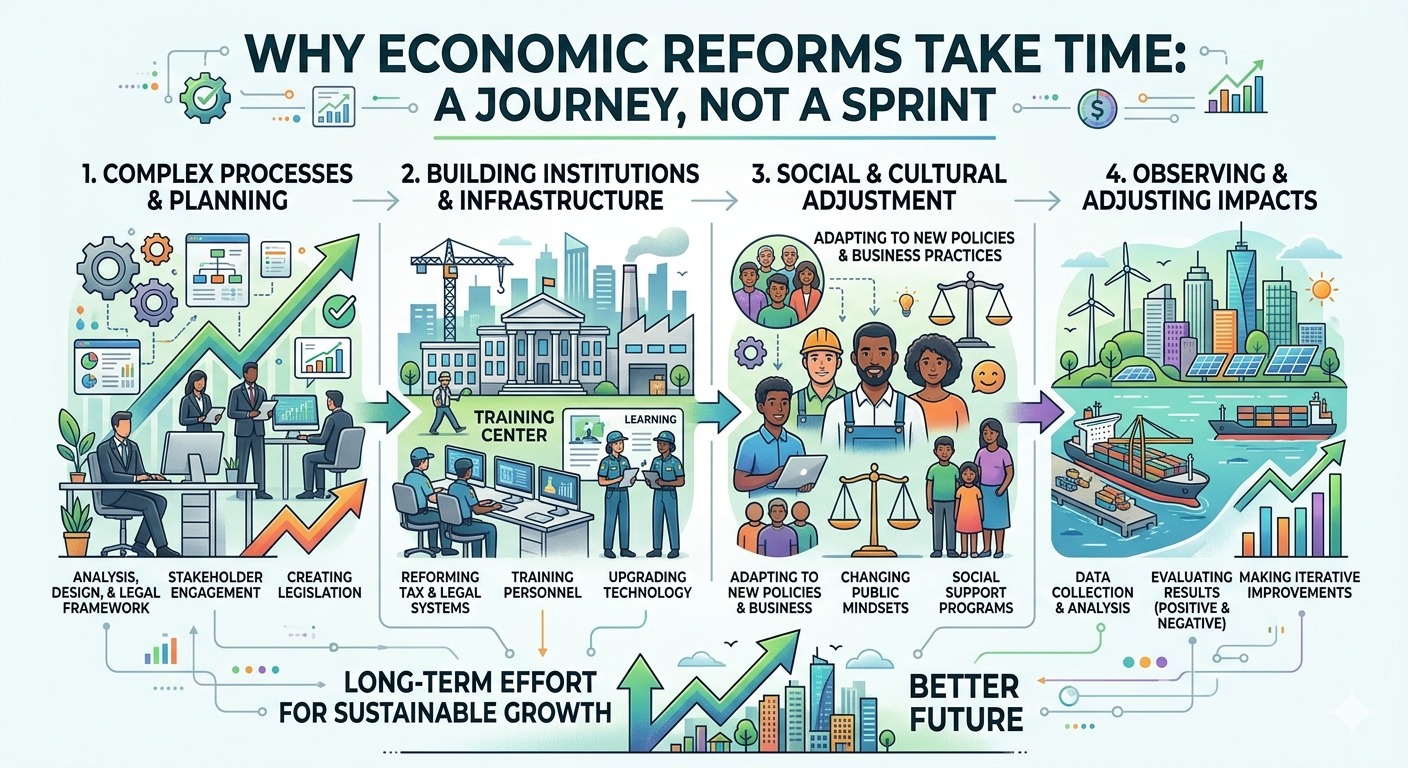
Why Economic Reforms Take Time – Economic reforms are often seen as quick fixes, but in reality, they take time to deliver results. This article explains why reforms move slowly and what that means for Ghana’s economy and everyday citizens.
Why Economic Reforms Take Time
Economic reforms are often announced with urgency and optimism. Governments promise stability, growth, and relief for citizens struggling with high prices or unemployment. Yet, for many people, the results seem slow, or even invisible at first. In Ghana, as in many developing economies, reforms can feel like a long journey rather than an instant solution.
Understanding why economic reforms take time is essential, especially at a moment when the country is implementing policy changes under programmes supported by institutions like the International Monetary Fund. The reality is simple: economies are complex systems, and changing them requires patience, coordination, and resilience.
📢 GET DETAILED ARTICLES + JOBS
Join THSB's WhatsApp Channel and never miss a post or opportunity.
Reforms Start with Pain Before Gain
One of the most difficult truths about economic reforms is that they often bring short-term discomfort before long-term benefits.
When governments implement reforms: such as cutting public spending, removing subsidies, or increasing taxes, they are usually trying to correct deeper structural problems. These actions can stabilize public finances, but they also tend to increase the cost of living in the short run.
In Ghana, for example, subsidy reductions or currency adjustments can lead to higher fuel and transport costs. Businesses may pass these costs on to consumers, and households feel the pressure almost immediately. This initial hardship can make reforms seem ineffective, even when they are laying the groundwork for stability.
Structural Changes Take Time to Reflect
Economic reforms are not just about policies on paper, they involve transforming entire systems. For instance, improving tax collection, strengthening financial institutions, or restructuring state-owned enterprises requires changes in processes, behaviour, and sometimes even culture. These are not things that happen overnight.
A reform aimed at boosting government revenue may take years to fully materialize. Systems must be updated, compliance must improve, and enforcement must become more effective. Until then, the impact remains gradual.
This is why economists often emphasize that reforms are a medium- to long-term strategy rather than a quick fix.
READ ALSO: How Economic Changes Affect Daily Life
Investor Confidence Builds Gradually
Another key reason reforms take time is that they rely heavily on investor confidence, and trust is not built instantly. When a country embarks on reforms, investors, both local and foreign, watch closely. They assess whether policies are consistent, credible, and sustainable. If confidence improves, investment flows into the economy, creating jobs and boosting growth.
However, this process takes time. Investors need to see stability over several months or even years before committing significant capital. Any signs of policy reversal or uncertainty can delay this process further.
In Ghana’s case, maintaining consistency in reform implementation is crucial to attracting long-term investment that can support economic recovery.
Global Factors Can Slow Progress
Even the best-designed reforms can be affected by external factors beyond a country’s control. Global inflation, rising interest rates, geopolitical tensions, or fluctuations in commodity prices can all influence how quickly reforms deliver results. For an economy like Ghana’s: where imports, exports, and foreign financing play significant roles, these external shocks can slow progress.
For example, if global fuel prices rise, domestic reforms aimed at stabilizing inflation may take longer to show results. Similarly, a strong US dollar can weaken the cedi, offsetting gains made through local policy measures.
In this sense, economic reforms do not operate in isolation, they are constantly interacting with the global economy.
Political and Social Realities Matter
Reforms are not implemented in a vacuum. They exist within political and social contexts that can either support or hinder progress. Governments must balance economic goals with public acceptance. Policies that are too harsh or poorly communicated can face resistance, protests, or even reversal. This can delay implementation or weaken the effectiveness of reforms.
In democratic societies like Ghana, leaders must also consider electoral cycles. Some reforms may be slowed down or adjusted to maintain political stability, even if that means delaying economic outcomes.
Public understanding and support are therefore critical. When citizens understand the purpose and long-term benefits of reforms, they are more likely to endure short-term challenges.
Institutions Need Time to Strengthen
Strong institutions are the backbone of successful economic reforms. Whether it is the central bank, revenue authorities, or regulatory bodies, these institutions must be capable, transparent, and efficient. Strengthening them is a gradual process that involves training, reforms in governance, and sometimes legislative changes.
For example, improving monetary policy effectiveness requires a credible and independent central bank. Building that credibility takes consistent decision-making over time. Without strong institutions, even well-designed reforms can fail to deliver lasting results.
Behavioural Change Doesn’t Happen Overnight
Economic reforms often require people: businesses, consumers, and government officials, to change how they behave. Businesses may need to formalise operations, pay taxes more consistently, or adapt to new regulations. Consumers may have to adjust spending habits in response to higher prices or reduced subsidies.
These behavioural changes take time. People naturally resist sudden shifts, especially when they involve financial sacrifice. Over time, however, as the benefits of reforms begin to emerge, adoption becomes easier.
Measuring Success Takes Time
Finally, it is important to recognise that economic success is not always immediately visible. Indicators like inflation, employment, GDP growth, and currency stability take time to respond to policy changes. Even when improvements begin, they may be gradual rather than dramatic.
For example, inflation may decline slowly over several months before stabilizing. Similarly, job creation may lag behind broader economic recovery. This delay can create a perception that reforms are not working, even when they are moving in the right direction.
RELATED: What The Cedi Performance Means for Importers and Exporters.
The Bigger Picture for Ghana
For Ghana, the ongoing reform process is about restoring stability, rebuilding confidence, and creating a foundation for sustainable growth. While the journey may feel slow, each step: whether it is fiscal discipline, currency stabilisation, or institutional strengthening, plays a role in shaping the future of the economy.
The key challenge is managing expectations. Economic reforms are not instant solutions; they are long-term investments in stability and resilience.
Conclusion: Patience as a Policy Tool
Economic reforms require more than good policies: they require time, consistency, and trust. For everyday Ghanaians, the impact may not always be immediate, but understanding the process can help put things into perspective. The discomfort of today is often part of the adjustment needed for a more stable tomorrow.
In the end, patience is not just a virtue: it is an essential part of economic transformation.
Source: The High Street Business
Disclaimer: Some content on The High Street Business may be aggregated, summarized, or edited from third-party sources for informational purposes. Images and media are used under fair use or royalty-free licenses. The High Street Business is a subsidiary of SamBoad Publishing under SamBoad Business Group Ltd, registered in Ghana since 2014.
For concerns or inquiries, please visit our Privacy Policy or Contact Page.

Esther Aku-Sika is a content writer and social media strategist who helps brands and startups grow through intentional storytelling and practical marketing strategies. With a keen eye for trends and audience behavior, she shares business insights, content strategies, and real-life lessons to help entrepreneurs build visibility and turn ideas into income. Through her writing, she simplifies complex concepts and equips readers with actionable steps to grow in today’s digital space.