










Ghana’s Insurance Industry Is Bigger Than Most People Realize — Ghana’s insurance industry has GH¢17.9bn in assets, GH¢1.24bn in annual profit, and pays GH¢9.2m in claims daily. Our deep‑dive analysis reveals the financial scale, the DDEP recovery, the 1% penetration paradox, and the path to reaching 80% of informal workers.
Executive Introduction
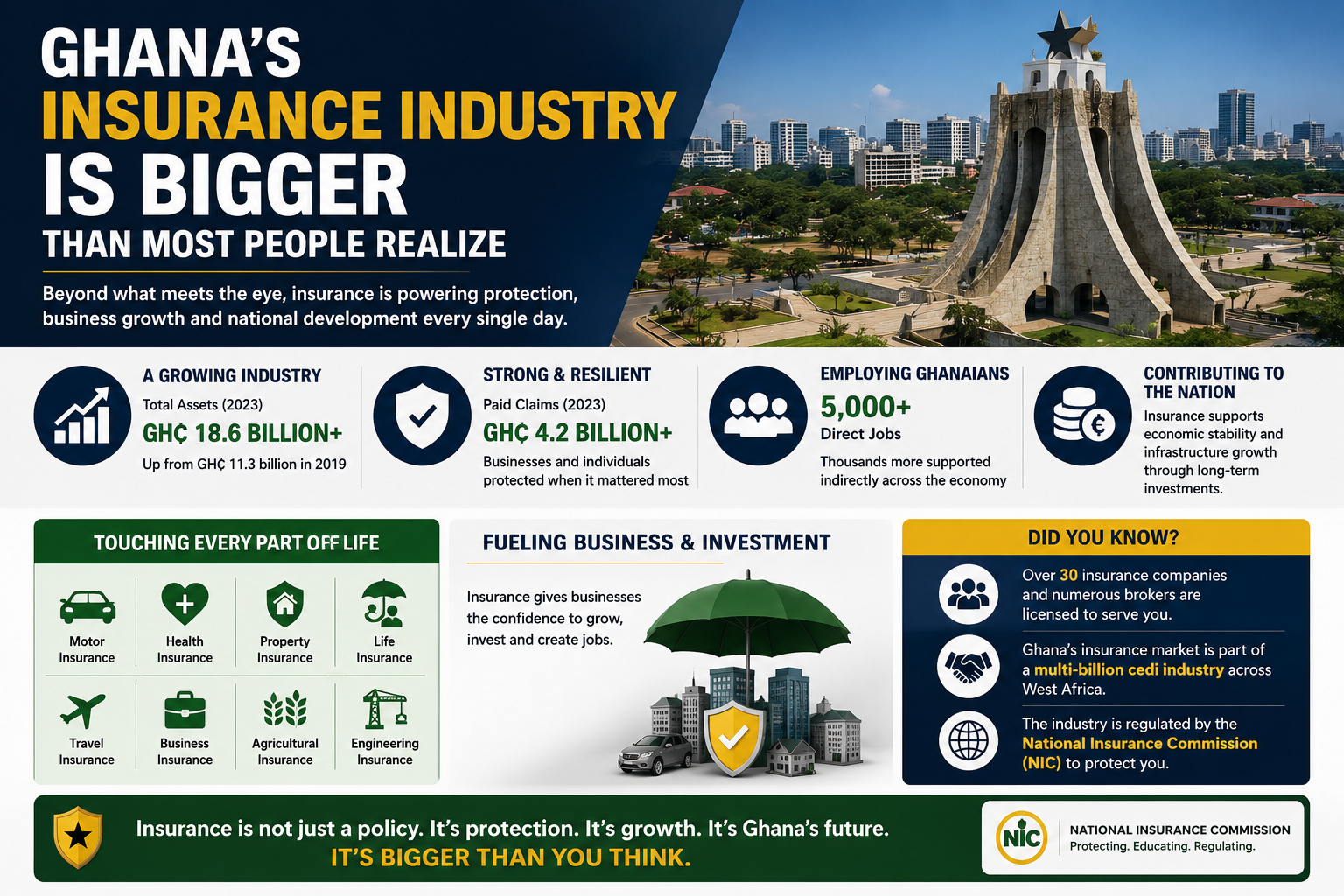
The numbers are arresting. Total industry assets in Ghana’s insurance sector climbed 18.6 per cent to GH¢17.9 billion by the end of 2024 — equivalent to about 1.5 per cent of GDP. Aggregate Profit After Tax (PAT) more than quadrupled between 2020 and 2024, soaring from GH¢293 million to GH¢1.24 billion, representing a compound growth of 324 per cent over just five years. Total industry revenue reached GH¢7.34 billion in 2024, up 31 per cent from the previous year. In 2025, the industry recorded real revenue growth of 19.9 per cent — more than double the 7.6 per cent achieved in 2024. Every day, Ghanaian insurers pay out approximately GH¢9.2 million in legitimate claims — GH¢5.2 million from general insurers and GH¢4 million from life insurers.
Measured in purely financial terms, the insurance industry in Ghana has quietly become a Goliath. It is a sector with 50 licensed insurers and reinsurers, an asset base closing in on GH¢20 billion, and a daily claims payout that would have been unimaginable a decade ago. The life insurance segment alone reported GH¢3.06 billion in insurance service revenue in 2025 — the income insurers recognise from their policies under the current IFRS 17 accounting rules. The capital adequacy ratios are exceptional: life insurers average 325 per cent of the regulatory minimum, and non‑life insurers average 390 per cent, meaning the industry carries more than triple the capital it is legally required to hold.
📢 GET DETAILED ARTICLES + JOBS
Join THSB's WhatsApp Channel and never miss a post or opportunity.
Yet this financial powerhouse exists alongside a staggering paradox. Insurance penetration — gross premiums as a percentage of GDP — has remained stuck at approximately 1 per cent, unchanged for years and well below the West African average of about 3 per cent. Under the stricter IFRS 17 reporting standard, which recalibrates how insurance revenue is recognised, penetration drops even further, to just 0.63 per cent. For a sector with GH¢17.9 billion in assets, 13 active life insurers, 26 non‑life insurers and three reinsurance companies, the numbers are deeply contradictory.

This profile tells the complete story of Ghana’s insurance industry — the size, the structure, the profitability, the 1 per cent penetration paradox, and the path forward. It is a sector that has weathered the Domestic Debt Exchange Programme (DDEP), absorbed the shock of IFRS 17, and emerged with capital buffers that are the envy of regional peers. It is also a sector that serves less than 2 per cent of the population with any meaningful coverage, leaving the 80 per cent of the workforce in the informal economy almost entirely unprotected. The insurance industry is bigger than most Ghanaians realise — but its potential is bigger still.
The Balance Sheet — GH¢17.9bn in Assets and GH¢7.34bn in Revenue
The most surprising fact about Ghana’s insurance industry is its sheer financial mass. Most Ghanaians encounter insurance only when they buy motor cover or when a broker solicits at their workplace. They never see the balance sheets of the 50 licensed institutions that make up the sector. Those balance sheets tell a story of quiet accumulation.
Assets: By the end of 2024, total insurance industry assets had climbed 18.6 per cent to GH¢17.9 billion, representing approximately 1.5 per cent of GDP. The life insurance segment alone held assets of GH¢13.3 billion in 2024, reflecting the long‑term nature of life policies, which accumulate substantial reserves over time. The non‑life segment accounted for the remainder, with assets concentrated in shorter‑duration investments.
The asset composition reveals a sector that, despite the DDEP, remains heavily invested in government securities. Life insurers held 42 per cent of their assets in government paper, followed by property (21 per cent) and bank fixed deposits (20 per cent). Non‑life insurers held a more diversified portfolio: government securities 32 per cent, equities 23 per cent, bank deposits 22 per cent, and property 17 per cent. This concentration in sovereign debt is both a strength and a vulnerability — a strength because government securities are safe and liquid, but a vulnerability as the DDEP so painfully demonstrated.
Revenue: The top‑line numbers are equally impressive. Total industry revenue in 2024 reached GH¢7.34 billion, up 31 per cent from the previous year. Non‑life insurance contributed GH¢5.01 billion in revenue, driven by motor comprehensive (GH¢1.48 billion), fire, theft and property (GH¢1.45 billion), and motor third‑party (GH¢455 million). Life insurance contributed GH¢2.33 billion in 2024 revenue, with Universal Life (GH¢565 million), Microinsurance (GH¢420 million), and Group Life (GH¢319 million) leading the product categories.
In 2025, the industry recorded real revenue growth of 19.9 per cent, a marked acceleration from 7.6 per cent in 2024. The life insurance segment reported GH¢3.06 billion in insurance service revenue for 2025, according to full‑year returns filed with the NIC. The difference between the 2024 revenue figure and the 2025 insurance service revenue figure reflects both real growth and the accounting transition under IFRS 17, which recognises insurance service revenue differently from traditional premium income.
Profitability: The profit trajectory is equally striking. Aggregate Profit After Tax (PAT) rose from GH¢293 million in 2020 to GH¢1.24 billion in 2024 — a 324 per cent increase over five years. Profit concentration is stark: in the life sector, StarLife Assurance leads with PAT of GH¢310 million, followed by Enterprise Life (GH¢196 million) and Prudential Life (GH¢139 million). In the non‑life sector, SIC Insurance leads with PAT of GH¢56 million, followed by Hollard (GH¢53 million) and Enterprise Insurance (GH¢17 million).
The table below summarises the key financial aggregates of Ghana’s insurance industry, illustrating both its size and its growth trajectory in recent years.
Metric 2020 2024 Growth
- Total Industry Assets — GH¢17.9bn +18.6% (2023‑2024)
- Total Revenue — GH¢7.34bn +31% YoY
- Profit After Tax (PAT) GH¢293m GH¢1.24bn +324%
- Real Revenue Growth (2025) — 19.9% —
- Life Insurance Service Revenue (2025) — GH¢3.06bn —
- Non‑Life Revenue (2024) — GH¢5.01bn —
Sources: National Insurance Commission data
The Daily Claims Reality — GH¢9.2m Every Day
If assets and revenue are the inputs, claims are the output — the reason insurance exists in the first place. According to the NIC, insurers pay an average of GH¢9.2 million in claims daily — GH¢5.2 million from non‑life insurers and GH¢4 million from life insurers.

This daily payout is not an occasional occurrence. It is the routine functioning of the insurance system. For context, a single week of claims payments would total approximately GH¢64 million; a year’s worth of daily payouts would approach GH¢3.4 billion. The figure, disclosed by the NIC, underscores the scale of legitimate claim payments that occur every day, even as public perception often focuses on the claims that are delayed or disputed.
The NIC Commissioner has stated that “we want to assure Ghanaians that on a daily basis, we pay GHC9.2 million in claims. This figure is rising, and we are committed to meeting our obligations”. The commitment is backed by data. Between January and August 2025, road accident statistics alone — 1,937 deaths, 16,348 vehicles involved, 10,957 injuries — would have generated substantial motor claims.
The counterpart to this daily payout is the fraud problem. The NIC estimates that approximately 25 per cent of all insurance claims in Ghana show elements of fraud, including staged accidents, falsified police reports, inflated repair estimates, and duplicate claims. This fraud burden drives up the claims ratio and compresses underwriting margins, contributing to the 10 per cent increase in third‑party motor premiums that took effect in February 2025. Every fraudulent claim that goes undetected is a direct subtraction from the industry’s profitability, and every hour spent investigating a suspicious claim is an operational expense that increases the expense ratio and worsens the combined ratio.
The following table places Ghana’s insurance industry in a regional and global context, showing how its balance‑sheet and revenue metrics compare to its key performance indicators:
Metric Value Regional / Global Context
- Total Assets (2024) GH¢17.9bn (1.5% of GDP) Dwarfed by banking sector (GH¢647bn)
- Total Revenue (2024) GH¢7.34bn Equivalent to ~0.6% of GDP
- Daily Claims Paid GH¢9.2m ~GH¢3.4bn annualised
- Licensed Insurers 50 Competitive but fragmented
- Penetration Rate 1% of GDP Well below WA average (~3%)
- Penetration under IFRS 17 0.63% Reflects conservative accounting
- Capital Adequacy Ratio (Life) 325% Robust solvency buffers
- Capital Adequacy Ratio (Non‑Life) 390% Well above 150% regulatory minimum
The 1 % Penetration Puzzle — Why Ghana Lags Regional Peers
The financial size of Ghana’s insurance industry is impressive in absolute terms. But relative to the size of the economy — and relative to the population — the sector remains deeply underdeveloped.
Insurance penetration — gross premiums as a percentage of GDP — has remained stuck at approximately 1 per cent for years, unchanged from 2023 to 2024. Under the new IFRS 17 international reporting standards, which recalibrate how insurance revenue is recognised, Ghana’s penetration rate falls even further, to just 0.63 per cent. The West African average is about 3 per cent. The global average is 7 per cent. The NIC Commissioner has observed that “insurance penetration in Ghana was currently below one per cent, with majority of the population either having limited access to insurance or lacking a proper understanding of its benefits”.
The informal sector is the primary explanation. Approximately 80 per cent of Ghana’s workforce is in the informal sector — market traders, farmers, artisans, gig workers — yet most insurance products were designed for salaried formal‑sector workers with predictable monthly income. Premiums are often paid annually or in large instalments, a payment structure that is incompatible with the daily or weekly cash flows of informal workers. Distribution has historically relied on expensive physical branches and commissioned agents, making it uneconomical to serve low‑income customers in remote areas. And the trust deficit — rooted in stories of delayed claims, denied payouts and opaque policy language — has discouraged voluntary uptake.
Deloitte, in its 2025 Africa Insurance Outlook, stated that “with 50 licensed insurers and reinsurers, and market penetration at just 1% in 2024, Ghana’s insurance industry remains underdeveloped relative to its potential”. The persistence of the 1 per cent figure is a policy puzzle that has resisted successive reform efforts. NIC strategy documents have identified trust, affordability, distribution and product relevance as the four binding constraints. The question is not whether the industry is financially viable — it is — but whether it can grow from serving a tiny fraction of the population to serving the majority. The gap between the GH¢17.9 billion asset base and the 1 per cent penetration rate is the central tension of the Ghanaian insurance story.
At the continental level, the picture is similarly varied. Total insurance penetration across East Africa stands at just 1.57 per cent, with Kenya leading at 2.61 per cent, followed by Uganda at 0.83 per cent, Tanzania at 0.60 per cent and Ethiopia at 0.30 per cent. West Africa’s figures are similarly constrained, with Ghana’s penetration remaining below 2 per cent despite a decade of regulatory reform. The Deloitte report has concluded that trust, not technology, will define Africa’s insurance future — a finding that resonates strongly in the Ghanaian context.
The table below compares Ghana’s insurance penetration with selected African peers, illustrating how the country sits in the middle of a low‑penetration region.
Country / Region Insurance Penetration (% of GDP)
- Ghana (IFRS 17 basis) 0.63%
- Ghana (traditional basis) 1.0%
- Kenya (East Africa) 2.61%
- Uganda 0.83%
- Tanzania 0.60%
- Ethiopia 0.30%
- West Africa Average ~3%
- South Africa ~13%
- Global Average ~7%
The DDEP Scar — GH¢4.6bn in Government Securities and the US$750m Stability Fund
No analysis of the insurance industry’s recent financial history would be complete without the Domestic Debt Exchange Programme (DDEP) of 2022‑2023. Before the restructuring, insurers had built a comfortable business model: collect premiums, invest the float in government securities earning double‑digit yields, and earn a reliable, sovereign‑backed investment income stream. That model shattered when the government announced the restructuring.
Prior to the debt restructuring, the insurance industry held approximately GH¢4.6 billion in government securities. The DDEP forced bondholders — including insurers — to exchange high‑yielding bonds for lower‑yielding instruments with extended maturities, incurring substantial losses in the process. The restructuring wiped out a significant portion of the capital reserves that insurers had built over years. According to the Ghana Insurers Association, insurance firms lost GH¢356 million directly, while a broader estimate suggested that over 7.5 million policies would be affected because more than 40 per cent of insurance premiums are invested in government securities.
The government responded by establishing a US$750 million Financial Stability Fund to provide capital support to affected financial institutions, including insurers. The fund helped stabilise the sector, but the damage to the industry’s investment income was lasting. The life sector’s holdings of government securities dropped from 49 per cent of its portfolio in 2022 to 40 per cent in 2023 — a 9 per cent reduction. The non‑life sector cut more aggressively, from 38 per cent to 27 per cent, a 13 per cent reduction.
The DDEP had an unintended positive effect: insurers could no longer rely on a comfortable, sovereign‑backed investment income stream to compensate for weak underwriting. They were forced to diversify their portfolios and to focus on underwriting profitability as a primary earnings driver. The NIC’s Insurance Sector Strengthening Strategy (ISSS), which is being implemented over a two‑year period, is designed to enhance underwriting profitability and reduce over‑reliance on volatile investment returns. However, the legacy of the DDEP continues to shape investment allocations. The Financial Stability Review has noted that “such dependence underscores potential vulnerabilities to future macroeconomic shocks”.
The Market Structure — 13 Life, 26 Non‑Life and Three Reinsurers
The industry is not a monolith. It is a complex ecosystem of 50 licensed insurers and reinsurers, each with distinct business models, product strategies and competitive positions.
Life insurance: Thirteen active life insurers reported GH¢3.06 billion in insurance service revenue in 2025. The top three — StarLife Assurance, Enterprise Life and Prudential Life — account for approximately 52 per cent of the sector’s PAT, leaving the remaining ten active companies to share the rest. Asset concentration is even more pronounced: the top five life insurers control 77 per cent of sector assets, and the top ten account for 97 per cent. The product strategies vary dramatically: one analysis noted that “Enterprise runs on Whole Life. StarLife depends on Endowment for 71 per cent of its revenue. SIC Life is tied to Universal Life, the one product category that shrank”.
Non‑life insurance: Twenty‑six non‑life insurers operate in the Ghanaian market, with total revenue of GH¢5.01 billion in 2024. SIC Insurance leads with PAT of GH¢56 million, followed by Hollard (GH¢53 million) and Enterprise Insurance (GH¢17 million). The top five non‑life insurers control 50 per cent of sector assets, and the top ten account for 73 per cent. Motor insurance dominates the non‑life portfolio: Motor Comprehensive alone generated GH¢1.48 billion, while Motor Third‑Party added GH¢455 million. Fire, theft and property lines contributed GH¢1.45 billion.
Reinsurance: Three domestic reinsurers — Ghana Reinsurance Company, Mainstream Reinsurance Company and GN Reinsurance Company — operate alongside international reinsurers. The reinsurance sector has been the surprise outperformer in the post‑DDEP environment. While life and non‑life insurers struggled with real asset growth, reinsurers recorded a robust 44 per cent nominal increase in assets, double the pace of headline inflation, generating 16 per cent real growth. Overseas reinsurance premium transfers increased significantly in 2024, with the NIC approving GH¢814 million in outward reinsurance placements.
Microinsurance: The fastest‑growing segment by customer count, if not by revenue, is microinsurance. aYo Ghana has insured over 8.5 million lives and paid more than GH¢35 million in claims. Microinsurance revenue reached GH¢420 million in 2024, reflecting the segment’s emergence as a viable channel for reaching low‑income customers. The NIC’s sandbox programme has granted temporary innovation licences to five insurtech companies, including Figtech (insurance aggregator), Moovon Insure (pay‑as‑you‑go premiums) and ETAP (telematics‑based motor insurance), creating a pipeline of digitally native microinsurance products.
The Regulatory State — NIC, IFRS 17, and the Push for Inclusive Insurance
The National Insurance Commission (NIC) is the industry’s regulator, established by the Insurance Act, 2021 (Act 1061). Its mandate is to ensure the effective administration, supervision, regulation, monitoring and control of insurance business in Ghana.
The NIC’s current strategy rests on three pillars: sanitising the insurance market, growing the market through technology, and positioning Ghana’s industry for long‑term competitiveness. The Commission has admitted five insurtech companies into its regulatory sandbox, allowing them to test innovative insurance solutions in a controlled environment before receiving full licences. The sandbox, supported by FSD Africa’s Bimalab programme, has accelerated 100 insurtechs continent‑wide, enabled 75 new projects, increased coverage by 5 million and facilitated US$35 million in capital raising.
The Insurance Act, 2021 also introduced the Ghana Card as a mandatory requirement for all insurance purchases, effective 1 January 2026, to eliminate identity fraud and link every policy to a verifiable individual. The Commission is also transitioning to a Risk‑Based Supervision (RBS) framework, aligning Ghana’s regulatory approach with global standards, and has proposed the establishment of special courts dedicated to the prosecution of insurance fraud.
The government has launched the Insurance Sector Strengthening Strategy (ISSS) , a two‑year initiative designed to grow and improve the efficiency, viability, competitiveness and profitability of the Ghanaian insurance industry via innovation‑driven transformation, with emphasis on capacity building, underwriting profitability, sustainability and economic development. The strategy explicitly targets the informal sector, which constitutes nearly 80 per cent of Ghana’s economy.
The Employment Footprint — Beyond the Balance Sheet
The insurance industry is not just a collection of balance sheets and regulatory filings. It is a significant employer in Ghana’s formal financial services sector.
While precise employment figures are not publicly aggregated, the industry’s employment footprint can be inferred from several indicators. The 50 licensed insurers and reinsurers each maintain corporate staff in actuarial, underwriting, claims, finance, compliance, IT and marketing roles. The life insurance segment alone — with GH¢13.3 billion in assets and 13 active companies — supports hundreds of specialised professionals in actuarial science, risk management and policy administration.
The distribution network multiplies this employment effect significantly. Independent agents, brokers and bancassurance representatives who sell insurance products on commission form a large, decentralised sales force. The Insurance Brokers Association of Ghana (IBAG) reported membership growth in 2025 and established a credit union that has grown to over 400 members. Job postings for insurance roles — claims officers, financial consultants, sales executives and operations associates — appear regularly across major platforms such as Jobberman and LinkedIn, indicating steady demand for sectoral labour.
KNUST has entered into a partnership with the NIC and the Ghana Insurance University College (GIUC) to strengthen insurance education, actuarial science training, research and innovation, while creating internship, research and professional development opportunities for students of KNUST’s Department of Statistics and Actuarial Science. The partnership addresses “long‑standing penetration, limited professional expertise and concerns over industry profitability”.
The industry’s employment footprint extends beyond direct hiring into ancillary services: legal services (claims litigation), IT services (digital platforms, the MID), consulting (actuarial valuations, market research), and training (certification programmes, continuous professional development). The total employment supported by the industry likely exceeds 5,000 direct jobs and a significantly larger number of indirect roles, though official statistics are not published on an industry‑wide basis.
The Future Outlook — Three Scenarios for Ghana’s Insurance Goliath
The insurance industry’s future trajectory will be shaped by three key variables: the speed of digital adoption, the effectiveness of regulatory enforcement, and the recovery of household incomes.
Scenario One: Gradual Digital Expansion (65 per cent probability)
In this base case, digital microinsurance continues to expand, reaching 12‑15 million lives by 2028. Penetration rises slowly to 1.5‑2 per cent of GDP. The NIC’s sandbox produces a steady stream of new entrants. Bancassurance partnerships extend coverage to banked SME customers. The industry remains profitable, with the large players — StarLife, Enterprise, SIC, Hollard — maintaining market dominance. The informal sector remains largely uncovered, but the foundation of digital trust is built. This scenario requires no major external shocks and continued regulatory support.
Scenario Two: Accelerated Inclusion Breakthrough (25 per cent probability)
The credit insurance guarantee scheme is successfully implemented, unlocking bank financing for hundreds of thousands of SMEs. Telematics becomes standard for motor policies, reducing fraud and enabling usage‑based pricing. Embedded health insurance becomes a standard feature of smartphone financing and mobile money accounts. The NIC’s open insurance framework enables seamless integration between insurers and third‑party digital platforms. Penetration rises to 2.5‑3 per cent by 2028. Ghana becomes a regional leader in inclusive insurance, and the 80 per cent informal workforce begins to be reached at scale.
Scenario Three: Stagnation and Trust Erosion (10 per cent probability)
A major fraud incident or high‑profile claims dispute erodes public trust. The NIC, facing enforcement capacity constraints, struggles to keep pace with new forms of fraud. The 1 per cent penetration ceiling holds. Microinsurance remains a niche product for the urban formal sector. The informal majority remains uncovered. This scenario would be a significant setback for the entire industry and would likely lead to consolidation among smaller insurers, as the top five life insurers already control 77 per cent of sector assets and the top five non‑life insurers control 50 per cent.
The most likely path is Scenario One: slow, incremental expansion, with the insurance industry remaining financially robust but still falling far short of its potential. The GH¢17.9 billion asset base will continue to grow. The GH¢9.2 million daily claims payout will rise. The 1 per cent penetration rate may tick up to 1.5 per cent or 2 per cent. But the structural gap between the industry’s financial size and its social reach — the paradox of a GH¢17.9 billion industry covering less than 2 per cent of the population with meaningful coverage — will persist unless the informal sector is finally reached. That is the unfinished business of Ghana’s insurance industry. And that is why, despite its size, it is still just getting started.
THSB Conclusion
Ghana’s insurance industry is bigger than most people realise — and far smaller than it should be. The numbers are not in dispute. GH¢17.9 billion in assets. GH¢7.34 billion in revenue. GH¢1.24 billion in annual profit. GH¢9.2 million in daily claims. 50 licensed institutions. Capital adequacy ratios exceeding 300 per cent. Real revenue growth of 19.9 per cent in 2025. By any measure, the industry is a financial heavyweight. It has weathered the DDEP, absorbed the shock of IFRS 17, and emerged with solvency buffers that would be the envy of peers across the continent. The money is there. The capital is there. The regulatory framework is improving.
Yet the 1 per cent penetration rate is not a rounding error. It is a measure of failure. More than 98 per cent of Ghana’s economic activity, household assets and personal income are not protected by any private insurance. The 80 per cent of the workforce in the informal sector remains almost entirely uncovered. The industry serves the formal sector effectively but has barely touched the majority of Ghanaians. This is the central contradiction of Ghana’s insurance story: a Goliath in balance‑sheet terms, a David in market reach.
The path forward requires a fundamental shift in mindset — from viewing insurance as a product for the few to designing systems that reach the many. Digital microinsurance, telematics and open banking frameworks offer the tools. The NIC’s sandbox, the ISSS and the push for inclusive insurance offer the policy direction. But technology and regulation alone will not solve the problem. The missing ingredient is trust — and that is earned, not mandated, through consistent claims payment, transparent pricing and genuine customer empathy.
The GH¢17.9 billion asset base is a foundation, not a ceiling. The 1 per cent penetration rate is a challenge, not a destiny. Ghana’s insurance industry has the capital, the regulatory support and the institutional experience to scale. The question is whether it can finally bring the 80 per cent of the workforce into the system — and whether it can do so before the next major shock exposes the vulnerability of an under‑insured nation.
The industry is bigger than most people realise. But its true potential is bigger still. And that potential will only be realised when every Ghanaian, not just a privileged few, can afford the protection that insurance is meant to provide. The building blocks are in place. The challenge now is to finish the work.
Quick Facts Box
Category || Details
- Total Industry Assets (end‑2024) GH¢17.9 billion (+18.6% YoY)
- Total Industry Revenue (2024) GH¢7.34 billion (+31% YoY)
- Real Revenue Growth (2025) 19.9% (up from 7.6% in 2024)
- Life Insurance Service Revenue (2025) GH¢3.06 billion
- Profit After Tax (2024) GH¢1.24 billion (up from GH¢293m in 2020, +324%)
- Daily Claims Paid GH¢9.2 million (GH¢5.2m non‑life, GH¢4m life)
- Licensed Insurers & Reinsurers 50 (13 life, 26 non‑life, 3 reinsurers, others)
- Insurance Penetration (GDP basis) ~1% (0.63% under IFRS 17)
- West African Average Penetration ~3%
- Global Average Penetration ~7%
- Capital Adequacy Ratio (Life) 325% of regulatory minimum
- Capital Adequacy Ratio (Non‑Life) 390% of regulatory minimum
- Life Insurance Retention Ratio 95.3%
- Non‑Life Insurance Retention Ratio 73%
- NIC Motor Insurance Database Launch 1 January 2020
- Fraudulent Claim Rate (NIC Estimate) ~25% of all claims
- Pre‑DDEP Govt Securities Held by Insurers GH¢4.6 billion
- Financial Stability Fund US$750 million
- Microinsurance Revenue (2024) GH¢420 million
- aYo Ghana Lives Insured Over 8.5 million
- aYo Ghana Claims Paid GH¢35 million+
- Primary Regulator National Insurance Commission (NIC)
Frequently Asked Questions (FAQ)
Q1: How big is Ghana’s insurance industry in terms of assets and revenue?
Total industry assets reached GH¢17.9 billion by the end of 2024, representing approximately 1.5 per cent of GDP. Total industry revenue in 2024 was GH¢7.34 billion, up 31 per cent from the previous year. In 2025, the industry recorded real revenue growth of 19.9 per cent, more than double the 7.6 per cent achieved in 2024.
Q2: How many insurance companies operate in Ghana?
Ghana has 50 licensed insurers and reinsurers, including 13 active life insurers, 26 non‑life insurers and three domestic reinsurers. The industry is competitive but concentrated: the top five life insurers control 77 per cent of sector assets, and the top five non‑life insurers control 50 per cent of assets.
Q3: How much does the insurance industry pay out in claims daily?
According to the National Insurance Commission, Ghanaian insurers pay approximately GH¢9.2 million in claims every day — GH¢5.2 million from non‑life insurers and GH¢4 million from life insurers. The annualised claims payout is approximately GH¢3.4 billion.
Q4: What is insurance penetration in Ghana and why is it so low?
Insurance penetration — gross premiums as a percentage of GDP — has remained stuck at about 1 per cent for years. Under the stricter IFRS 17 accounting standard, penetration falls to just 0.63 per cent. The West African average is about 3 per cent. Low penetration is explained by the large informal sector (80 per cent of the workforce), low trust, limited distribution channels and product designs that do not align with irregular incomes.
Q5: How did the DDEP affect Ghana’s insurance industry?
Prior to the Domestic Debt Exchange Programme, insurers held approximately GH¢4.6 billion in government securities. The restructuring imposed losses on bondholders and reduced yields, forcing insurers to diversify their investment portfolios and focus more heavily on underwriting profitability. The government established a US$750 million Financial Stability Fund to support affected institutions.
Q6: What is the NIC’s role in regulating the industry?
The National Insurance Commission is the industry regulator, established under the Insurance Act, 2021 (Act 1061). Its mandate includes supervising insurers, enforcing market conduct rules, promoting inclusive insurance, licensing insurtechs through its sandbox programme, and managing the Motor Insurance Database.
Q7: How profitable is Ghana’s insurance industry?
Aggregate Profit After Tax (PAT) rose from GH¢293 million in 2020 to GH¢1.24 billion in 2024 — a 324 per cent increase over five years. In the life sector, StarLife Assurance leads with PAT of GH¢310 million, followed by Enterprise Life (GH¢196 million) and Prudential Life (GH¢139 million). In the non‑life sector, SIC Insurance leads with PAT of GH¢56 million, followed by Hollard (GH¢53 million).
Q8: What percentage of insurance claims are fraudulent?
The NIC estimates that approximately 25 per cent of all insurance claims in Ghana show elements of fraud, including staged accidents, falsified police reports, inflated repair estimates and duplicate claims. Fraud drives up the claims ratio and contributes to higher premiums for honest policyholders.
Q9: How many people does microinsurance reach in Ghana?
aYo Ghana, the market leader in digital microinsurance, has insured over 8.5 million lives and paid more than GH¢35 million in claims. Microinsurance revenue reached GH¢420 million in 2024. The NIC’s sandbox programme has admitted five insurtechs, including Figtech, Moovon Insure and ETAP, to develop innovative microinsurance products.
Q10: What is the capital adequacy of Ghana’s insurers?
Life insurers recorded an average Capital Adequacy Ratio of 325 per cent of the regulatory minimum, while non‑life insurers reported 390 per cent. These ratios reflect robust capital positions and the industry’s ability to absorb unexpected losses, though high capital adequacy does not directly measure profitability.
Q11: How does the insurance industry contribute to Ghana’s economy?
The insurance industry contributes to GDP growth through the Financial and Insurance Activities sub‑sector, which recorded 9.3 per cent growth in Q1 2025. The industry employs thousands directly and thousands more indirectly through agents, brokers and ancillary services. It also mobilises long‑term capital through its investment portfolio and provides risk protection that stabilises households and businesses.
Q12: What is the future outlook for Ghana’s insurance industry?
The most likely scenario is gradual digital expansion, with microinsurance and telematics driving moderate growth. Penetration is expected to rise to 1.5‑2 per cent of GDP by 2028. The industry will remain profitable but will continue to face structural constraints in reaching the 80 per cent of workers in the informal sector. The NIC’s ISSS and insurtech sandbox are key policy levers for accelerating inclusive growth.
Source: The High Street Business
Disclaimer: Some content on The High Street Business may be aggregated, summarized, or edited from third-party sources for informational purposes. Images and media are used under fair use or royalty-free licenses. The High Street Business is a subsidiary of SamBoad Publishing under SamBoad Business Group Ltd, registered in Ghana since 2014.
For concerns or inquiries, please visit our Privacy Policy or Contact Page.

Esther Aku-Sika is a content writer and social media strategist who helps brands and startups grow through intentional storytelling and practical marketing strategies. With a keen eye for trends and audience behavior, she shares business insights, content strategies, and real-life lessons to help entrepreneurs build visibility and turn ideas into income. Through her writing, she simplifies complex concepts and equips readers with actionable steps to grow in today’s digital space.