







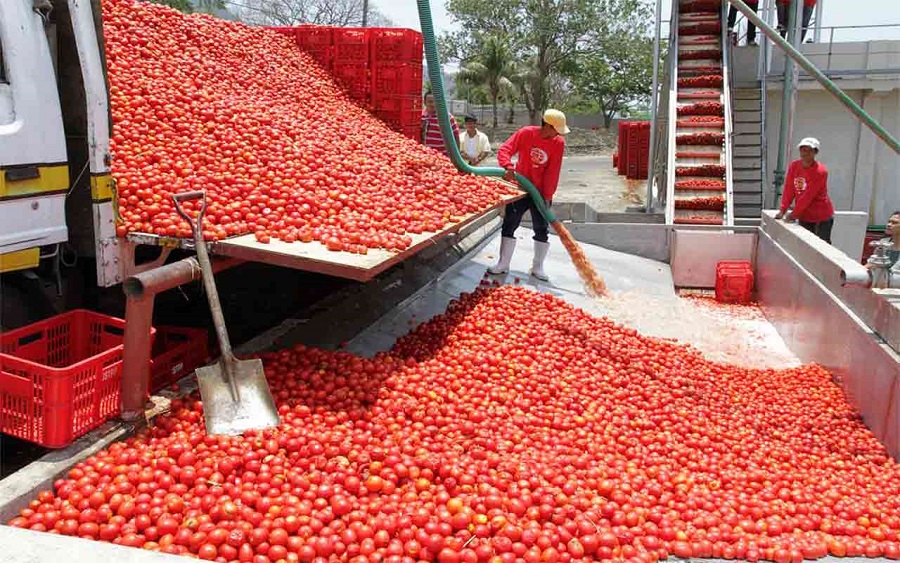
Africa’s agricultural sector has long been defined by its immense potential—and its equally immense structural challenges. Despite its fertile lands and millions of smallholder farmers, the continent consistently loses billions of dollars annually to food imports that could be produced locally. One of the clearest examples of this paradox is Nigeria’s tomato industry. Although Nigeria ranks among Africa’s top producers of fresh tomatoes, it remains one of the continent’s largest importers of tomato paste, spending an estimated US$350 million yearly on a product that should be locally abundant.
This contradiction may finally be challenged in a meaningful way, thanks to an ambitious new project by the Dangote Group. The conglomerate has launched Africa’s largest tomato processing plant in Northern Nigeria—a monumental US$20 million investment that promises to reshape Nigeria’s agricultural landscape and reduce its historical dependence on imported tomato paste.
More than a factory, the new Dangote tomato processing complex represents a strategic leap toward agricultural self-reliance, value addition, and rural industrialization. If successful, this project could serve as a transformative model for other African countries seeking to strengthen their agro-processing capabilities, reduce post-harvest losses, create employment, and build competitive agricultural value chains.
📢 GET A DETAILED ARTICLES + JOBS
Join SamBoad's WhatsApp Channel and never miss a post or opportunity.
Nigeria’s Tomato Paradox: High Production, Low Productivity
Nigeria is the second-largest producer of tomatoes in Africa, harvesting approximately 1.8 million metric tons annually. But up to 40% of these tomatoes never reach consumers due to severe inefficiencies in the supply chain.
Farmers routinely face:
-
Lack of cold storage facilities
-
Poor road networks
-
Limited processing options
-
Post-harvest spoilage
-
Access to low-quality seedlings
-
Lack of structured markets
As a result, nearly half of Nigeria’s tomato output rots before it can be consumed or processed. This massive waste has forced the country into the ironic position of importing nearly 300,000 metric tons of tomato paste yearly, mostly from China.
The financial cost has been staggering. But even worse, it has undermined local farmers, stunted agribusiness growth, and weakened Nigeria’s ability to generate income from a crop that should thrive domestically.
A $20 Million Intervention: Dangote’s Long-Term Vision
After five years of planning, infrastructure development, and stakeholder engagement, the Dangote Group has finally launched a massive tomato processing plant capable of processing 400,000 metric tons of tomatoes annually. This single facility has the potential to close the longstanding gap between local production and domestic demand.
The project aims to:
-
Reduce Nigeria’s tomato paste imports
-
Create thousands of direct and indirect jobs
-
Stabilize local tomato prices
-
Strengthen rural economies
-
Enhance farmers’ incomes
-
Position Nigeria as a regional exporter of tomato products
By building capacity for surplus production, the plant is not just solving today’s problem—it is helping create a future where Nigeria becomes an agro-industrial hub.
The Power of a Greenhouse: Seedlings for Transformation
One of the most ambitious components of this initiative is the mega greenhouse nursery, designed to produce 300 tons of hybrid tomato seedlings each year. Poor seed quality has been a recurring obstacle for Nigerian farmers, leading to low yields, pest susceptibility, and inconsistent harvests.
With the introduction of high-performing seedlings, farmers will now have access to:
-
Disease-resistant varieties
-
High-yield hybrids
-
Climate-tolerant species
-
Better fruit quality
This nursery is not just supplying seeds—it is providing an economic lifeline. When farmers cultivate better seedlings, productivity improves, incomes rise, and entire communities can benefit from the agricultural multiplier effect.
Training, Capacity Building, and Value Chain Growth
To further enhance outcomes, the Dangote Group has launched training programs for local farmers, focusing on:
-
Irrigation techniques
-
Efficient fertilizer use
-
Harvest management
-
Modern agronomy practices
-
Post-harvest handling
-
Value chain integration
These capacity-building efforts are vital. Without strong farmer participation, no processing plant can achieve long-term sustainability. By equipping farmers with the skills and resources needed to supply the factory consistently, Dangote is laying the groundwork for a stable and reliable industrial ecosystem.
This approach also creates opportunities for women and youth, especially in rural communities where unemployment is high and agricultural knowledge transfer is essential.
Boosting Nigeria’s Agro-Industrial Self-Reliance
The tomato plant aligns with Nigeria’s broader national agenda of boosting food security, cutting imports, and promoting local production. Over the past decade, the country has struggled with foreign exchange shortages—much of which has been drained by agricultural imports. Reducing dependency on foreign tomato paste will save the nation hundreds of millions of dollars annually and free up resources for investment in other critical sectors.
Moreover, the project reinforces Nigeria’s shift toward agro-processing, which remains the missing link in Africa’s global competitiveness. While Africa grows crops in abundance, it processes only a fraction of them, exporting raw produce and re-importing finished products at a significant markup.
Industries like these help break the cycle.
Reducing Post-Harvest Losses: A Massive Economic Win
Post-harvest losses cost Africa up to US$48 billion annually. For tomatoes alone, Nigeria loses hundreds of thousands of tons each year due to rotting and spoilage. A processing plant of this scale ensures farmers have a reliable market, reducing waste and stabilizing incomes.
Stability is key:
-
When farmers have guaranteed buyers, they plant more.
-
When processors have consistent supply, they invest more.
-
When economies reduce losses, they grow faster.
This is how industrial ecosystems are built.
The Potential for Exports and Regional Leadership
With a production capacity of 400,000 metric tons, Nigeria could eventually become a major exporter of tomato paste to West Africa and beyond. Several neighboring countries rely heavily on imports and lack the heavy industrial infrastructure to develop large processing facilities. Nigeria could fill that gap.
This positions the tomato plant not only as a national asset but as a regional competitive advantage.
A Model for Africa’s Agricultural Future
The success of this project could spark similar industrial investments across Africa. Agriculture employs more than 60% of the population on the continent, yet contributes relatively little to GDP due to weak processing industries.
Dangote’s tomato plant demonstrates that with the right investment:
-
Africa can process what it grows
-
Farmers can earn more income
-
Industrial jobs can flourish
-
Imports can decline
-
Rural economies can modernize
This is exactly the type of value-added agriculture needed to drive Africa’s next phase of economic growth.
FAQs
1. Why is Nigeria one of the largest tomato producers but still imports tomato paste?
Nigeria faces large post-harvest losses due to poor storage, transportation problems, and inadequate processing facilities. As a result, nearly 40% of tomatoes spoil before use, forcing the country to import paste.
2. How will the Dangote tomato processing plant reduce Nigeria’s import bill?
The plant can process 400,000 metric tons annually, significantly reducing reliance on foreign tomato paste and saving Nigeria up to US$350 million each year.
3. What benefits will farmers gain from this project?
Farmers will access high-yield seedlings, improved training, higher incomes, and a guaranteed buyer for their tomatoes, reducing financial risk.
4. Can Nigeria become an exporter of tomato paste?
Yes. With increased processing capacity and improved yields, Nigeria could produce enough to meet domestic needs and export surplus to West Africa.
5. How does this project impact job creation?
The factory is expected to create thousands of direct and indirect jobs in farming, logistics, processing, packaging, and distribution.
Source: The High Street Business
Disclaimer: Some content on The High Street Business may be aggregated, summarized, or edited from third-party sources for informational purposes. Images and media are used under fair use or royalty-free licenses. The High Street Business is a subsidiary of SamBoad Publishing under SamBoad Business Group Ltd, registered in Ghana since 2014.
For concerns or inquiries, please visit our Privacy Policy or Contact Page.

Samuel Kwame Boadu is a Ghanaian entrepreneur, writer, and digital consultant passionate about creating impactful stories and business solutions. He is the Founder & CEO of SamBoad Business Group Ltd, a dynamic company with subsidiaries in digital marketing, logistics, publishing, and risk management.