









Mandatory motor insurance drives GH¢8–10m daily claims, yet undercutting and fraud persist. Our deep‑dive analysis reveals the economics of third‑party vs comprehensive cover, the MID digital revolution, claim failures, and the future of usage‑based pricing.
The Business of Motor Insurance in Ghana Explained — The Third‑Party Mandate, Claim Delays and the Digital Middleman
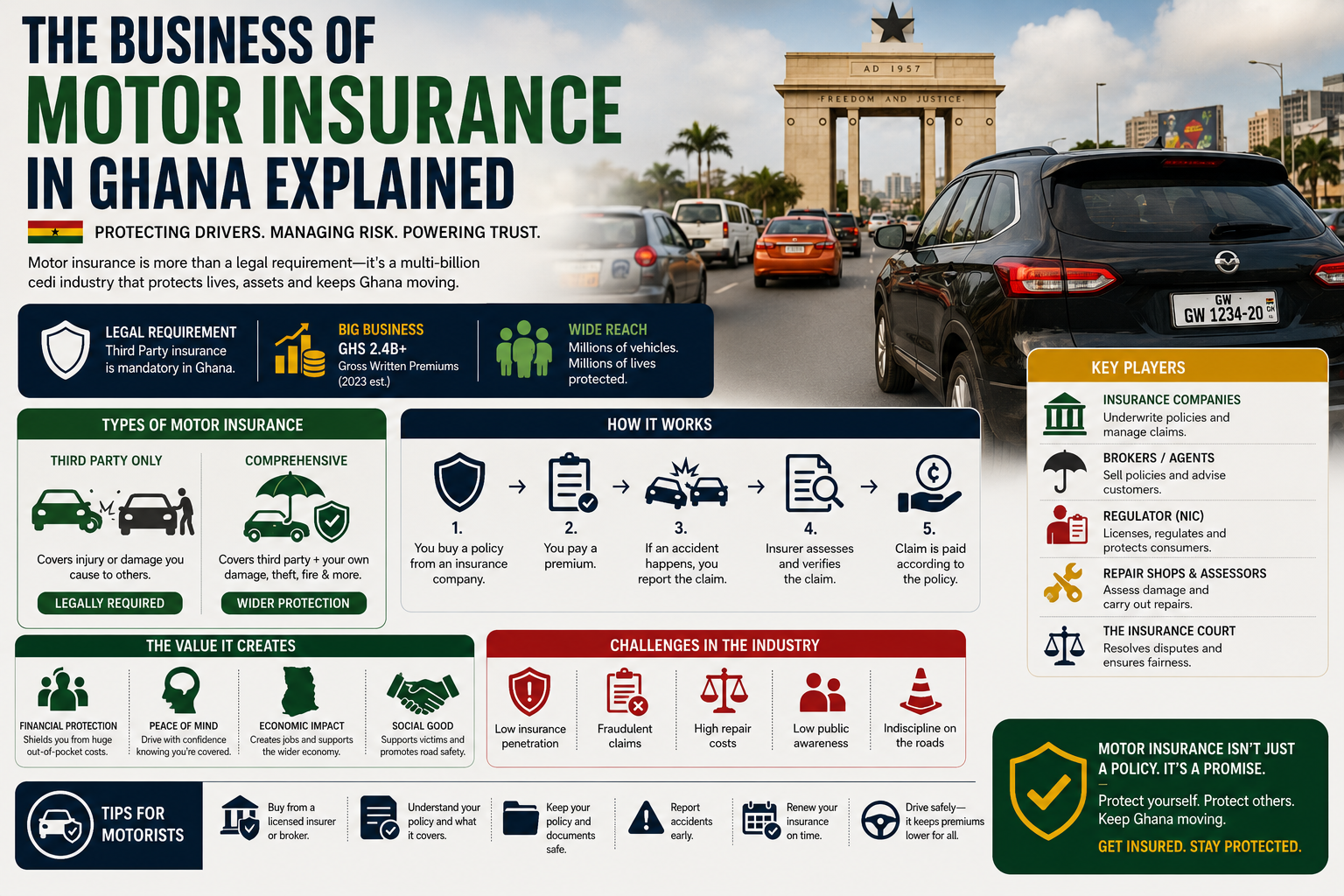
Motor insurance is the only type of cover most Ghanaians ever buy – largely because the law says they must. Under Section 3(1) of the Motor Vehicles (Third‑Party Insurance) Act, 1958, no vehicle can legally operate on a Ghanaian road without valid insurance. The mandate is enforced by the Driver and Vehicle Licensing Authority (DVLA) and the National Insurance Commission (NIC). Driving uninsured can mean impounded vehicles, hefty fines, and potential civil and criminal liability.
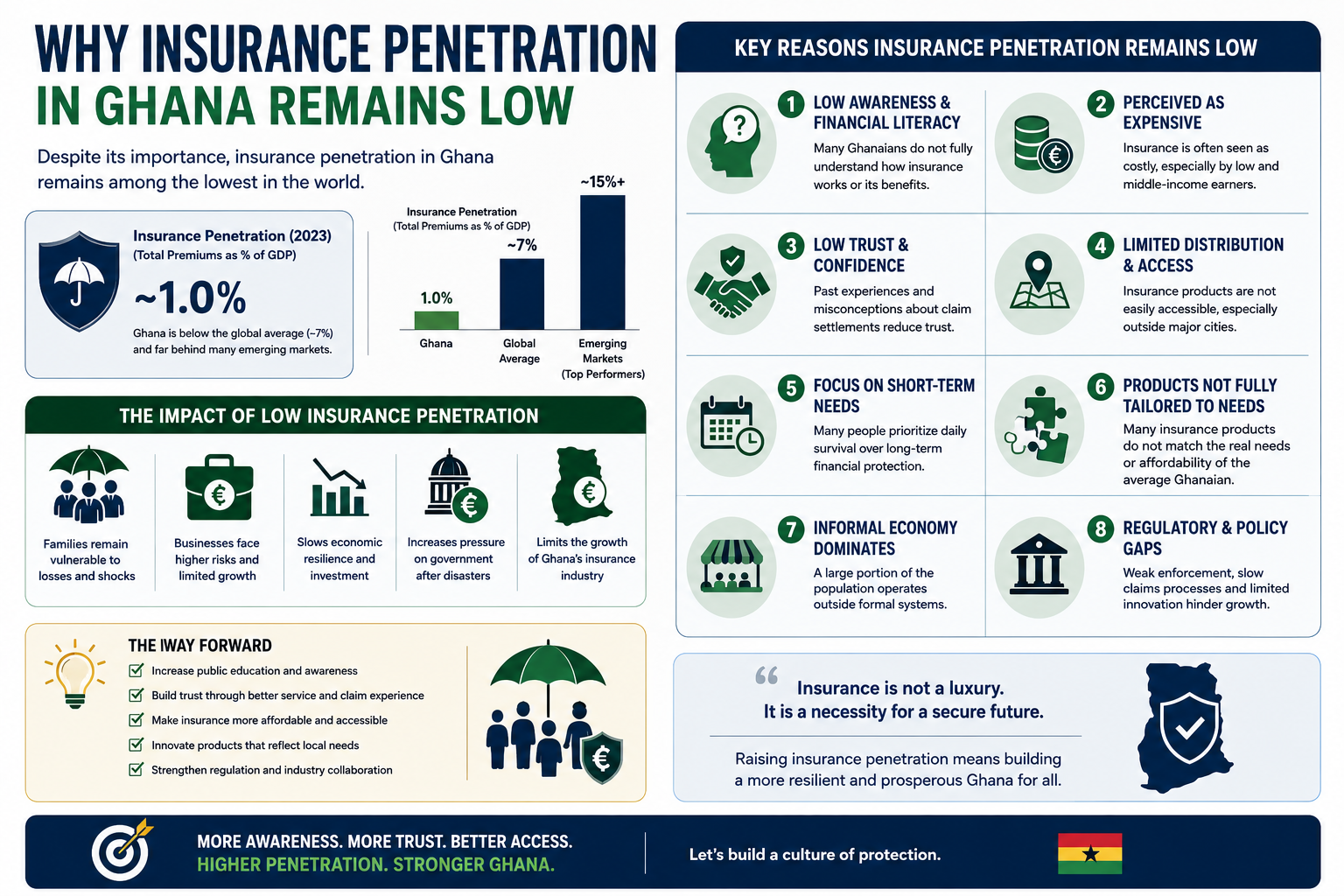
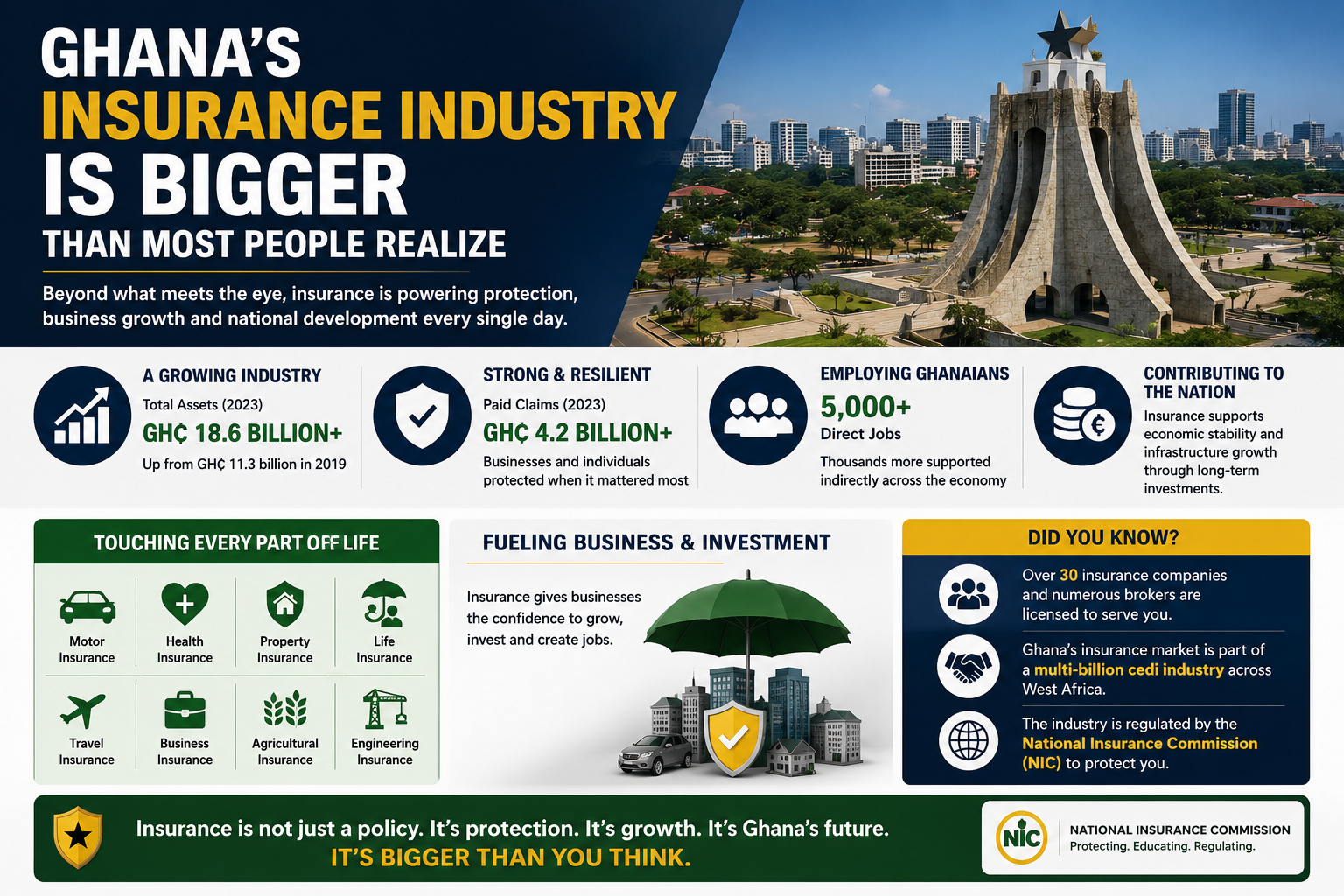
Yet the business that sits behind this mandatory sticker is far more complex, precarious, and digitally advanced than most motorists realise. Ghana’s 50 licensed insurers collected real revenue growth of 19.9 per cent in 2025, a sharp increase from 7.6 per cent in 2024, with strong solvency and premium retention as digitalisation and regulatory reform took hold. The low overall insurance penetration of around 1‑2 per cent of GDP continues to represent both a massive market gap and the scale of the untapped informal sector. But the motor segment is unique: it is sustained not by trust or financial literacy, but by the power of the traffic stop.
📢 GET DETAILED ARTICLES + JOBS
Join THSB's WhatsApp Channel and never miss a post or opportunity.
This profile explains the business of motor insurance in Ghana: the three policy tiers (third‑party, third‑party fire & theft, and comprehensive), the regulator that sets the tariffs, the economics of premium undercutting, the claims process that frustrates consumers, the Motor Insurance Database (MID) that has revolutionised verification, the enduring fraud problem, and the emerging technology that could finally align premiums with actual driver behaviour.

The Three Policy Tiers: Legal Minimum, Middle Ground, and Full Protection
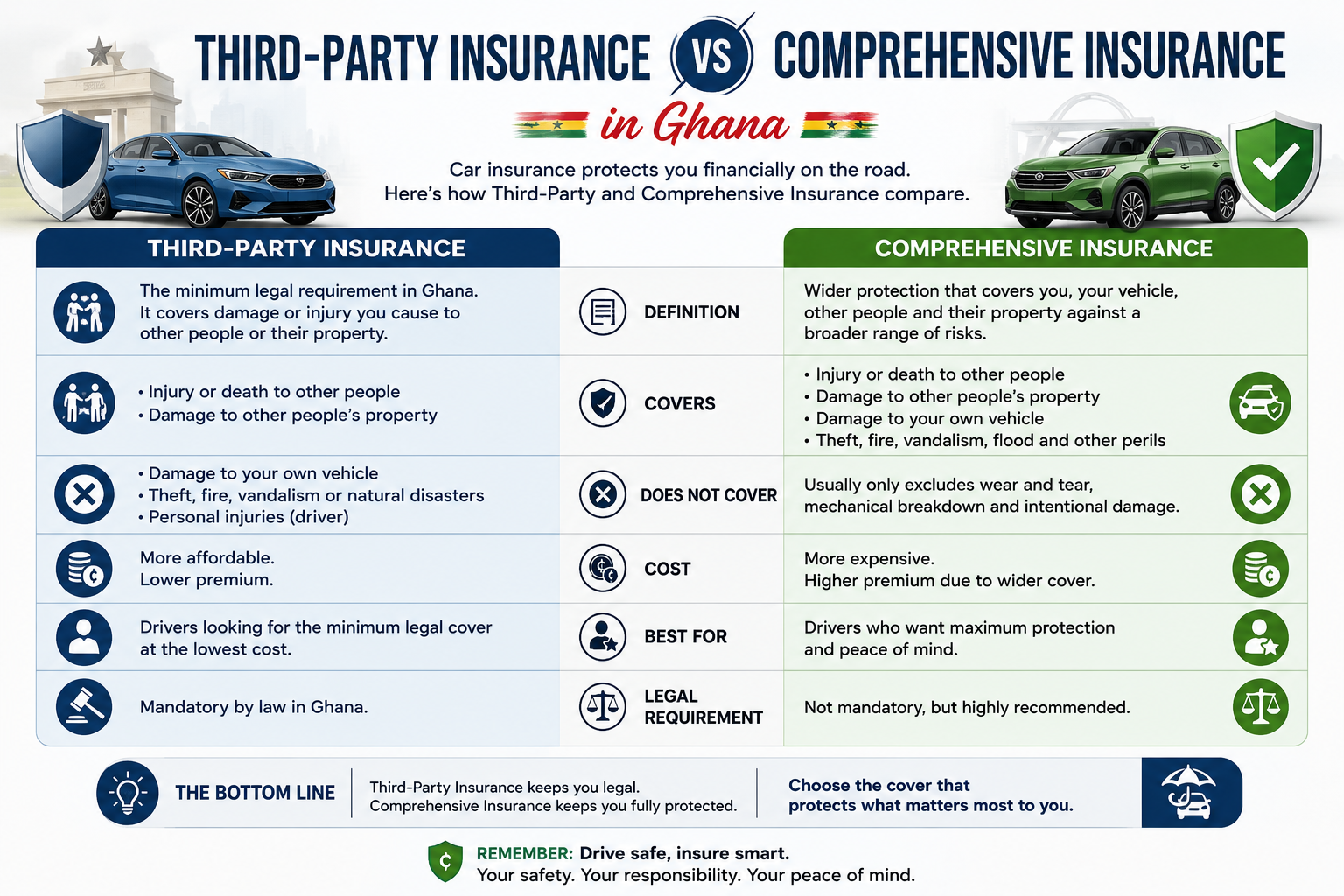
Third‑Party Only (GH¢300–500 for private cars, plus category premiums) covers injury, death, or damage caused to other people or their property. Property damage under third‑party is typically capped at around GH¢8,000; beyond that, the policyholder covers the excess out of pocket. The policy does not cover damage to the policyholder’s own vehicle, own medical expenses, theft, or fire.
Why do drivers choose third‑party? For older vehicles with low market value, for budget‑constrained owners who only need legal compliance, or because paying the full 5–7 per cent of the car’s value for comprehensive feels unaffordable. The January 2025 NIC proposal for a 10 per cent premium hike was suspended after backlash from the Ghana Private Road Transport Union (GPRTU) and other stakeholders who warned that higher insurance costs would immediately feed into higher transport fares.
Third‑Party, Fire & Theft sits between the two. It covers third‑party liabilities plus fire damage to the insured vehicle and theft, but still excludes accidental self‑damage. It is a common upgrade for drivers who fear their car being stolen or set ablaze in a riot but still cannot afford comprehensive.
Comprehensive Insurance (5–7 per cent of the car’s value) is the only policy that protects the policyholder’s own vehicle. It covers third‑party damage, own‑vehicle damage from accidents, theft, fire, natural disasters, windscreen damage, and sometimes personal accident cover. But comprehensive has exclusions: driving under the influence, using the vehicle outside its declared purpose (for example, commercial use on a private car policy), allowing an unlicensed driver to drive, unpaid premiums, or false information on the application can void the claim.
Premium Economics: The Undercutting Crisis
Motor insurance pricing in Ghana is heavily regulated. The NIC publishes tariff frameworks, especially for motor classes, with premiums varying by vehicle category: private cars, taxis, commercial passenger vehicles (trotro), trucks, and motorcycles. In January 2025, the NIC proposed a 10 per cent across‑board increase (revised down from an initial 15 per cent) to take effect on 1 February. Transport unions threatened nationwide strikes. An MP appealed directly to the President. The NIC suspended the increase indefinitely, citing “unforeseen circumstances”. The 10 per cent increase never took effect.
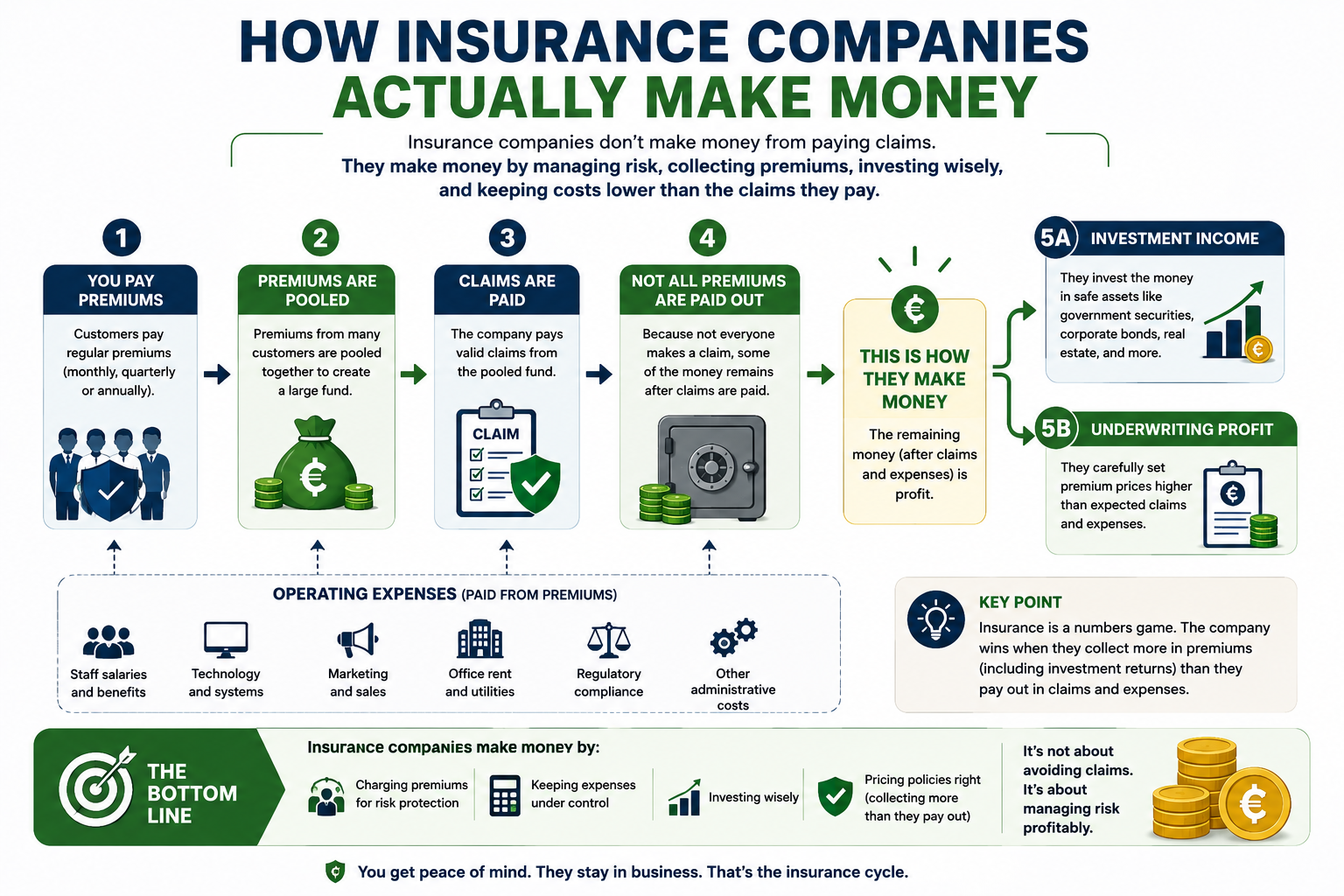
But the deeper market problem is not high official tariffs – it is price undercutting below actuarial floors. Brokers and insurers frequently offer premiums below the true cost of risk to win business. The NIC highlighted in its 2023 Annual Report that “price undercutting in motor and fire classes continues to threaten fair competition and market solvency”. The PwC Ghana Insurance Survey (2023) called price‑led competition the single biggest threat to underwriting profitability in the Ghanaian market. The results are predictable: when insurers compete on price alone, claims reserves are underfunded, delays multiply, and the public concludes that insurance is a scam.
The Motor Insurance Database (MID): The Digital Revolution That Killed Fake Stickers
Before 2020, fake insurance stickers were endemic. Of the 2.3 million vehicles registered in 2018, only about 1 million had genuine stickers, leaving a massive coverage gap. On 1 January 2020, the NIC launched the Motor Insurance Database (MID) – a centralised digital repository of every valid motor policy in the country. The NIC Commissioner called it “a groundbreaking success in revolutionising the motor insurance business in the country”.
The MID offers three instant verification methods:
1. SMS confirmation – policyholders receive an automatic SMS confirming authenticity.
2. USSD verification (92057#) – anyone can dial the short code, enter a registration number, and receive the vehicle’s insurer and policy expiry date in seconds.
3. QR code scanning – electronic stickers can be scanned to reveal full insurance details.
Within six weeks of launch, the MID onboarded over 78,000 newly insured vehicles that had previously evaded the system. By March 2021, 1.4 million policies had been issued through the MID portal. The NIC donated 900 Gota phones to the MTTD police unit, allowing officers to verify insurance validity instantly at checkpoints. For passengers, dialling 92057# before boarding a commercial vehicle has become a standard safety practice.

For insurers, the MID has curbed the premium undercutting and policy undervaluation that made it impossible to assess market-wide risk accurately. Fake stickers have not disappeared entirely, but the MID has cut the problem from epidemic to statistical noise.
The Fraud Problem and the Enforcement Gaps
The persistence of criminal counterfeiting networks underscores the scale of fraud. The DVLA uncovered a GH¢12.5 million fake dealer vehicle (DV) plate network in March 2026, producing more than 30,000 counterfeit plates. The fake plates were accompanied by forged documentation, including counterfeit motor insurance certificates. The DVLA’s CEO warned that accident victims might find that their “insurance cover” was fraudulent, leaving them without any protection or compensation. Counterfeit plates are typically sold through illegal intermediaries (goro boys) operating outside DVLA offices.
The NIC has estimated that about 25 per cent of all insurance claims in Ghana show elements of fraud – staged accidents, falsified police reports, inflated repair estimates, and duplicate claims for the same incident. The fight against fraud absorbs significant industry resources and drives up legitimate claim waiting times, as insurers verify every file with suspicion.
The Claims Process: Why Good Claims Fail
The claims process in Ghana begins at the accident scene. Policyholders are required to: ensure safety; report to the police (especially for third‑party injury or significant damage); gather evidence (photographs, witness contacts); then file the claim with their insurer using the specific claim form. Once assessed, the insurer may authorise repairs or issue compensation. Simple claims settle faster; complex claims with disputes over liability or inflated repair bills take longer.
So why do legitimate claims fail? Five factors are most common:
1. Late reporting – waiting days or weeks after the accident gives insurers grounds to argue that causation cannot be established.
2. Misunderstanding coverage – many third‑party policyholders are shocked to discover that their own vehicle is not covered.
3. Excluded circumstances – drunk driving, using the vehicle for commercial purposes when insured as private, or an unlicensed driver at the wheel all void liability.
4. Fake policies – counterfeit insurance offered by roadside vendors; victims only discover the fraud when they try to claim.
5. Incomplete documentation – missing police reports, repair estimates, or evidence of ownership.
The GIA CEO, Kingsley Kwame Brako, noted that “there’s a misconception that insurers are only interested in collecting premiums and reluctant to pay claims. That is not true”. Ghanaian insurers collectively pay out over GHS 8‑10 million daily in claims. Claim volumes, particularly from motor and health policies, continue to outpace available claims‑assessment expertise, and the widespread reliance on manual paperwork remains a choke point.
Regulatory Direction: Ghana Card, Cargo Insurance and NPL Overhang
In January 2026, the NIC made the Ghana Card mandatory for all motor insurance purchases and renewals, effective from 1 January 2026, with corporate clients required to provide their Tax Identification Number (TIN). The policy aims to eliminate identity fraud, link every policy to a verifiable individual, and improve claims traceability.
From February 2026, the Ministry of Finance made local cargo insurance mandatory for all imports, a move designed to deepen the non‑life insurance market, though its enforcement and impact remain to be seen. In the same period, the NIC announced that overloading would void insurance cover, cautioning drivers and tricycle operators that carrying passengers or goods beyond capacity could leave them uninsured.
The DDEP hangover also affected insurers. Prior to the debt default, the insurance industry held close to GH¢4.6 billion in government securities. The DDEP eroded capital reserves across the sector, forcing insurers to shift portfolios into Treasury bills; when T‑bill yields collapsed in late 2024, insurers faced further losses. The government established a US$750 million Financial Stability Fund to provide capital support to affected financial institutions.
The NIC is also exploring a revision of motor insurance acquisition rules in collaboration with the DVLA, potentially requiring vehicle owners to secure insurance before obtaining a roadworthy certificate, closing a current loophole where uninsured vehicles can still be on the road.
IFRS 17 and new reporting standards: Insurers are now required to measure and report profit and loss as services are earned, not on cash‑received basis, which forces greater transparency in how motor premiums are matched to claims reserves over policy periods.
Telematics and the Future of Motor Pricing
For decades, Ghanaian auto insurers have priced premiums based on traditional variables: vehicle type, the driver’s age, years of experience, and gender. These factors do not accurately reflect actual road risk or driving behaviour.
Telematics – a combination of telecommunications and informatics – allows insurers to track driving habits (speed, braking patterns, acceleration, cornering skills) using black boxes or GPS devices. Telematics ratemaking determines premiums based on collected driving data rather than demographic proxies. Global adoption of usage‑based insurance (UBI) models, including pay‑how‑you‑drive (PHYD) and pay‑as‑you‑drive (PAYD), has made pricing significantly more accurate. Early adopters report fewer fatal accidents because drivers behave more carefully when they know they are being monitored.
Ghana has a nascent telematics market, and the local PAYD app Sorpi‑Sorpi already allows drivers to supplement their existing third‑party policies with per‑kilometre top‑up coverage. Integration into mainstream auto insurance would allow good drivers to pay less and bad drivers to pay what they actually cost the pool.
Future Outlook: Three Scenarios for the Motor Insurance Business
Scenario One: Gradual Digital Reform (65 per cent probability)
Motor insurance remains mandatory, with the MID continuing to reduce fake policies. Telematics adoption remains niche. Premium undercutting persists because the NIC lacks enforcement bandwidth. The 10 per cent increase never returns, but insurers find margin through digital claims efficiency and cross‑selling ancillary products (windscreen, roadside assist). Claims remain slow, but the daily payout volume (GH¢8–10 million) shows the system fundamentally works.
Scenario Two: Sticker‑Less Breakthrough (25 per cent probability)
The Ghana Card mandate and MID integration make physical stickers obsolete. Telematics adoption takes off, driven by ride‑share fleets and commercial operators. Pay‑per‑drive models become mainstream, attracting younger, low‑mileage drivers who previously bought only third‑party for compliance. Ghana’s insurance penetration rises to 2.5‑3 per cent, largely driven by motor and microinsurance.
Scenario Three: Fraud and Underwriting Crisis (10 per cent probability)
A major accident reveals widespread fake policy exposure, shaking public confidence. Claims delays worsen as fraud investigations backlog legitimate claims. Premium undercutting drives multiple small insurers into solvency crises. The NIC is forced to impose stricter pricing floors, causing a sudden premium spike and political backlash.
The most likely path is Scenario One: incremental digital improvement, but motor insurance remains a compliance‑driven, low‑trust, high‑volume business that no single reform can magically fix.
Conclusion
The business of motor insurance in Ghana is a story of contrasts. On one hand, it is the most successful segment of the entire insurance market – driven by legal mandate, enforced by police checkpoints, and digitally transformed by the Motor Insurance Database. The MID has largely solved the fake‑sticker epidemic that plagued the roads for decades. Real‑time verification means a passenger can know before boarding whether a trotro is insured.
On the other hand, the motor insurance market remains fundamentally broken for many of its participants. Policyholders who buy only third‑party are shocked to find their own car uncovered. Claim delays are chronic, driven by manual paperwork, under‑resourced investigators, and a mandatory police accident report that can take weeks to obtain. Fraud accounts for roughly a quarter of claims filed. Price undercutting means the cheapest premiums often leave insufficient reserves for claim payments. The NIC’s attempt to raise premiums by 10 per cent was met with such fierce political resistance that it never even took effect.
Yet the market continues to grow. Real revenue growth of 19.9 per cent in 2025 is not a crisis number. The MID, Ghana Card integration, telematics pilots, and IFRS 17 transparency are laying the groundwork for a more accurate, more efficient, and more trustworthy system. The Ghanaian motorist will always need insurance – the law guarantees that. The question is whether the business of providing that insurance can finally deliver a claims experience that matches the promise of the policy.
Frequently Asked Questions (FAQ)
Q1: Is motor insurance mandatory in Ghana?
Yes. Under Section 3(1) of the Motor Vehicles (Third‑Party Insurance) Act, 1958, no vehicle can lawfully be used on a road without a valid motor insurance policy. Enforcement is carried out by the DVLA and the MTTD police.
Q2: What is the minimum legal motor insurance required in Ghana?
The minimum legal requirement is third‑party insurance, which covers injury, death or damage caused to other people or their property. It does not cover your own vehicle, your own medical expenses, theft or fire.
Q3: How much does third‑party motor insurance cost in Ghana?
As of February 2026, private cars pay approximately GH¢557 per year. Taxis pay about GH¢744, trotros pay GH¢894–1,194 depending on passenger capacity, and motorcycles pay about GH¢331. These are the revised NIC tariff rates.
Q4: What is comprehensive motor insurance?
Comprehensive insurance covers damage to your own vehicle in addition to third‑party liability, as well as theft, fire, natural disasters, and windscreen damage. Premiums are typically 5–7 per cent of the vehicle’s market value.
Q5: Why do so many drivers choose third‑party insurance instead of comprehensive?
Budget constraints, older vehicles with low market value, and the perception that insurance is only a legal requirement to avoid police fines are the main reasons. Some drivers also underestimate the financial risk of crashing their own car.
Q6: What is the Motor Insurance Database (MID)?
The MID is a centralised digital system launched in January 2020 that records every valid motor policy in Ghana. It allows instant verification of a vehicle’s insurance status via USSD short code 92057#, SMS confirmation, or QR code scanning.
Q7: How can I check if a vehicle is insured in Ghana?
Dial 92057# on any mobile phone, enter the vehicle registration number, and receive the insurer name and policy expiry date instantly. The service is free and available to any member of the public.
Q8: Why are insurance claims often delayed in Ghana?
Common causes include manual paperwork processes, insufficiently trained claims assessors, disputes over liability that require police reports, the need to investigate fraud (estimated 25% of claims have fraud elements), and incomplete documentation submitted by policyholders.
Q9: What voids a motor insurance claim in Ghana?
Driving under the influence of alcohol or drugs; using the vehicle for commercial purposes when the policy states private use; allowing an unlicensed driver to drive; unpaid premiums; providing false information on the application; and overloading the vehicle beyond its legal capacity.
Q10: Is the insurance sticker still required on windscreens?
The Insurance Act, 2021 does not explicitly require sticker display, but NIC regulatory directives enforce sticker practices through police departments. The MID and QR codes have made physical stickers less critical for verification.
Q11: What is premium undercutting and why is it a problem?
Premium undercutting occurs when insurers or brokers charge premiums below the actuarially calculated risk cost to win business. It leads to underfunded claims reserves, delayed payments, solvency risks, and long‑term public distrust in insurance.
Q12: What is telematics and is it coming to Ghana?
Telematics uses GPS and black box devices to monitor actual driving behaviour – speed, braking, acceleration, cornering. It enables usage‑based insurance (pay‑how‑you‑drive or pay‑as‑you‑drive), which rewards safe drivers with lower premiums. Ghana has a nascent telematics market; full adoption would require regulatory integration and widespread device deployment.
Source : The High Street Business
Disclaimer: Some content on The High Street Business may be aggregated, summarized, or edited from third-party sources for informational purposes. Images and media are used under fair use or royalty-free licenses. The High Street Business is a subsidiary of SamBoad Publishing under SamBoad Business Group Ltd, registered in Ghana since 2014.
For concerns or inquiries, please visit our Privacy Policy or Contact Page.

Esther Aku-Sika is a content writer and social media strategist who helps brands and startups grow through intentional storytelling and practical marketing strategies. With a keen eye for trends and audience behavior, she shares business insights, content strategies, and real-life lessons to help entrepreneurs build visibility and turn ideas into income. Through her writing, she simplifies complex concepts and equips readers with actionable steps to grow in today’s digital space.