

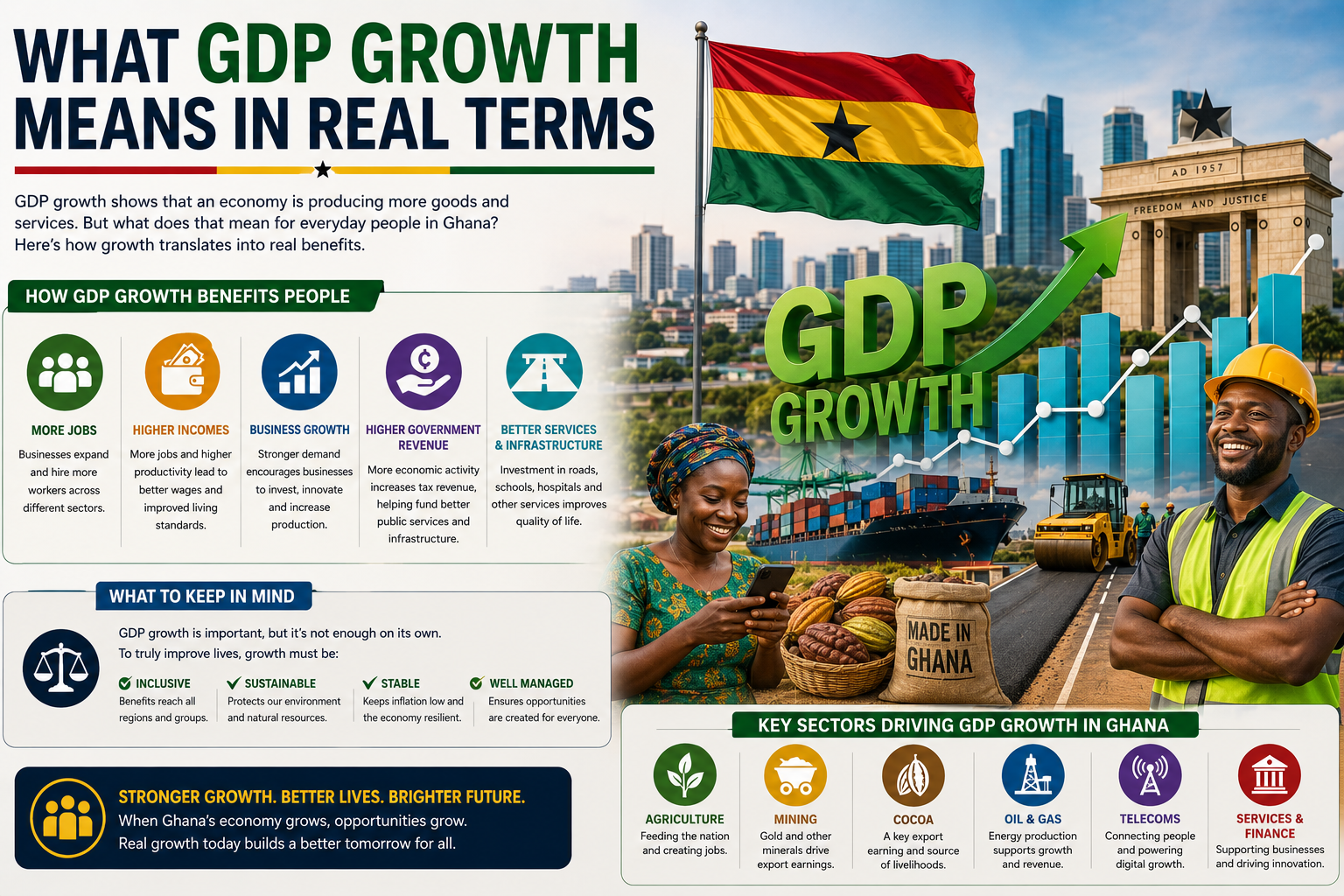
What GDP Growth Means in Real Terms – What does GDP growth actually mean for everyday people? Learn how Gross Domestic Product growth affects jobs, incomes, business activity, and living standards in Ghana.
What GDP Growth Means in Real Terms
Gross Domestic Product (GDP) growth is one of the most widely cited measures of economic performance. When headlines report that Ghana’s economy has grown, it usually refers to an increase in GDP. But for many people, the more important question is what that growth means in practical terms.
GDP growth matters because it can signal rising business activity, stronger incomes, and expanding job opportunities. However, economic growth is most meaningful when it improves living standards and creates opportunities across the country.
📢 GET DETAILED ARTICLES + JOBS
Join THSB's WhatsApp Channel and never miss a post or opportunity.
What Is GDP?
GDP is the total value of all goods and services produced within a country over a specific period. This includes household spending, business investment, government expenditure, and net exports.
When GDP increases, it generally means that more goods are being produced, more services are being delivered, and more economic activity is taking place.
What GDP Growth Indicates
GDP growth shows that the economy is expanding. In real terms, this can mean:
- Businesses are selling more products and services.
- Companies are investing in equipment and expansion.
- Employment opportunities are increasing.
- Government revenues are rising.
- Household incomes are improving.
Growth suggests that the economy is generating more value than it did previously.
Why “Real” GDP Matters
Economists often focus on real GDP growth rather than nominal GDP growth. Real GDP adjusts for inflation, which means it measures the actual increase in production rather than simply higher prices. This provides a clearer picture of whether the economy is truly expanding.
For example, if prices rise sharply but output remains unchanged, nominal GDP may increase even though real economic activity has not improved significantly.
What GDP Growth Means for Jobs
One of the most important benefits of economic growth is job creation. As companies expand, they may need more workers in sectors such as agriculture, manufacturing, construction, retail, and services.
In Ghana, stronger GDP growth can create opportunities for:
- Farmers and agribusiness workers
- Factory employees
- Construction workers
- Bank and telecom staff
- Small business owners
When more people are employed, household incomes and consumer spending tend to increase.
Impact on Household Incomes
A growing economy often leads to higher earnings. Businesses experiencing stronger sales may raise wages, offer more hours, or hire additional staff. Entrepreneurs may also benefit from greater demand for their products and services.
Although gains are not always evenly distributed, sustained growth generally improves income prospects over time.
Support for Government Revenue
When GDP rises, government tax collections often increase as businesses earn more and individuals generate higher incomes. Higher revenue can help fund:
- Roads and transport infrastructure
- Schools and universities
- Hospitals and clinics
- Social support programmes
This means economic growth can contribute to better public services if resources are managed effectively.
Stronger Investor Confidence
Investors closely monitor GDP growth as a signal of economic momentum. Consistent growth can attract both local and foreign investment, as businesses become more optimistic about future demand. Greater investment can lead to new factories, improved infrastructure, and expanded production capacity. This creates a positive cycle of growth and job creation.
Better Business Opportunities
GDP growth usually reflects stronger demand across the economy. Retailers may sell more goods, manufacturers may increase output, and service providers may gain more customers. Small and medium-sized enterprises often benefit when consumers and larger firms spend more.
For entrepreneurs, a growing economy can present new opportunities for expansion.
Why GDP Growth Alone Is Not Enough
GDP growth does not automatically guarantee that everyone benefits. The economy may expand while:
- Inflation remains high
- Income inequality persists
- Youth unemployment stays elevated
- Living costs continue to rise
That is why economists also examine indicators such as inflation, poverty rates, employment, and access to public services.
Ghana’s Key Growth Sectors
In Ghana, GDP growth is often driven by sectors such as:
- Agriculture
- Gold mining
- Cocoa production
- Oil and gas
- Telecommunications
- Financial services
- Construction
Diversifying growth across multiple sectors helps make the economy more resilient and inclusive.
What GDP Growth Means for Everyday Ghanaians
For households, GDP growth can translate into practical improvements such as:
- More employment opportunities
- Higher incomes
- Increased business activity
- Better infrastructure
- Improved government services
When growth is broad-based and well managed, it can raise living standards and create long-term opportunities.
The THSB Bottom Line
GDP growth is more than a statistic. In real terms, it reflects whether the economy is producing more goods and services and whether opportunities are expanding.
For Ghana, sustained real GDP growth can support jobs, higher incomes, stronger businesses, and improved public services. The true value of growth lies in how effectively it translates into better living standards for people across the country.
Source: The High Street Business
Disclaimer: Some content on The High Street Business may be aggregated, summarized, or edited from third-party sources for informational purposes. Images and media are used under fair use or royalty-free licenses. The High Street Business is a subsidiary of SamBoad Publishing under SamBoad Business Group Ltd, registered in Ghana since 2014.
For concerns or inquiries, please visit our Privacy Policy or Contact Page.

Esther Aku-Sika is a content writer and social media strategist who helps brands and startups grow through intentional storytelling and practical marketing strategies. With a keen eye for trends and audience behavior, she shares business insights, content strategies, and real-life lessons to help entrepreneurs build visibility and turn ideas into income. Through her writing, she simplifies complex concepts and equips readers with actionable steps to grow in today’s digital space.