



How Ghana Measures Economic Progress – How does Ghana measure economic progress? Discover the key indicators economists use to track growth, inflation, employment, and living standards across the country.
How Ghana Measures Economic Progress
Economic progress is more than just whether people feel better off. It is measured using a range of indicators that show how businesses are performing, how prices are changing, and whether living standards are improving.
In Ghana, policymakers, investors, and households closely monitor economic data to understand the country’s direction. These indicators help reveal whether growth is accelerating, inflation is easing, jobs are being created, and public finances are becoming more sustainable.
📢 GET DETAILED ARTICLES + JOBS
Join THSB's WhatsApp Channel and never miss a post or opportunity.
By tracking these measures, Ghana can assess whether reforms are working and where additional action may be needed.
Gross Domestic Product (GDP)
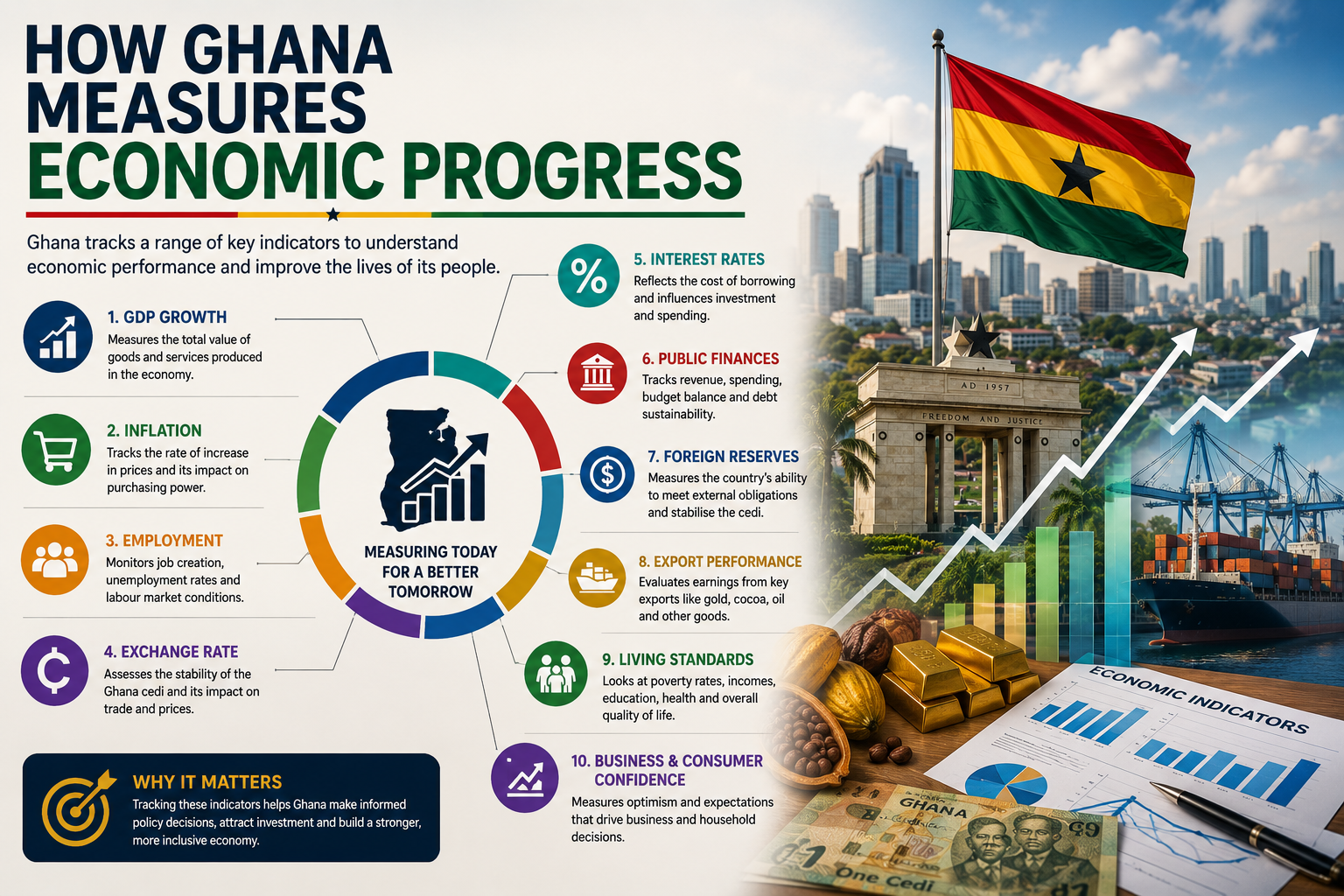
The most widely used measure of economic progress is Gross Domestic Product, or GDP. GDP represents the total value of goods and services produced within a country over a given period.
When GDP grows, it generally indicates that businesses are producing more, incomes are rising, and economic activity is expanding. In Ghana, sectors such as agriculture, mining, oil and gas, manufacturing, and services all contribute to GDP. Strong GDP growth is a positive sign, but it does not by itself show how widely the benefits are shared.
Inflation
Inflation measures the rate at which prices of goods and services increase over time. In Ghana, inflation is one of the most closely watched indicators because it directly affects household purchasing power. Lower inflation means prices are rising more slowly, making it easier for families and businesses to plan their budgets.
The Ghana Statistical Service publishes inflation data regularly, while the Bank of Ghana uses it to guide interest rate decisions.
Employment and Job Creation
A growing economy should create opportunities for people to work and earn incomes. Employment indicators show how many people are working, how many are unemployed, and how labour market conditions are evolving. Job creation in sectors such as construction, manufacturing, agriculture, and services is a practical sign of economic progress.
When more Ghanaians have access to stable jobs, living standards tend to improve.
Exchange Rate Stability
The performance of the Ghanaian cedi is another important measure. A stable currency reduces uncertainty for businesses, helps control import costs, and supports lower inflation. Sharp currency depreciation can increase the prices of fuel, medicines, and other imported goods.
Because Ghana trades extensively with the rest of the world, exchange rate stability is a key indicator of macroeconomic health.
Interest Rates
Interest rates affect borrowing costs for households, businesses, and the government. When inflation is under control and economic conditions improve, interest rates may gradually decline. Lower rates can encourage investment, mortgage lending, and business expansion.
The Bank of Ghana sets the policy rate to help maintain price stability and support sustainable growth.
Public Debt and Fiscal Balance
Government finances are central to measuring progress. Analysts track:
- Public debt levels
- Budget deficits
- Tax revenues
- Government spending
When debt becomes more manageable and fiscal deficits narrow, confidence tends to improve. Stronger public finances allow more resources to be directed toward infrastructure, education, and healthcare.
Foreign Exchange Reserves
Foreign reserves are assets held by the central bank in foreign currencies. These reserves help Ghana pay for imports, service external obligations, and stabilise the currency during periods of volatility. Rising reserves generally indicate stronger resilience and greater confidence in the economy.
Export Performance
Ghana earns foreign exchange from exports such as gold, cocoa, and crude oil. Higher export earnings support the cedi, increase government revenue, and strengthen the balance of payments. Diversifying exports into manufacturing and value-added products is also an important sign of structural progress.
Poverty and Living Standards
Economic progress is ultimately about improving people’s lives. Indicators such as poverty rates, access to education, healthcare outcomes, and household incomes provide a broader view of development. Growth is most meaningful when it translates into better opportunities and higher living standards for citizens across the country.
Business and Consumer Confidence
Sentiment indicators offer insight into how businesses and households feel about the future. When confidence is high, firms are more likely to invest and hire, while consumers are more willing to spend. Positive sentiment often supports stronger economic momentum.
Why Multiple Indicators Matter
No single statistic tells the whole story. GDP may rise even while inflation remains high, or the currency may stabilise while job creation lags. By examining a range of indicators together, policymakers gain a more accurate understanding of Ghana’s economic performance.
This broader perspective helps guide better decisions and more effective reforms.
THSB Bottom Line
Ghana measures economic progress using a combination of indicators, including GDP growth, inflation, employment, exchange rate stability, public finances, export performance, and living standards.
Together, these measures show whether the economy is becoming stronger, more stable, and more inclusive. For businesses, investors, and households, understanding these indicators provides a clearer picture of where Ghana is heading and what that means for the future.
Source: The High Street Business
Disclaimer: Some content on The High Street Business may be aggregated, summarized, or edited from third-party sources for informational purposes. Images and media are used under fair use or royalty-free licenses. The High Street Business is a subsidiary of SamBoad Publishing under SamBoad Business Group Ltd, registered in Ghana since 2014.
For concerns or inquiries, please visit our Privacy Policy or Contact Page.

Esther Aku-Sika is a content writer and social media strategist who helps brands and startups grow through intentional storytelling and practical marketing strategies. With a keen eye for trends and audience behavior, she shares business insights, content strategies, and real-life lessons to help entrepreneurs build visibility and turn ideas into income. Through her writing, she simplifies complex concepts and equips readers with actionable steps to grow in today’s digital space.