



Ghana’s GH₵7.4 Billion Informal Trade – A Wake-Up Call for Smarter Border Economics

Picture1 e1768247542427 300x174 jKV9Ej

The Ghana Statistical Service (GSS) has once again put numbers to what many traders and analysts have long suspected — the informal economy along Ghana’s borders is not just active; it is enormous.

According to the GSS’s maiden Informal Cross-Border Trade (ICBT) Report and reports by Accra Street Journal the total value of informal trade in the fourth quarter of 2024 alone reached GH₵7.4 billion, representing 4.3% of Ghana’s total trade within that period. By contrast, formal trade stood at GH₵165.3 billion.

These figures, though seemingly modest beside the formal numbers, reveal a powerful truth: Ghana’s border economy is far larger, more complex, and more vital than official records have long reflected.

📢 GET A DETAILED ARTICLES + JOBS

Join SamBoad's WhatsApp Channel and never miss a post or opportunity.
📲 Join the Channel Now

Cross-border informal trade in 2024 Q4 estimated at GH₵7.4bn - GSS

The Invisible Engine of Border Commerce

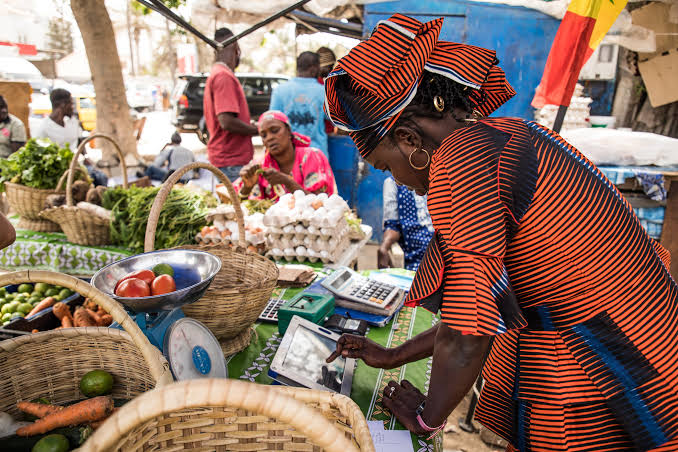
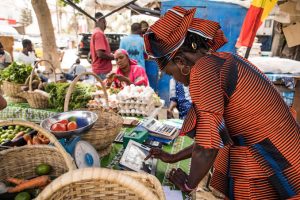
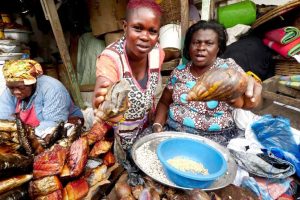
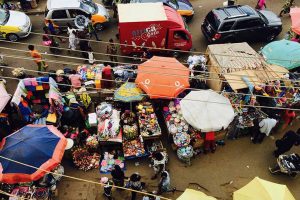
The GSS defines informal cross-border trade as goods and services that move between Ghana and its neighbours — Togo, Côte d’Ivoire, and Burkina Faso — but are not recorded through formal customs procedures. These include goods carried by truck, small vans, or even on foot.

The survey, which covered 10 out of Ghana’s 16 regions through 321 border points and 102 field officers, offers a rare glimpse into this hidden economy.

The Volta Region topped the list with 76 border points, followed by Western North (45) and the Upper Regions (44). Predictably, Ghana’s eastern neighbour, Togo, emerged as the dominant player in informal trade — leading imports with GH₵1.8 billion, while Burkina Faso led exports with GH₵1.7 billion.

OTHERS READING:  Balancing Act: What the Money-Market Tightening, Crypto Regulation & Liquidity Sweep Mean for Businesses and Investors

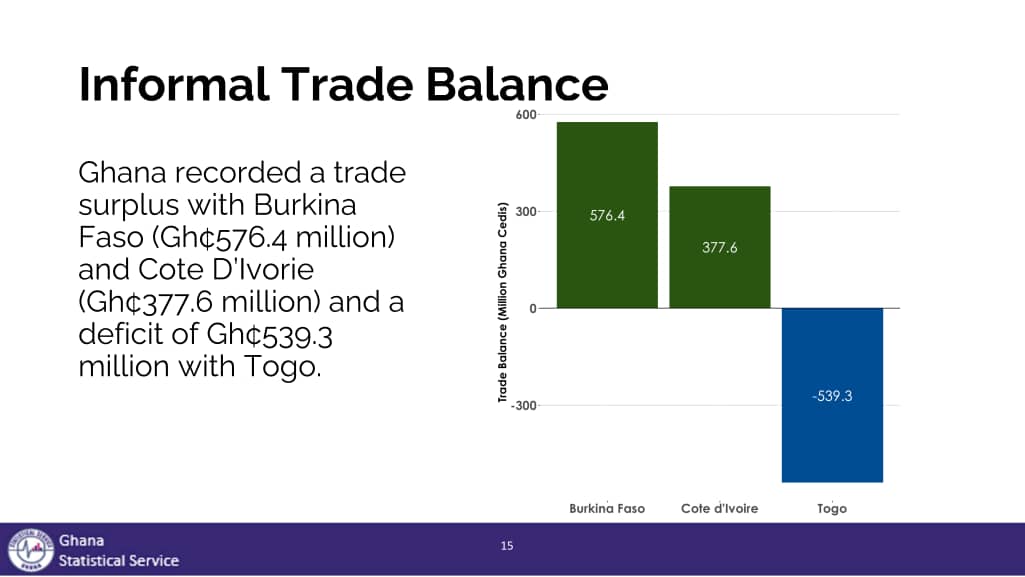
However, Ghana’s trade balance with Togo tells a different story: a deficit of GH₵538.9 million, compared with surpluses of GH₵571 million and GH₵374.6 million with Burkina Faso and Côte d’Ivoire respectively.
Cross-border informal trade in 2024 Q4 estimated at GH₵7.4bn - GSS

Food at the Core of Informal Trade

The ICBT report makes clear that informal trade is not limited to luxury or manufactured goods — it is driven by food.

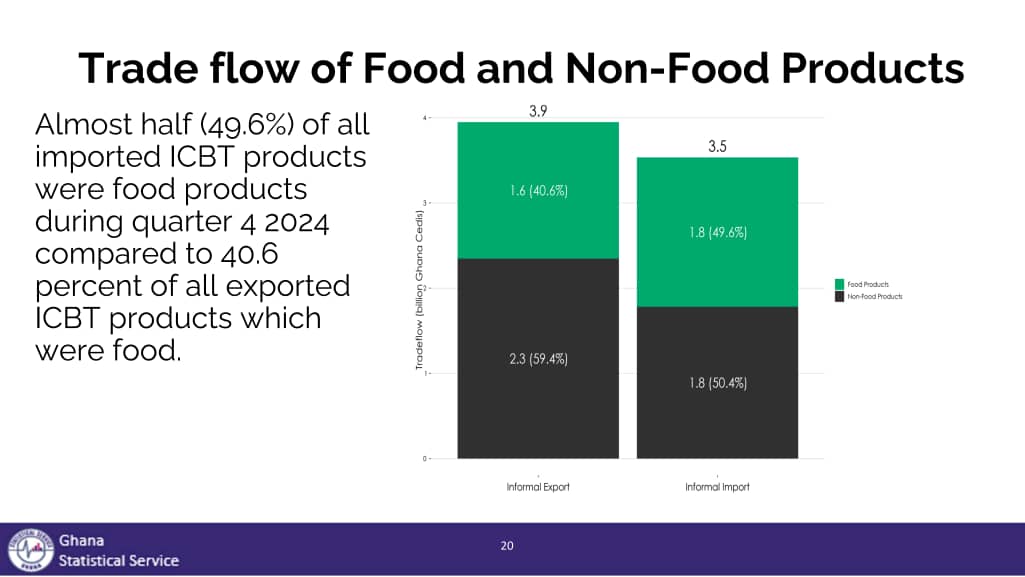
From alcoholic beverages and cooking oil to livestock and grains, food items dominate cross-border flows. The report found that 74.6% of formal imports from Ghana’s three neighbours are food products, compared to 49.5% of informal imports.

The imbalance in livestock trade is striking: Ghana imported GH₵300 million worth of livestock, nearly twice the value of its exports (GH₵177 million). These patterns underscore a critical vulnerability Ghana’s dependence on imported food items that could otherwise be produced locally.

A Call for Border Reform and Production Investment

Government Statistician Dr. Alhassan Iddrisu used the report’s launch to issue a call to action. He urged a shift from viewing informal trade as a challenge to seeing it as an opportunity for reform and growth.

“Boost production of items like cooking oil, mattresses, to cut dependence on imports,” he advised, adding that collaboration with neighbouring countries on data sharing and infrastructure is vital to formalising trade.

Indeed, Ghana’s borders are not just lines of control — they are arteries of commerce. Improving border infrastructure, simplifying customs procedures, and creating trader registration and micro-financing schemes could convert informal commerce into taxable, traceable, and more profitable exchanges.

Formalisation, however, should not mean over-regulation. Policies must recognise that informal trade supports thousands of livelihoods and sustains communities that depend on border activity for survival.

OTHERS READING:  Central African Republic’s Crypto Experiment Raises Risks to State Assets, Report Warns

From Data to Development

The GSS has done its part by shining a light on what was previously invisible. The responsibility now shifts to policymakers, the private sector, and regional partners under ECOWAS and the AfCFTA framework to turn data into design — and design into decisive policy.

If Ghana can successfully integrate informal trade into its national accounts and trade strategies, the country’s GDP may reveal a more accurate, and potentially more optimistic, picture of economic performance.

The message from the ICBT report is clear: the border economy is not an outlier — it is part of Ghana’s growth story. Counting it, supporting it, and integrating it could be one of the smartest moves for inclusive economic planning in the years ahead.

Source: Accra Business News

Disclaimer: Some content on The High Street Business may be aggregated, summarized, or edited from third-party sources for informational purposes. Images and media are used under fair use or royalty-free licenses. The High Street Business is a subsidiary of SamBoad Publishing under SamBoad Business Group Ltd, registered in Ghana since 2014.

For concerns or inquiries, please visit our Privacy Policy or Contact Page.

Leave a Reply

Your email address will not be published. Required fields are marked *

Ghana’s GH₵7.4 Billion Informal Trade – A Wake-Up Call for Smarter Border Economics

Why Inflation Hurts Savings and Investment in Ghana’s Economy

The Ghana Statistical Service (GSS) has once again put numbers to what many traders and analysts have long suspected — the informal economy along Ghana’s borders is not just active; it is enormous.

According to the GSS’s maiden Informal Cross-Border Trade (ICBT) Report and reports by Accra Street Journal the total value of informal trade in the fourth quarter of 2024 alone reached GH₵7.4 billion, representing 4.3% of Ghana’s total trade within that period. By contrast, formal trade stood at GH₵165.3 billion.

These figures, though seemingly modest beside the formal numbers, reveal a powerful truth: Ghana’s border economy is far larger, more complex, and more vital than official records have long reflected.

📢 GET A DETAILED ARTICLES + JOBS

Join SamBoad's WhatsApp Channel and never miss a post or opportunity.

📲 Join the Channel Now

Cross-border informal trade in 2024 Q4 estimated at GH₵7.4bn - GSS

The Invisible Engine of Border Commerce

The GSS defines informal cross-border trade as goods and services that move between Ghana and its neighbours — Togo, Côte d’Ivoire, and Burkina Faso — but are not recorded through formal customs procedures. These include goods carried by truck, small vans, or even on foot.

The survey, which covered 10 out of Ghana’s 16 regions through 321 border points and 102 field officers, offers a rare glimpse into this hidden economy.

The Volta Region topped the list with 76 border points, followed by Western North (45) and the Upper Regions (44). Predictably, Ghana’s eastern neighbour, Togo, emerged as the dominant player in informal trade — leading imports with GH₵1.8 billion, while Burkina Faso led exports with GH₵1.7 billion.

OTHERS READING:  Ghana’s HR Regulator CIHRM Partners with SHRM to Elevate Workforce Standards and Global Competitiveness

However, Ghana’s trade balance with Togo tells a different story: a deficit of GH₵538.9 million, compared with surpluses of GH₵571 million and GH₵374.6 million with Burkina Faso and Côte d’Ivoire respectively.

Cross-border informal trade in 2024 Q4 estimated at GH₵7.4bn - GSS

Food at the Core of Informal Trade

The ICBT report makes clear that informal trade is not limited to luxury or manufactured goods — it is driven by food.

From alcoholic beverages and cooking oil to livestock and grains, food items dominate cross-border flows. The report found that 74.6% of formal imports from Ghana’s three neighbours are food products, compared to 49.5% of informal imports.

The imbalance in livestock trade is striking: Ghana imported GH₵300 million worth of livestock, nearly twice the value of its exports (GH₵177 million). These patterns underscore a critical vulnerability Ghana’s dependence on imported food items that could otherwise be produced locally.

A Call for Border Reform and Production Investment

Government Statistician Dr. Alhassan Iddrisu used the report’s launch to issue a call to action. He urged a shift from viewing informal trade as a challenge to seeing it as an opportunity for reform and growth.

“Boost production of items like cooking oil, mattresses, to cut dependence on imports,” he advised, adding that collaboration with neighbouring countries on data sharing and infrastructure is vital to formalising trade.

Indeed, Ghana’s borders are not just lines of control — they are arteries of commerce. Improving border infrastructure, simplifying customs procedures, and creating trader registration and micro-financing schemes could convert informal commerce into taxable, traceable, and more profitable exchanges.

Formalisation, however, should not mean over-regulation. Policies must recognise that informal trade supports thousands of livelihoods and sustains communities that depend on border activity for survival.

OTHERS READING:  BoG Registers Over 100 Virtual Asset Firms as Ghana Moves to Regulate Cryptocurrency Market

From Data to Development

The GSS has done its part by shining a light on what was previously invisible. The responsibility now shifts to policymakers, the private sector, and regional partners under ECOWAS and the AfCFTA framework to turn data into design — and design into decisive policy.

If Ghana can successfully integrate informal trade into its national accounts and trade strategies, the country’s GDP may reveal a more accurate, and potentially more optimistic, picture of economic performance.

The message from the ICBT report is clear: the border economy is not an outlier — it is part of Ghana’s growth story. Counting it, supporting it, and integrating it could be one of the smartest moves for inclusive economic planning in the years ahead.

Source: Accra Business News

Disclaimer: Some content on The High Street Business may be aggregated, summarized, or edited from third-party sources for informational purposes. Images and media are used under fair use or royalty-free licenses. The High Street Business is a subsidiary of SamBoad Publishing under SamBoad Business Group Ltd, registered in Ghana since 2014.

For concerns or inquiries, please visit our Privacy Policy or Contact Page.

Leave a Reply

Your email address will not be published. Required fields are marked *

error: Content is protected. Kindly credit The High Street Business when referencing.