


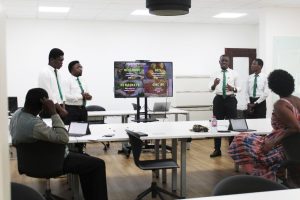


To better share its mission, raise awareness, and spark interest in opportunities among diverse groups, the UG Nkabom Collaborative hosted its first press engagement. Held at the Alisa Hotel in Accra, the event gathered top media figures – editors, presenters, producers, senior journalists, influential bloggers, and food and agriculture content creators – for an evening of meaningful conversation.
Kicking off the event, the Collaborative’s Communication Lead, Professor Abena Yeboah-Banin, highlighted the vital role an informed media plays in shaping public understanding and sparking discussions about Ghana’s agri-food systems.
She emphasized that to carry this out effectively, it’s important to understand Ghana’s food systems and the goals of the Nkabom Collaborative, as well as their processes. She explained that the soirée aimed not only to share the work of the UG Nkabom Collaborative with the media but also to foster lasting connections with some of Ghana’s most influential storytellers.
📢 GET DETAILED ARTICLES + JOBS
Join THSB's WhatsApp Channel and never miss a post or opportunity.
Delivering a presentation on Ghana’s agri-food landscape, the Education Pillar lead for the Collaborative, Dr. Hayford Ayerakwa, made a compelling case for the initiative’s multi-stakeholder approach.
He grounded its urgency in a stark national paradox: while over two million Ghanaians remained food insecure—including 1 million chronically malnourished children—nearly one-third of all food produced was lost or wasted, according to the World Food Programme’s 2025 country brief. He argued that this inefficiency stemmed from deep-seated structural gaps, which a fragmented approach coud not solve.
“Youth disengagement, fractured support systems, and the limited integration of vulnerable groups such as women, persons with disabilities (PWDs), and internally displaced persons,” he remarked, “provide a stark and compelling backdrop that makes our holistic, collaborative intervention not just timely, but necessary.”
He emphasised that the Collaborative’s approach was grounded in systemic problem-solving rather than traditional project thinking. “What we are attempting to build is not another project,” he noted, “but a coordinated path that brings young people, academia, private sector actors, and underserved groups into a shared mission for transforming our food systems.”
Professor Richmond Aryeetey, the Collaborative Lead presented the vision of UG Nkabom as a Ghana in which young people drive the agri-food ecosystem in a sustainable manner. We are joining hands with the Mastercard Foundation, other educational institutions, civil society, industry players, and communities to pursue this vision,” he explained.
He further highlighted how the harmonised efforts of the Collaborative’s three pillars—Education, Entrepreneurship, and Access & Success—were intentionally designed to tackle the system’s underlying pain points. “We believe that an effectively trained and tooled human resource, combined with the deliberate inclusion of women, persons with disabilities, and internally displaced persons, and a complete suite of entrepreneurship support, will holistically drive the agenda we seek.”
The evening’s panel discussion and its interactive question and answer (Q&A) session revealed a shared enthusiasm for building an enduring, mutually beneficial relationship between the Collaborative and the media. Editors and reporters called for regular updates, simplified communication of technical issues, and increased access to human-centred stories that would bring the initiative’s work to life.
“Let us see the young people themselves; their challenges, their wins, their growth,” one reporter urged, setting the tone for more people-focused storytelling. Another editor added, “Feature not just the usual spokespeople, but the young innovators themselves. Their stories are what will make this resonate with a wider audience.”
Journalists also expressed a desire for more immersive experiences. “Imagine if we were having this conversation right in the middle of your training fields,” one participant suggested. “Seeing the work firsthand would make the story so much more powerful for our audiences.”
To ensure that the media could play its role effectively, participants called for predictable and streamlined communication. “A monthly or quarterly update, even a simple newsletter with success stories and photos would give us the material we need to keep this narrative alive,” one editor advised. Another added, “If you give us a heads-up on your events and milestones, we can be better prepared to cover them creatively.”
Perhaps, the most resonant observation of the night came from a senior journalist who underscored the importance of a sustained public conversation: “This conversation is what holds leadership accountable. If we let it fade, so does the pressure to act.”
The soirée was the first step in a bigger plan to give media partners the context and clarity they need to share the Nkabom story accurately and powerfully. By connecting directly, the goal is to turn the media from passive onlookers into active supporters, making sure future coverage goes beyond simple announcements to spark conversations that keep the public engaged and inspire action around Ghana’s food systems.
UG Nkabom
UG Nkabom is part of the Nkabom Collaborative – a partnership between the University of Ghana, Mastercard Foundation, McGill University, and six other Ghanaian institutions aiming to transform Ghana’s agri-food systems by empowering young people. Built on three main pillars – Education, Access and Success, and Entrepreneurship – UG Nkabom links youth with the training, resources, and expertise they need to succeed in agribusiness. The program focuses on supporting those often left out of the sector, such as women, displaced persons, and people with disabilities.
UG Nkabom offers educational opportunities, helps secure funding, strengthens entrepreneurial skills, and connects youth with mentors and industry networks. By putting young people at the heart of Ghana’s food systems, we show that agri-food is more than just an economic sector—it’s a platform for empowerment and national growth.
Source: The High Street Business
Disclaimer: Some content on The High Street Business may be aggregated, summarized, or edited from third-party sources for informational purposes. Images and media are used under fair use or royalty-free licenses. The High Street Business is a subsidiary of SamBoad Publishing under SamBoad Business Group Ltd, registered in Ghana since 2014.
For concerns or inquiries, please visit our Privacy Policy or Contact Page.
Samuel Kwame Boadu is a Ghanaian entrepreneur, writer, and digital consultant passionate about creating impactful stories and business solutions. He is the Founder & CEO of SamBoad Business Group Ltd, a dynamic company with subsidiaries in digital marketing, logistics, publishing, and risk management.