

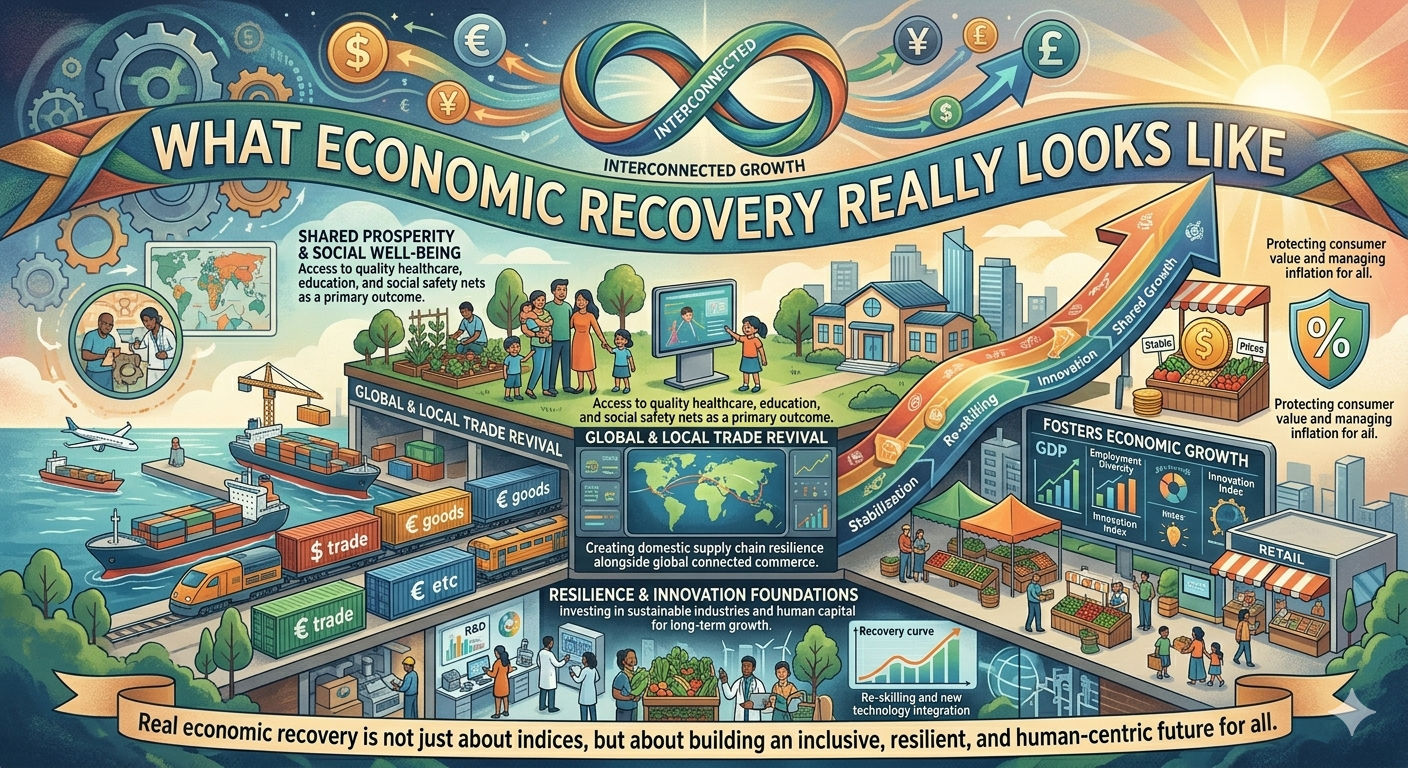
What Economic Recovery Really Looks Like – Economic recovery goes beyond statistics and growth figures. Here’s what real economic recovery looks like for businesses, households, and the broader Ghanaian economy.
What Economic Recovery Really Looks Like
Economic recovery is often discussed in terms of growth rates, inflation trends, and government policies. But for many people, recovery is not truly felt until daily life begins to improve. It is reflected in stable prices, stronger businesses, job opportunities, and greater financial confidence among households.
In Ghana, conversations about economic recovery have become increasingly important as the country works through inflation pressures, currency fluctuations, and global economic uncertainty. While official data can show signs of improvement, real recovery is usually measured by how much ordinary people and businesses feel positive change in their everyday lives.
📢 GET DETAILED ARTICLES + JOBS
Join THSB's WhatsApp Channel and never miss a post or opportunity.
Understanding Economic Recovery
Economic recovery refers to the period when an economy begins improving after experiencing financial or economic difficulties. This improvement may happen gradually and is often driven by stronger business activity, rising consumer confidence, stable inflation, and increased investment.
Recovery does not mean every problem disappears immediately. In many cases, it is a slow process where economic conditions steadily improve over time.
Stable Prices Are Often the First Sign
One of the clearest signs of recovery is when inflation begins to slow and prices become more predictable. During periods of economic instability, households often struggle with rising food costs, transportation expenses, and utility bills.
When prices stabilise, families are better able to plan their finances and businesses can manage costs more effectively. Consumers also regain confidence to spend on goods and services beyond basic necessities.
In Ghana, inflation trends are closely watched because they directly affect the cost of living and public confidence in the economy.
Stronger Businesses Reflect Recovery
Economic recovery becomes more visible when businesses begin expanding operations and improving performance. Companies are more likely to invest, hire workers, and introduce new products when economic conditions become stable.
Retail activity, construction projects, manufacturing output, and increased commercial activity are all indicators that businesses are regaining confidence.
Small businesses especially play an important role because they are often among the first to feel the impact of economic hardship and among the first to respond when conditions improve.
Employment and Household Confidence Matter
For many people, real economic recovery is measured by employment opportunities and income stability rather than national statistics alone.
When businesses begin hiring again and workers experience more stable incomes, consumer spending usually improves. Households may feel more comfortable saving money, paying school fees, investing in property, or supporting small businesses.
Recovery becomes meaningful when ordinary people begin to experience reduced financial pressure in their daily lives.
Currency Stability Supports Recovery
The performance of the Ghana cedi also influences perceptions of economic recovery. Currency stability helps businesses manage import costs and improves investor confidence.
When exchange rates become more stable, inflation pressures can ease, especially in sectors that rely heavily on imported goods and fuel. This creates a more predictable environment for businesses and consumers alike.
In economies like Ghana’s, where imports play a major role in trade and production, currency stability is often closely linked to broader economic confidence.
Investment Signals Economic Confidence
Investors tend to increase activity when they believe economic conditions are improving. Both local and foreign investment can signal confidence in future growth prospects.
Investment in infrastructure, technology, manufacturing, and agriculture often creates jobs and stimulates further economic activity. Increased investor confidence can also strengthen financial markets and support long-term development.
Governments usually encourage investment during recovery periods because it can accelerate growth and improve productivity.
Recovery Is Not Always Felt Equally
Even when economic indicators improve, not everyone experiences recovery at the same pace. Some sectors may recover faster than others, while low-income households may continue facing challenges long after official figures begin improving.
This is why economic recovery can sometimes feel uneven. Businesses in urban areas may see growth earlier, while smaller communities or struggling industries may take longer to recover fully.
Understanding this difference is important because economic recovery is not only about national numbers—it is also about social and financial well-being across different groups.
Government Policy Plays a Major Role
Public policy often shapes the pace of economic recovery. Governments may introduce measures aimed at controlling inflation, supporting businesses, improving infrastructure, and restoring investor confidence.
In Ghana, fiscal reforms, revenue mobilisation efforts, and economic support programmes are often designed to create long-term stability and encourage sustainable growth.
The effectiveness of these policies can influence how quickly recovery reaches households and businesses.
THSB’s Conclusion
Economic recovery is more than an improvement in statistics or growth projections. It is reflected in stable prices, stronger businesses, job opportunities, improved consumer confidence, and a better quality of life for households.
In Ghana, recovery is likely to remain a gradual process shaped by inflation trends, currency stability, investment activity, and government policy. While economic data can signal progress, real recovery is ultimately measured by how much people feel that life and business conditions are becoming more stable and hopeful again.
Source: The High Street Business
Disclaimer: Some content on The High Street Business may be aggregated, summarized, or edited from third-party sources for informational purposes. Images and media are used under fair use or royalty-free licenses. The High Street Business is a subsidiary of SamBoad Publishing under SamBoad Business Group Ltd, registered in Ghana since 2014.
For concerns or inquiries, please visit our Privacy Policy or Contact Page.

Esther Aku-Sika is a content writer and social media strategist who helps brands and startups grow through intentional storytelling and practical marketing strategies. With a keen eye for trends and audience behavior, she shares business insights, content strategies, and real-life lessons to help entrepreneurs build visibility and turn ideas into income. Through her writing, she simplifies complex concepts and equips readers with actionable steps to grow in today’s digital space.