





Rising Tensions in the Middle East Shake Kenya’s Tea Trade
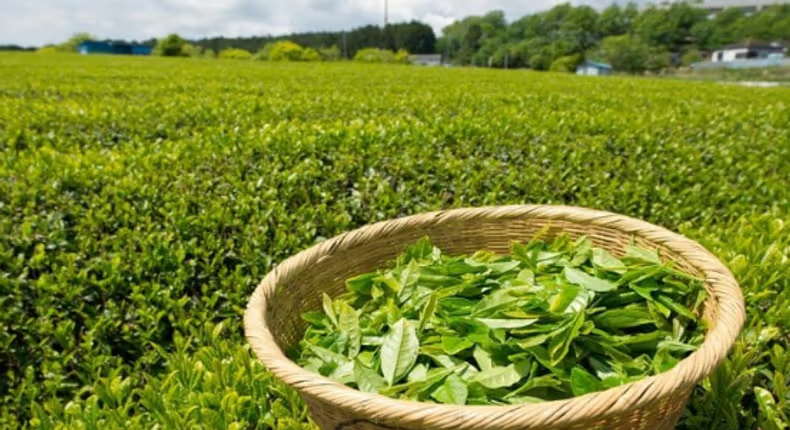
Kenya’s tea industry is facing a fresh wave of uncertainty as escalating conflict in the Middle East threatens critical export routes and a key market that purchased $32.8 million (KSh4.26 billion) worth of Kenyan tea in 2024.
Iran, one of Kenya’s top ten tea buyers, imported approximately 13 million kilograms of tea last year, according to the Tea Board of Kenya. But with airspace closures, cargo suspensions and surging insurance premiums disrupting regional trade flows, exporters are bracing for turbulence.
The mounting crisis underscores how geopolitical instability far from East Africa can ripple directly into farmgate earnings in Kericho, Bomet and Nandi.
📢 GET DETAILED ARTICLES + JOBS
Join THSB's WhatsApp Channel and never miss a post or opportunity.
Export Routes Under Pressure
The flare-up in the Middle East has triggered airspace restrictions and warnings to commercial shipping operators. Portions of regional air corridors have been temporarily closed, while freight operators have suspended services over security concerns.
A central chokepoint is the Strait of Hormuz, through which roughly a fifth of global oil shipments transit. Heightened security risks have driven marine insurers to either withdraw war-risk coverage or significantly increase premiums for vessels operating in the Gulf.
For Kenyan tea exporters, the implications are immediate:
-
Longer transit times
-
Higher freight charges
-
Elevated marine and cargo insurance costs
-
Potential delivery delays
Tea, being perishable and quality-sensitive, is particularly vulnerable to shipping disruptions. Delays can affect freshness and compromise contractual obligations in markets where replenishment cycles are tight.
A $32.8 Million Market at Stake
In 2024, Kenya exported about $50.8 million worth of goods to Iran, with tea, coffee and spices accounting for over 90 percent of that figure, according to United Nations COMTRADE data.
Tea alone contributed $32.8 million of that total. While Iran is not Kenya’s largest tea buyer, it plays a crucial stabilizing role during periods of high production.
Data from the Kenya National Bureau of Statistics shows that Pakistan remains Kenya’s leading tea export destination, accounting for 34.7 percent of total export volume. Other significant markets include Egypt, the United Kingdom, the United Arab Emirates and Iran.
Secondary buyers like Iran help absorb surplus volumes that might otherwise depress international auction prices at the Mombasa Tea Auction.
Proposed $40 Million Deal in Limbo
The conflict threatens not only current trade flows but also Kenya’s forward-looking expansion strategy.
A proposed $40 million (KSh5.6 billion) tea supply agreement with Iran—seen as part of Kenya’s efforts to diversify markets beyond traditional destinations—now faces uncertainty amid geopolitical instability.
Lee Kinyanjui, Kenya’s Trade Cabinet Secretary, has warned that escalating hostilities are disrupting both logistics networks and financial channels that underpin Kenya’s trade with the Gulf region.
Replacing a top-ten tea buyer, he noted, is not straightforward in an intensely competitive global market dominated by producers such as India and Sri Lanka.
Financial Channels Under Strain
Beyond shipping routes, financial transactions present another challenge.
Sanctions regimes and increased scrutiny of payments involving Iran complicate trade settlements. Exporters may encounter delays in receiving payment or may need to rely on intermediary banks, raising transaction costs.
Currency volatility inside Iran could further dampen demand. Economic strain within the country may limit its ability to sustain import volumes at previous levels.
For Kenyan exporters operating on narrow margins, these layered risks—logistical, financial and demand-side—create a precarious environment.
Competitive Pressures Intensify
Higher freight and insurance costs threaten Kenya’s price competitiveness. If buyers face rising landed costs, they may pivot to alternative suppliers in Asia.
India and Sri Lanka, two of the world’s largest tea producers, are well-positioned to capture market share if Kenyan shipments become irregular or more expensive.
Given that tea remains Kenya’s top agricultural export, any sustained disruption could affect farmer incomes, foreign exchange earnings and overall trade balances.
Broader Trade Context
Trade between Kenya and the Middle East has expanded significantly in recent years.
Imports from the region rose from $1.32 billion in 2020 to $4.14 billion in 2023 before easing slightly to $3.72 billion in 2024. Exports nearly tripled during the same period, increasing from $401 million to $1.12 billion.
This growing interdependence makes Kenya particularly exposed to Middle Eastern instability.
The current crisis illustrates the vulnerabilities inherent in concentrated export markets and strategically sensitive shipping corridors.
What Comes Next?
Government officials say they are monitoring developments and assessing contingency measures. Possible responses may include:
-
Exploring alternative shipping routes
-
Enhancing domestic value addition to command premium pricing
-
Supporting exporters with temporary relief measures
However, structural realities remain. Replacing a major buyer in a crowded global tea market is difficult, especially when demand patterns are shaped by long-standing taste preferences and blending practices.
A Delicate Balancing Act
Kenya’s tea sector has weathered global shocks before—from pandemic-era logistics disruptions to currency fluctuations. But geopolitical conflict introduces complexities that extend beyond supply chains.
With $32.8 million in annual exports at stake and a $40 million prospective deal hanging in the balance, the Middle East crisis presents a significant test for Kenya’s agricultural trade resilience.
For tea farmers and exporters alike, stability in distant shipping lanes and diplomatic corridors has never felt more directly connected to livelihoods at home.
FAQs
How much tea does Kenya export to Iran?
In 2024, Kenya exported approximately 13 million kilograms of tea to Iran, valued at $32.8 million.
Why is the Middle East conflict affecting Kenya’s tea exports?
Airspace closures, shipping disruptions, higher insurance premiums and financial transaction challenges are complicating logistics and trade settlements.
Is Iran Kenya’s largest tea buyer?
No. Pakistan remains Kenya’s largest tea export destination, but Iran ranks among the top ten importers and plays a stabilizing role in absorbing surplus production.
What is the Strait of Hormuz and why does it matter?
The Strait of Hormuz is a critical maritime corridor in the Gulf through which a significant share of global oil shipments passes. Heightened tensions there increase shipping and insurance costs.
Could Kenya replace Iran as a tea market?
Officials warn that replacing a major buyer is challenging due to intense global competition and established trade relationships.
Disclaimer: Some content on The High Street Business may be aggregated, summarized, or edited from third-party sources for informational purposes. Images and media are used under fair use or royalty-free licenses. The High Street Business is a subsidiary of SamBoad Publishing under SamBoad Business Group Ltd, registered in Ghana since 2014.
For concerns or inquiries, please visit our Privacy Policy or Contact Page.

Samuel Kwame Boadu is a Ghanaian entrepreneur, writer, and digital consultant passionate about creating impactful stories and business solutions. He is the Founder & CEO of SamBoad Business Group Ltd, a dynamic company with subsidiaries in digital marketing, logistics, publishing, and risk management.