





A New Era in U.S.–Africa Health Cooperation
A sweeping recalibration of American foreign assistance under Donald Trump is reshaping health partnerships across Africa, as Washington pivots from multilateral frameworks to bilateral compacts with individual governments.
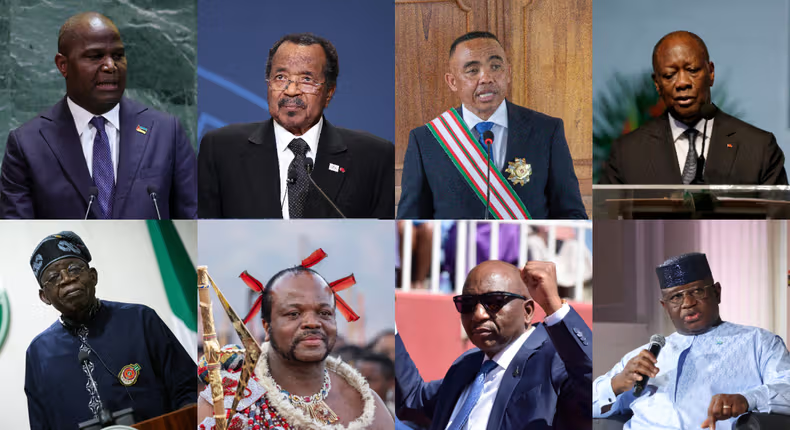
At least 17 African countries have now signed health agreements under the new model, committing to co-financing arrangements and, in some cases, expanded data-sharing provisions in exchange for multi-year U.S. funding. Supporters inside Washington describe the strategy as a move toward accountability and self-reliance. Critics across Africa warn it could alter the balance of sovereignty, equity and fiscal sustainability in public health systems.
The shift marks one of the most consequential restructurings of U.S.–Africa health engagement in decades.
📢 GET DETAILED ARTICLES + JOBS
Join THSB's WhatsApp Channel and never miss a post or opportunity.
From Multilateralism to Bilateral Compacts
The Trump administration’s “America First” foreign assistance philosophy has favored direct, country-specific agreements over traditional multilateral channels such as the World Health Organization and large-scale programs historically associated with USAID.

Under the new framework, participating countries receive funding packages targeting HIV, malaria, tuberculosis, maternal health and epidemic preparedness. In return, governments must increase domestic health spending, meet defined performance benchmarks and, in some cases, agree to structured data and pathogen-sharing provisions.
U.S. officials argue the model improves performance tracking and reduces administrative overhead, while encouraging national ownership of health systems. Public health advocates counter that the arrangements shift greater financial risk onto governments already grappling with constrained budgets.
Early Signatories Set the Tone
Kenya became the first African country to sign in December 2025, securing a package reportedly worth more than $1.6 billion. Nairobi agreed to boost domestic health spending significantly under a co-financing model Washington hopes to replicate elsewhere.
Uganda followed with one of the largest packages, reportedly up to $1.7 billion over five years, alongside a commitment to raise roughly $500 million in domestic contributions. Analysts note that while the funding could stabilize HIV and malaria programs, it may strain fiscal space.
Rwanda and Liberia joined swiftly, reflecting their histories of structured health cooperation with Western donors. For Liberia, still focused on epidemic preparedness following Ebola, the deal represents a notable pivot toward shared financing.
In Southern Africa, Lesotho and Eswatini—both heavily reliant on donor-backed HIV programs—have embraced the agreements while acknowledging the fiscal demands they entail.
Expansion Across Regions
The framework has since spread to Central and West Africa. Nigeria’s pact has drawn particular attention due to reported provisions emphasizing faith-based health providers, prompting debate among civil society groups in Africa’s most populous nation.
Cameroon and Democratic Republic of the Congo have also signed on. Congo’s agreement reportedly combines $900 million in U.S. support with $300 million in progressively scaled domestic spending over five years, targeting HIV/AIDS, TB, malaria and maternal health.
In the Sahel, Burkina Faso and Niger joined amid shifting geopolitical dynamics, with Washington emphasizing direct bilateral engagement to reinforce disease surveillance and frontline services.
Other participants include Mozambique, Madagascar, Sierra Leone, Botswana, Ethiopia and Côte d’Ivoire, bringing the total confirmed African signatories to 17.

The Data and Sovereignty Debate
One of the most sensitive aspects of the agreements involves reported data and pathogen-sharing clauses. Officials at the Africa Centres for Disease Control and Prevention have cautioned that extensive data provisions could expose sensitive biological information if not carefully structured with reciprocal safeguards.
Supporters argue that improved surveillance and transparent reporting strengthen global pandemic preparedness. Critics contend that asymmetrical data flows could undermine national control over health information and intellectual property.
The broader debate extends beyond technical provisions. Health economists warn that co-financing requirements, introduced at a time when many African governments face debt pressures and fiscal consolidation, could force reallocations from other essential services.
Accountability vs. Dependency
Washington maintains that the bilateral model reduces long-term aid dependency and builds sustainable systems by tying funding to measurable benchmarks. Proponents say predictable, multi-year financing could offer greater stability than traditional grant cycles.
Yet public health advocates caution that sustainability hinges not only on domestic spending increases but also on macroeconomic conditions, currency stability and debt dynamics.
In countries with stronger fiscal buffers, such as Botswana, analysts believe co-financing may be manageable. In more fragile economies, the obligations could prove challenging if growth slows or revenue shortfalls emerge.
A Redefined Aid Relationship
The bilateral health agreements represent more than funding arrangements; they symbolize a philosophical shift in U.S.–Africa engagement. By prioritizing direct compacts with defined obligations, the Trump administration is reframing health cooperation as a transactional partnership with measurable outputs.
Whether this model ultimately strengthens African health systems or deepens fiscal and political pressures will depend heavily on implementation, transparency and mutual accountability.
For now, with additional countries reportedly considering similar agreements, the debate surrounding the new U.S. health strategy shows little sign of abating.
Disclaimer: Some content on The High Street Business may be aggregated, summarized, or edited from third-party sources for informational purposes. Images and media are used under fair use or royalty-free licenses. The High Street Business is a subsidiary of SamBoad Publishing under SamBoad Business Group Ltd, registered in Ghana since 2014.
For concerns or inquiries, please visit our Privacy Policy or Contact Page.

Samuel Kwame Boadu is a Ghanaian entrepreneur, writer, and digital consultant passionate about creating impactful stories and business solutions. He is the Founder & CEO of SamBoad Business Group Ltd, a dynamic company with subsidiaries in digital marketing, logistics, publishing, and risk management.