









Inside Ghana’s Mobile Money Economy: Who Really Profits? —GH¢4.1 trillion in mobile money transactions, but who captures the value? Our deep-dive analysis reveals MTN’s GH¢6bn fintech revenue, agent margins, regulatory shifts and the battle for digital finance in Ghana.
Inside Ghana’s Mobile Money Economy: Who Really Profits? — Revenue Flows, Agent Struggles and the Battle for Digital Finance
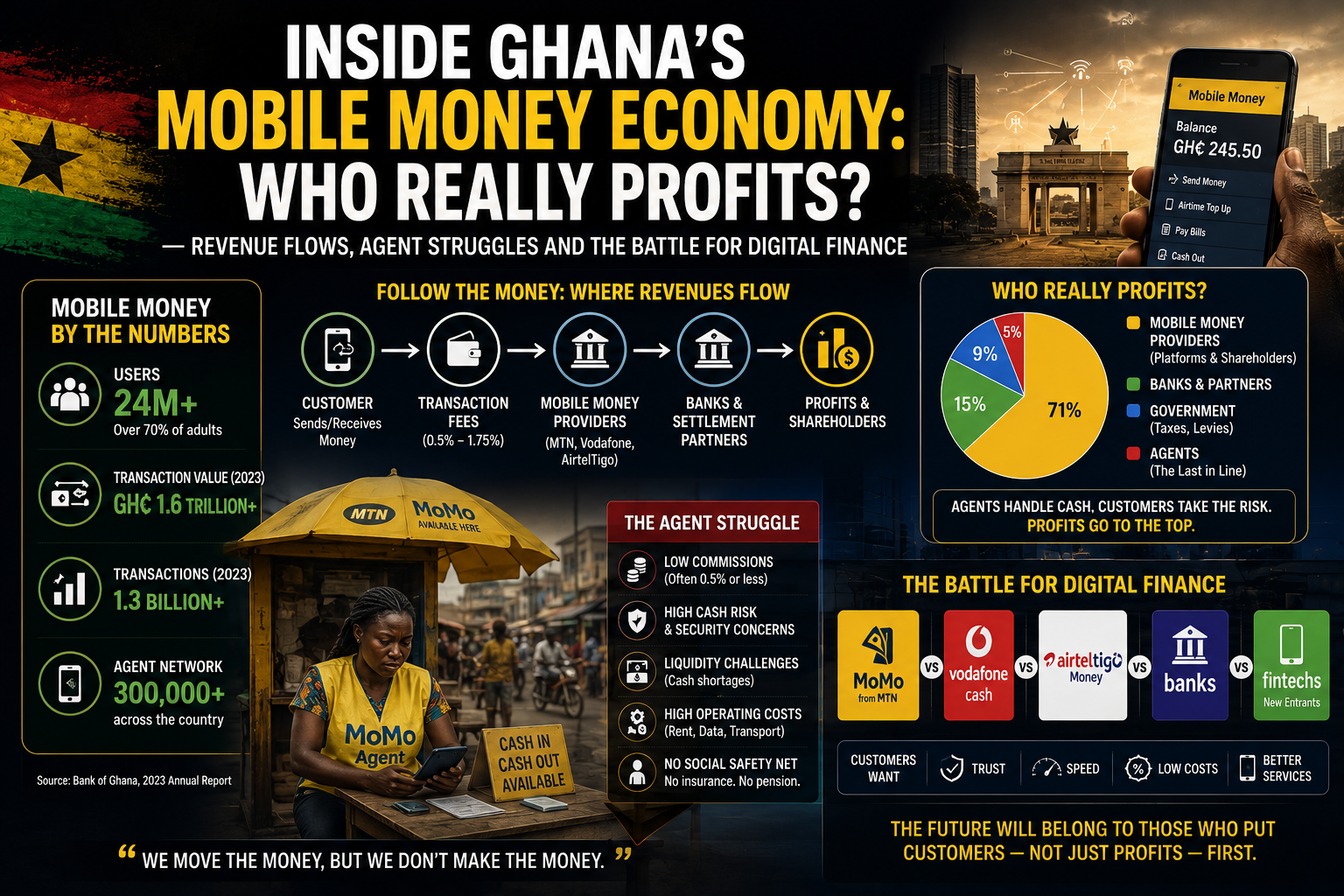
GH¢4.1 trillion. That is the total value of mobile money transactions that flowed through Ghana’s digital pipes in 2025 — more than double the country’s entire GDP. Registered accounts now exceed 80 million, far outstripping the adult population, while active users have climbed past 26 million. Mobile money has become the circulatory system of the Ghanaian economy, moving value from Accra’s corporate towers to the remotest villages, from government treasuries to market traders.
But beneath the staggering headline numbers lies a more complex and revealing question: who actually profits?
📢 GET DETAILED ARTICLES + JOBS
Join THSB's WhatsApp Channel and never miss a post or opportunity.
The answer is not evenly distributed. At the top sits MTN Ghana, whose MobileMoney Limited (MML) saw revenues jump 35.7% to GH¢6 billion in 2025, with advanced services — digital payments, merchant transactions and mobile lending — growing nearly 56%. At the bottom, nearly 500,000 active mobile money agents fight for thin margins, bearing the brunt of cyber fraud, armed robbery and liquidity management costs, all while commission rates remain fixed by the very telcos that dominate the market.

In the middle, a quiet structural shift is underway. MTN is merging its fintech entities to meet local ownership requirements. The Bank of Ghana is reviewing float management rules that could reshape how billions in customer funds are held. Telecel Cash is integrating with Google Play. AT Money is expanding micro-lending. Traditional banks — once dismissive of mobile money — are now rushing to partner, lend, or be left behind.
This profile goes inside Ghana’s mobile money economy to answer the hard questions: How does a GH¢4 trillion market actually make money? How are commissions split? Why are thousands of agents barely breaking even? And as mobile money evolves from transfers to lending, savings and insurance, who will capture the next wave of value?
The Market at a Glance: Size, Scale and Structure
To understand who profits, one must first grasp the sheer scale of what is at stake. In 2025, total mobile money transactions reached GH¢4.1 trillion, a 53.8% increase from GH¢2.7 trillion in 2024. Transaction volume rose 18.4% to 8.4 billion transactions. Monthly transaction values peaked at a record GH¢518.4 billion in December 2025, driven by festive spending. Registered accounts hit 80.5 million by year-end, while active accounts — those used at least once in 90 days — rose to 26.7 million.
The agent network, the physical backbone of the system, expanded to 491,000 active agents by December 2025, down from earlier peaks as profitability concerns forced consolidation. The total balance held in customer wallets — known as “float” — reached a record GH¢39.6 billion, suggesting growing trust in mobile wallets as a store of value.
Interoperability — the ability to transfer money across different networks — remains a small but growing part of the ecosystem, accounting for just about 1% of total transaction value in early 2025, though cross-network values nearly doubled from GH¢2.5 billion to GH¢5.8 billion over the year.
The market is dominated by three major players: MTN MoMo (by far the largest, with over 60% market share), Telecel Cash (formerly Vodafone Cash), and AirtelTigo Money (AT Money).
How the Mobile Money Machine Makes Money
The mobile money revenue model is layered, opaque to most users, and highly profitable for platform owners. Understanding who profits requires breaking down where the money actually comes from.
1. Transaction Fees (Cash-Out Dominates, But Declining)
The most visible revenue stream is customer-facing transaction fees. When a user sends money, withdraws cash, pays a bill, or buys airtime, a small fee is deducted. Historically, cash-out fees have been the largest contributor — but that is changing.
In 2025, withdrawals declined as a share of MTN MoMo’s revenue, dropping from 51.2% in 2024 to 45.6%. Peer-to-peer transfers increased their contribution from 28.9% to 33.7%, reflecting greater use of mobile money for direct payments rather than cash conversion. Advanced services — digital payments, merchant transactions and mobile lending — grew from 19.4% to 20.7%.
The fastest-growing segment, however, is advanced services, where revenue surged 55.9% to GH¢2 billion in 2025. This includes merchant payments (where businesses accept MoMo at point-of-sale), mobile lending products, savings accounts, and insurance offerings. As the ecosystem matures, the profit centre is shifting away from basic transfers toward value-added financial services.
2. Float Income: The Silent Profit Engine
Perhaps the most overlooked source of profit is float income — the interest earned on the billions of cedis held in customer wallets.
Under the Payment Systems and Services Act (Act 987), mobile money operators are required to hold trust accounts with commercial banks, backed by actual cash deposits equivalent to every cedi of electronic value in circulation. These deposits earn interest. With customer wallet balances reaching GH¢39.6 billion by end-2025, the interest income accruing to mobile money operators is substantial — and mostly invisible to users.
The Bank of Ghana is currently reviewing the modalities governing how banks manage these float accounts, a process that could reshape where that interest income ultimately flows.
3. Lending and Credit Products
Mobile lending has emerged as a high-margin revenue stream. AT Money focuses on micro-lending, offering small loans with quick approvals. MTN MoMo’s advanced services segment, which includes lending, grew 55.9% to GH¢2 billion in 2025, signalling strong demand for digital credit.
The digital lending space is now formally regulated under the Non-Bank Financial Institutions Act, requiring minimum capital of GH¢2 million and licensing fees starting at GH¢20,000.
4. Merchant and Business Services
As more businesses accept mobile money payments, platform owners earn merchant discount rates on every transaction. The shift away from cash withdrawals toward merchant payments is accelerating: withdrawals’ share of revenue dropped from 51.2% to 45.6% in 2025, while merchant and advanced services gained ground.
5. International Remittances
Cross-border money transfers into mobile wallets are a growing revenue line. Inward remittance guidelines revised in August 2025 set stricter settlement and compliance obligations, but also formalised the role of mobile money operators in the international payments chain.
6. E-Levy Repeal Effect
The abolition of the electronic transfer levy (E-levy) in 2025 had a direct impact: revenue from basic transfers increased by 27.2%, largely due to stronger transfer activity following the removal of the tax disincentive. More activity means more fee revenue for platform operators.
The King: MTN MoMo’s Profit Dominance
MTN Ghana is the undisputed profit champion of the mobile money economy. Its fintech subsidiary, MobileMoney Limited (MML), recorded revenue of GH¢6 billion in 2025, a 35.7% increase from GH¢4.4 billion the previous year.
Across MTN Ghana’s entire operations, mobile money revenue jumped 39.2% to GH¢4.3 billion in Q3 2025, contributing to a 45.9% profit after-tax increase to $401 million (GH¢5.5 billion). For the full year 2025, MTN Ghana’s profit after tax surged 55.9% to $731 million (GH¢7.8 billion), with service revenue climbing 36.2% to $2.29 billion.
The platform now serves 19.3 million active MoMo users, up 12.3% from 2024. The value of funds held in MML’s customer wallets rose 60.9% to GH¢38.4 billion. Total transaction volume on MML’s platform reached 8.4 billion in 2025, with transaction value climbing 53.8% to GH¢4.1 trillion.
MTN Ghana’s financial performance has been so strong that Group CEO Ralph Mupita announced Ghana is now the third major market for the MTN Group, alongside South Africa and Nigeria, “purely as a function of the way it has performed and the potential that we see going forward.
The company also paid GH¢10.5 billion in direct and indirect taxes in 2025 — a staggering sum that makes it one of Ghana’s largest corporate taxpayers. It invested GH¢6.4 billion in capital expenditure, largely directed at 4G expansion and network upgrades.
The Local Ownership Pivot: In a significant structural development, MTN initiated a merger between MobileMoney Ltd and MobileMoney Fintech Ltd in late 2025 to comply with the Payment Systems and Services Act’s requirement that electronic money issuers have at least 30% local equity participation. The merger, approved by shareholders in December 2025, will see MobileMoney Fintech Ltd emerge as the surviving entity. This restructuring is designed to strengthen domestic involvement and ensure greater accountability in digital financial services — but it will also affect profit distribution to local shareholders going forward.
The Challengers: Telecel Cash and AT Money
While MTN dominates, the competitive landscape is evolving. Telecel Cash (formerly Vodafone Cash) has positioned itself around lower transfer fees and bank-level security features. In 2025, Telecel Cash enabled Google Play payments in Ghana, integrating mobile money with mainstream digital commerce — a significant move that expands its use case beyond basic transfers.
AirtelTigo Money (AT Money) has focused on micro-lending, offering small loans with quick approvals as a differentiator. Both platforms benefit from interoperability, which allows users to transfer money across networks, even if most activity still occurs within walled gardens.
However, neither challenger comes close to MTN’s scale. MTN holds over 60% of the market, giving it pricing power, the largest agent network, and the most advanced service integrations.
The Agent Squeeze: Profit at the Margins
If MTN is the undisputed profit champion of mobile money, agents are its foot soldiers — and the economics of being an agent are far less glamorous.
The agent network is the physical interface between digital wallets and cash. When a customer wants to deposit cash into their MoMo wallet (“cash-in”) or withdraw cash (“cash-out”), they visit an agent, who advances the cash from their own working capital. The agent earns a commission on each transaction, but carries significant risks: liquidity management (running out of cash or having too much idle cash), fraud, and armed robbery.
Commission rates are set by the platform operators and are not negotiable. For MTN MoMo, the commission structure works as follows:
- Cash-out: GH¢0.20 for amounts under GH¢50, 0.4% for transactions between GH¢50 and GH¢2,000, and a flat GH¢8 for amounts above GH¢2,000.
- Cash-in: Agents earn a small percentage on deposits as well.
- Bill payments and airtime: Agents also earn commissions for processing utility bills (ECG, Ghana Water) and selling airtime across all networks, often through applications like Korba Agent.
Despite the large number of registered agents — which reached 949,000 in October 2025 — the number of active agents remains far lower, suggesting high turnover and marginal profitability for many. Active agents peaked at 491,000 in December 2025 but have struggled to grow, with active agents in June 2025 standing 23% lower than the same month in 2024.
Why the squeeze? Agents bear the operational risks while telcos retain the majority of transaction fees. With telcos like MTN holding over 60% market share, they are able to keep commission rates fixed while capturing the lion’s share of revenue growth. Agents have little bargaining power, as the agent model is highly competitive and any individual agent is replaceable.
Security is another major burden. Mobile money agents are frequent targets for armed robbery, as they are known to hold significant amounts of cash. They also bear the brunt of cyber fraud, with limited support from telcos for fraud recovery. As one report noted, telcos “have failed to make adequate cybersecurity investments or establish real-time response teams,” leaving agents to absorb losses.
Many agents now supplement MoMo commissions with retail sales, airtime vending, bill payment services, and other complementary businesses just to stay afloat. The agent business model is viable at scale — a well-capitalised agent with a prime location can earn a decent income — but for the majority, the margins are thin and the risks are high.
The Regulatory Architecture: Who Sets the Rules?
The Bank of Ghana is the ultimate authority governing mobile money, and its regulatory choices directly determine who profits and how.
The foundational legislation is the Payment Systems and Services Act, 2019 (Act 987), which mandates that all electronic money issuers, payment service providers and financial technology service providers be licensed by the BoG. Key requirements include:
- Minimum capital of GH¢20 million for Electronic Money Issuers (EMIs)
- At least 30% local equity participation for EMI licences — the requirement driving MTN’s merger
- Trust account requirements: banks must hold float balances for mobile money operators, ensuring every cedi in digital wallets is backed by actual cash in the banking system
In June 2025, the BoG announced a comprehensive review of float management rules, seeking industry input on how banks manage these trust accounts. This review could reshape where interest income flows and potentially increase returns to wallet holders or operators.
The BoG also issued Corporate Governance Guidelines for Payment Service Providers in June 2025, requiring regulated entities to have a minimum of three directors and adhere to stricter governance standards. In December 2025, the central bank called on fintechs and mobile money operators to strengthen compliance and consumer protection measures.
The National Communications Authority (NCA) held stakeholder meetings in August 2025 aimed at strengthening security in Ghana’s Digital Financial Services ecosystem, including plans for independent security testing of mobile payment applications.
Looking ahead, the BoG plans to introduce new regulatory frameworks for open banking, digital banking and digital credit by end of 2026, which could further reshape competitive dynamics by allowing third-party fintechs to access customer data and offer competing services.
The Battle with Banks: Competition or Convergence?
For years, traditional banks viewed mobile money with suspicion — a competitor operating outside the formal banking framework. That stance has changed.
The reality is that mobile money has now surpassed traditional banking channels in transaction volume. Bank digital channels account for less than 1% of digital transaction volume, while mobile money platforms process over 97% of all digital payments. ATM usage fell from 34% in 2024 to 16% in 2025, while mobile money usage surged to 80% of the population.
Facing this reality, banks have shifted from resistance to partnership. The BoG’s float management framework already requires mobile money operators to hold trust accounts with banks, creating a symbiotic relationship. At the MobileMoney Limited Annual Partner Bank Forum in 2025, Shaibu Haruna, CEO of MobileMoney Limited, highlighted the transformative impact of bank-fintech collaboration, noting that “together, we have rewritten the narrative of competition into one of alliance.
Twenty-two partner banks now work with MobileMoney Limited, facilitating everything from float management to digital savings products to international remittances. The collaboration has expanded access to digital wallets, created an interoperable financial system, and improved access to credit and remittance services.
Some banks are going further. Fidelity Bank, in partnership with MobileMoney Limited and JUMO, launched BoseaLoan, a mobile-based short-term loan product. Other banks are expected to follow as the BoG’s digital lending guidelines create a clearer regulatory framework.
Yet tensions remain. Banks still hold significant deposits and process large-value transactions, while mobile money dominates small-value, high-frequency retail payments. As mobile money platforms expand into lending, savings and insurance — traditional bank territory — the “alliance” narrative may become strained.
Challenges and Risks
For all its growth, Ghana’s mobile money economy faces serious challenges.
Agent Profitability and Sustainability: With nearly 500,000 active agents but declining margins, the risk of agent fatigue is real. Agent networks are the physical backbone of mobile money; if agents cannot earn a sustainable living, service coverage — especially in rural areas — will suffer.
Cyber Fraud and Security: The sector faces emerging challenges around cybersecurity and fraud that threaten trust. As Shaibu Haruna noted, “cybersecurity issues and fraud threaten the very foundation of our ecosystem — trust”. The BoG and NCA are both moving to strengthen security frameworks, but the scale of the challenge is significant.
Interoperability Gaps: Despite the launch of interoperability in 2018, cross-network transfers account for just about 1% of transaction value. Most activity remains within networks, limiting competition and keeping users locked into their mobile money provider.
Regulatory Uncertainty: The BoG’s ongoing review of float management rules, upcoming open banking frameworks, and potential changes to capital requirements create uncertainty for operators. MTN’s merger to meet local ownership requirements is one response; others may follow.
Competition from Beyond: While MTN dominates today, the landscape is not static. Telecel Cash’s integration with Google Play, AT Money’s micro-lending focus, and potential entry of pan-African fintechs could reshape market shares. The BoG’s open banking framework could enable new entrants to compete on services rather than network size.
Float Management Risks: With customer wallet balances now exceeding GH¢39 billion, the management of float accounts has systemic implications. The BoG’s review of float rules will need to balance consumer protection, operator profitability and financial stability.
Economic and Industry Impact
Mobile money is no longer just a financial service — it is economic infrastructure.
Financial Inclusion: Mobile money has brought formal financial services to millions of previously unbanked Ghanaians. With 80% of the population now using mobile money, the gaps in access are closing, though quality and depth of usage remain uneven.
Job Creation: The agent network alone employs nearly half a million active agents, plus tens of thousands more indirectly in support roles, training and logistics. However, concerns about agent sustainability suggest these jobs may be precarious.
Government Revenue: Mobile money operators — especially MTN — are among Ghana’s largest taxpayers. MTN alone paid GH¢10.5 billion in taxes in 2025, directly supporting national development priorities.
SME Enablement: Mobile money has become essential for small businesses, enabling digital payments, access to working capital via mobile lending, and integration into formal supply chains. The shift toward merchant payments — growing at 55.9% annually — suggests this trend is accelerating.
Shift Away from Cash: The decline of ATM usage from 34% to 16% and the dominance of mobile money in retail payments signals a structural shift away from cash. This has implications for tax collection, anti-money laundering efforts, and the informal economy’s formalisation.
Tax Policy Impact: The repeal of the E-levy in 2025 directly boosted transaction volumes, with revenue from basic transfers increasing 27.2% following the removal of the tax disincentive. This suggests that transaction taxes suppress mobile money usage — a lesson for policymakers considering future digital taxes.
Future Outlook
Where is Ghana’s mobile money economy heading? Several trends will shape the next phase.
From Transfers to Financial Services: The fastest growth is in advanced services — lending, savings, insurance and investments. Revenue from these services grew 55.9% in 2025, compared to 27.2% for basic transfers. As the market matures, profits will increasingly come from value-added financial services rather than basic transaction fees.
Open Banking and New Entrants: The BoG’s planned open banking framework will allow third-party fintechs to access customer data (with consent) and offer competing services. This could challenge MTN’s dominance by allowing smaller players to compete on service quality rather than network scale.
Agent Consolidation: The decline in active agents relative to registered agents suggests a shakeout is underway. Agents with strong capital positions, prime locations and diversified service offerings will survive; marginal agents will exit. This could lead to reduced service coverage in rural areas.
Local Ownership Deepens: MTN’s merger to meet 30% local equity requirements is likely the first of several such moves. Over time, more mobile money profits will accrue to Ghanaian shareholders, though the impact on pricing and service quality remains to be seen.
Interoperability Must Scale: For the market to become genuinely competitive, interoperability must move beyond 1% of transaction value. This will require fee parity (same cost for cross-network as within-network), better user education, and seamless user experience.
Float Interest Redistribution: The BoG’s review of float management rules could lead to changes in how interest earned on customer wallet balances is distributed — potentially directing more returns to wallet holders rather than operators or banks.
Projected Market Size: Industry analysts project the Ghana Mobile Money Market will grow from USD 227 billion in 2025 to USD 770 billion by 2032, a CAGR of 19.16%. At that scale, profit pools will expand dramatically — and the question of who captures that value will only grow more urgent.
Conclusion
Ghana’s mobile money economy is a paradox of scale and concentration. The numbers are breathtaking: GH¢4.1 trillion in transaction value, 80 million registered accounts, 491,000 active agents. Mobile money has achieved what decades of traditional banking could not — near-universal access to digital financial services across one of Africa’s most dynamic economies.
Yet the profits from this vast ecosystem are overwhelmingly concentrated at the top. MTN Ghana captures the lion’s share, with MoMo revenue jumping 35.7% to GH¢6 billion, profit margins expanding, and the platform now serving as the group’s third major global market. Agents — the physical backbone of the system — operate on thin margins, carrying liquidity costs, fraud risks and armed robbery threats, while their commissions remain fixed. Telecel Cash and AT Money compete around the edges but cannot match MTN’s scale.
The question of who really profits is also a question of who should profit. As the BoG reviews float management rules, pushes for local ownership, and designs an open banking framework, it is actively reshaping the profit distribution of the mobile money economy. The merger of MTN’s fintech entities to meet 30% local equity requirements is a signal: the era of pure foreign ownership and profits is ending.
For the average Ghanaian, mobile money remains a remarkable success story — faster, cheaper and more accessible than traditional banking. For agents, the story is more ambiguous: essential to the system, but struggling to earn a sustainable living. For the mobile money operators, the story is one of extraordinary profitability, with room to grow into lending, savings, insurance and beyond.
The mobile money economy is still young. The next phase — from transfers to comprehensive financial services, from walled gardens to open banking, from concentrated profits to more distributed value — will determine whether this ecosystem delivers prosperity for all its participants, or merely concentrates wealth for a few.
The numbers are clear. The profits are real. The question is: who gets to keep them?
READ MORE:
1. “Why Banks in Ghana Are Quietly Changing Their Lending Strategy — The End of T-Bill Reliance”
2. “MTN Ghana’s GH¢10.5bn Tax Bill and the Making of a Third Major Market”
3. “Why Treasury Bills Became Ghana’s Hottest Investment Again — The Extraordinary Journey”
4. “Inside Ghana’s Digital Credit Directive: What the 2025 Rules Mean for Fintechs and Borrowers”
5. “The Agent Squeeze: Why Half a Million Ghanaians Are Struggling to Profit from Mobile Money”
Frequently Asked Questions (FAQ)
Q1: How much money moves through Ghana’s mobile money system?
In 2025, total mobile money transaction value reached GH¢4.1 trillion, a 53.8% increase from 2024. Monthly transactions peaked at GH¢518.4 billion in December 2025.
Q2: Who is the biggest winner in Ghana’s mobile money economy?
MTN Ghana, through its fintech subsidiary MobileMoney Limited (MML). MML recorded revenue of GH¢6 billion in 2025, a 35.7% increase. MTN holds over 60% market share and MoMo contributed significantly to MTN Ghana’s $731 million profit after tax for 2025.
Q3: How much do mobile money agents earn?
Commission rates are fixed by operators. For MTN MoMo cash-out, agents earn GH¢0.20 for amounts under GH¢50, 0.4% for transactions between GH¢50 and GH¢2,000, and a flat GH¢8 for amounts above GH¢2,000. Many agents supplement MoMo income with retail services, airtime sales and bill payments. However, agent profitability is under pressure, with active agents 23% lower than the previous year.
Q4: How does MTN make money from mobile money beyond transaction fees?
MTN earns revenue from transaction fees (cash-out, transfers, bill payments), float interest on customer wallet balances (which reached GH¢38.4 billion in 2025), merchant discount rates on business payments, mobile lending fees, and advanced services including savings and insurance products.
Q5: What is “float” in mobile money?
Float refers to the total value of funds held in customer mobile money wallets. Under the Payment Systems and Services Act, these funds must be held in trust accounts with commercial banks, backed by actual cash deposits. As of December 2025, total customer wallet balances reached GH¢39.6 billion.
Q6: What is interoperability and why does it matter?
Interoperability allows users to transfer money across different mobile money networks (e.g., from MTN MoMo to Telecel Cash). Launched in 2018, it still accounts for only about 1% of total transaction value, suggesting most users stay within their network.
Q7: How is the Bank of Ghana regulating mobile money?
The BoG regulates mobile money primarily through the Payment Systems and Services Act, 2019 (Act 987). Key requirements include a GH¢20 million minimum capital for Electronic Money Issuers, 30% local equity participation, and trust account rules for float management. The BoG is currently reviewing float management rules and planning open banking frameworks.
Q8: Why is MTN merging its mobile money companies?
MTN is merging MobileMoney Ltd and MobileMoney Fintech Ltd to meet the Payment Systems and Services Act’s requirement that electronic money issuers have at least 30% local equity participation. This will strengthen domestic involvement in the sector.
Q9: How do mobile lending products work?
Mobile lending offers small, short-term loans directly through mobile money wallets, using transaction history and other data to assess creditworthiness. AT Money focuses on micro-lending with quick approvals. Advanced services including lending grew 55.9% in 2025 to GH¢2 billion for MTN MoMo.
Q10: What is the Electronic Transfer Levy (E-levy) and what happened to it?
The E-levy was a tax on electronic transfers introduced in 2022. It was abolished in 2025, leading to a 27.2% increase in revenue from basic transfer services as users returned to the platform.
Q11: How do mobile money operators keep customer funds safe?
Under Act 987, mobile money operators must hold customer funds in trust accounts with licensed commercial banks. Every cedi of electronic money in circulation must be backed by actual cash deposits in the banking system. The BoG is currently reviewing these float management rules to strengthen the framework.
Q12: What is the future outlook for Ghana’s mobile money market?
The market is projected to grow from USD 227 billion in 2025 to USD 770 billion by 2032. Key trends include expansion into lending and savings, open banking frameworks enabling new entrants, possible agent consolidation, and potential redistribution of float interest income as the BoG reviews regulations.
Source: The High Street Business
Disclaimer: Some content on The High Street Business may be aggregated, summarized, or edited from third-party sources for informational purposes. Images and media are used under fair use or royalty-free licenses. The High Street Business is a subsidiary of SamBoad Publishing under SamBoad Business Group Ltd, registered in Ghana since 2014.
For concerns or inquiries, please visit our Privacy Policy or Contact Page.

Esther Aku-Sika is a content writer and social media strategist who helps brands and startups grow through intentional storytelling and practical marketing strategies. With a keen eye for trends and audience behavior, she shares business insights, content strategies, and real-life lessons to help entrepreneurs build visibility and turn ideas into income. Through her writing, she simplifies complex concepts and equips readers with actionable steps to grow in today’s digital space.